
Recursos
Exploren una amplia gama de recursos valiosos en GCED para profundizar su comprensión y promover su búsqueda, incidencia, enseñanza y aprendizaje.
1,402 resultados encontrados
 Couvrir les migrations et les réfugiés : manuel pour les formateurs en journalisme Año de publicación: 2023 Autor corporativo: Organisation des Nations Unies pour l'éducation, la science et la culture (UNESCO) Couvrir les migrations : Un défi pour les formateurs en journalisme du monde entier Ce manuel permet aux formateurs en journalisme du monde entier de relever l'un des défis du XXIe siècle : la migration et le déplacement forcé. Cet ensemble de treize modules constitue un cursus complet. Il couvre tous les aspects nécessaires pour enseigner l'analyse, la recherche documentaire, la mise en forme, le démarchage des organes de presse et l'éthique de la couverture des migrations. Unique en son genre, il intègre les connaissances issues des champs de la communication et des sciences politiques et sociales. Il a été conçu par un groupe international et interculturel de chercheurs, de formateurs et de journalistes.Les enseignants seront à même de lancer un programme d'études innovant. Les étudiants apprendront que les questions de migration et de déplacement forcé concernent des êtres humains et nécessitent donc une connaissance et une attention particulière à l'exactitude des faits, à la fiabilité des sources, à l'éthique de la collecte d'informations et aux bonnes pratiques en la matière. Les journalistes expérimentés y trouveront un outil d'auto-apprentissage. Quant aux organisations de développement des médias, elles pourront intégrer le cursus à leurs plans de formation.Cette initiative vise à couvrir de manière plus complète les questions relatives aux migrants et aux réfugiés dans les pays d'origine, de transit et de destination, pour que puisse s’instaurer un débat public plus équilibré et plus éclairé à travers le monde et les cultures. Cubrir la migración: Un desafío para los educadores/as Репортажи о мигрантах и беженцах: Руководство для преподавателей журналистики Año de publicación: 2023 Autor corporativo: UNESCO Освещение миграции: Вызов для преподавателей журналистики во всем мире Это руководство позволяет преподавателям журналистики во всем мире решать одну из проблем 21 века проблемы миграции и беженцев. В наборе из тринадцати модулей преподавателям журналистики предлагается комплексная учебная программа. Она охватывает все аспекты, необходимые для обучения анализу, исследованиям, презентации, маркетингу и этике освещения миграции.Справочник уникален тем, что в нем собраны результаты исследований в области коммуникации, а также политических и социальных наук. Он был разработан международной и межкультурной группой исследователей медиа, медиапедагогов и медиапрактиков.Преподаватели журналистики получат возможность запустить новую учебную программу. Студенты-журналисты узнают, что вопросы миграции и вынужденного перемещения касаются человека и поэтому требуют знания и осведомленности о точных фактах, надежных источниках, этичном освещении и надлежащей практике. Опытные журналисты получат пользу от использования этого тома в качестве инструмента самообучения, а организации по развитию СМИ могут адаптировать учебную программу к своим учебным планам.Проект повлияет на более полное освещение вопросов мигрантов и беженцев в странах происхождения, транзита и назначения, а также на более сбалансированные и информированные общественные дебаты в разных странах и культурах.
  Mapping Cultural Policies in Small Island Developing States: Amplifying SIDS Voices in the Global Policy Dialogue on Culture and Sustainable Development Año de publicación: 2025 Autor corporativo: UNESCO Mapping Cultural Policies in Small Island Developing StatesSpanning three sub-regions – the Atlantic, Indian Ocean and South China Sea (AIS), the Caribbean, and the Pacific – the Small Island Developing States (SIDS) represent 39 UNESCO Member States and 9 Associate Members. Countries and regional organizations have increasingly demonstrated their commitment in the context of fast-evolving policy landscape and cultural ecosystems, encompassing the different dimensions of culture through its diversity and a wide spectrum of concerned stakeholders. Today, a SIDS-specific, culture-led development vision is on the rise.Culture has a multifaceted impact on sustainable development pathways of the SIDS, from climate action, biodiversity protection and food security to economic diversification, social inclusion, gender equality or urban sustainability. The voices and aspirations of SIDS must be heard in the global policy dialogue, in acknowledgement of their priorities, opportunities and insights. International cooperation efforts by UNESCO and other organizations are also essential in identifying areas for future policy investment and adaptation at the national and regional levels.Following the UNESCO World Conference on Cultural Policies and Sustainable Development – MONDIACULT 2022, SIDS are championing culture for sustainable development towards the adoption of a new Programme of Action, the Antigua and Barbuda Agenda for SIDS 2024-2034.
  Her Atlas: Interactive Advocacy Tool on Girls’ and Women’s Right to Education Año de publicación: 2023 Autor corporativo: UNESCO Many girls and women cannot exercise their right to education due to gender inequality and discriminatory practices. Poverty, early marriage, and gender-based violence are just some of the many reasons behind the high percentage of global female illiteracy and school drop-outs. Strengthening the right of girls and women to quality education is key to eliminate discrimination and to achieve equal rights between genders. This cannot be achieved without solid national legal frameworks that are rightsbased, gender responsive and inclusive. This is where HerAtlas comes in. HerAtlas, is a first of its kind online tool that maps the right to education of girls and women. It aims to enhance public knowledge and monitor the status of national constitutions, legislation and regulations related to education rights for girls and women to encourage countries to take action, strengthen their laws and policies, and lead to long term change. Concrete changes are already apparent. In 2019, 4% of countries were explicitly restricting the right to education of married, pregnant, and parenting girls. This has dropped to 2% in 2022, benefiting millions of girls who can now legally attend school when they marry or become pregnant.
  South-Eastern Europe regional synthesis: climate change, displacement and the right to education Año de publicación: 2023 Autor corporativo: UNESCO In 2021 alone, 23.7 million people were displaced in 137 countries and territories due to natural disasters, which the scientific community has recognized have become more frequent and intense due to climate change. Climate change and displacement is currently taking place in Europe, with particularly disastrous consequences in South-Eastern Europe due to regional specificities. Comparative country case studies were carried out in Bosnia and Herzegovina, the Republic of Moldova, and Serbia, as they exemplify clear, present patterns of climate displacement, to examine the impacts of climate change on the right to education in the region. The case studies show that climate change directly threatens education through the destruction of schools and property. It also indirectly puts learning in peril by leading people across borders where their legal residency nor right to education is ensured. This publication aims to guide policy-makers by providing recommendations on how to ensure the protection of the right to education in South-Eastern Europe in the face of climate change and displacement. It is one of four regional reports that will lead to the development of a global report providing global policy guidance.
 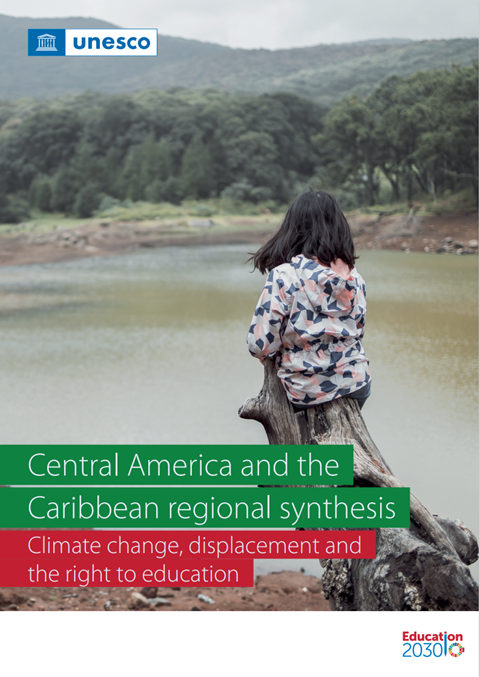 Central America and the Caribbean regional synthesis: climate change, displacement and the right to education Año de publicación: 2023 Autor corporativo: UNESCO From rising sea level to drought and increasingly frequent natural disasters - the effects of climate change are well-known today. However, its effect on human mobility is just coming to the forefront of the political discussion. In 2020 alone, 30.7 million people globally were displaced by natural disasters. Central America and the Caribbean region is prone to the effects of climate change and displacement due to its socioeconomic characteristics and geographic location. Country case studies were carried out in the Bahamas, Cuba, the Dominican Republic, Guatemala, and Jamaica to examine the impacts on the right to education in the region. The research shows that climate change directly threatens education through the destruction of schools and property. It also leads people across borders where their legal residency and right to education are not guaranteed. This report aims to guide policy-makers on how to ensure education is protected in the face of climate change and displacement. The report is one of four being developed and will contribute to UNESCO’s global initiative on climate change, displacement and the right to education. It will inform the development of a Global Report with policy recommendations.
  UNESCO World Heritage sites: key to biodiversity conservation Año de publicación: 2023 Autor corporativo: UNESCO
 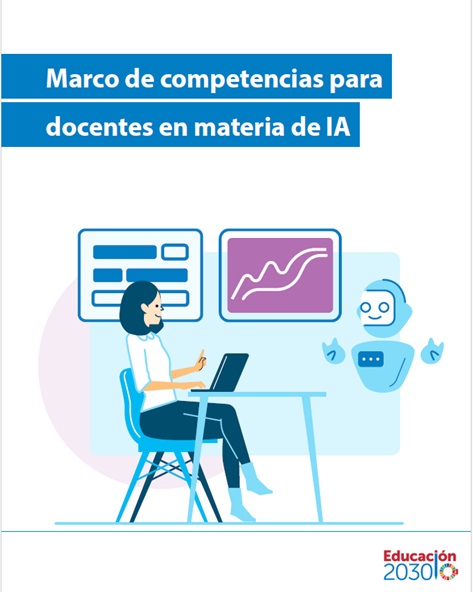 Marco de competencias para docentes en materia de IA Año de publicación: 2025 Autor: Fengchun Miao | Mutlu Cukurova Autor corporativo: UNESCO Orientación para docentes sobre el uso y el mal uso de la IA en la educaciónLa IA procesa enormes cantidades de información, genera nuevos contenidos y ayuda a la toma de decisiones mediante análisis predictivos. En el ámbito educativo, la IA ha transformado la relación tradicional docente-estudiante, creando una nueva dinámica docente-IA-estudiante. Este cambio exige replantear los roles de los docentes y las competencias que necesitan en la era de la IA. Sin embargo, son pocos los países que han definido estas competencias o desarrollado programas nacionales para capacitar a los docentes en IA, lo que deja a muchos educadores sin una orientación adecuada.El Marco de competencias en materia de IA para docentes aborda esta brecha al definir los conocimientos, habilidades y valores que los docentes deben dominar en la era de la IA. Desarrollada bajo los principios de protección de los derechos de los docentes, del fortalecimiento de la capacidad de acción humana y de la promoción de la sostenibilidad, la publicación describe 15 competencias que atraviesan cinco dimensiones: una forma de pensar centrada en el ser humano, la ética de la IA, los fundamentos y aplicaciones de la IA, la pedagogía de la IA, y la IA para el aprendizaje profesional. Estas competencias se clasifican en tres niveles de progresión: adquirir, profundizar y crear.Como una referencia global, esta herramienta orienta el desarrollo de marcos nacionales de competencias en IA, brinda insumos para los programas de formación docente y ayuda a diseñar parámetros de evaluación. También ofrece estrategias para que los docentes desarrollen conocimientos sobre IA, apliquen principios éticos y apuntalen su crecimiento profesional.
 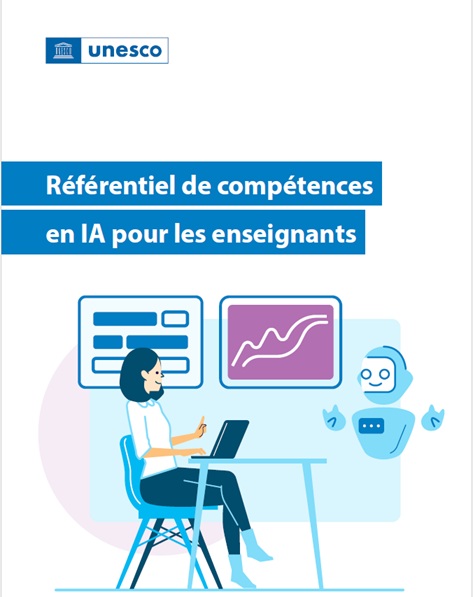 Référentiel de compétences en IA pour les enseignants Año de publicación: 2025 Autor: Fengchun Miao | Mutlu Cukurova Autor corporativo: UNESCO Guider les enseignants à propos de l’usage judicieux ou problématique de l’IA en éducationL’intelligence artificielle (IA) traite une grande quantité d’informations, génère de nouveaux contenus et aide à la prise de décision grâce à des analyses prédictives. Dans le domaine de l’éducation, l’IA a transformé la relation traditionnelle entre l’enseignant et l’apprenant en un triptyque dynamique entre l’enseignant, l’IA et l’apprenant. Cette évolution exige de repenser le rôle des enseignants et les compétences dont ils ont besoin à l’ère de l’IA. Pourtant, peu de pays ont défini ces compétences ou élaboré des programmes nationaux pour former les enseignants à l’IA, ce qui prive de nombreux éducateurs d’un cadre adéquat.Le Référentiel de compétences en IA pour les enseignants comble cette lacune : il définit les connaissances, les habiletés et les valeurs que les enseignants doivent maîtriser à l’ère de l’IA. Élaborée dans le respect de la protection des droits des enseignants, de l’accroissement de l’agentivité humaine et de la promotion de la durabilité, la publication présente 15 compétences réparties en cinq composantes : une approche de l’IA centrée sur l’humain, l’éthique de l’IA, les fondements et les applications de l’IA, la pédagogie de l’IA et l’IA pour l’apprentissage professionnel. Ces compétences sont classées selon trois niveaux de progression : acquérir, approfondir, créer.En tant que référence internationale, cet outil sert de guide pour l’élaboration de référentiels nationaux de compétences en IA, apporte des informations sur les programmes de formation des enseignants et aide à définir des paramètres d’évaluation des apprentissages. Il fournit également aux enseignants des stratégies pour développer leurs connaissances en matière d’IA, respecter des principes éthiques et soutenir leur développement professionnel.
  Consultation Paper on AI Regulation: Emerging Approaches Across the World Año de publicación: 2024 Autor: Juan David Gutiérrez Autor corporativo: UNESCO Since 2016, over thirty countries have passed laws explicitly mentioning AI, and in 2024, the discussion about AI bills in legislative bodies has increased globally. This policy brief aims to inform legislators about the different regulatory approaches to artificial intelligence (AI) being considered worldwide by legislative bodies. The brief explains nine emerging regulatory approaches, each illustrated with specific cases worldwide. The order in which the nine AI regulatory approaches are presented is deliberately structured to guide readers from less interventionist, light-touch regulatory measures to more coercive, demanding approaches. These regulatory approaches are not mutually exclusive and AI bills often combine two or more approaches:1. Principles-Based Approach2. Standards-Based Approach3. Agile and Experimentalist Approach4. Facilitating and Enabling Approach5. Adapting Existing Laws Approach6. Access to Information and Transparency Mandates Approach7. Risk-Based Approach8. Rights-Based Approach9. Liability Approach The policy brief suggests parliamentarians how they can address three key questions before adopting AI regulations:1. Why regulate? Determine whether regulation is needed to address public problems, fundamental and collective rights, or desirable futures.2. When to regulate? Reach a consensus on why regulation is needed, map available regulatory instruments, compare them with other policy instruments, and assess the feasibility of adopting the former.3. How to regulate? Identify a combination of AI regulatory approaches that are tailored to specific contexts.