
Recursos
Exploren una amplia gama de recursos valiosos en GCED para profundizar su comprensión y promover su búsqueda, incidencia, enseñanza y aprendizaje.
3,385 resultados encontrados
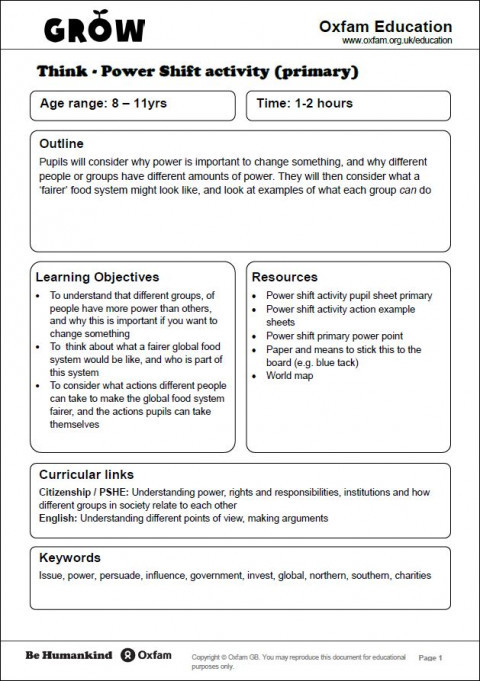 Think: Power-Shift Activity Teachers Guide for Primary Schools Autor corporativo: Oxfam GB Linked to Oxfam's GROW campaign, the Food for Thought school resources get young people learning, thinking and taking action for a fairer food system.Through this activity pupils will consider why power is important to change something, and why different people or groups have different amounts of power. They will then consider what a ‘fairer’ food system might look like, and look at examples of what each group can do.
 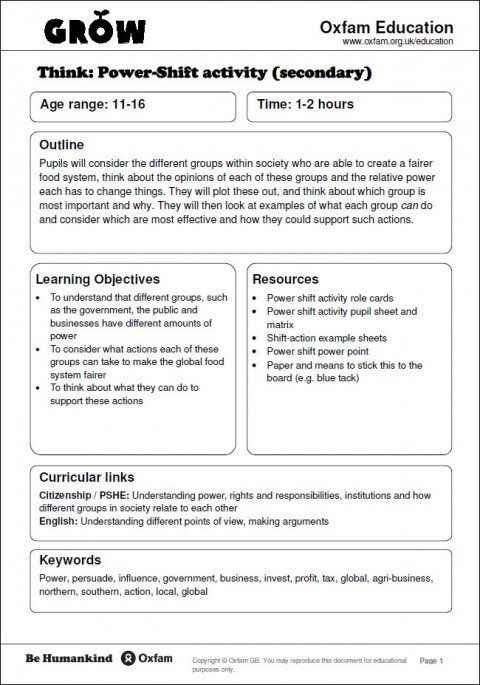 Think: Power-Shift Activity Teachers Guide for Secondary Schools Autor corporativo: Oxfam GB Linked to Oxfam's GROW campaign, the Food for Thought school resources get young people learning, thinking and taking action for a fairer food system.Through this activity pupils will consider the different groups within society who are able to create a fairer food system, think about the opinions of each of these groups and the relative power each has to change things. They will plot these out, and think about which group is most important and why. They will then look at examples of what each group can do and consider which are most effective and how they could support such actions.
  The Education We Want: Workshop Facilitator Guide For the Advocacy Toolkit Año de publicación: 2014 Autor: Daniel Smith | James Edleston | Tom Burke | Emily Laurie Autor corporativo: A World at School | UN Global Education First Initiative - Youth Advocacy Group (YAG) | Plan International This guide is intended as a resource to accompany the ‘Education we want: An Advocacy’. It aims to provide a wide range of workshop activities for those who intend to Understand, Plan or Do their education advocacy using workshop based approaches.Workshops are an effective way of involving others in advocacy. They can support you in carrying out research, drafting a plan and building skills for action.The successful delivery of workshops relies on effective preparation, good facilitation skills and a commitment to support people’s learning and development.
 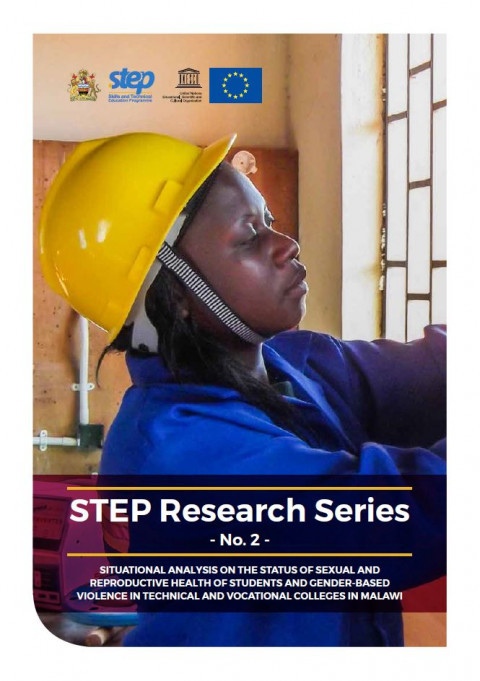 Situational Analysis on the Status of Sexual and Reproductive Health of Students and Gender-based Violence in Technical and Vocational Colleges in Malawi (STEP Research Series No. 2) Año de publicación: 2017 Autor corporativo: Skills and Technical Education Programme (STEP) Funded by the EU and implemented by UNESCO in collaboration with the Government of Malawi, the Skills and Technical Education Programme (STEP) is dedicated to reinforcing Technical, Entrepreneurial and Vocational Education and Training (TEVET) in Malawi.The programme will run from 2016-2020 and aims to improve TEVET at post-secondary level with a focus on equal access to enrolment, with particular emphasis on female learners; improving quality in the sector; and the establishment of clear governance structures. The STEP Research Series presents the highlights of the research undertaken by the programme.The situational analysis on the status of sexual and reproductive health of students and gender-based violence in technical and vocational colleges in Malawi is the second report in the STEP Research Series.
 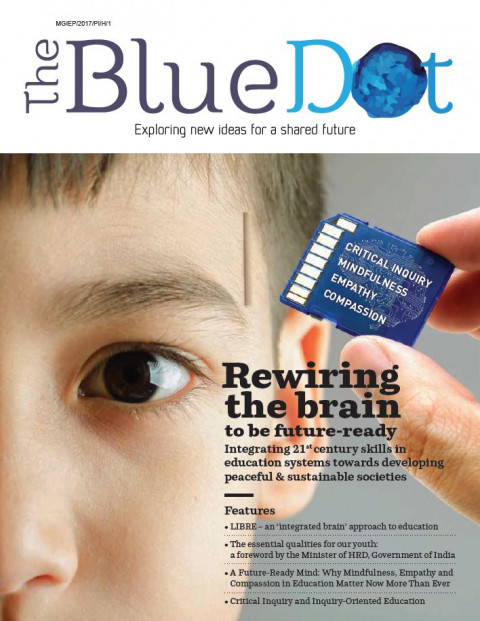 Rewiring the Brain to be Future-ready: Integrating 21st Century Skills in Education Systems Towards Developing Peaceful & Sustainable Societies (The Blue Dot Issue 6, 2017) Año de publicación: 2017 Autor corporativo: Mahatma Gandhi Institute of Education for Peace and Sustainable Development (MGIEP) In the sixth issue of the Blue Dot, we focus on the importance of these 21st century skills for the young. The issue includes a foreword by the Minister of Human Resource Development, Government of India on the importance of inculcating 21st century skills in education systems and our Cover Story, which introduces UNESCO MGIEP’s LIBRE programme that follows an ‘integrated brain’ approach to education.Additionally, we feature opinions by specialists from academia, research and the industry on the lacuna present in existing education systems and the opportunities available to address this gap by introducing socio-emotional skills and inquiry oriented learning into curricula. Amongst various experts, we hear from Ines Kudo and Joan Hartley from The World Bank on the importance of ‘Teaching empathy and compassion in schools’; Prof. K.P. Mohanan on ‘Critical Inquiry and Inquiry oriented education’ and Dr. Marilee Bresciani Ludvik on how mindfulness forms the foundation for cultivating compassion.Further, we present excerpts from a collection of ‘Ask me Anything’ sessions focused on socioemotional skills, hosted on Knowledge Commons, UNESCO MGIEP’s knowledge sharing platform.We have been honoured to have the opportunity to host and learn from experts such as Dr. Richard Davidson, recognised as one of ‘The 100 most influential people in the world’ in 2006 by the Time Magazine and Chade-Meng Tan, currently the Chairman of Search Inside Yourself Leadership Institute and Co-chair of One Billion Acts of Peace, which has been nominated eight times for the Nobel Peace Prize.
 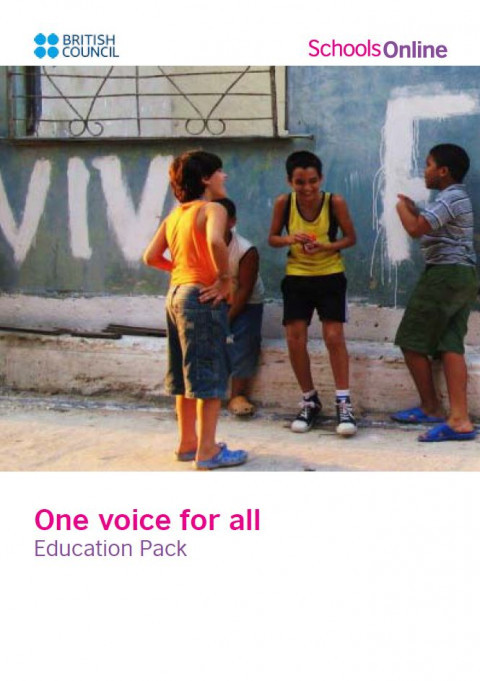 One Voice for All: Education Pack Año de publicación: 2013 Autor corporativo: British Council One Voice for All is a set of resources designed to help teachers work on the Connecting Classrooms themes of Rights and Responsibilities and Fairness and Equality through an exploration of human rights and street children. Its focus is the UN Convention on the Rights of the Child and it aims to allow learners to develop understanding of the key concepts of global citizenship, universal rights and justice.This resource aims to give young people the opportunity to understand the complexity of the wider world in which they live by exploring inequality and steps to address it.
 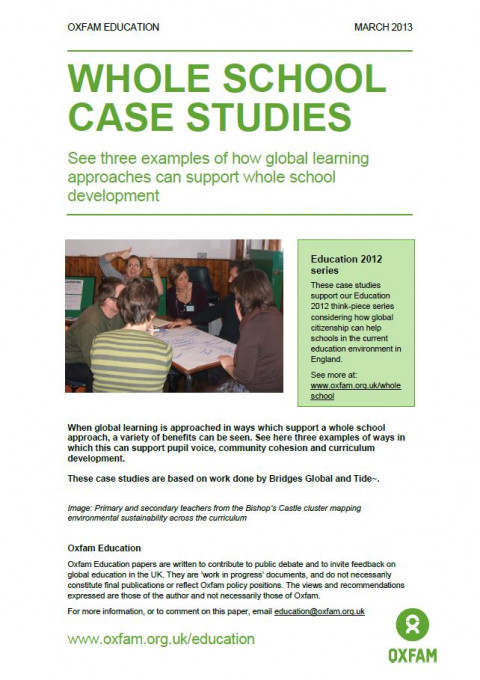 Whole School Case Studies: See Three Examples of How global Larning Approaches Can Support Whole School Development Año de publicación: 2013 Autor corporativo: Oxfam GB These case studies support our Education 2012 think-piece series considering how global citizenship can help schools in the current education environment in England.When global learning is approached in ways which support a whole school approach, a variety of benefits can be seen. See here three examples of ways in which this can support pupil voice, community cohesion and curriculum development.These case studies are based on work done by Bridges Global and Tide~.See more at: www.oxfam.org.uk/wholeschool
  Beyond Access: Toolkit for Integrating Gender-based Violent Prevention and Response into Education Projects Año de publicación: 2015 Autor corporativo: United States Agency for International Development (USAID) This toolkit was developed to support implementation of the U.S. Strategy to Prevent and Respond to Gender-based Violence Globally. It provides guidance and resources for USAID technical and program officers working on education to increase understanding of GBV in the education context and strengthen integration of a gender-based violence (GBV) response into projects and activities. Because reducing school-related GBV is a high priority for USAID in all school systems globally, this toolkit includes school-related GBV, but the overall focus is GBV in the education context broadly.The Toolkit provides:The United States government definition of GBV and USAID’s definition of school-related GBVExplanation for why integrating GBV prevention and response improves education outcomes, and the evidence on the prevalence of GBV in the education sectorGuiding principles to ensure the well-being of those at risk for, and survivors of, GBVIllustrative GBV prevention and response activities by the USAID Education Strategy GoalsGuidance on how to integrate GBV prevention and response throughout theUSAID Program Cycle to be able to monitor, evaluate, learn, and adapt education projects and activities accordingly, and it includes illustrative indicators for measuringGBV prevention and response for each of the USAID Education Strategy goals.
  [Vidéo] Pédagogie du projet et éducation à la citoyenneté mondiale Año de publicación: 2018 Autor corporativo: Annoncer la Couleur (ALC) Quels sont les avantages de la pédagogie du projet ? En quoi cette pédagogie est particulièrement propice pour faire de l'éducation à la citoyenneté mondiale ?
  [Vidéo] L'éducation à la citoyenneté au Sud Año de publicación: 2016 Autor corporativo: ONG Défi Belgique Afrique (DBA) Un projet d'éducation au développement de la jeuness africaine