
Recursos
Exploren una amplia gama de recursos valiosos en GCED para profundizar su comprensión y promover su búsqueda, incidencia, enseñanza y aprendizaje.
3,448 resultados encontrados
 How to Hit a Moving Target: 35 Years of Gender and Sexual Diversity in Teacher Education Año de publicación: 2019 Autor: Lee Airton | Austen Koecher This essay shares findings from an exhaustive review of the English-language published scholarship on integrating gender and sexual diversity in teacher education (GSDTE) since 1982. The 158 sources substantiate a largely USA-based field with an array of studied pedagogies and a citational reliance on statistics that reveal the school-sited suffering of gender and sexual minority youth. Implications for the field are shared, including: critical questions about the field's construction, objects and beneficiaries; the importance of citing GSDTE and teacher education research and not only youth outcome research; and preparing teachers for gender and sexual diversities that are presently unimaginable. Highlights • A review of the literature on integrating gender and sexual diversity in teacher education.• There is a citational reliance on the school-sited suffering of gender and sexual minority youth.• It is important to cite GSDTE and teacher education research and not only youth outcome research.• This will help prepare teachers for gender and sexual diversities that are presently unimaginable.
 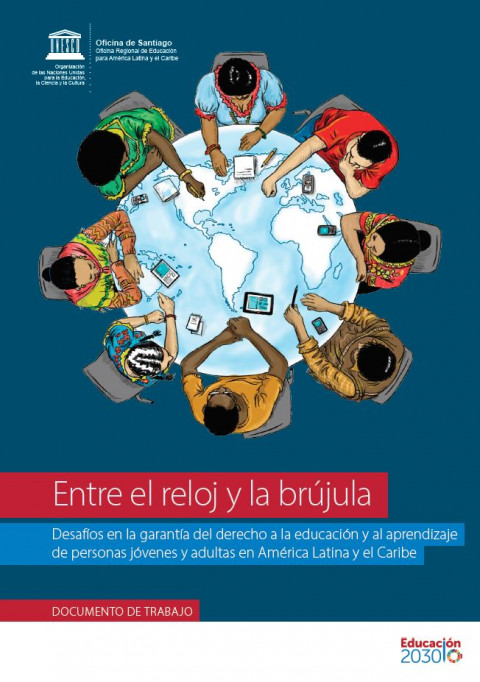 Entre el reloj y la brújula: desafíos en la garantía del derecho a la educación y al aprendizajede personas jóvenes y adultas en América Latina y el Caribe; documento de trabajo Año de publicación: 2019 Autor: Henry Renna Autor corporativo: UNESCO Santiago Este documento tiene por objetivo proporcionar una visión general de la educación y del aprendizaje de personas jóvenes y adultas como derecho humano y social. Los instrumentos de derecho vinculante y no vinculante que la sustentan son históricos y de larga data, como también contingentes, amplios y extensos en su alcance, con presencia regional e internacional. El documento muestra —sobre la base de los Indicadores del Objetivo de Desarrollo Sostenible 4 (ODS 4 Agenda 2030)— que los principales desafíos para los países de América Latina y el Caribe tienen relación con la lentitud de los progresos (el desafío del reloj) dejando a muchas y muchos jóvenes y adultos al margen de oportunidades educativas, de conocimientos, habilidades y aptitudes, y privados de alcanzar el bienestar integral. Este informe también sostiene —basado en los informes nacionales del Tercer Reporte Global de Educación y Aprendizaje de Adultos— que muchos desafíos están vinculados con la dirección de las políticas (el desafío de la brújula), con sentidos reduccionistas y homogeneizadores detrás de las instituciones y de la acción pública, lo que precariza y fragiliza la garantía del derecho a la educación y al aprendizaje de las personas jóvenes y adultas. Este documento es consistente con el llamado de la UNESCO a «repensar la educación» e invita a reconstruir en el siglo XXI un mundo y una educación sin muros, donde se difuminen las fronteras mentales e institucionales que reducen, dividen y aislan los sistemas educativos, con el fin de liberar su poder transformador para todos y todas.
 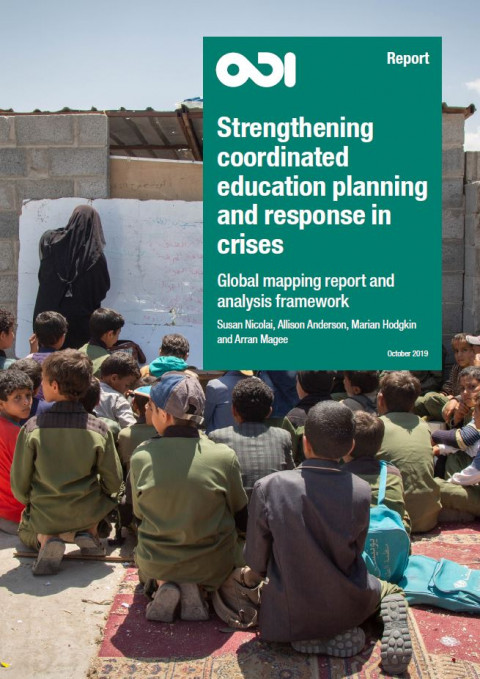 Strengthening Coordinated Education Planning and Response in Crises: Global Mapping Report and Analysis Framework Año de publicación: 2019 Autor: Susan Nicolai | Allison Anderson | Marian Hodgkin | Arran Magee Autor corporativo: Overseas Development Institute (ODI) This report presents a framework for analysis of formal coordination approaches for education planning and response in emergencies and protracted crises. It reviews concepts and definitions of coordination, approaches and structures for coordinated planning and response, and expected outcomes of these processes, with a focus on humanitarian structures across the humanitarian–development nexus.It is part of a set of publications produced in partnership with the Global Education Cluster, the Inter-Agency Network for Education in Emergencies and UNHCR – the UN Refugee Agency – with funding from the Education Cannot Wait Fund. The conceptual framework and set of research questions that emerge from this report is applied to six country case studies, which will be published in December 2019.
 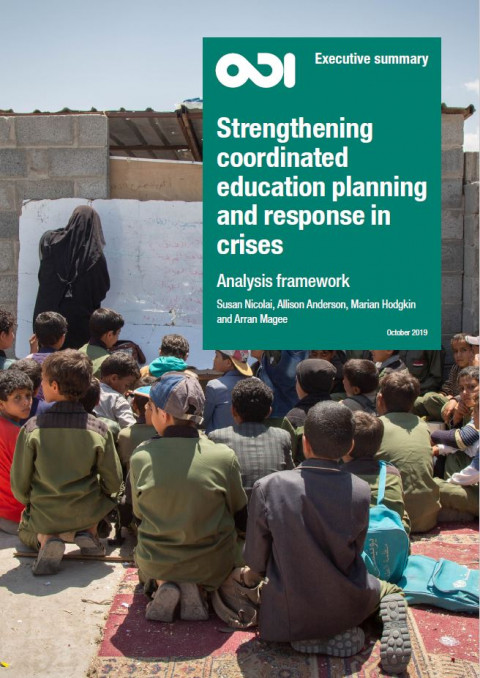 [Summary] Strengthening Coordinated Education Planning and Response in Crises: Analysis Framework; Executive Summary Año de publicación: 2019 Autor: Susan Nicolai | Allison Anderson | Marian Hodgkin | Arran Magee Autor corporativo: Overseas Development Institute (ODI) This report presents a framework for analysis of formal coordination approaches for education planning and response in emergencies and protracted crises. It reviews concepts and definitions of coordination, approaches and structures for coordinated planning and response, and expected outcomes of these processes, with a focus on humanitarian structures across the humanitarian–development nexus. The main types of formal education coordination groups include Education Clusters, Refugee Education Working Groups and Local Education Groups (LEGs). These often have different purposes and organisations associated with them, sometimes resulting in overlaps and gaps in coordination efforts.
  Transforming Systems in Times of Adversity: Education and Resilience; White Paper Año de publicación: 2019 Autor: Ritesh Shah Autor corporativo: United States Agency for International Development (USAID) This white paper was commissioned to provide USAID, including Missions, Regional Bureaus, Pillar Bureaus, and the Office of U.S. Foreign Disaster Assistance (OFDA), with an overview of global and Agency thinking and practice on education and resilience and a foundation and justification for positioning USAID education efforts more concretely within a resilience frame.The white paper is organized into three key sections. The first section outlines the business case for resilience, explaining how and why resilience is an important consideration for education programs to consider in contexts of crisis and conflict and how education is well poised as a sector to contribute to strengthening resilience. The second section presents a conceptual framework for understanding how resilience operates through and within the education sector and program interventions. The third section provides a series of key considerations for developing and supporting USAID education programs with a resilience lens or focus.
 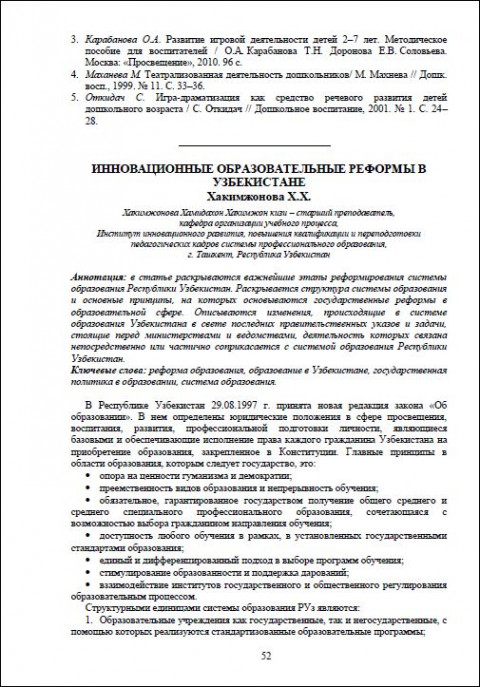 Innovative Educational Reforms in Uzbekistan Año de publicación: 2019 Autor: Kh. Khakimjonova The article reveals the most important stages of reforming the education system of the Republic of Uzbekistan. The structure of the education system and the basic principles on which state reforms in the educational sphere are based are revealed. Describes the changes taking place in the education system of Uzbekistan in the light of recent government decrees and the challenges facing ministries and departments whose activities are directly or partially related to the education system of the Republic of Uzbekistan. Инновационные образовательные реформы в Узбекистане Año de publicación: 2019 Autor: Kh. Khakimjonova В статье раскрываются важнейшие этапы реформирования системы образования Республики Узбекистан. Раскрывается структура системы образования и основные принципы, на которых основываются государственные реформы в образовательной сфере. Описываются изменения, происходящие в системе образования Узбекистана в свете последних правительственных указов и задачи, стоящие перед министерствами и ведомствами, деятельность которых связана непосредственно или частично соприкасается с системой образования Республики Узбекистан.
 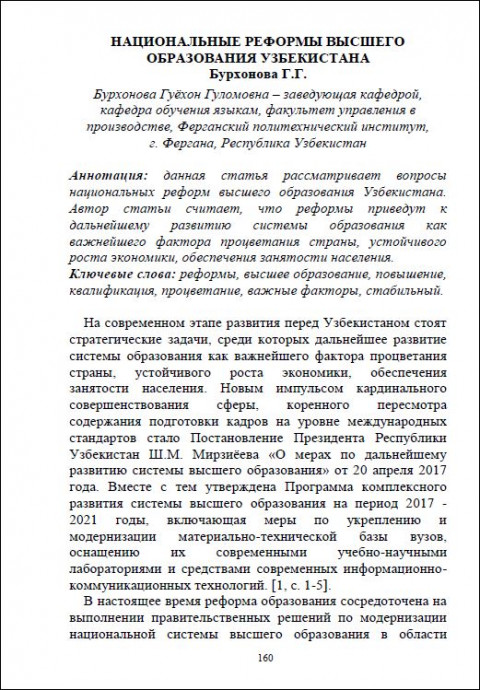 National Reforms of the Higher Education in Uzbekistan Año de publicación: 2019 Autor: G. Burkhonova This article addresses the issues of national reform of higher education in Uzbekistan. The author of the article believes that the reforms will lead to the further development of the education system as an important factor in the country's prosperity, sustainable economic growth, and employment. Национальные реформы высшего образования Узбекистана Año de publicación: 2019 Autor: G. Burkhonova Данная статья рассматривает вопросы национальных реформ высшего образования Узбекистана. Автор статьи считает, что реформы приведут к дальнейшему развитию системы образования как важнейшего фактора процветания страны, устойчивого роста экономики, обеспечения занятости населения.
 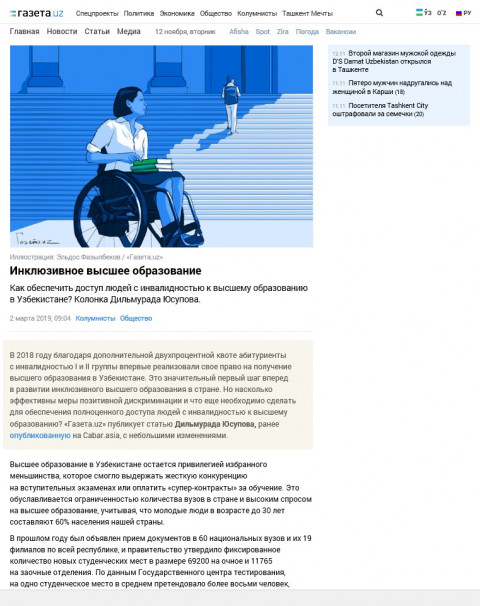 Инклюзивное высшее образование: Как обеспечить доступ людей с инвалидностью к высшему образованию в Узбекистане? Año de publicación: 2019 Autor: Dilmurad Yusupov Статья посвящена анализу изменений, происходящих в системе высшего образования Узбекистана, а также мер, необходимых для обеспечения полноценного доступа людей с инвалидностью к высшему образованию.