
Recursos
Exploren una amplia gama de recursos valiosos en GCED para profundizar su comprensión y promover su búsqueda, incidencia, enseñanza y aprendizaje.
1,402 resultados encontrados
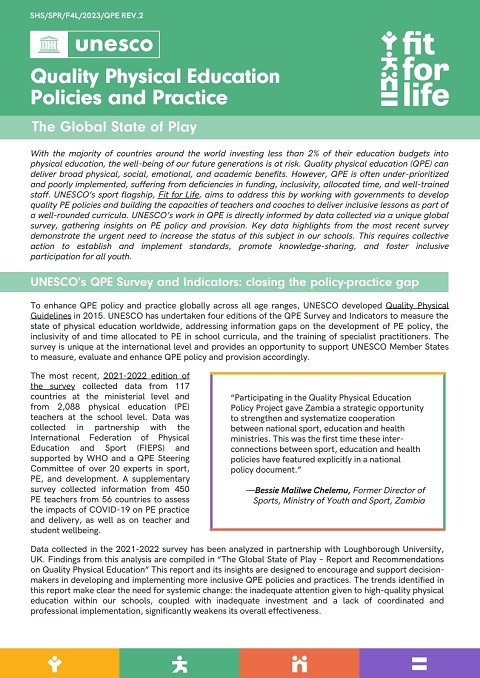 Quality Physical Education Policies and Practice: The Global State of Play Año de publicación: 2023 Autor corporativo: UNESCO With the majority of countries around the world investing less than 2% of their education budgets into physical education, the well-being of our future generations is at risk. Quality physical education (QPE) can deliver broad physical, social, emotional, and academic benefits. However, QPE is often under-prioritized and poorly implemented, suffering from deficiencies in funding, inclusivity, allocated time, and well-trained staff. UNESCO’s sport flagship, Fit for Life, aims to address this by working with governments to develop quality PE policies and building the capacities of teachers and coaches to deliver inclusive lessons as part of a well-rounded curricula. UNESCO’s work in QPE is directly informed by data collected via a unique global survey, gathering insights on PE policy and provision. Key data highlights from the most recent survey demonstrate the urgent need to increase the status of this subject in our schools. This requires collective action to establish and implement standards, promote knowledge-sharing, and foster inclusive participation for all youth.
 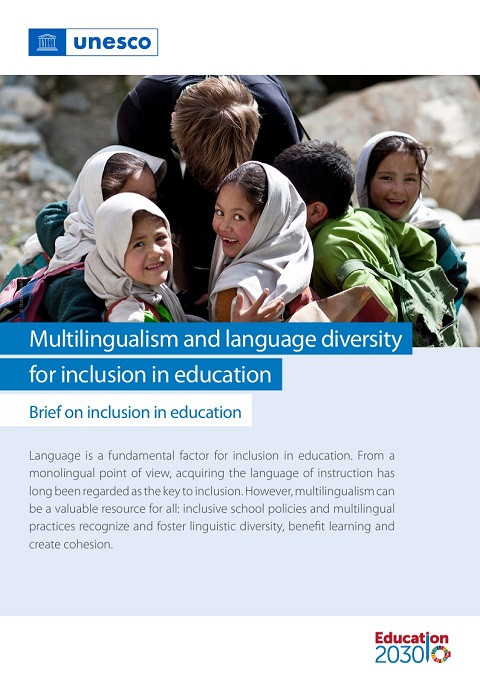 Multilingualism and Language Diversity for Inclusion in Education: Brief on Inclusion in Education Año de publicación: 2024 Autor: Piet Van Avermart Autor corporativo: UNESCO Language is a fundamental factor for inclusion in education. From a monolingual point of view, acquiring the language of instruction has long been regarded as the key to inclusion. However, multilingualism can be a valuable resource for all: inclusive school policies and multilingual practices recognize and foster linguistic diversity, benefit learning and create cohesion.
  Enhancing TVET through Digital Transformation in Developing Countries Año de publicación: 2023 Autor corporativo: UNESCO Technological advancements and digitalization are profoundly reshaping our work and lifestyle, business models and operations, and government policy choices. Digital transformation in technical and vocational education and training (TVET) is the planned and structured introduction of automated and streamlined processes within institutions and national technical and vocational education and training (TVET) systems through digital technology, with the goal of enhancing their scope, scale, efficiency and effectiveness and ultimately, driving their more sustainable development. This document provides overall perspective and five country case studies on digital transformation in TVET. Most countries studied face similar enabling factors: the digital infrastructure available; legal and policy frameworks; focused institutional change to improve the acquisition of digital skills; and the promotion of equality and inclusivity. To understand how digital transformation in TVET is occurring, the report analyses it at four levels: technical and technological development; curriculum and qualifications; teaching and learning using technology; and its contribution to the sustainability and resilience of societies.
  High Level Ministerial Dialogue on Education for Peace Año de publicación: 2023 Autor corporativo: UNESCO This High-level event brought together voices from around the world to discuss what quality and relevant education needs to look like today to bring about real and lasting peace.
  Chile: Artificial Intelligence Readiness Assessment Report Año de publicación: 2023 Autor corporativo: UNESCO The Readiness Assessment Methodology (RAM) is a diagnostic tool intended to assist Member States in upholding their commitment to the Recommendation by helping them understand how prepared they are to implement AI ethically and responsibly for all their citizens. The RAM questionnaire forms the basis for the first section of this readiness assessment report, providing a comprehensive but detailed overview of laws, institutions, and the cultural, social, and human capital landscape shaping AI. This is then complemented in the second section by a summary of concerns and priorities raised during a national multistakeholder consultation that was conducted in 2023. Finally, the third section presents a roadmap and recommendations for building capacities across national institutions, laws and policies, and human capital, to achieve a responsible AI ecosystem aligned with the UNESCO Recommendation. As the very first country to complete the RAM and the country report, Chile is blazing the trail not only for Latin America but the world. We applaud the initiative the Chilean government has taken to update its AI strategy putting ethics and governance front and centre, and thank them for inviting UNESCO to assist in this endeavour. The report presented here reveals a complex and rapidly-changing landscape. In the legal and regulatory dimension, the 2021 National Artificial Intelligence Policy (NAIP) represents a substantive and wide-ranging commitment to developing AI. One of the key recommendations of this report is to fully integrate the UNESCO Recommendation into the NAIP’s axis of Ethics, Regulation, and Socioeconomic Impacts. Notably, the RAM reveals the pressing need to update legislation around data protection and cybersecurity to meet the challenges of AI. It also highlights several areas the Chilean government is actively working to develop. [...] Overall, this report presents a fundamentally optimistic vision that we at UNESCO share: that ethical governance and responsible regulation of AI is entirely consistent with innovation and economic growth, and is essential for ensuring a technological ecosystem that benefits the public good. In drawing a clear line from the RAM data through to the multistakeholder consultations and the recommendations, Chile has a clear roadmap for how to get there. (This text has been extracted from the Foreword of the publication)
  Transforming Knowledge and Research for Just and Sustainable Futures: Towards a New Social Imaginary for Higher Education (Education, Research and Foresight: Working Papers; No.33, 2024) Año de publicación: 2024 Autor: Leon Tikly Autor corporativo: UNESCO The paper considers why it is important to transform knowledge and research for just and sustainable futures and discusses the role of higher education in these transformation processes. The paper sets out how knowledge, research, and knowledge systems can be understood and critiques knowledge hierarchies that have emerged in the context of colonialism, leading to the marginalization of the knowledge systems and languages of the colonized. It is argued that there is a need to create new ecologies of knowledge that value and develop synergies between ‘all of the archives of the world’ and that can revitalize and expand the knowledge commons and contribute to more just and sustainable futures. Higher education has a pivotal role to play in the creation of new ecologies of knowledge and a revitalized knowledge commons through promoting socially and ethically engaged research, the decolonization and reorientation of university curricula and pedagogy to foster sustainable futures, and the democratization of universities to better represent historically marginalized groups. Underpinning this role must be a shift from a Western modernist social imaginary of higher education to one based on a new planetary consciousness.
  Guidelines for the governance of digital platforms: safeguarding freedom of expression and access to information through a multi-stakeholder approach Año de publicación: 2023 Autor corporativo: UNESCO Guidelines for an Internet for TrustSafeguarding freedom of expression and the right to information while dealing with dis- and misinformation, hate speech, and conspiracy theories requires a multistakeholder approach. This is the reason why UNESCO, the leading UN agency for the promotion and protection of freedom of expression and to information, is launching Guidelines for the Governance of Digital Platforms. The Guidelines outline a set of duties, responsibilities and roles for States, digital platforms, intergovernmental organizations, civil society, media, academia, the technical community and other stakeholders to enable the environment where freedom of expression and information are in the core of digital platforms governance processes. The Guidelines were produced through a multi-stakeholder consultation that gathered more than 10,000 comments from 134 countries. These global-scale consultations fostered inclusive participation, ensuring a diversity of voices to be heard, including those from groups in situation of marginalization and vulnerability. Cultivating an Internet of Trust is a shared responsibility among all stakeholders. It calls upon us all to sustain an enabling environment for freedom of expression and the right to information.
  Countering Online Hate Speech Año de publicación: 2015 Autor: Iginio Gagliardone | Danit Gal | Thiago Alves | Gabriela Martinez Autor corporativo: UNESCO The present report provides a global overview of the dynamics characterizing hate speech online and some of the measures that have been adopted to counteract and mitigate it, highlighting good practices that have emerged at the local and global levels. While the study offers a comprehensive analysis of the international, regional and national normative frameworks developed to address hate speech online, and their repercussions for freedom of expression, it places particular emphasis on social and non-regulatory mechanisms that can help to counter the production, dissemination and impact of hateful messages online. Combattre les discours de haine sur internet Año de publicación: 2015 Autor: Iginio Gagliardone | Danit Gal | Thiago Alves | Gabriela Martinez Autor corporativo: UNESCO Le présent rapport offre un panorama mondial des dynamiques caractéristiques des discours de haine en ligne et des mesures prises pour les combattre et les contenir, en mettant en évidence les bonnes pratiques qui ont émergé au niveau local comme au niveau international. Si l’étude fournit une analyse exhaustive des cadres normatifs internationaux, régionaux et nationaux mis en place pour lutter contre les discours de haine en ligne et de leurs répercussions sur la liberté d’expression, elle met particulièrement l’accent sur les mécanismes sociaux et non réglementaires qui peuvent contribuer à lutter contre la production, la diffusion et l’impact des messages de haine en ligne.
  Towards Inclusion in Education: Status, Trends and Challenges: The UNESCO Salamanca Statement 25 Years on Año de publicación: 2020 Autor corporativo: UNESCO The 2030 Agenda for Sustainable Development focuses on leaving no one behind with its Goal 4 on education calling upon education systems ‘to ensure inclusive and equitable quality education and promote lifelong learning opportunities for all’. With ten years remaining to the target date of 2030, countries need to step up e¬orts to reach out to all learners, respect their diverse needs, abilities and characteristics and eliminate all forms of discrimination in the learning environment. This requires adopting an inclusive approach whose foundations have been laid by the UNESCO World Conference on Special Needs Education held in Salamanca, Spain, in 1994. The publication looks at the past, present and future since Salamanca. It provides examples from around the world and make recommendations to guide the further development of inclusive national policies and practices.