
Recursos
Exploren una amplia gama de recursos valiosos en GCED para profundizar su comprensión y promover su búsqueda, incidencia, enseñanza y aprendizaje.
3,448 resultados encontrados
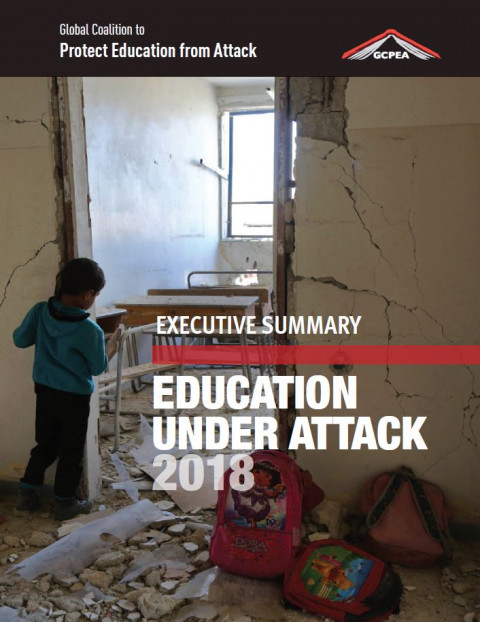 [Summary] Education Under Attack 2018; Executive Summary Año de publicación: 2018 Autor corporativo: Global Coalition to Protect Education from Attack (GCPEA) A global study of threats or use of force, either deliberate or indiscriminate, against students, teachers, academics, education support and transport staff or education officials, and against schools, universities and other education institutions carried out for political military, ideological, sectarian, ethnic or religious reasons from 2013 to 2017. [Resumen] Ataques a la Educación 2018; Resumen Ejecutivo Año de publicación: 2018 Autor corporativo: Global Coalition to Protect Education from Attack (GCPEA) Estudio global de las amenazas o instancias de uso deliberado o indiscriminado de la fuerza contra estudiantes, docentes, académicos, personal auxiliar educativo y de transporte o funcionarios de educación, y contra escuelas, universidades y otras instituciones educativas, perpetradas con fines políticos, militares, ideológicos, sectarios, étnicos o religiosos entre 2013 y 2017. [Résumé] L’education prise pour cible 2018; Un résumé de Año de publicación: 2018 Autor corporativo: Global Coalition to Protect Education from Attack (GCPEA) Une étude globale des menaces ou de l'usage de la force, délibérée ou non, contre les élèves, les enseignants, les universitaires, le personnel scolaire et des transports ou les agents de l'éducation; et contre les écoles, les universités et autres institutions éducatives, menées pour des raisons politiques, militaires, idéologiques, sectaires, ethniques ou religieuses de 2013 à 2017.
 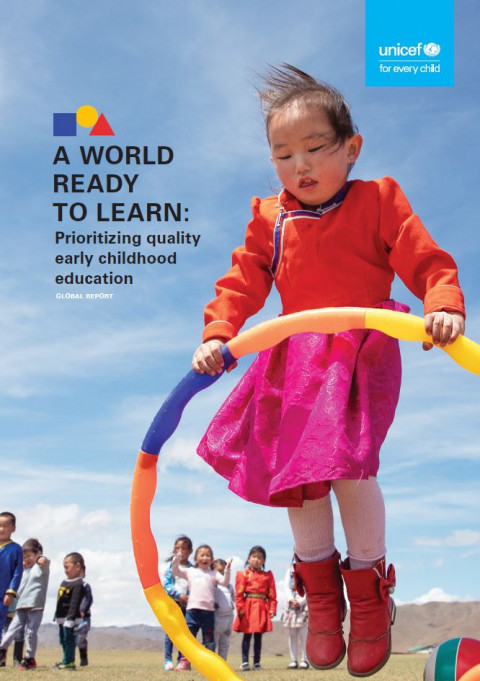 A World Ready to Learn: Prioritizing Quality Early Childhood Education Año de publicación: 2019 Autor corporativo: United Nations Children's Fund (UNICEF) The Sustainable Development Goals (SDGs), and target 4.2 specifically, convey a clear objective that all girls and boys have access to quality early childhood development, care and pre-primary education so that they are ready for primary education. This global report confirms the importance of early childhood education in achieving SDG 4 and supports a bold challenge: Provide all children with at least one year of quality pre-primary education by 2030.The reasons for this aspiration are clear, as a solid body of evidence shows that the foundations for learning are largely built in the early years of life, before a child ever crosses the threshold of a primary school.In recent proposals on how to achieve universal education at all levels, the International Commission on Financing Global Education Opportunity (the Education Commission), the World Development Report and the Global Education Monitoring Reports3,4,5 have all emphasized that investments in early childhood education have positive returns not only for individual children but also for building more efficient and effective education systems.Yet, currently, both domestic financing and international aid invested in pre-primary education are poorly targeted and grossly inadequate. This represents one of the greatest missed opportunities to nurture the world’s human capital and help children reach their fullest potential.Based on comprehensive, data-driven analysis, this report examines the current status of pre-primary education and offers a practical vision for expanding equitable access and improving quality. Recognizing that many countries, especially low- and lower-middle-income countries, are at the beginning of this journey, providing universal access to pre-primary education in all countries by 2030 requires a realistic yet bold approach.
  Pour une démocratie engagée: Vox Populi et l'éducation à la citoyenneté dans les écoles du Québec Año de publicación: 2017 Autor: Ariane Godbout Autor corporativo: Fondation Jean-Charles-Bonenfant Au tournant des années 2000, les acteurs politiques du Québec ont décidé d'intégrer l'éducation à la citoyenneté dans le nouveau Programme de Formation de l'École québécoise. Cette mesure, qui visait à contrer le désengagement des jeunes de la sphère politique, a cependant posé de nombreux problèmes aux acteurs du milieu scolaire lorsqu'est venu le temps de la mettre en pratique, au point où l'on envisage maintenant de retirer des pans importants de cette composante du cursus des élèves québécois. L'essai proposé vise à comprendre l'origine de ces obstacles et à proposer des manières dont l'Assemblée nationale et le Directeur Général des Élections du Québec, avec le programme Vox Populi, pourraient mieux appuyer les acteurs du milieu scolaire en matière d'éducation à la citoyenneté.
  Human rights education at Holocaust memorial sites across the European Union : An overview of practices Año de publicación: 2011 Autor corporativo: European Union Agency for Fundamental Rights Most European Union (EU) Member States have memorial sites and museums that both preserve the memory of the Holocaust and encourage visitors, in particular young people, to reflect on current human rights issues. In this handbook, the European Union Agency for Fundamental Rights (FRA) provides examples of the various ways in which memorial sites link the history of the Holocaust to human rights, ensuring that the past resonates in the present and its lessons are brought to bear on difficult contemporary issues against its backdrop. The report offers a sampling of educational programmes at selected historical sites and museums that either address human rights directly or approach, in a more general way, the dignity of human life and the equality of all human beings. (By the publisher)
  Education on the Holocaust and on Anti-Semitism : An overview and analysis of Educational Approaches Año de publicación: 2006 Autor corporativo: OSCE. Office for Democratic Institutions and Human Rights (ODIHR) This study provides both the background on what is already being done in the field of Holocaust education and the identification of good practices to support future efforts by OSCE states and civil society. It also highlights new challenges that need to be addressed in education on both the Holocaust and on anti-Semitism. The first part of the study is based on information provided to the ODIHR by national ministries of education; national delegations of the Task Force for International Cooperation on Holocaust Education, Remembrance and Research (ITF); experts; educators; Jewish communities; and NGOs, in response to a questionnaire sent out by the ODIHR between December 2004 and April 2005. Comprehensive recommendations regarding Holocaust education conclude this first part of the overview. The second part of this report constitutes a first step in this regard: using country overviews on four OSCE states, it highlights the need to supplement Holocaust education in response to new forms of anti-Semitism and provides a number of relevant recommendations. (By the publisher)
 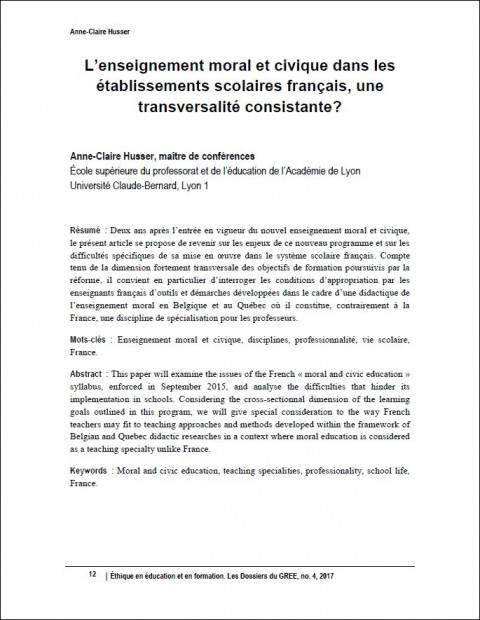 Moral and Civic Teaching in French Schools, a Consistant Transversality? Año de publicación: 2017 Autor: Anne-Claire Husser Autor corporativo: Éthique en éducation et en formation This paper will examine the issues of the French « moral and civic education » syllabus, enforced in September 2015, and analyse the difficulties that hinder its implementation in schools. Considering the cross-sectionnal dimension of the learning goals outlined in this program, we will give special consideration to the way French teachers may fit to teaching approaches and methods developed within the framework of Belgian and Quebec didactic researches in a context where moral education is considered as a teaching specialty unlike France. L’enseignement moral et civique dans les établissements scolaires français, une transversalité consistante? Año de publicación: 2017 Autor: Anne-Claire Husser Autor corporativo: Éthique en éducation et en formation Deux ans après l’entrée en vigueur du nouvel enseignement moral et civique, le présent article se propose de revenir sur les enjeux de ce nouveau programme et sur les difficultés spécifiques de sa mise en oeuvre dans le système scolaire français. Compte tenu de la dimension fortement transversale des objectifs de formation poursuivis par la réforme, il convient en particulier d’interroger les conditions d’appropriation par les enseignants français d’outils et démarches développées dans le cadre d’une didactique de l’enseignement moral en Belgique et au Québec où il constitue, contrairement à la France, une discipline de spécialisation pour les professeurs.
 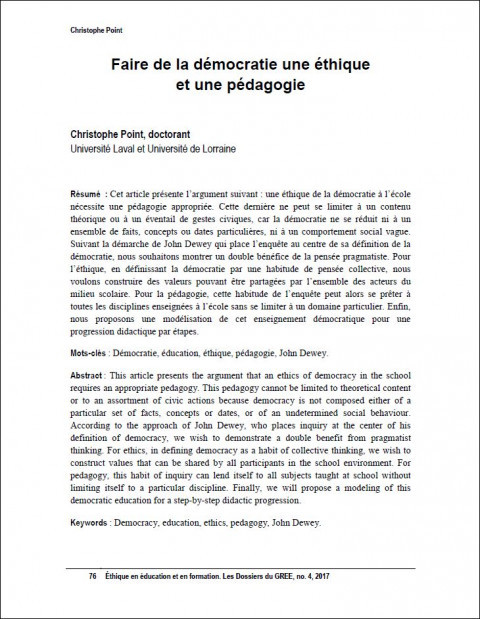 Making Democracy an Ethic and a Pedagogy Año de publicación: 2017 Autor: Christophe Point Autor corporativo: Éthique en éducation et en formation This article presents the argument that an ethics of democracy in the school requires an appropriate pedagogy. This pedagogy cannot be limited to theoretical content or to an assortment of civic actions because democracy is not composed either of a particular set of facts, concepts or dates, or of an undetermined social behaviour. According to the approach of John Dewey, who places inquiry at the center of his definition of democracy, we wish to demonstrate a double benefit from pragmatist thinking. For ethics, in defining democracy as a habit of collective thinking, we wish to construct values that can be shared by all participants in the school environment. For pedagogy, this habit of inquiry can lend itself to all subjects taught at school without limiting itself to a particular discipline. Finally, we will propose a modeling of this democratic education for a step-by-step didactic progression.