
Recursos
Exploren una amplia gama de recursos valiosos en GCED para profundizar su comprensión y promover su búsqueda, incidencia, enseñanza y aprendizaje.
1,322 resultados encontrados
 Приготовьтесь действовать!: Практические советы по защите окружающей среды и борьбе с изменением климата; Климатический глоссарий для молодёжи Año de publicación: 2024 Autor corporativo: UNICEF Uzbekistan Инструментарий для молодых активистов в области изменения климата в регионе Латинской Америки и Карибского бассейна был создан молодыми людьми, обеспокоены ситуацией, сложившейся на нашей планете и которые, будучи активистами, столкнулись со многими проблемами при отстаивании интересов и принятии мер по борьбе с изменением климата. Цель - поделиться четкой, краткой и понятной информацией, описывающей ход глобальных, региональных и национальных действий в области изменения климата с тем, чтобы подготовить вас к активному и осознанному участию в них.
  Global Priority Africa Flagships 2023: An Update from UNESCO Regional Office for Southern Africa Año de publicación: 2024 Autor corporativo: UNESCO Harare Two years into the implementation of the Operational Strategy for Priority Africa 2022-2029 (OSPA), a new biennium has commenced through the Programme and Budget for 2024-2025. With a goal of achieving the Sustainable Development Goals (SDGs) of the United Nations’ Agenda 2030 and the African Union’s Agenda 2063 “The Africa We Want”, the OSPA remains pivotal in accelerating the achievement of SDGs amidst a growing threat of regression and stagnation on some of the SDG targets. The relentless climatic changes have resulted in droughts and cyclones whose incessant rains have caused food insecurity, waterborne diseases and loss of biodiversity. Geopolitical crisis and the remnants of the impacts of COVID-19 continue to waylay the aspirations of the continent. Gender inequality, youth unemployment, education and HIV and AIDS continue to be areas for concern. Despite this plethora of challenges, Member States remain committed to Agenda 2030 and 2063 and the strong partnership existing with UNESCO and the rest of the UN system. While the OSPA is driven to address challenges in the areas of demography and sustainable development, education and knowledge, climate change, cultural renaissance, and peace and democracy these all have far-reaching consequences beyond their focus hence addressing these contributes widely to other thematic areas. Priority Africa reinforces UNESCO’s partnerships with African governing bodies such as the African Union (AU), Regional Economic Communities (RECs), Member States as well as other UN agencies. Being also aligned with the Southern African Development Community (SADC) and UNESCO’s Joint Programme of Action (JPA) 2022-2025, the OSPA continues to demonstrate its relevance to the region.
 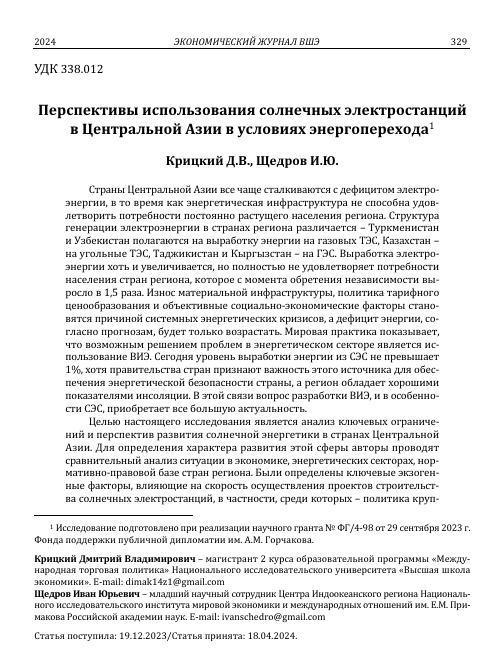 Перспективы использования солнечных электростанций в Центральной Азии в условиях энергоперехода (Экономический журнал ВШЭ, Том 28, №2) Año de publicación: 2024 Autor: Крицкий Дмитрий | Щедров Иван Целью настоящего исследования является анализ ключевых ограничений и перспектив развития солнечной энергетики в странах Центральной Азии. Для определения характера развития этой сферы авторы проводят сравнительный анализ ситуации в экономике, энергетических секторах, нормативно-правовой базе стран региона.
  UNDP KYRGYZSTAN : Annual Result Report 2023 Año de publicación: 2024 Autor corporativo: UNDP Kyrgyzstan In 2023, UNDP in Kyrgyzstan will use its global experience and strategic partnerships to achieve Sustainable Development Goals, focusing on digital transformation, development finance and innovation. Годовой отчет ПРООН в Кыргызстане за 2023г. Año de publicación: 2024 Autor corporativo: UNDP Kyrgyzstan В 2023 году ПРООН в Кыргызстане использовала свой глобальный опыт и стратегические партнерства для реализации Целей устойчивого развития, уделяя особое внимание цифровой трансформации, финансированию развития и инновациях.
  Inclusion of the Domains of Sustainable Development in Al Hadith Text Books in the Intermediate Stage Año de publicación: 2019 Autor: Zubaida S. Al Shamary | Talal M. Al Maaajal Autor corporativo: Sultan Qaboos University This study aims to identify the areas of sustainable development that should be included in the textbooks of Prophetic Sayings (Hadeeth) in the Kingdom of Saudi Arabia, to determine the degree of availability, and to find out if there are statistically significant differences at (α≤0.05) in the degree of availability. The descriptive analytical method was used to analyze the whole study population. Cooper coefficient of stability, frequencies, and percentages were used to analyze the results and measure the degree of availability of these fields. Chi Square equation was also used to measure the differences between the availability of fields among grades. The social field was firstly ranked with a percentage of 78.16%, and a total of 433 frequencies, while the environmental field followed it with a percentage of 6.98% and a total of 37 frequencies. The paper showed that there were statistically significant differences in the inclusion in Chi equation. تضمين مجالات التنمية المستدامة في كتب الحديث للمرحلة المتوسطة Año de publicación: 2019 Autor: Zubaida S. Al Shamary | Talal M. Al Maaajal Autor corporativo: Sultan Qaboos University هدف البحث إلى التعرف على مجالات التنمية المستدامة لتضمينها في كتب الحديث للمرحلة المتوسطة بالمملكة العربية السعودية، والكشف عن فروق دالة إحصائيا عند مستوى (0.05≥α) في درجة توفرها. واستخدمت الطريقة التحليلية الوصفية لتحليل كل العينة. واستخدمت الباحثان معامل اختبار كاي تربيع للاستقلالية لقياس الفروق بين درجة توافر المجالات بين الصفوف الدراسية، وأظهرت نتائج البحث: أن المجال الاجتماعي كان الأعلى تكراراً إذ بلغ ٤٣ بنسبة مئوية 16.78بينما يتضح أن المجال البيئي الأقل تكرارا إذ بلغ ٣٧ بنسبة مئوية 98.6 وظهر من خلال اختبار كاي للاستقلالية وجود فروق دالة احصائيا.
  Is every child counted? Status of data for children in the SDGs Año de publicación: 2017 Autor corporativo: United Nations Children's Fund (UNICEF) “Is every child counted”, a recent status report by UNICEF, shows that sufficient data are available for less than half of child-related SDG indicators. Many indicators, such as those on poverty and violence, are not comparable across countries, and are either too limited or of poor quality, leaving governments without the information they need to accurately address challenges facing millions of children, or to track progress towards achieving the Goals. Data are also very limited on the situation of the most disadvantaged populations within each country. Better disaggregated data on these populations is necessary. The report also identifies priorities for enhancing the collection, analysis and use of data for children.
  Is every child counted? Summary of the status of data for children in the SDGs Año de publicación: 2017 Autor corporativo: United Nations Children's Fund (UNICEF) “Is every child counted”, a recent status report by UNICEF, shows that sufficient data are available for less than half of child-related SDG indicators. Many indicators, such as those on poverty and violence, are not comparable across countries, and are either too limited or of poor quality, leaving governments without the information they need to accurately address challenges facing millions of children, or to track progress towards achieving the Goals. Data are also very limited on the situation of the most disadvantaged populations within each country. Better disaggregated data on these populations is necessary. The report also identifies priorities for enhancing the collection, analysis and use of data for children.
  Egyptian Youth Rethink the Future of Wellbeing in 2050: Report of the Futures Literacy Lab-novelty; Online, 21-24 July 2020 Año de publicación: 2020 Autor corporativo: UNESCO Cairo The UNESCO (Cairo Office and Research, Policy and Foresight Section) and the Egyptian Ministry of Youth and Sport, with support of Bibliotheca Alexandrina, UNFPA and UN Women, organized a Futures Literacy Laboratory - Novelty (FLL-N) entitled “Egyptian Youth Rethink the Future of Wellbeing in 2050”. Held online during 21-24 July 2020, and deploying the latest advances in anticipatory systems thinking and collective intelligence processes, the Lab brought together around 30 persons from across Egypt for 8-hours intensive work spread over a week’s time.Thirty young participants explored the topic of ‘wellbeing’ in Egypt in 2050 using a tool called the Futures Literacy Lab-Novelty (FLL-N). Wellbeing is an open concept that invites many different ways of defining what it means to ‘live well’. The participants engaged in learning-by-doing activities that exercised their imaginations, exploring questions like, how do people in 2050 in Egypt describe ‘wellbeing’? What is daily life like such that people in 2050 believe that they have achieved ‘wellbeing’? By working together to imagine the future this Lab provided an opportunity to better understand the origins of what we imagine, why and how we create the images of the future, and crucially the powerful influence such images have on our fears and hopes, perceptions and choices.