
Recursos
Exploren una amplia gama de recursos valiosos en GCED para profundizar su comprensión y promover su búsqueda, incidencia, enseñanza y aprendizaje.
3,790 resultados encontrados
 Participation and Exercising Pupils’ Citizenship at French-Language Elementary School in Ontario Año de publicación: 2018 Autor: Nathalie Bélanger Autor corporativo: Lien social et Politiques This article first describes the evolution which allowed the child to be considered as an actor. In this vein, citizenship education programs at school are discussed, although they do not often take into account exercising citizenship in the school context and children’s voice. Research results from a broader project on how students represent their school experience in French-language schools in Ontario are analyzed specifically with respect to what a welcoming school means for them. The methodology uses an inductive approach and the data were gathered from administering a questionnaire designed for children, observation and semi-directed interviews. The results show the impact of school culture and school form on the exercise of students' citizenship, the topics they address, their concerns and priorities. The greater the predominance of settlement and integration issues are, the less the exercise of citizenship includes deliberative opportunities regarding school functioning. Participation et exercice de la citoyenneté des élèves à l’école Año de publicación: 2018 Autor: Nathalie Bélanger Autor corporativo: Lien social et Politiques Cet article retrace les courants théoriques qui permettent de penser l’enfant en tant que sujet et donne la parole aux enfants au sujet de leur expérience scolaire. Dans ce contexte, des programmes d’éducation à la citoyenneté sont apparus, sans toutefois que l’exercice de la citoyenneté des élèves et leur prise de parole soient pris en compte et valorisés. Pour y remédier, il s’agit d’interroger des élèves au sujet de ce que représente pour eux une école accueillante. La méthodologie recourt à une approche inductive et les données ont été recueillies à partir de l’administration d’un questionnaire conçu pour des enfants, d’observation et d’entretiens semi-dirigés. Les résultats montrent l’incidence de la culture de l’école et de la forme scolaire sur l’exercice de la citoyenneté des élèves, sur les thèmes qu’ils abordent, les soucis et les priorités qui sont les leurs. Plus les enjeux d’installation et d’intégration sont prédominants, moins l’exercice de la citoyenneté inclut de possibilités délibératives quant au fonctionnement scolaire.
  Perceptions of the Holocaust in Europe and Muslim communities : Sources, Comparisons and Educational challenges Año de publicación: 2012 Autor: Gunther Jikeli | Joëlle Allouche-Benayoun The way people think about the Holocaust is changing. The particular nature of the transformation depends on people’s historical perspectives and how they position themselves and their nation or community vis-à-vis the tragedy. Understandably, European Muslims perceive the Holocaust as less central to their history than do other Europeans. Yet while the acknowledgement and commemoration of the horrors of the Holocaust are increasingly important in Europe, Holocaust denial and biased views on the Holocaust are widespread in European Muslims’ countries of origin. In this book, a number of distinguished scholars and educators of various backgrounds discuss views of the Holocaust. Problematic views are often influenced by a persistent attitude of Holocaust denial, which is derived, in part, from discourses in the Muslim communities in their countries of origin. The essays collected here explore the backgrounds of these perceptions and highlight positive approaches and developments. Many of the contributions were written by people working in the field and reflecting on their experiences. This collection also reveals that problematic views of the Holocaust are not limited to Muslim communities. (By the publisher)
  The Democratic Enigma Año de publicación: 2014 Autor: Philip Pettit Autor corporativo: Philosophiques Democracy means popular control, by almost all accounts. And by almost all accounts democracy entails legitimacy. But popular control, at least as that is understood in many discussions, does not entail legitimacy. So something has got to give. Democratic theories divide on what this is, so that the question prompts a taxonomy of approaches. The most appealing answer, so the paper suggests, involves a reinterpretation of the notion of popular control. L’énigme démocratique Año de publicación: 2014 Autor: Philip Pettit Autor corporativo: Philosophiques La démocratie signifie d’abord et avant toute chose l’idée d’un contrôle populaire, et ce par l’ensemble des moyens possibles. Ces moyens donnent lieu à la légitimité. Mais ces contrôles populaires, du moins tels qu’ils sont entendus dans de nombreuses discussions, ne donnent pas lieu à la légitimité espérée. Les théories de la démocratie ne partagent pas une même conception des choses à ce sujet, ce qui donne lieu à une pluralité d’approches. Dans cet article, l’auteur soutient que la réponse la plus intéressante à cette question implique une réinterprétation de la notion de contrôle populaire.
  The Social Representations of Democracy: Reflexivity, Efferevescence and Conflict Año de publicación: 2008 Autor: Anne-Marie Gingras | Adriana Dudas | Magali Paquin | Marc Foisy Autor corporativo: Politique et Sociétés (Canada) This paper deals with “democracy within society” that appears predominantly in our research on social representations of democracy. We have interviewed 110 persons who have a regular access to the public sphere to perceive their understanding of democracy, its many dimensions, and its main stakes. Democracy within society, or democracy as a state of society, is opposed to institutional democracy (that is, political practices and Rule of law) toward which critics abound. Democracy within society is twofold: on the one hand, emphasis on effervescence and reflexivity that crystallize in collective organisations and in debate and communication and, on the other hand, assimilation of democracy to conflict, considered in terms of normality and processes. Moreover, democracy within society needs an actor, the citizen, who does not respond to the call of democracy, as shown in the many social sciences studies of the last decades. Les représentations sociales de la démocratie: réflexivité, effervescence et conflit Año de publicación: 2008 Autor: Anne-Marie Gingras | Adriana Dudas | Magali Paquin | Marc Foisy Autor corporativo: Politique et Sociétés (Canada) Cet article porte sur la « démocratie sociale », un concept qui ressort avec force dans notre recherche sur les représentations sociales sur la démocratie. Nous avons interviewé 110 personnes ayant accès à l’espace public dans le but de saisir leur compréhension de la démocratie, de ses diverses dimensions et des principaux enjeux qui l’affectent. La démocratie sociale, ou démocratie comme état de société, s’oppose à la démocratie institutionnelle (pratiques politiques institutionnelles et État de droit) à l’égard de laquelle les critiques abondent. La démocratie sociale comporte deux volets : d’une part, l’insistance sur l’effervescence et la réflexivité qui s’incarnent dans l’organisation collective et dans le débat et la communication et, d’autre part, l’assimilation de la démocratie au conflit qui est pensé en termes de normalité et de processus. Cependant, la démocratie sociale a besoin d’un acteur, le citoyen, qui, comme le montrent les travaux en sciences sociales depuis des décennies, ne répond pas à l’appel de la construction de la démocratie.
 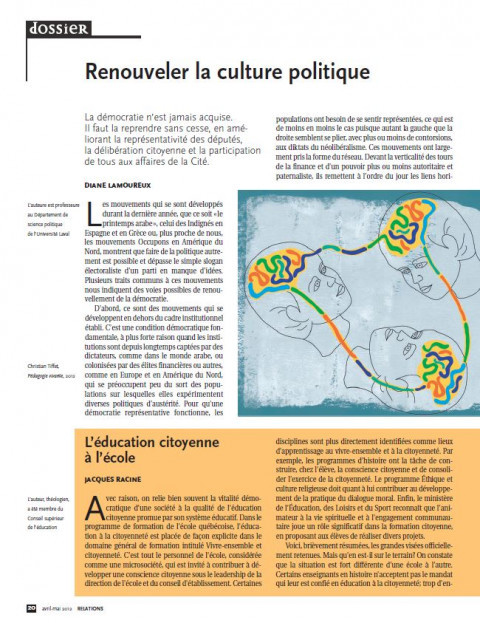 Citizenship Education at School Año de publicación: 2012 Autor: Jacques Racine Autor corporativo: Relations Special Issue of Relations intitled "Our democracy (23 articles) L’éducation citoyenne à l’école Año de publicación: 2012 Autor: Jacques Racine Autor corporativo: Relations Numéro spécial de la revue Relations intitulé "Notre démocratie : fiction ou réalité ?" (23 articles) Never again!: how the lessons from Auschwitz project impacts on schools in Scotland As the education for citizenship agenda continues to make an impact on schools in Scotland, and with the Holocaust Educational Trust (HET) in conjunction with the Scottish Government organizing its Lessons From Auschwitz Project for Scottish students and teachers until 2011, this study aimed to investigate the school processes by which students were chosen to participate in the Lessons From Auschwitz (LFA) project; examine student and teacher perceptions of the LFA Project; investigate the impact the LFA Project has on student citizenship values and on their schools and communities; and investigate the impact the LFA Project has on teachers. (By the author)