
Recursos
Exploren una amplia gama de recursos valiosos en GCED para profundizar su comprensión y promover su búsqueda, incidencia, enseñanza y aprendizaje.
1,402 resultados encontrados
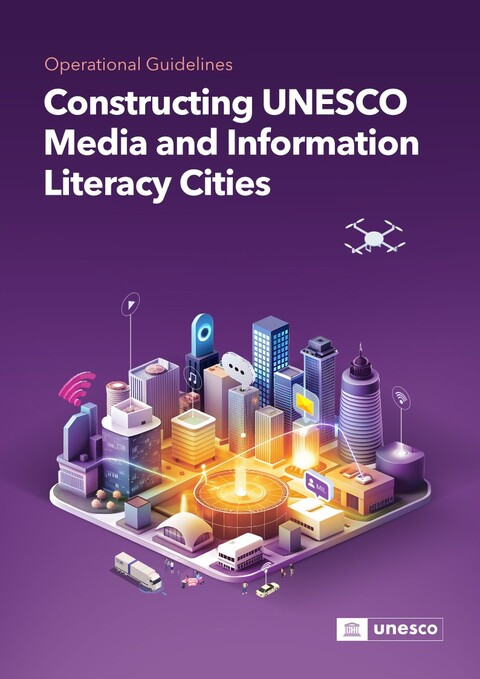 Operational Guidelines: Constructing UNESCO Media and Information Literacy Cities Año de publicación: 2024 Autor corporativo: UNESCO To support the integration of media and information literacy in urban spaces, UNESCO is releasing operational guidelines for city governance stakeholders. These guidelines aim to help cities align their goals with the benefits of integrating MIL into physical and virtual spaces.The guidelines offer examples of actions for cities interested in pioneering the MIL Cities. Cities are encouraged to share their progress and achievements with UNESCO for future initiatives.All cities and municipalities can participate, regardless of size, internet penetration, or technology use. The guidelines aim to foster diverse partnerships at the municipal level for implementing MIL actions and programmes. Directrices operativas: construyendo Ciudades de Alfabetización Mediatica eIinformacional de la UNESCO Año de publicación: 2024 Autor corporativo: UNESCO Con miras a apoyar la integración de la alfabetización mediática e informacional en los entornos urbanos, la UNESCO publica directrices operativas para las partes interesadas en la gobernanza de las ciudades. Estas directrices procuran ayudar a las ciudades a alinear sus objetivos con los beneficios de integrar la AMI en espacios físicos y virtuales.Las directrices ofrecen ejemplos de actividades a las ciudades interesadas en ser pioneras en “Ciudades AMI”. Se les alienta a compartir sus avances y logros con la UNESCO para la elaboración de iniciativas en el futuro.Todas las ciudades y municipios pueden participar, independientemente de su tamaño, penetración de Internet o utilización de tecnología. Las directrices intentan propiciar asociaciones diversas a nivel municipal con objeto de ejecutar actividades y programas AMI.
  Countering Holocaust Denial and Distortion through Education: A Guide for Teachers Año de publicación: 2025 Autor corporativo: UNESCO Antisemitic hate speech, disinformation, and conspiracy theories thrive during crises, making it vital for teachers to address these issues in school curricula. Social media has significantly amplified the spread of such harmful content, including Holocaust denial and distortion. These falsehoods, rooted in antisemitic prejudice and conspiratorial thinking, threaten our shared historical memory and promote hatred. To effectively combat these issues, it is essential to have a comprehensive understanding of the Holocaust —how and why the genocide of the Jewish people occurred. This knowledge helps us recognize the causes and risk factors, contributing to the prevention of future atrocity crimes and the fight against antisemitism. In the digital age, it is also imperative to be able to decipher the manipulation of history, and the misrepresentation of the past.The guide provides teachers with the necessary tools and guidance to prevent the spread of Holocaust denial and distortion. It equips teachers with knowledge, teaching principles, and strategies to foster digital literacy, historical understanding, and critical thinking in learners. Aimed primarily at history and social sciences teachers, it outlines key concepts, teaching methods, and approaches to counter Holocaust denial and distortion.
  Countering Holocaust Denial and Distortion through Education: Lesson Activities for Secondary Education Año de publicación: 2025 Autor corporativo: UNESCO Adaptable lessons to foster critical thinking, empathy and tolerance Holocaust denial rejects historical facts outright, while distortion manipulates the narrative. Both phenomena undermine historical truth, fuel antisemitism, and attack democratic values. By addressing these issues, this set of lesson activities for secondary education seeks to build students’ resilience against falsehoods through fostering critical thinking, empathy, and global citizenship. It was developed by UNESCO and funded by the European Commission to equip educators with tools to confront the dangerous spread of Holocaust denial and distortion. With 12 engaging lessons, students aged 14 to 18 will explore the historical facts of the Holocaust while learning to critically evaluate misinformation in today’s digital world. From analyzing survivor testimonies to deconstructing harmful memes and conspiracy theories, this resource features 12 adaptable lessons that focus on historical literacy, media analysis, and social-emotional competencies. Topics range from identifying denial and distortion, evaluating media and online sources, analyzing primary evidence like survivor testimonies, and understanding the misuse of Holocaust history in memes and conspiracy theories. Activities are scaffolded with questions, examples, and practical exercises to encourage analytical skills and promote meaningful classroom discussions. The lessons also include suggestions for incorporating primary sources, visiting memorial sites, and addressing broader issues of genocide and hate. In doing so, the guide aims to not only preserve Holocaust memory but also strengthen the values of truth, empathy, and tolerance in younger generations.
  Covering Hate Speech: A Guide for Journalists Año de publicación: 2025 Autor: Cherian George Autor corporativo: UNESCO This guide is the first in a series of guides for journalists prepared jointly by the UNESCO Communication and Information and Education Sectors on covering hate speech and its different manifestations.This guide explains what may count as hate speech, the harms it may cause, the way it works, and how media gatekeepers and other actors can address it. Many debates around hate speech are about law and regulation. Understanding the law, especially international law, can help journalists when reporting incidents where speakers are accused of hate speech. It can also help them analyse whether existing laws, as written and as applied, comply with international human rights approaches for striking the right balance between freedom of expression and the right to dignity, equality and non-discrimination.
  Как писать о языке ненависти: руководство для журналистов Año de publicación: 2025 Autor: Cherian George Autor corporativo: UNESCO Настоящее руководство — первое из серии, подготовленной совместно Секторами коммуникации и информации и образования ЮНЕСКО, и посвящено освещению журналистами языка ненависти и его различных проявлений.В настоящем руководстве рассматриваются определения языка ненависти, вред, который он может причинять, механизмы его распространения, а также способы, с помощью которых представители СМИ и другие заинтересованные стороны могут ему противодействовать. Вокруг языка ненависти нередко возникают правовые споры. Знание законодательства, особенно международного, помогает журналистам освещать случаи, когда кого-либо обвиняют в использовании языка ненависти, а также анализировать, соответствуют ли действующие нормы — как в теории, так и на практике — международным стандартам прав человека, где необходимо находить баланс между свободой выражения и правами на достоинство, равенство и недопущение дискриминации.
  Strategies to Counter Antisemitism: A Handbook for Educators Año de publicación: 2025 Autor corporativo: UNESCO Education is the first line of defence against hate and prejudice. By targeting the root causes of hate ideologies, deconstructing the stereotypes that underlie them from an early age, and promoting inclusive models, education is the keystone of a holistic approach to combating discrimination. Tackling antisemitism through education requires tailored content that addresses its complex, shifting and multilayered forms, both past and present.Acknowledging the topic’s complexity and the paucity of resources available to education stakeholders, this concise guide developed by UNESCO and funded by the European Commission aims to provide a roadmap for policymakers, curriculum developers and educators on current approaches and initiatives. It presents ten educational practices, each grounded in academic literature and illustrated by a promising educational initiative that operationalizes core pedagogical principles. The handbook is built around the three core learning domains which inform UNESCO’s approach to Global Citizenship Education: cognitive, socio-emotional, and behavioural learning.Conceived as an accessible operational guide for practitioners, this resource sets out to start a larger conversation about the needs of educators for tackling contemporary forms of antisemitism. It aims to encourage investments in high-quality empirical research that can pave the way for a better approach to combat antisemitism.
 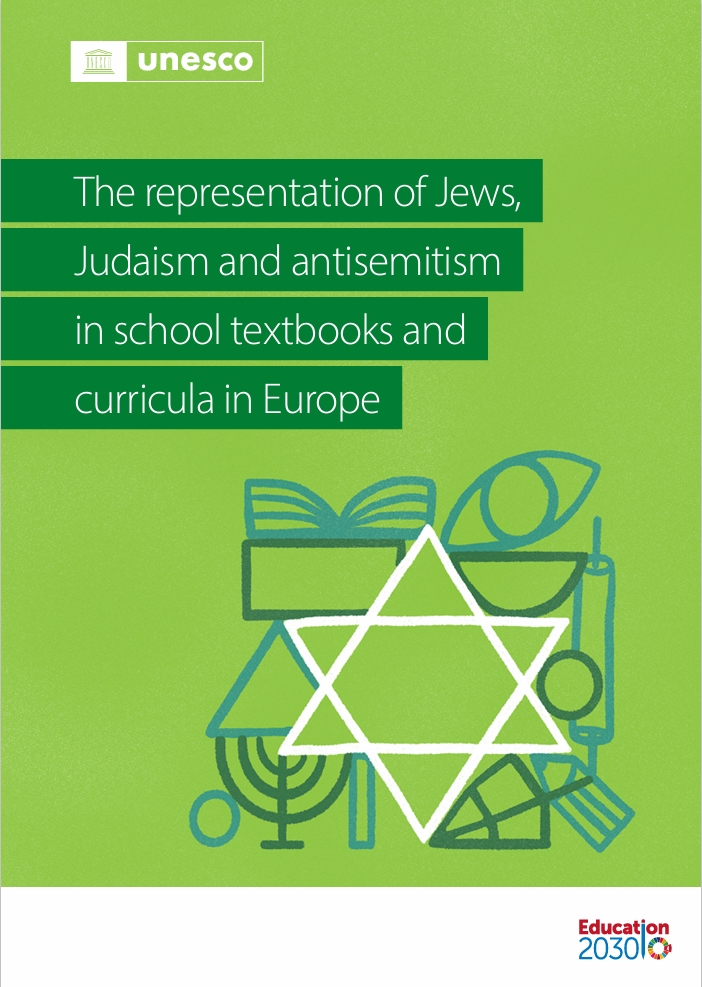 The Representation of Jews, Judaism and Antisemitism in School Textbooks and Curricula in Europe Año de publicación: 2025 Autor corporativo: UNESCO Jewish communities have been integral to Europe’s social fabric for centuries, preserving rich religious and cultural traditions while facing recurring periods of exclusion, persecution, and resilience. School textbooks are important vantage points to understand how this history and heritage is represented, (de)constructed and embedded into a shared historical and cultural memory. They are also important practical tools used daily by students, teachers, and parents.This comprehensive research, carried out by UNESCO in collaboration with the Georg-Eckert-Institute and supported by funding from the European Commission, examines the ways in which Jewish culture, history, life, and anti-Jewish prejudice are represented in secondary school materials across eight European nations.The publication highlights opportunities within curricula to address Jewish experiences and antisemitism, reviews how these themes are incorporated into textbooks, and analyzes the narratives and portrayals that arise. The study also looks at the use of visual sources and assesses whether Jewish viewpoints and agency are sufficiently reflected. The findings highlight both recurring stereotypes and promising practices. By showcasing these contrasts, the study provides targeted recommendations to guide the creation of more inclusive educational materials.
 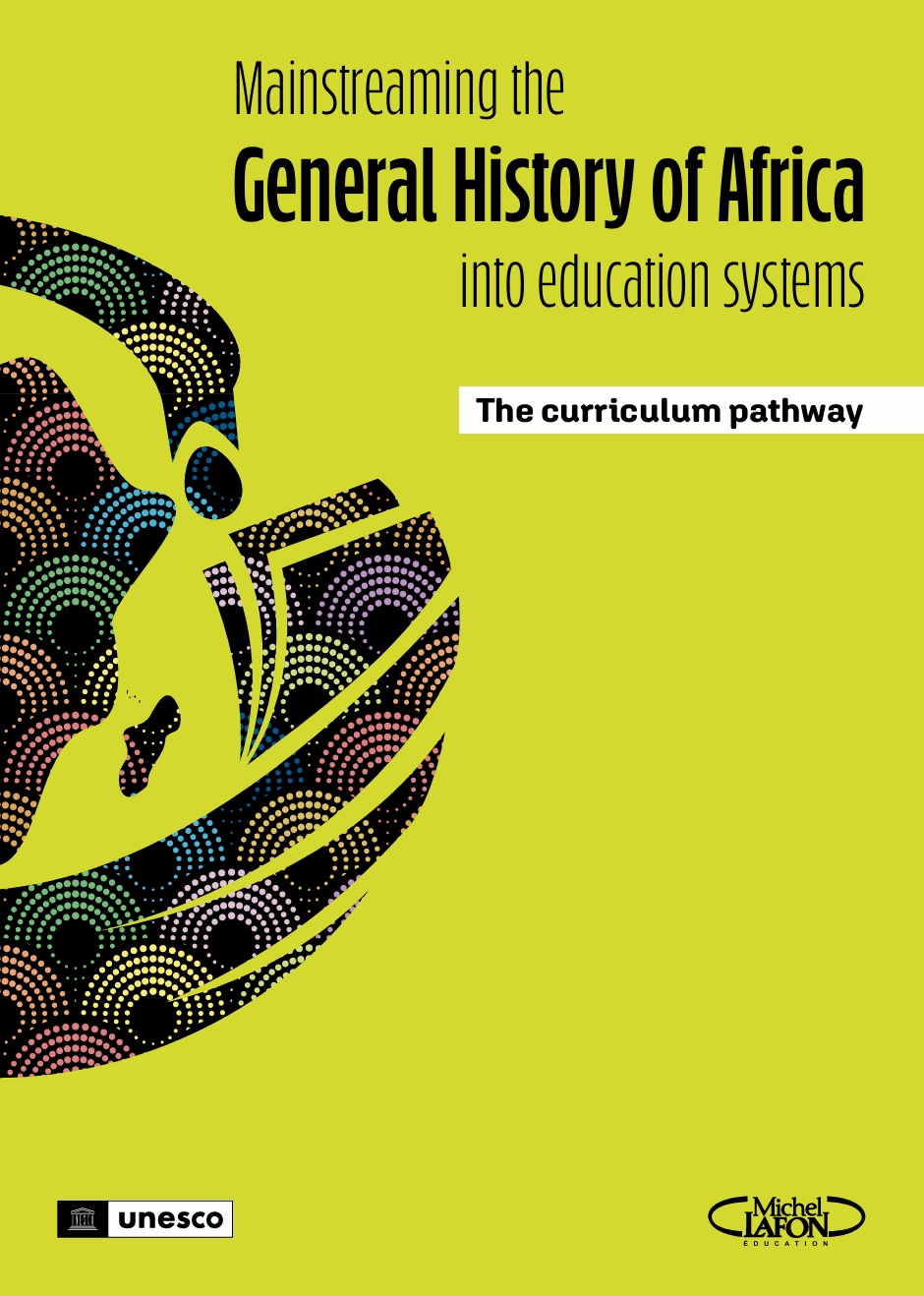 Mainstreaming the General History of Africa into Education Systems: The Curriculum Pathway Año de publicación: 2025 Autor corporativo: UNESCO Education about the history of Africa in formal, non-formal and informal learning settings continues to be dominated by Eurocentric perspectives, which has led to imbalanced representation of Africa’s history and preconceptions.This publication is a tool to support countries in challenging the skewed perspectives on how African history is taught and how Africa is perceived. It aims to bring to the foreground Africa’s history, cultures and heritage through the curriculum to strengthen knowledge, skills, values and attitudes that contribute towards addressing long-standing hegemonic, colonial thinking and connected racial bias, while forging a united, prosperous and peaceful Africa and world.Stemming from the decolonial vision and content of the volumes of the General History of Africa, the publication proposes guiding principles and approaches for designing and implementing the General History of Africa into the curriculum. It puts forth curriculum outlines for basic and secondary education to offer renewed and broader perspectives on the history of Africa and its diasporas, and their contributions to humanity.The curriculum outlines are structured around nine thematic Learning Units, arranged chronologically from the origins of humanity and civilizations to Africa’s most recent history.
 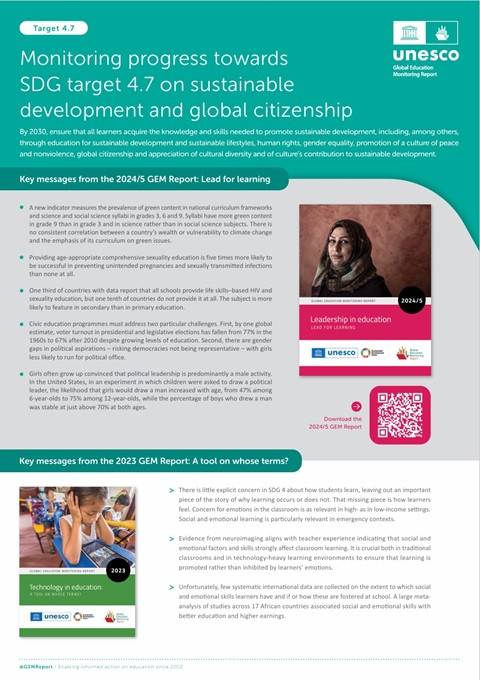 Monitoring Progress towards SDG Target 4.7 on Sustainable Development and Global Citizenship Año de publicación: 2024 Autor corporativo: UNESCO | Global Education Monitoring Report Team This document introduces key messages from the GEM Reports and other related publications and online resources regarding the progress towards SDG Target 4.7.