
Recursos
Exploren una amplia gama de recursos valiosos en GCED para profundizar su comprensión y promover su búsqueda, incidencia, enseñanza y aprendizaje.
1,450 resultados encontrados
 Manuel de développement des compétences interculturelles: les cercles d’histoires Año de publicación: 2020 Autor: Darla K. Deardorff Autor corporativo: UNESCO Le présent ouvrage propose une méthode structurée mais flexible de développement des compétences interculturelles qui pourra être utilisée dans les contextes les plus divers, formels ou informels. Mise en oeuvre à titre expérimental par l’UNESCO dans plusieurs pays du monde, cette méthode, qui aborde une grande diversité de thèmes, a apporté la preuve de son efficacité dans des situations très variées. Elle constitue donc un outil capital pour tous ceux qui ont à coeur d’appréhender efficacement la diversité culturelle grandissante qui est devenue la marque de nos sociétés, et ce afin de parvenir à un développement inclusif et durable.Ce manuel consacre l’adaptation innovante d’une tradition très ancienne, celle du récit, que l’on retrouve dans un très grand nombre de cultures. À l’aide de cette méthode, les participants apprennent à renforcer certains aspects clés des compétences interculturelles comme la conscience de soi, l’ouverture d’esprit, le respect, la réflexivité, l’empathie, la conscience d’autrui, en manifestant, en fin de compte, une plus grande humilité culturelle.Cette publication présente un grand intérêt pour les formateurs interculturels, les dirigeants politiques, les praticiens du développement, les éducateurs, les responsables des communautés et de la société civile, les universitaires et les étudiants – pour tous ceux qui s’intéressent au développement des compétences interculturelles comme moyen de comprendre et d’apprécier la différence, d’approfondir les relations indépendamment des différences, de participer au dialogue interculturel et de surmonter tout ce qui divise les sociétés. 培养跨文化能力手册 : 故事圈 Año de publicación: 2020 Autor: Darla K. Deardorff Autor corporativo: UNESCO 该文件详细介绍了用以培养跨文化能力的“故事圈”的方法,包括其使用的工具,操作方法等,同时包括了大量培训资源、案例素材与辅助材料。
  Access to Information: A New Promise for Sustainable Development Año de publicación: 2019 Autor corporativo: UNESCO The central aim of this study is to unpack the major trends in the field of ATI laws and their implementation. In order to understand the trends, the report examines the activities of trendsetters. It focuses on awareness-raising by UNESCO, Member State recommendations in the Universal Periodic Review, the commitments of the Open Government Partnership, actions of civil society organizations, and the standard-setting activities of such regional intergovernmental organizations as the Council of Europe, the African Union and the Organization of American States.
  Country Commitments to Gender Equality in Education Año de publicación: 2018 Autor: Erica Murphy Autor corporativo: UNESCO The international community has committed through legal and political frameworks to achieving gender equality in all spheres, including education. These frameworks include obligations to protect and secure women and girls' right to education through the elimination of discriminatory barriers, whether they exist in law or in everyday life, and to undertake positive measures to bring about equality, including in access of, within, and through education.This paper firstly sets out the legal and political frameworks on gender equality in education to which states have committed and then describes how they have committed.In the second section, the content of states’ commitments to achieve gender equality in education is explained, including the normative content of relevant provisions found in international and regional human rights treaties and the 2030 Agenda for Sustainable Development. This section also includes a classification of states according to what legal commitments to women and girls’ right to education they have made.The final section details how states can be held accountable for failure to meet their legal commitments to gender equality in education, including what mechanisms are available and examples of how these mechanisms have been used to hold states accountable.This paper is also background paper prepared for the 2018 Global education monitoring report gender review: Meeting our commitments to gender equality in education.
 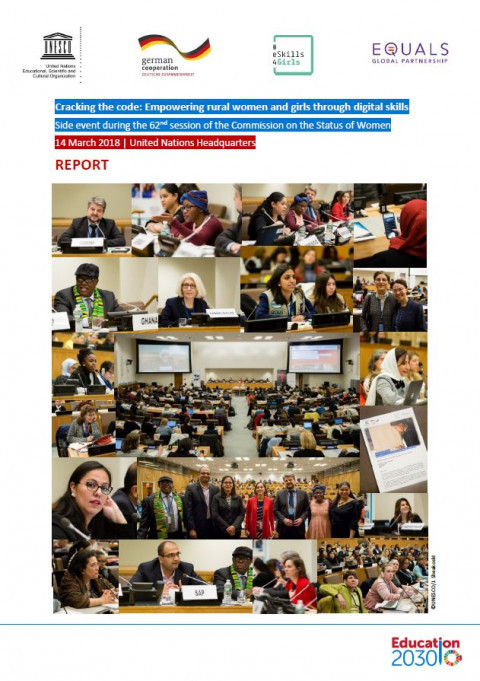 Cracking the Code: Empowering Rural Women and Girls through Digital Skills; Side Event during the 62nd Session of the Commission on the Status of Women, 14 March 2018, United Nations Headquarters: Report Año de publicación: 2018 Autor corporativo: UNESCO | Germany. Federal Ministry for Economic Cooperation and Development (BMZ) UNESCO and the German Federal Ministry of Economic Cooperation and Development (BMZ) co-organised the side event ‘Cracking the code: Empowering rural women and girls through digital skills’ on 14 March 2018, United Nations Headquarters in New York, on the margins of the 62nd session of the CSW. More than 500 participants participated in the event while a broad global audience followed the discussions through live webcast.This report provides an overview of the discussions and examples of government, civil society organizations, and private sector initiatives to close the gender digital gap and empower rural girls and women to be ICT users, creators and innovators through gender-responsive digital skills training as well as science, technology, engineering and mathematics (STEM) education more broadly.
  Curriculum Development and Review for Democratic Citizenship and Human Rights Education Año de publicación: 2016 Autor corporativo: UNESCO | Council of Europe | Organization of American States (OAS) | OSCE. Office for Democratic Institutions and Human Rights (ODIHR) Education for democratic citizenship and human rights education are vital for peaceful, sustainable and inclusive societies based on respect for the human rights of every person. Effective teaching and learning processes require well-trained teachers, positive learning environments and high-quality learning materials. This is underpinned by education policy, including curriculum development and review, which is the main focus of this book. The strengthening of education policies in the fields of education for democratic citizenship and human rights lies at the very heart of the efforts of the Council of Europe, the United Nations Educational, Scientific and Cultural Organization, the Office for Democratic Institutions and Human Rights of the Organization for Security and Co-operation in Europe, and the Organization of American States. These organisations have jointly produced this publication in order to support states’ commitment to fostering citizenship and human rights education and improving access to quality education for all. Élaboration et révision des programmes d'enseignement pour l'éducation à la citoyenneté démocratique et aux droits de l'homme Año de publicación: 2016 Autor corporativo: UNESCO | Conseil de l'Europe | Organization of American States (OAS) | OSCE. Office for Democratic Institutions and Human Rights (ODIHR) Education for democratic citizenship and human rights education are vital for peaceful, sustainable and inclusive societies based on respect for the human rights of every person. Effective teaching and learning processes require well-trained teachers, positive learning environments and high-quality learning materials. This is underpinned by education policy, including curriculum development and review, which is the main focus of this book. The strengthening of education policies in the fields of education for democratic citizenship and human rights lies at the very heart of the efforts of the Council of Europe, the United Nations Educational, Scientific and Cultural Organization, the Office for Democratic Institutions and Human Rights of the Organization for Security and Co-operation in Europe, and the Organization of American States. These organisations have jointly produced this publication in order to support states’ commitment to fostering citizenship and human rights education and improving access to quality education for all. Разработка и пересмотр учебных программ по воспитанию демократической гражданственности и образованию в области прав человека Año de publicación: 2016 Autor corporativo: UNESCO | Council of Europe | Organization of American States (OAS) | OSCE. Office for Democratic Institutions and Human Rights (ODIHR) Education for democratic citizenship and human rights education are vital for peaceful, sustainable and inclusive societies based on respect for the human rights of every person. Effective teaching and learning processes require well-trained teachers, positive learning environments and high-quality learning materials. This is underpinned by education policy, including curriculum development and review, which is the main focus of this book. The strengthening of education policies in the fields of education for democratic citizenship and human rights lies at the very heart of the efforts of the Council of Europe, the United Nations Educational, Scientific and Cultural Organization, the Office for Democratic Institutions and Human Rights of the Organization for Security and Co-operation in Europe, and the Organization of American States. These organisations have jointly produced this publication in order to support states’ commitment to fostering citizenship and human rights education and improving access to quality education for all.
  [Video] Global Citizenship Education: Taking it Local! Año de publicación: 2018 Autor corporativo: UNESCO | APCEIU Societies across the world have long lived according to principles that emphasize solidarity, dialogue and respect for diversity. It is from this rich well of practices that UNESCO’s Global Citizenship Education (GCED) programme draws inspiration -- to instill in learners the skills, values, attitudes and behaviors to ‘live together’ and help shape more peaceful, sustainable societies and world. GCED is not a new concept, but an aspiration long-held across the world.
  Education pour le développement durable: bonnes pratiques en matière de biodiversité Año de publicación: 2012 Autor corporativo: UNESCO To support the growing interest in biodiversity issues and ESD, UNESCO is publishing this volume containing 24 examples of programmes addressing biodiversity in ESD settings and practices. These good practices and shared experiences, which were provided by a range of different stakeholders, are concrete examples of successful implementation of ESD in different fields and sectors, from the political to the school level, and including formal, non-formal and informal learning situations.