
Recursos
Exploren una amplia gama de recursos valiosos en GCED para profundizar su comprensión y promover su búsqueda, incidencia, enseñanza y aprendizaje.
1,402 resultados encontrados
 Artificial Intelligence and Gender Equality: Key Findings of UNESCO’s Global Dialogue Año de publicación: 2020 Autor corporativo: UNESCO The purpose of the UNESCO’s Dialogue on Gender Equality and AI was to identify issues, challenges, and good practices to help: Overcome the built-in gender biases found in AI devices, data sets and algorithms; Improve the global representation of women in technical roles and in boardrooms in the technology sector; and Create robust and gender-inclusive AI principles, guidelines and codes of ethics within the industry. This Summary Report sets forth proposed elements of a Framework on Gender Equality and AI for further consideration, discussion and elaboration amongst various stakeholders. It reflects experts’ inputs to the UNESCO Dialogue on Gender Equality and AI, as well as additional research and analysis. This is not a comprehensive exploration of the complexities of the AI ecosystem in all its manifestations and all its intersections with gender equality. Rather, this is a starting point for conversation and action and has a particular focus on the private sector. It argues for the need to 1. Establish a whole society view and mapping of the broader goals we seek to achieve in terms of gender equality;2. Generate an understanding of AI Ethics Principles and how to position gender equality within them; 3. Reflect on possible approaches for operationalizing AI and Gender Equality Principles; and4. Identify and develop a funded multi-stakeholder action plan and coalition as a critical next step.
  UNESCO Women for Ethical AI: Outlook Study on Artificial Intelligence and Gender Año de publicación: 2024 Autor corporativo: UNESCO The gender chapter of the UNESCO Recommendation on the Ethics of AI is a concrete commitment by 194 Member States to advance gender equality in the AI ecosystem. To track progress in the implementation of the gender provisions of UNESCO’s Recommendation, and to assess the impacts of AI on gender equality, the UNESCO Women for Ethical AI (W4EAI) Platform has been established. This report advances the workstream through evidence-based insights in three critical areas: women’s participation in AI development and deployment, the inclusion of gender equality concerns in AI governance and the impact of AI on gender equality. It highlights the significant underrepresentation of women in AI, the lack of gender-disaggregated data, and the compounded challenges women face in the field. The report also addresses the neglect of gender dimensions in AI policy, the risks posed by AI systems to women, and the need for responsible and ethical AI governance to promote gender equality. Finally, it outlines actionable recommendations to enhance gender equality through and in AI, emphasizing the importance of comprehensive data collection, targeted interventions, and inclusive policy-making.
  Youth Can Move the World Año de publicación: 2021 Autor corporativo: UNESCO The COVID-19 pandemic brought unprecedented educational disruption with 1.2 billion children and youth impacted by school closures. Yet, despite these challenges, there is hope. This documentary focuses on the power and agency of youth. It is developed under the framework of the long-term partnership between UNESCO's Global Citizenship and Peace Education and UNODC that bridges the justice and education sectors to guide young people towards building strong, just and democratic societies. Youth’s voices are in the forefront with sentiments echoed by world leaders, policy makers, justice actors and educators to deliver a compelling message on the power of youth to move the world.
  Reimagining Our Futures Together: A New Social Contract for Education Año de publicación: 2021 Autor corporativo: International Commission on the Futures of Education | UNESCO Our humanity and planet Earth are under threat. The pandemic has only served to prove our fragility and our interconnectedness. Now urgent action, taken together, is needed to change course and reimagine our futures. This report by the International Commission on the Futures of Education acknowledges the power of education to bring about profound change. We face a dual challenge of making good on the unfulfilled promise to ensure the right to quality education for every child, youth and adult and fully realizing the transformational potential of education as a route for sustainable collective futures. To do this, we need a new social contract for education that can repair injustices while transforming the future.This new social contract must be grounded in human rights and based on principles of non-discrimination, social justice, respect for life, human dignity and cultural diversity. It must encompass an ethic of care, reciprocity, and solidarity. It must strengthen education as a public endeavour and a common good.This report, two years in the making and informed by a global consultation process engaging around one million people, invites governments, institutions, organizations and citizens around the world to forge a new social contract for education that will help us build peaceful, just, and sustainable futures for all.The visions, principles, and proposals presented here are merely a starting point. Translating and contextualizing them is a collective effort. Many bright spots already exist. This report attempts to capture and build on them. It is neither a manual nor a blueprint but the opening up of a vital conversation.
 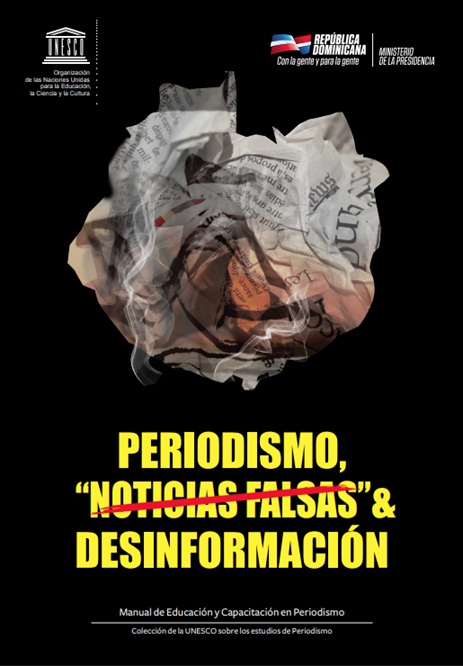 Periodismo, “Noticias Falsas” & Desinformación : Manual de Educación y Capacitación en Periodismo Año de publicación: 2020 Autor: Julie Posetti | Cherilyn Ireton | Claire Wardle | Hossein Derakhshan | Alice Matthews | Magda Abu-Fadil | Tom Trewinnard | Fergus Bell | Alexios Mantzarlis Autor corporativo: Organización de las Naciones Unidas para la Educación, la Ciencia y la Cultura (UNESCO) Esta guía tiene como objetivo proporcionar un plan de estudios modelo relevante a nivel internacional, abierto a la implementación y/o adaptación, que responda al problema global emergente de la desinformación que afrontan las sociedades en general y el periodismo en particular. Este plan de estudios modelo está diseñado para brindar a los educadores y formadores de periodistas un marco de referencia y lecciones, a fin de ayudar a estudiantes y profesionales del periodismo a lidiar con los problemas relativos a las “noticias falsas”.El texto reúne el aporte de los principales educadores, investigadores y pensadores internacionales del periodismo que están ayudando a actualizar el método y la práctica del periodismo para afrontar los desafíos de la desinformación y la información errónea. Las lecciones son contextuales, teóricas y, en el caso de la verificación en línea, extremadamente prácticas. Empleadas juntas como un curso, o de manera independiente, pueden ayudar a actualizar los módulos de enseñanza existentes o crear nuevas ofertas.La Guía forma parte de la “Iniciativa Mundial para la Excelencia en la Enseñanza del Periodismo”, elemento esencial del Programa Internacional para el Desarrollo de la Comunicación de la UNESCO (PIDC). La Iniciativa tiene como objetivo contribuir con la enseñanza, la práctica y la investigación del periodismo, desde una perspectiva global, incluyendo el intercambio de buenas prácticas internacionales.
  Journalisme, fake news & désinformation : Manuel pour l’enseignement et la formation en matière de journalisme Año de publicación: 2019 Autor: Julie Posetti | Cherilyn Ireton | Claire Wardle | Hossein Derakhshan | Alice Matthews | Magda Abu-Fadil | Tom Trewinnard | Fergus Bell | Alexios Mantzarlis Autor corporativo: Organisation des Nations Unies pour l'éducation, la science et la culture (UNESCO) Cette publication vise à fournir un modèle de programme applicable à l’échelle internationale, qui peut être adopté tel quel ou adapté, pour répondre au problème de la désinformation auquel sont confrontées toutes les sociétés en général, dans le monde, et le secteur du journalisme en particulier. Ce modèle de programme a été conçu pour fournir aux formateurs et aux enseignants en journalisme un cadre et une série de leçons, destinés aux étudiants et aux professionnels du journalisme, sur les questions associées aux « fake news ».Ce manuel a été rédigé avec la contribution de journalistes, enseignants, chercheurs et intellectuels internationaux de premier plan, engagés dans l’innovation des méthodes et des pratiques journalistiques face aux menaces de la mésinformation et de la désinformation. Ces leçons sont contextuelles, théoriques et, en ce qui concerne la vérification en ligne, extrêmement pratiques. Qu’elles soient utilisées dans le cadre d’un cours complet ou chacune séparément, elles peuvent contribuer à mettre à jour les modules d’enseignement existants ou à créer une nouvelle offre. Cette publication fait partie de l’« Initiative mondiale d’excellence pour l’enseignement du journalisme » qui est au centre du Programme international pour le développement de la communication (PIDC) de l’UNESCO. Cette initiative souhaite traiter l’enseignement, la pratique et la recherche en matière de journalisme dans une perspective mondiale, y compris par le partage de bonnes pratiques internationales.
 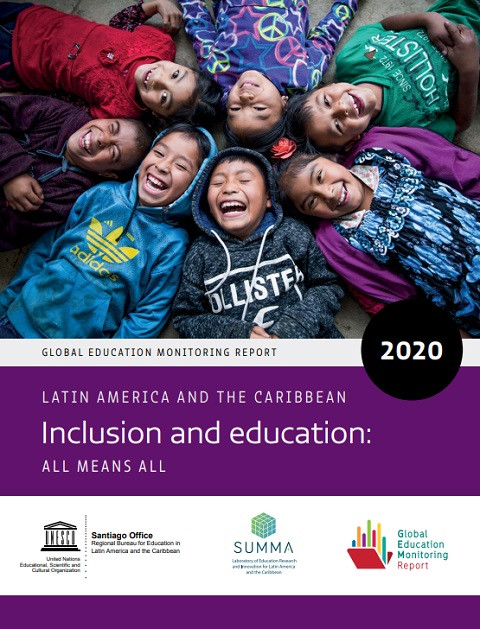 Latin America and the Caribbean 2020: Inclusion and Education; All Means All (Global Education Monitoring Report) Año de publicación: 2020 Autor corporativo: Global Education Monitoring Report Team | UNESCO | Laboratory of Education Research and Innovation for Latin America and the Caribbean (SUMMA) Latin America and the Caribbean has the largest and most challenging socio-economic inequalities in the world, which have shaped its education systems over the decades. This report looks at everyone both in and excluded from education in the region, pinpointing barriers facing learners, especially when multiple disadvantages intersect. The report also explores challenges in education posed by COVID-19 and the need for urgent action to prevent an exacerbation of inequalities. Produced by the Global Education Monitoring (GEM) Report team, in partnership with the UNESCO Regional Bureau for Education in Latin America and the Caribbean (OREALC) and the Laboratory of Education Research and Innovation for Latin America and the Caribbean (SUMMA), the report assesses key solutions for greater inclusion through several case studies from the region. It provides in-depth analysis on challenges to inclusion in education arising from migration and displacement in Colombia and Costa Rica; remoteness in Brazil and Suriname; disability in Cuba and Nicaragua; gender in Peru and Jamaica; sexual orientation, gender identity and expression in Chile and Mexico; poverty in the Dominican Republic and Honduras; ethnicity in Bolivia and Ecuador; and incarceration in El Salvador and Uruguay. Building on the 2020 Global Education Monitoring Report, this regional edition concludes that strong laws and policies in Latin America and the Caribbean demonstrate a commitment to inclusion, but that the daily realities faced by learners suggest implementation is lagging. Recommendations are aimed at promoting more inclusive education systems to benefit all children and youth, no matter their background, identity or ability. The recommendations provide a systematic framework for identifying and dismantling barriers for vulnerable populations, according to the principle that ‘every learner matters and matters equally’. América Latina y el Caribe 2020: Inclusión y educación; Todos y todas sin excepción (Informe de seguimiento de la educación en el mundo) Año de publicación: 2020 Autor corporativo: Global Education Monitoring Report Team | UNESCO | Laboratory of Education Research and Innovation for Latin America and the Caribbean (SUMMA) América Latina y el Caribe es la región con las mayores y más tenaces desigualdades socioeconómicas del mundo. Durante decenios estas desigualdades se han reflejado en sus sistemas educativos. El presente informe examina a quiénes incluyen y a quiénes excluyen estos sistemas y llama la atención sobre las barreras que enfrentan los educandos, especialmente cuando están expuestos a múltiples desventajas. El informe también explora los nuevos retos educativos que plantea la pandemia de la Covid-19 y la necesidad de actuar sin dilación para evitar que se agraven las desigualdades. El informe, elaborado por el equipo del Informe de Seguimiento de la Educación en el Mundo (Informe GEM), en colaboración con la Oficina Regional de Educación para América Latina y el Caribe (OREALC/ UNESCO Santiago) y el Laboratorio de Investigación e Innovación en Educación para América Latina y el Caribe -SUMMA, evalúa algunas de las principales iniciativas emprendidas para mejorar la inclusión, basándose en varios estudios de casos de la región. Analiza en profundidad algunos ejemplos de los grandes desafíos que amenazan la inclusión en la educación: migración y desplazamiento en Colombia y Costa Rica; aislamiento rural en el Brasil y Suriname; discapacidad en Cuba y Nicaragua; discriminación de género en el Perú y Jamaica; orientación sexual e identidad y expresión de género en Chile y México; pobreza en la República Dominicana y Honduras; etnicidad en Bolivia y el Ecuador; y jóvenes en situación de privación de libertad en El Salvador y el Uruguay. Esta edición regional del Informe de Seguimiento de la Educación en el Mundo 2020 concluye que, si bien las leyes y políticas de América Latina y el Caribe demuestran la firme determinación de promover la inclusión, la realidad cotidiana de los alumnos y las alumnas sugiere que la aplicación práctica lleva retraso. Se formulan recomendaciones con el objeto de promover sistemas de educación más inclusivos en beneficio de todos los niños, niñas y jóvenes, sin distinción de origen, identidad o capacidad. Las recomendaciones brindan un marco sistemático que permite identificar y eliminar barreras para las poblaciones marginadas, conforme al principio de que “cada alumno es importante y todos los alumnos importan por igual”.
  Education for Sustainable Development: A Roadmap Año de publicación: 2022 Autor corporativo: UNESCO This roadmap sets out the urgent challenges facing the planet and underlines the implementation of the new Education for Sustainable Development: Towards achieving the SDGs (ESD for 2030) framework, which was adopted with the aim of increasing the contribution of education to building a more just and sustainable world. ESD for 2030 will step up actions on five priority action areas on policy, education environments, building capacities of educators, youth and local level action, stressing further ESD’s key role for the successful achievement of the 17 SDGs and the great individual and societal transformation required to address the urgent sustainability challenges. The roadmap also underlines the key areas of implementation of the ESD for 2030 framework. ESD is widely recognized as an integral element of Agenda 2030, in particular Sustainable Development Goal 4 (SDG 4), and a key enabler of all the other SDGs. 지속가능발전교육(ESD): 로드맵 Año de publicación: 2022 Autor corporativo: 유네스코 보다 공정하고 지속가능한 세상을 만드는 데 교육의 기여를 증진시키고자 채택한 이 로드맵은 세계가 직면한 긴급한 도전 과제를 설명하고, 새로이 수립된 체계인 ‘지속가능발전교육: 지속가능발전목표 달성을 향해’(Education for Sustainable Development: Towards achieving the SDGs), 즉 지속가능발전교육 2030의 이행을 강조한다. 지속가능발전교육 2030은 정책, 교육환경, 교육자 역량 구축, 청년 및 지역사회 차원의 실천이라는 5가지 우선 실천 영역에서의 이행을 강화시킬 것이다. 이들 활동은 17개 SDGs의 성공적인 달성과 더불어, 시급한 지속가능성 관련 도전과제들에 대응하는 데 필요한 개인과 사회의 큰 변혁을 위해 교육이 보다 핵심적인 역할을 담당할 것을 강조한다. 또한 이 로드맵은 지속가능발전교육 2030 체계 이행에서의 핵심 영역들을 강조한다. ESD는 2030 의제, 특히 SDG 4번 목표의 핵심요소이자 여타 SDGs의 핵심 추동력으로서 광범위하게 인식되고 있다.