
Recursos
Exploren una amplia gama de recursos valiosos en GCED para profundizar su comprensión y promover su búsqueda, incidencia, enseñanza y aprendizaje.
2,790 resultados encontrados
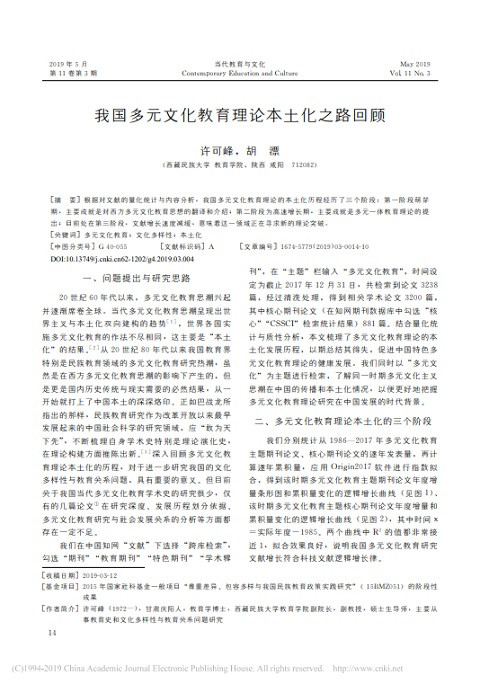 我国多元文化教育理论本土化之路回顾 Año de publicación: 2019 Autor: Xu Kefeng | Hupaio Autor corporativo: Contemporary Education and Culture 根据对文献的量化统计与内容分析,我国多元文化教育理论的本土化历程经历了三个阶段:第 一 阶 段 萌 芽 期,主要成就是对西方多元文化教育思想的翻译和介绍;第二阶段为高速增长期,主要成就是多元一体教育理论的提 出;目前处在第三阶段,文献增长速度减缓,意味着这一领域正在寻求新的理论突破。
  한국사회 인종차별을 말하다: 2018. 7. 20 ~ 21 인종차별 보고대회 자료집 Año de publicación: 2018 Autor corporativo: UN인종차별철폐협약 한국심의대응 시민사회 공동사무국 | 서울지방변호사회 2018년 7월 20일부터 21일까지 개최되었던 토론회 인종차별보고대회의 자료집으로 1966년 UN총회 결의로 선포된 인종차별철폐협약(The Committee on the Elimination of Racial Discrimination, CERD)과 관련하여 경과보고와 현재까지 남아 있는 한국사회 내의 인종차별의 원인과 현황을 다루고 있다. 1부 : 한국사회와 인종차별을 말하다 - 한국사회와 인종차별 역사와 배경2부 : 현실을 말하다 - 국가는 인종차별 강화에 어떻게 기여하고 있는가?3부 : 인종차별의 선긋기는 어디에서 교차되는가?4부 : 미래를 말하다 - 미래를 향한 제언
  Fostering national and global citizenship: an example from South Africa (Social Studies and the Young Learner, vol 21, no. 1, september/october 2008) Año de publicación: 2008 Autor: Omiunota Nelly Ukpokodu Autor corporativo: National Council for the Social Studies Multicultural and global scholars urge that we prepare the young for national and global democratic citizenship given the increasing interdependence and challenging realities for today. Young people desire to be a part of the solution to global problems, but they must be educated about what those problems are and how solutions can be arrived at. As has been seen in the U.S. presidential campaign, young people care about their communities, country, and planet, and they are volunteering and voting at record rates. We must take responsibility to plant the seeds of critical citizenship if we are to foster a more sustainable, peaceful, just, and prosperous world. Educator Sheldon Berman sums it up by writing: It is important for teachers to tell young people about the success stories of others, students who have reclaimed forests, cleaned up rivers, improved their school environment, helped the homeless. They need to hear about the Mother Teresas and the Martin Luther Kings, of course, but also about the people who live down the street who are doing what they can to improve the neighbourhood and about the many organizations that make a difference in our communities. We must put students in touch with these people and organizations so that they can see how deeply people care about their world and how worthwhile it is to participate in creating change.
 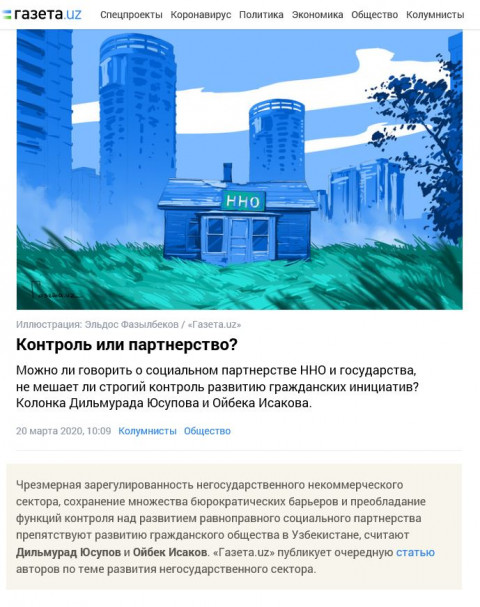 Контроль или партнерство? Año de publicación: 2020 Autor: Dilmurod Yusupov | Oybek Isakov Чрезмерная зарегулированность негосударственного некоммерческого сектора, сохранение множества бюрократических барьеров и преобладание функций контроля над развитием равноправного социального партнерства препятствуют развитию гражданского общества в Узбекистане, считают авторы статьи. Control or Partnership? Año de publicación: 2020 Autor: Dilmurod Yusupov | Oybek Isakov Excessive regulation of the non-governmental non-profit sector, the preservation of many bureaucratic barriers and the predominance of the functions of control over the development of equal social partnership hinder the development of civil society in Uzbekistan, the authors of the article say.
 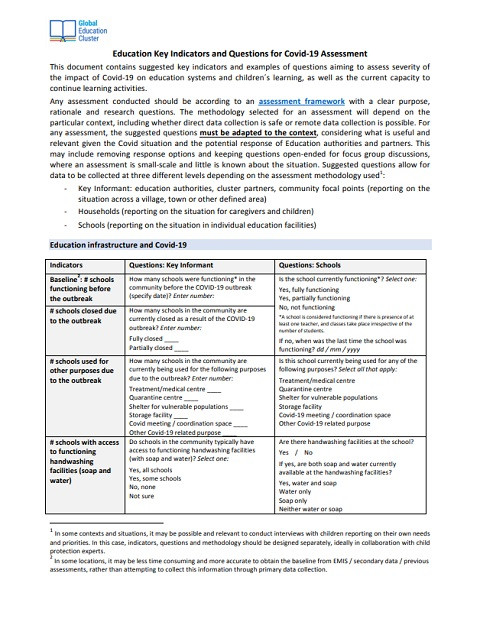 Education Key Indicators and Questions for Covid-19 Assessment Año de publicación: 2020 Autor corporativo: Global Education Cluster This document contains suggested key indicators and examples of questions aiming to acess severity of the impact of Covid-19 on education systems and children’s learning, as well as the current capacity to continue learning activities.
  Teaching Controversial Issues: A Guide for Teachers Año de publicación: 2018 Autor corporativo: Oxfam GB This revised and updated version of Oxfam’s popular guide recognises the changes in social and political contexts in recent years and seeks to support educators in their discussions with young people in this complex environment. In increasingly divisive and polarised times, the need for young people to feel confident in tackling controversial issues is more pressing than ever. Advances in technology and the rise of social media mean that it is more important than ever for young people to think critically to become effective global citizens.This guide explores:• What controversial issues are.• Reasons for teaching controversial issues.• The value of a global citizenship education approach.• Guidance and classroom strategies for handling and exploring controversial issues.• Some practical activities for teaching controversial issues.
  Global education in Lithuania: challenges and opportunities Año de publicación: 2014 Autor: Indrė Augutienė | Zina Baltrėnienė Autor corporativo: Lithuanian Development Education and Cooperation Network of Non-governmental Institutions (Association LITDEA) | Lithuanian National Non-Governmental Development Cooperation Organisations‘ Platform (NGDO Platform) The publication has been produced implementing the project ‘‘Quality Partnership for Development-EU Presidency project for the Lithuanian EU Presidency, 2013“ (no. DCINSA ED/2013/319-124). Today we live in a constantly changing world which is bound by the spirit of relations between people, countries and cultures and which presents various challenges and opportunities. Every day we have to solve numerous economic, social and environmental issues connecting us with other countries, their cultures and citizens and providing an opportunity for all of us to become part of a global society.In order to accept the opportunities provided by the globalisation processes and cope with the emerging challenges it is necessary to create the conditions for people to acquire the knowledge on global realities, emerging global development problems and to relate them with their own life. It is also important to provide the opportunities for people to acquire the skills and enhance own values facilitating active global citizenship and responsibility. Global problems increasingly impact on the lives of everybody throughout the world, therefore we must realise that we are part of the world with the still prevailing poverty, social inequality, climate change and global warming problems. In the current society it is especially important to ensure that different forms of education enhance people‘s understanding about the above challenges and their impact on personal, communal, national and global development.Global Education is directed toward formation and development of people‘s skills, knowledge and values facilitating understanding and response to the challenges of the 21st century. So far the concept of Global Education was not validated in any national documents. Today non-governmental organisations are actively discussing this issue with the academic society and with the Ministries of Foreign Affairs/and Education and Science representing the state in the above area. Besides, Lithuania has not developed a uniform Global Education strategy yet, but the dimension of Global Education is included in several specific national policy documents. In view of this, this article reviews the prerequisites for integration of global education set forth in the main legal acts defining Lithuania‘s sustainable development, development cooperation and education. This document provides a review of the Global Education concept, prerequisites for its implementation and description of the current situation in Lithuania. It also includes the proposals for a successful development of Global Education activities in our country. Éducation globalein Lithuania: challenges and opportunities Año de publicación: 2014 Autor: Indrė Augutienė | Zina Baltrėnienė Autor corporativo: Lithuanian Development Education and Cooperation Network of Non-governmental Institutions (Association LITDEA) | Lithuanian National Non-Governmental Development Cooperation Organisations‘ Platform (NGDO Platform) La publication a été réalisée la mise en œuvre du projet « Partenariat Qualité pour le projet de développement de l'UE Présidence de la présidence lituanienne de l'UE, 2013 »(no. DCINSA ED / 2013 / 319-124). Aujourd'hui, nous vivons dans un monde en constante évolution qui est lié par l'esprit des relations entre les peuples, les pays et les cultures, et qui présente divers défis et opportunités. Chaque jour, nous devons résoudre de nombreux problèmes économiques, sociaux et environnementaux qui nous relie avec d'autres pays, leurs cultures et leurs citoyens et de fournir une occasion pour nous tous de faire partie d'une société mondiale. Pour acept les possibilités offertes par les processus de mondialisation et faire face aux nouveaux défis, il est nécessaire de créer les conditions pour les gens à acquérir les connaissances sur les réalités mondiales, les problèmes de développement mondiaux émergents et à les relier à leur propre vie. Il est également important de fournir les possibilités pour les personnes à acquérir les compétences et de renforcer les valeurs propres à faciliter la citoyenneté mondiale active et la responsabilité. Les problèmes mondiaux de plus en plus d'impact sur la vie de tout le monde à travers le monde, nous devons donc réaliser que nous faisons partie du monde avec la pauvreté qui prévaut encore, les inégalités sociales, le changement climatique et les problèmes de réchauffement planétaire. Dans la société actuelle, il est particulièrement important de veiller à ce que les différentes formes d'éducation d'améliorer la compréhension des gens sur les défis ci-dessus et de leur impact sur le développement personnel, communautaire, national et mondial. Éducation globaleis dirigée vers la formation et le développement des compétences, les connaissances des personnes et des valeurs qui facilitent la compréhension et la réponse aux défis du 21e siècle. Jusqu'à présent, le concept de l'éducation globalewas pas validée dans les documents nationaux. Aujourd'hui, les organisations non-gouvernementales discutent activement de cette question avec la société académique et avec les Ministères des Affaires Étrangères / et de l'éducation et de la science représentant l'état dans la zone ci-dessus. Par ailleurs, la Lituanie n'a pas encore mis au point une formation globalestrategy uniforme, mais la dimension de l'éducation globaleis inclus dans plusieurs documents spécifiques de la politique nationale. Compte tenu de cela, cet article examine les conditions préalables à l'intégration de l'éducation globaleset énoncées dans les principaux actes juridiques définissant le développement durable, la coopération au développement et de l'éducation de la Lituanie. Ce document fournit un examen de la globaleconcept Éducation, conditions préalables à sa mise en œuvre et la description de la situation actuelle en Lituanie. Il comprend également les propositions pour un développement réussi d’activités mondiales de l'éducation dans notre pays.
  Rethinking Learning: A Review of Social and Emotional Learning for Education Systems Año de publicación: 2020 Autor: Nandini Chatterjee Singh | Anantha Duraiappah Autor corporativo: Mahatma Gandhi Institute of Education for Peace and Sustainable Development (MGIEP) This publication titled ‘Rethinking Learning: A Review of Social and Emotional Learning for Education Systems’, published by the UNESCO Mahatma Gandhi Institute of Education for Peace and Sustainable Development (MGIEP) reviews the latest research on Social and Emotional Learning (SEL), its impact on student health and school climate and its transformative role in building happier classrooms. It seeks to inform and impress upon Member States the urgent need to mainstream social and emotional learning in education systems.