
Recursos
Exploren una amplia gama de recursos valiosos en GCED para profundizar su comprensión y promover su búsqueda, incidencia, enseñanza y aprendizaje.
2,668 resultados encontrados
 La migración en la Agenda 2030: Guía para profesionales Año de publicación: 2018 Autor: Elisa Mosler Vidal Autor corporativo: International Organization for Migration (IOM) La presente guía va dirigida a los actores gubernamentales, tanto nacionales como locales, participantes en cualquier proceso de implementación de los ODS, incluidos aquellos que trabajan específicamente en la migración y aquellos que lo hacen en otros sectores interesados en integrar la migración. Asimismo, va dirigida a los actores gubernamentales que trabajan en el campo de la migración y que deseen integrar los ODS en su trabajo. El objetivo de esta guía es ayudar a los legisladores a implementar los aspectos de migración de los ODS. Los formuladores de políticas pueden utilizar esta guía para integrar la migración en la planificación del desarrollo local o nacional, diseñando e implementando intervenciones relacionadas con la migración en el contexto de los ODS. Estas intervenciones pueden tomar la forma de legislación, políticas, programas, proyectos u otras actividades, y pueden relacionarse con temas centrales de migración o integrar la migración en actividades en otro sector. Por ejemplo, los formuladores de políticas pueden usar esta guía para diseñar intervenciones que aborden directamente la trata de personas, así como intervenciones en el sector de la salud que ayuden a proteger a las víctimas de la trata. Para los actores con experiencia en la integración transversal de la migración de la migración, esta guía ofrece un nuevo enfoque basado en la Agenda 2030. Para quienes no tienen experiencia en dicha integración transversal de la migración, ofrece una introducción sobre cómo se vinculan la migración y el desarrollo en el contexto de los ODS, y cómo actuar en torno a estas conexiones.
  Plan de Educación para la Ciudadanía Global 2019 Año de publicación: 2019 Autor corporativo: UNRWA España El presente Plan de Educación para la Ciudadanía Global para el año 2019 responde a la necesidad de marcar unas líneas de trabajo en este campo por parte de UNRWA España durante este año que guíen su intervención; recojan aprendizajes y potencien el valor añadido adquirido por la organización en este tiempo; se adapten a los cambios de contexto a nivel global, nacional y local; y que sigan contribuyendo construir una ciudadanía global solidaria, comprometida, corresponsable, protagonista y activa con los derechos humanos, el desarrollo sostenible y la justicia social desde la misión-visión de UNRWA España.
  Indigenous Peoples Glossary Año de publicación: 2018 Autor corporativo: International Fund for Agricultural Development (IFAD) The purpose of this glossary is to ensure consistency and accuracy of terminology in English, French and Spanish, and standardize the terminology used in relation to indigenous peoples in official documentation and publications, and in all aspects of meeting preparations. It is intended for use by IFAD staff, indigenous peoples' organizations and other interested parties. Terms and definitions are accompanied by details of the source document and its date of publication.
  Human Rights Stories: Tales of Human Rights Defenders for Primary Schools Año de publicación: 2012 Autor: Claire Glavey | Fiona O’Shea | Valeria Navarro Autor corporativo: Amnesty International Ireland | Irish Aid This resource pack has been developed by Amnesty International Ireland in consultation with an advisory and piloting group of primary school teachers. The concept for the resource pack originated with primary school teachers who identified storytelling as a powerful medium through which a range of concepts and topics can be introduced in the classroom. Human rights issues can appear daunting, distant and theoretical. Through the familiar medium of storytelling, human rights situations can be explored on a level at which children can encounter the real life impact of human rights in practice. Engaging with stories through discussion, creative thinking and character exploration develops the skill of empathy. This brings about the realisation that human rights belong to everyone and that we all have a role to play in ensuring that human rights are protected locally and globally.
 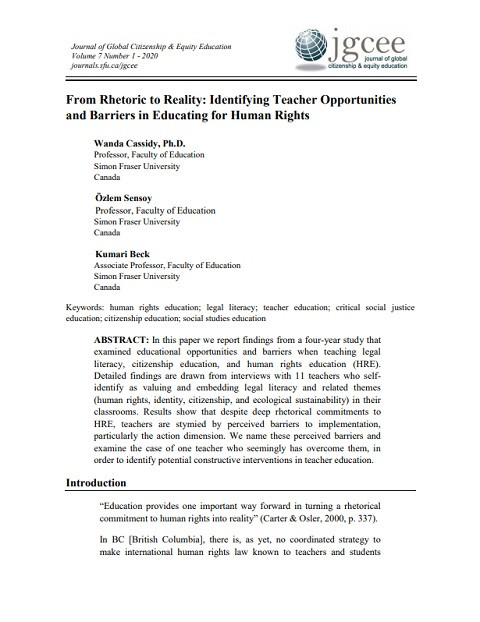 From Rhetoric to Reality: Identifying Teacher Opportunities and Barriers in Educating for Human Rights (Journal of Global Citizenship & Equity Education; Vol. 7, No. 1) Año de publicación: 2020 Autor: Wanda Cassidy | Özlem Sensoy | Kumari Beck Autor corporativo: Centennial College In this paper we report findings from a four-year study into legal literacy that examined educational opportunities and barriers when teaching about legal literacy, citizenship education, and human rights education. Detailed findings are drawn from interviews with eleven teachers who self-identify as valuing and embedding legal literacy and related themes (human rights, identity, citizenship, and ecological sustainability) in their classrooms. Results show that despite deep rhetorical commitments to human rights education, teachers are stymied by perceived barriers to implementing HRE, particularly the action dimension. We name these perceived barriers and examine the case of one of the teachers who seemingly has overcome them, in order to identify potential constructive interventions in teacher education. Glosario sobre los pueblos indígenas Año de publicación: 2018 Autor corporativo: International Fund for Agricultural Development (IFAD) La finalidad de este glosario es asegurar la coherencia y la exactitud de la terminología en español, francés e inglés, así como normalizar la terminología en materia de pueblos indígenas que se emplea en la documentación y las publicaciones oficiales, y en todos los aspectos relativos a la preparación de reuniones. Sus destinatarios son el personal del FIDA, las organizaciones de pueblos indígenas y otras partes interesadas. Los términos y las definiciones van acompañados de información sobre el documento de origen y su fecha de publicación. Glossaire sur les peuples autochtones Año de publicación: 2018 Autor corporativo: International Fund for Agricultural Development (IFAD) Le but de ce glossaire est de garantir la cohérence et la précision de la terminologie relative aux peuples autochtones, et ce en anglais, en espagnol et en français, et d’uniformiser cette terminologie dans les documents officiels ainsi que dans tout ce qui a trait à l’organisation de réunions. Il a été établi à l’intention du personnel du FIDA, des organisations des peuples autochtones et d’autres parties concernées. À côté de chaque terme, on trouvera le document source et sa date de publication.
 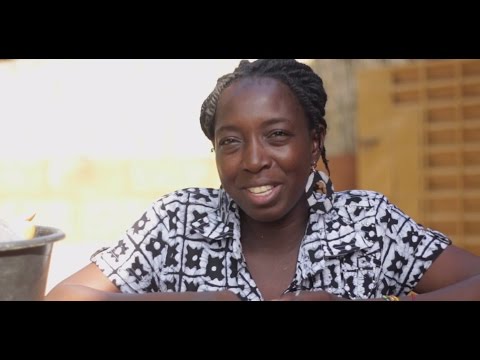 L'émancipation des femmes Año de publicación: 2015 Autor corporativo: Îles de Paix Iles de Paix mène au Bénin un programme dédié aux femmes. Il concerne le développement de leurs activités rémunératrices, mais aussi des formations en gestion, au crédit, à l’épargne et des sensibilisations pour une amélioration de leur position dans la société. Ce programme ambitieux, qui concernera directement, sur trois ans, plus de 600 femmes, engendre de profonds bouleversements et, pour bien de ses bénéficiaires, des changements majeurs dans leur vie quotidienne. En témoigne cette femme, qui y a participé. « Au début, quand je voulais suivre une formation pour mener une activité, mon mari me battait pour m’en empêcher. Il me disait que ma place était à la maison.Mais aujourd’hui, il constate que, grâce à cette formation et aux choses que j’ai apprises, je gagne beaucoup mieux ma vie. Alors, il m’encourage à continuer et… il me supplie de lui donner de l’argent ! »Il reste à souhaiter que tous ses gains ne finissent pas dans l’escarcelle de son mari et qu’ils servent avant tout à répondre à ses besoins personnels et à ceux de ses enfants.
  Tackling Controversial Issues in the Citizenship Classroom: A Resource for Citizenship Education Año de publicación: 2012 Autor: Lesley Emerson | Mary Gannon | Conor Harrison | Valerie Lewis | Anne-Marie Poynor Autor corporativo: City of Dublin Vocational Education Committee (CDVEC). Curriculum Development Unit | European Union (EU) The purpose of this resource is to provide teachers with the opportunity to reflect on a number of issues associated with teaching controversial issues in the classroom. It offers a practical approach which allows students to explore controversial issues which arise in citizenship and other areas of the curriculum in a way which is safe for both teacher and students.
  Equality & Diversity: Building a Culture of Equality in Our Society; A Citizenship Education Resource for Transition Year and Key Stage 4 Año de publicación: 2012 Autor: Mary Gannon | Aoife Ruane-Kelly Autor corporativo: City of Dublin Vocational Education Committee (CDVEC). Curriculum Development Unit | Centre for Cross Border Studies This resource is intended to support young people in critically exploring the concepts of equality and diversity and in acting to build a culture of equality within their own environment and within society. Looking specifically at equality and diversity within the school, community and society, the resource provides an opportunity for students to increase their knowledge and understanding of equality, develop the skills to critically analyse inequality, and become empowered to actively promote equality within their school and/or community.The resource is intended primarily for use in Citizenship Education in Transition Year (Ireland) and Key Stage 4 (Northern Ireland). As a resource on equality and diversity, it is clearly based on human rights, which underpin the citizenship curricula in both jurisdictions. It meets the aims of the KS 4 curriculum for Local and Global Citizenship by helping students:Respond to the specific challenges and opportunities which diversity and inclusion present in Northern Ireland and the wider worldIdentify and exercise their rights and social responsibilities in relation to local, national and global issuesDevelop their understanding of the role of society and government in safeguarding individual and collective rights in order to promote equality and to ensure that everyone is treated fairlyDevelop their understanding of how to participate in a range of democratic processesDevelop awareness of key democratic institutions and their role in promoting inclusion, justice and democracy.