
Recursos
Exploren una amplia gama de recursos valiosos en GCED para profundizar su comprensión y promover su búsqueda, incidencia, enseñanza y aprendizaje.
3,385 resultados encontrados
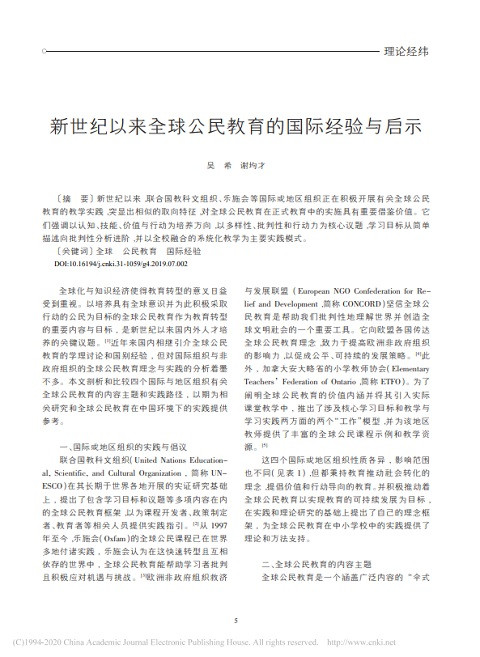 新世纪以来全球公民教育的国际经验与启示 (上海教育科研) Año de publicación: 2019 Autor: Wuxi | Thomas Tse Autor corporativo: Shanghai Educational Research 新世纪以来,联合国教科文组织、乐施会等国际或地区组织正在积极开展有关全球公民 教育的教学实践,突显出相似的取向特征,对全球公民教育在正式教育中的实施具有重要借鉴价值。它 们强调以认知、技能、价值与行动为培养方向,以多样性、批判性和行动力为核心议题,学习目标从简单 描述向批判性分析进阶,并以全校融合的系统化教学为主要实践模式。
 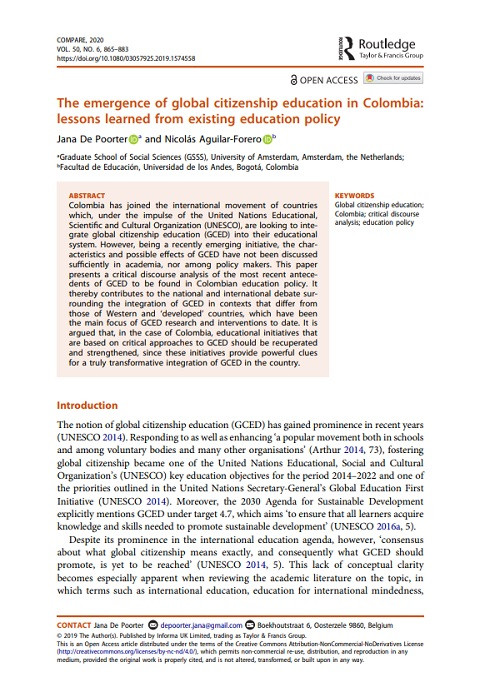 The Emergence of Global Citizenship Education in Colombia: Lessons Learned From Existing Education Policy (Compare: A Journal of Comparative and International Education; Vol. 50, No. 6) Año de publicación: 2019 Autor: Jana De Poorter | Nicolás Aguilar-Forero Autor corporativo: Taylor & Francis Colombia has joined the international movement of countries which, under the impulse of the United Nations Educational, Scientific and Cultural Organization (UNESCO), are looking to integrate global citizenship education (GCED) into their educational system. However, being a recently emerging initiative, the characteristics and possible effects of GCED have not been discussed sufficiently in academia, nor among policy makers. This paper presents a critical discourse analysis of the most recent antecedents of GCED to be found in Colombian education policy. It thereby contributes to the national and international debate surrounding the integration of GCED in contexts that differ from those of Western and ‘developed’ countries, which have been the main focus of GCED research and interventions to date. It is argued that, in the case of Colombia, educational initiatives that are based on critical approaches to GCED should be recuperated and strengthened, since these initiatives provide powerful clues for a truly transformative integration of GCED in the country.
 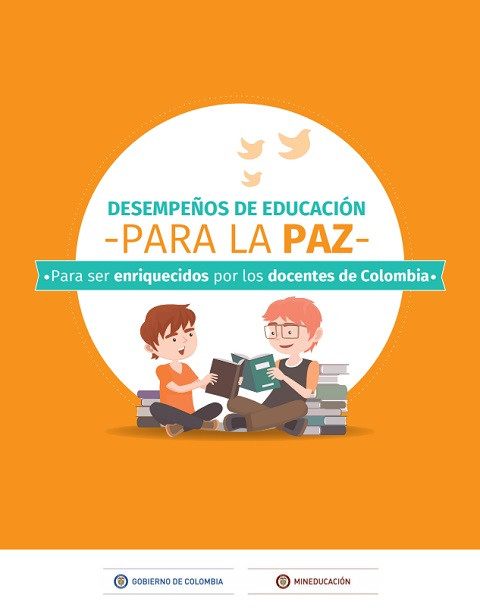 Peace Education Performances Año de publicación: 2016 Autor: Enrique Chaux | José Fernando Mejía | Juanita Lleras | David Guáqueta | Andrea Bustamante | Gloria Inés Rodríguez | Paula Andrea Pineda | Alexander Ruiz-Silva | Carolina Valencia | Charlotte Greniez | Daniel García | Sara Victoria Alvarado | Ana María Velásquez Autor corporativo: Colombia. Ministerio de Educación Nacional This document presents a proposal for Peace Education performances for grades k to 11th. This proposal seeks to be an illustration of a curricular design consistent with the Guidelines for the Implementation of the Peace Law.
 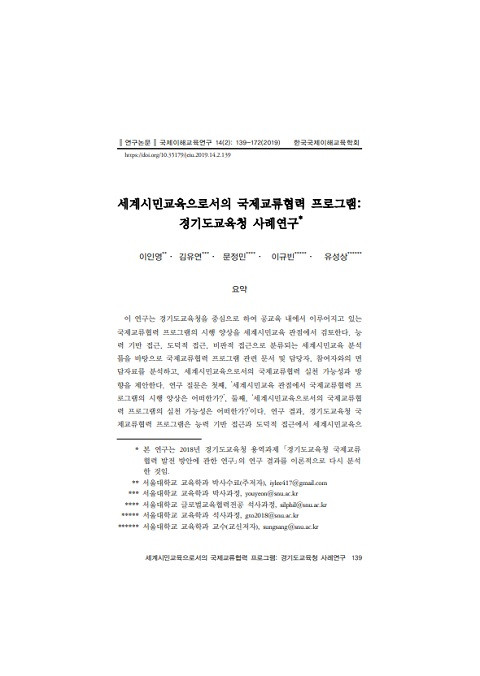 International Exchange and Cooperation Programs as Global Citizenship Education: A Case Study of the Gyeonggi Provincial Office of Education (Journal of Education for International Understanding; Vol. 14, No. 2) Año de publicación: 2019 Autor: Inyoung Lee | Youyeon Kim | Jeongmin Moon | Kyubin Lee | Sungsang Yoo Autor corporativo: Korean Society of Education for International Understanding (KOSEIU) This study examines the implementation of international exchange programs conducted within public education, focusing on the Gyeonggi Provincial Office of Education from the standpoint of global citizenship education. It also proposes the feasibility and direction of international exchange programs based on the analytical framework that analyses the global citizenship education as the competency-based approach, moral approach, and critical approach. The research questions are: first, 'what is the aspects of the implementation of international exchange programs in terms of global citizenship education?' and second, 'what is the possibility of implementing international exchange programs as global citizenship education?' To find the answer to the questions, documents related to the international exchange program and data from interviews with the person in charge and the participants of programs were analyzed. This paper found that there is a feasibility for implementing the competency-based approach and moral approach in the international exchange programs. However, in order to invigorate international exchange as the practice of global citizenship education, it is recommended that: first, international exchange from the viewpoint of critical approach should be developed. Second, every student should have the opportunity to participate in the programs regardless of their economic status. Lastly, target nations for international exchange should be chosen not only from the competency-based approach but from the various perspective of global citizenship education. 세계시민교육으로서의 국제교류협력 프로그램: 경기도교육청 사례연구 (국제이해교육연구; Vol. 14, No. 2) Año de publicación: 2019 Autor: 이인영 | 김유연 | 문정민 | 이규빈 | 유성상 Autor corporativo: 한국국제이해교육학회 이 연구는 경기도교육청을 중심으로 하여 공교육 내에서 이루어지고 있는 국제교류협력 프로그램의 시행 양상을 세계시민교육 관점에서 검토한다. 능력 기반 접근, 도덕적 접근, 비판적 접근으로 분류되는 세계시민교육 분석틀을 바탕으로 국제교류협력 프로그램 관련 문서 및 담당자, 참여자와의 면담자료를 분석하고, 세계시민교육으로서의 국제교류협력 실천 가능성과 방향을 제안한다. 연구 질문은 첫째, ‘세계시민교육 관점에서 국제교류협력 프로그램의 시행 양상은 어떠한가?’, 둘째, ‘세계시민교육으로서의 국제교류협력 프로그램의 실천 가능성은 어떠한가?’이다. 연구 결과, 경기도교육청 국제교류협력 프로그램은 능력 기반 접근과 도덕적 접근에서 세계시민교육으로서의 실천 가능성을 보였다. 그러나 향후 세계시민교육의 실천으로서 국제교류협력을 활성화하기 위해서는 다음과 같은 개선방안을 제안한다. 첫째, 비판적 접근에서의 세계시민교육에 기반한 국제교류협력을 강화해야 한다. 둘째, 국제교류협력에 가정의 경제적 배경과 관심에 상관없이 모든 학생이 참여할 수 있도록 운영되어야 한다. 셋째, 능력 기반 접근에 한정되지 않고 다양한 관점에서 세계시민교육에 접근하여 교류 대상 국가를 선정할 필요가 있다.
 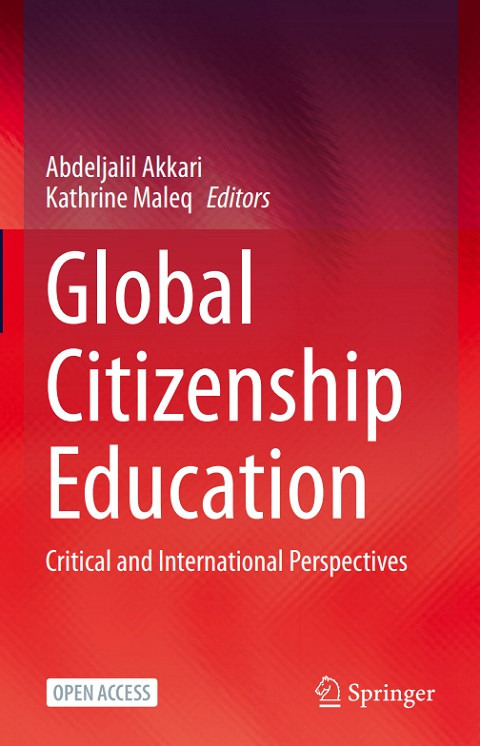 Global Citizenship Education: Critical and International Perspectives Año de publicación: 2020 Autor: Abdeljalil Akkari | Kathrine Maleq Autor corporativo: Springer Nature | Swiss National Science Foundation This open access book takes a critical and international perspective to the mainstreaming of the Global Citizenship Concept and analyses the key issues regarding global citizenship education across the world. In that respect, it addresses a pressing need to provide further conceptual input and to open global citizenship agendas to diversity and indigeneity.Social and political changes brought by globalisation, migration and technological advances of the 21st century have generated a rise in the popularity of the utopian and philosophical idea of global citizenship. In response to the challenges of today’s globalised and interconnected world, such as inequality, human rights violations and poverty, global citizenship education has been invoked as a means of preparing youth for an inclusive and sustainable world.In recent years, the development of global citizenship education and the building of students’ global citizenship competencies have become a focal point in global agendas for education, international educational assessments and international organisations. However, the concept of global citizenship education still remains highly contested and subject to multiple interpretations, and its operationalisation in national educational policies proves to be challenging.This volume aims to contribute to the debate, question the relevancy of global citizenship education’s policy objectives and to enhance understanding of local perspectives, ideologies, conceptions and issues related to citizenship education on a local, national and global level. To this end, the book provides a comprehensive and geographically based overview of the challenges citizenship education faces in a rapidly changing global world through the lens of diversity and inclusiveness. Desempeños de educación para la paz Año de publicación: 2016 Autor: Enrique Chaux | José Fernando Mejía | Juanita Lleras | David Guáqueta | Andrea Bustamante | Gloria Inés Rodríguez | Paula Andrea Pineda | Alexander Ruiz-Silva | Carolina Valencia | Charlotte Greniez | Daniel García | Sara Victoria Alvarado | Ana María Velásquez Autor corporativo: Colombia. Ministerio de Educación Nacional Este documento presenta una propuesta de desempeños de Educación para la Paz para los grados transición a 11º. Esta propuesta busca servir de ilustración de cómo podría ser un diseño curricular consistente con las Orientaciones para la Implementación de la Cátedra de la Paz.
 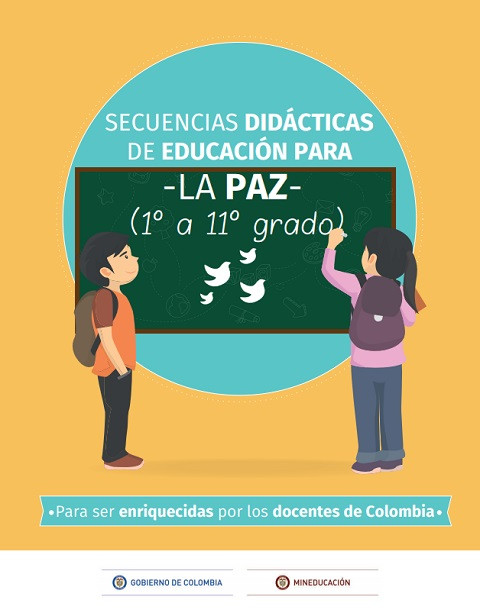 Didactic Sequences of Education for Peace Año de publicación: 2016 Autor: Enrique Chaux | José Fernando Mejía | Juanita Lleras | David Guáqueta | Andrea Bustamante | Gloria Inés Rodríguez | Paula Andrea Pineda | Alexander Ruiz-Silva | Carolina Valencia | Charlotte Greniez | Daniel García | Sara Victoria Alvarado | Ana María Velásquez Autor corporativo: Colombia. Ministerio de Educación Nacional This document proposes examples of didactic sequences of Peace Education for all grades from 1st to 11th. A didactic sequence can be understood as the detailed description of a series of articulated lesson organized in a coherent way. The proposed sequences include between 4 and 7 class sessions of approximately 50 minutes each. They seek to be consistent with the General Guidelines for the Implementation of the Peace Law and with the Proposed Performances. Secuencias didácticas de educación para la paz Año de publicación: 2016 Autor: Enrique Chaux | José Fernando Mejía | Juanita Lleras | David Guáqueta | Andrea Bustamante | Gloria Inés Rodríguez | Paula Andrea Pineda | Alexander Ruiz-Silva | Carolina Valencia | Charlotte Greniez | Daniel García | Sara Victoria Alvarado | Ana María Velásquez Autor corporativo: Colombia. Ministerio de Educación Nacional En este documento se proponen ejemplos de secuencias didácticas de Educación para la Paz para cada uno de los grados desde 1º hasta 11º. Una secuencia didáctica puede comprenderse como la descripción detallada de una serie de planeaciones de clases articuladas de una manera coherente. Las secuencias propuestas incluyen entre 4 y 7 sesiones de clase de aproximadamente 50 minutos cada una. Buscan ser consistentes con las Orientaciones Generales para la Implementación de la Cátedra de la Paz y con la Propuesta de Desempeños de Educación para la Paz.
  What Does Peace Sound Like? Education for Coexistence Año de publicación: 2015 Autor: María Del Carmen Muñoz | Marco Fidel Vargas Autor corporativo: Center for Research and Popular Education / Program for Peace (CINEP/PPP) This podcast discusses education for peace in Colombia and how it contributes to overcoming violence and promoting coexistence.