
Recursos
Exploren una amplia gama de recursos valiosos en GCED para profundizar su comprensión y promover su búsqueda, incidencia, enseñanza y aprendizaje.
2,668 resultados encontrados
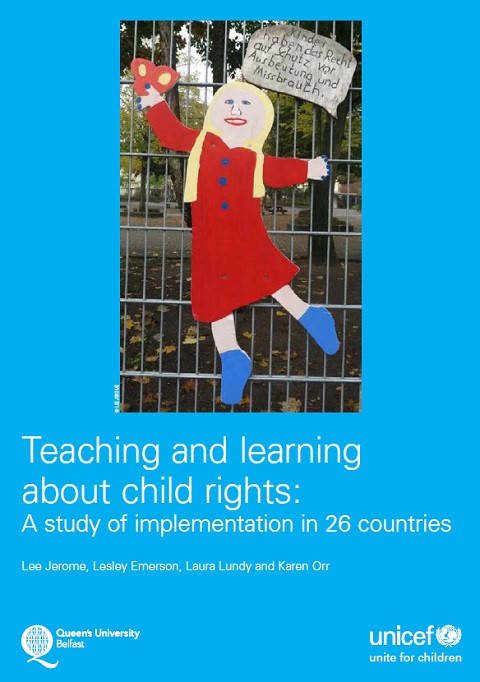 Teaching and Learning about Child Rights: A Study of Implementation in 26 Countries Año de publicación: 2015 Autor: Lee Jerome | Lesley Emerson | Laura Lundy | Karen Orr Autor corporativo: Queen’s University Belfast | United Nations Children's Fund (UNICEF) This research contributes to the global debate on child rights education (CRE). It explores implementation of CRE in early childhood education, primary and secondary schools in 26 countries with a UNICEF National Committee presence. It includes a literature review, results from an on-line survey completed by national experts, seven country case studies and a series of benchmarking statements for CRE implementation.
  Well-Being and Safety of Women: OSCE-Led Survey on Violence Against Women Año de publicación: 2019 Autor corporativo: Organization for Security and Co-operation in Europe (OSCE) This report presents the cross-regional, comparable findings of the OSCE-led Survey on the Well-being and Safety of Women, which was implemented in 2018 in Albania, Bosnia and Herzegovina, Montenegro, North Macedonia and Serbia, Moldova3 and Ukraine. The research was also conducted in Kosovo.The OSCE-led survey included a quantitative and qualitative component and was undertaken with the goal of providing comparable data on different forms of violence women experience in their childhood and throughout the course of their lives. The research examined violence that women experience in conflict and non-conflict settings, as well as the impact violence has on women, including its lasting consequences. Questions on norms and attitudes connected to violence against women were asked to better understand the underlying causes of violence.The area covered by this research is diverse and has different historical, social and economic contexts. Rather than focusing on the findings from particular locations, the report aims to provide an overview of women’s experiences and to highlight the issues – often similar – that persist and continue to hamper the well-being and safety of women throughout the area covered by the research.
 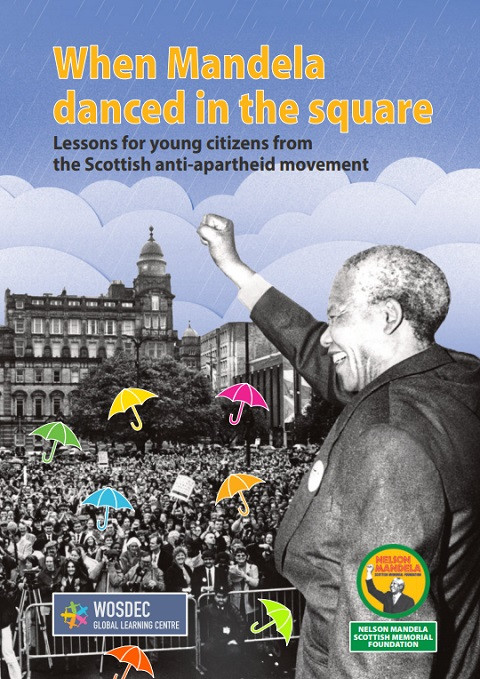 When Mandela Danced in the Square: Lessons for Young Citizens from the Scottish Anti-Apartheid Movement Año de publicación: 2020 Autor corporativo: West of Scotland Development Education Centre (WOSDEC) | Nelson Mandela Scottish Memorial Foundation This resource aims to understand the context of apartheid South Africa, the life of Nelson Mandela and the connections to the Scottish anti-apartheid movement. The activities in this resource support second and third level learners within Scotland's Curriculum for Excellence to explore Scotland’s connection with Nelson Mandela and feel empowered to take action on issues of importance to them today.
 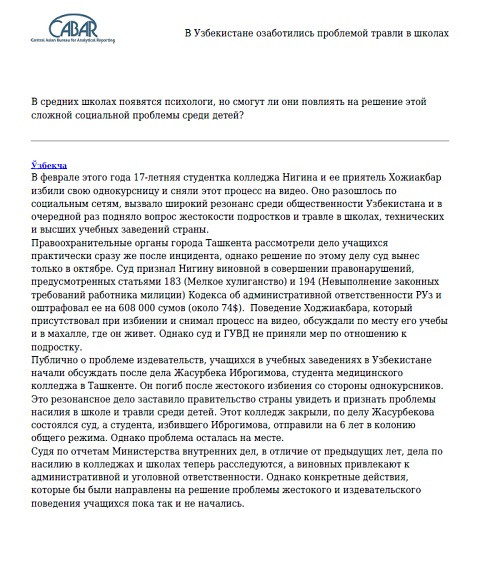 Uzbekistan Expresses Concerns about School Bullying Año de publicación: 2018 Autor: Дарина Солод Autor corporativo: Central Asian Bureau for Analytical Reporting (CABAR) Psychologists will appear in secondary schools in Uzbekistan. The author asks if they will be able to influence the solution of this complex social problem among children. В Узбекистане озаботились проблемой травли в школах Año de publicación: 2018 Autor: Дарина Солод Autor corporativo: Central Asian Bureau for Analytical Reporting (CABAR) В средних школах в Узбекистане появятся психологи. Автор задается вопросом, смогут ли они повлиять на решение этой сложной социальной проблемы среди детей.
 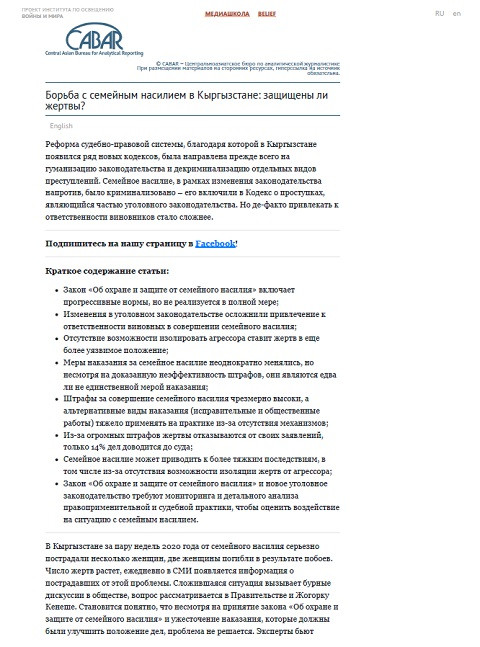 Combating Domestic Violence in Kyrgyzstan: Are Victims Protected? Año de publicación: 2020 Autor: Анна Зубенко Autor corporativo: Central Asian Bureau for Analytical Reporting (CABAR) The reform of the judicial system, thanks to which a number of new codes appeared in Kyrgyzstan, was aimed primarily at the humanization of legislation and the decriminalization of certain types of crimes. Domestic violence, in the framework of changing the legislation, on the contrary, was criminalized - it was included in the Code of Misconduct, which is part of the criminal law. But the de facto prosecution of perpetrators has become more difficult.
 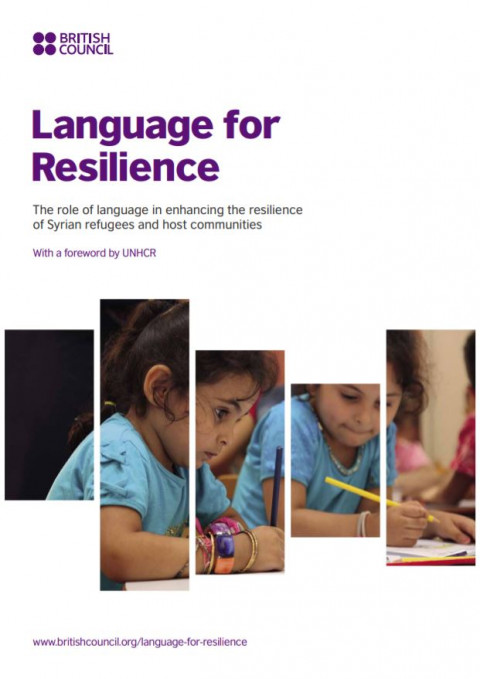 اللغة لتعزيز القدرة على مواجهة الأزمات: فهم الدور الذي تؤديه اللغة في تعزيز قدرة اللاجئين السوريين والمجتمعات المستضيفة لهم على مواجهة الأزمات Año de publicación: 2018 Autor: Tony Capstick | Marie Delaney Autor corporativo: British Council | UN. Office of the United Nations High Commissioner for Refugees (UNHCR) يستند التقرير الى دروس مستفادة من برامج اللغة الانجليزية التي يقدمها المجلس الثقافي البريطاني، ويستخدم كمرجع في تطوير البرامج المستقبلية الخاصة بتعليم اللغات للمتأثرين بالأزمة السورية. Language for Resilience: The Role of Language in Enhancing the Resilience of Syrian Refugees and Host Communities Año de publicación: 2018 Autor: Tony Capstick | Marie Delaney Autor corporativo: British Council | UN. Office of the United Nations High Commissioner for Refugees (UNHCR) The Language for Resilience report examines the impact of language on refugees and host communities affected by the Syrian crisis, identifying the different ways that language skills enhance resilience and providing suggestions for programme responses that address key needs.The report shows that for children and young people attending schools or post-school education, and for educators in host communities handling influxes of refugee students, quality language learning improves attainment and attendance and builds safer and more inclusive classrooms. It also illustrates how creative approaches to language education can support the development of life skills and help meet psycho-social needs.
  Global Rights, Nobel Goals: Refugees, Migration, the Sustainable Development Goals and Youth; Resource Pack Año de publicación: 2016 Autor: Valerie Duffy | Leo Gilmartin | Grace McManus | Dermot O’Brien Autor corporativo: National Youth Council of Ireland (NYCI) This resource pack explores the terms around migration (asylum seeker, refugee, internally displace peoples etc), the reasons that people choose or are forced to migrate and makes connections with the SDGs. It also includes a great selection of activities for young people at different ages and stages.
  한국사회 인종차별을 말하다: 2018. 7. 20 ~ 21 인종차별 보고대회 자료집 Año de publicación: 2018 Autor corporativo: UN인종차별철폐협약 한국심의대응 시민사회 공동사무국 | 서울지방변호사회 2018년 7월 20일부터 21일까지 개최되었던 토론회 인종차별보고대회의 자료집으로 1966년 UN총회 결의로 선포된 인종차별철폐협약(The Committee on the Elimination of Racial Discrimination, CERD)과 관련하여 경과보고와 현재까지 남아 있는 한국사회 내의 인종차별의 원인과 현황을 다루고 있다. 1부 : 한국사회와 인종차별을 말하다 - 한국사회와 인종차별 역사와 배경2부 : 현실을 말하다 - 국가는 인종차별 강화에 어떻게 기여하고 있는가?3부 : 인종차별의 선긋기는 어디에서 교차되는가?4부 : 미래를 말하다 - 미래를 향한 제언