
Recursos
Exploren una amplia gama de recursos valiosos en GCED para profundizar su comprensión y promover su búsqueda, incidencia, enseñanza y aprendizaje.
2,199 resultados encontrados
 Human rights education in the school systems of Europe, Central Asia and North America: a compendium of good practice Año de publicación: 2009 Autor corporativo: Council of Europe | UNESCO | UN. Office of the United Nations High Commissioner for Human Rights (UN. OHCHR) | OSCE. Office for Democratic Institutions and Human Rights (ODIHR) “Human Rights Education in the School Systems of Europe, Central Asia and North America: A Compendium of Good Practice” is a compilation of 101 examples of good practice in human rights education in primary schools, secondary schools and teacher training institutions in the Organization for Security and Co-operation in Europe (OSCE) area, which is also covered by the United Nations Educational, Scientific and Cultural Organization (UNESCO), the Office of the United Nations High Commissioner for Human Rights (OHCHR) and, partially, the geographical mandate of the Council of Europe (CoE).The term “human rights education” is often used in this resource in a broader sense, to also include educationfor democratic citizenship and education for mutual respect and understanding, which are all based on internationally agreed human rights standards. These three areas are seen as interconnected and essential within educational systems in order to prepare youth to be active, responsible and caring participants in their communities, as well as at the national and global levels.Human rights education has been defined as education, training and information aimed at building a universal culture of human rights. A comprehensive education in human rights not only provides knowledge about human rights and the mechanisms that protect them, but also imparts the skills needed to promote, defend and apply human rights in daily life. Education for democratic citizenship focuses on educational practices and activities designed to help young people and adults to play an active part in democratic life and exercise their rights and responsibilities in society. Education for mutual respect and understanding highlights self-respect, respect for others, and the improvement of relationships between people of differing cultural traditions.This book aims to support quality teaching in these areas and to inspire educational policymakers (those working in education ministries and local school boards) and administrators, teachers, teacher trainers, non-formal educators and all other interested actors, as well as to facilitate networking and the exchange of experience among education professionals.
  MTB-MLE: mother tongue-based multilingual education; lessons learned from a decade of research and practice Año de publicación: 2014 Autor corporativo: UNESCO What role can language play in improving education for minority language communities? What are language rights? What place does Mother Tongue-Based Multilingual Education have in realizing other development goals?These important questions were addressed by the 4th International Conference on Language and Education. The conference brought together over 300 practitioners from 30 countries, reflecting the incredible diversity of the Asia-Pacific region and clearly demonstrating the importance of Mother Tongue-Based Multilingual Education (MTB-MLE). This brochure summarizes some of the key messages from this landmark event. MTB-MLE: langue maternelle basée sur l'éducation multilingue; les enseignements tirés d'une décennie de recherche et de pratique Año de publicación: 2014 Autor corporativo: Organisation des Nations Unies pour l'éducation, la science et la culture (UNESCO) Quel rôle la langue peut jouer dans l'amélioration de l'éducation pour les communautés de langue minoritaire? Quels sont les droits linguistiques? Quelle est la place langue maternelle basée sur l'éducation multilingue ont dans la réalisation d'autres objectifs de développement?Ces questions importantes ont été abordées par la 4e Conférence internationale sur la langue et de l'éducation. La conférence a réuni plus de 300 praticiens de 30 pays, ce qui reflète l'incroyable diversité de la région Asie-Pacifique et démontre clairement l'importance de la langue maternelle basée sur l'éducation multilingue (MTB-MLE). Cette brochure résume les principaux messages de cet événement historique. Joint E-9 Statement on Education Beyond 2015: Islamabad Statement Año de publicación: 2014 Autor corporativo: UNESCO This statement is adopted by the participants of the 10th E-9 Ministerial Review Meeting held in Islamabad, Pakistan, on November 27-28, 2014. They have taken stock of the progress made since 2000 and challenges remaining in the nine countries in achieving the six Education for All (EFA) goals, and reflected on the priorities and prospects for each country to sustain and further advance educational development beyond 2015. Their deliberations were based on a careful examination of the National EFA 2015 Reviews of the countries concerned, the Muscat Agreement adopted at the Global Education for All Meeting (Muscat, Oman, 12-14 May 2014), the Outcome Document of the United Nations General Assembly Open Working Group on Sustainable Development Goals, and took into account the Aichi-Nagoya Declaration on Education for Sustainable Development as well as the changing global environment that shapes the cooperation among the E-9 countries. Joint E-9 Déclaration sur l'éducation Au-delà de 2015: Déclaration Islamabad Año de publicación: 2014 Autor corporativo: Organisation des Nations Unies pour l'éducation, la science et la culture (UNESCO) Cette déclaration est adoptée par les participants de la 10e E-9 Réunion Ministérielle tenue à Islamabad, au Pakistan, le 27-28 Novembre 2014. Ils ont fait le point sur les progrès réalisés depuis 2000 et des défis restant dans les neuf pays dans la réalisation des six éducation pour tous (EPT), et réfléchi sur les priorités et les perspectives de chaque pays pour soutenir et faire progresser le développement de l'éducation au-delà de 2015. Leurs délibérations se sont fondées sur un examen attentif des nationaux EPT 2015 Avis sur les pays concernés, le Muscat Accord adopté à l'éducation globale pour tous Réunion (Muscat, Oman, 12-14 mai 2014), le document final du groupe de travail à composition Assemblée Générale des Nations Unies sur les objectifs de développement durable, et a pris en compte la Déclaration d'Aichi-Nagoya sur l'éducation pour développement durable, ainsi que l'évolution du contexte mondial qui façonne la coopération entre les pays E-9.
  Informe de las Naciones Unidas sobre el desarrollo de los recursos hídricos en el mundo 2016: agua y empleo Año de publicación: 2016 Autor corporativo: Organización de las Naciones Unidas para la Educación, la Ciencia y la Cultura (UNESCO) Three out of four jobs worldwide rely on water. As such, water shortages and lack of access may limit economic growth in the years to come, according to the World Water Development Report 2016. From its collection, through various uses, to its ultimate return to the natural environment, water is a key factor in the development of job opportunities either directly related to its management (supply, infrastructure, wastewater treatment, etc.) or in economic sectors that are heavily water-dependent such as agriculture, fishing, power, industry and health. In its analysis of the economic impact of access to water, the report cites numerous studies that show a positive correlation between investments in the water sector and economic growth. It also highlights the key role of water in the transition to a green economy.
 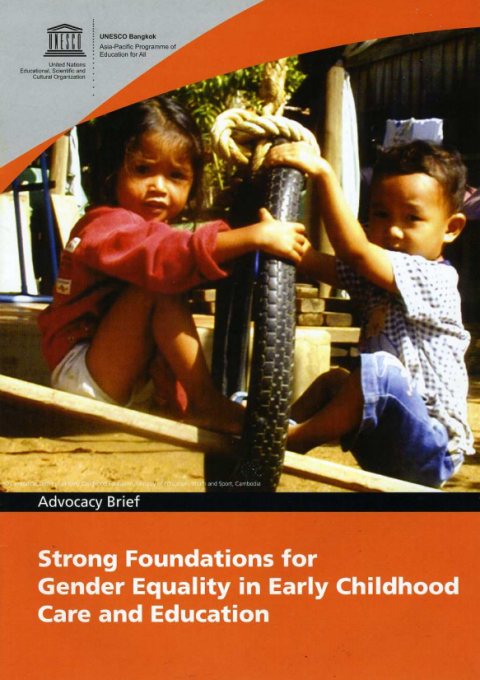 Strong foundations for gender equality in early childhood care and education: advocacy brief Año de publicación: 2007 Autor corporativo: UNESCO The term Early Childhood Care and Education (ECCE) refers to services for children from birth to eight years of age. These include educating parents in how to care for their children and help them learn, as well as providing community-run and formal preschool programmes for pre-primary school-aged boys and girls. Given the varying needs of children from birth to eight years, educators have found it best to have different policies and strategies for children below and above three years of age. This brief focuses on the gender issues in the services provided for children who are three years of age or older in the Asia-Pacific region. Its scope is informed by UNESCO's commitment to holistic pre-primary services for this age group. The goal is to provide early childhood education that helps girls and boys succeed in primary school and in learning throughout their lives. The brief starts by looking into the growth of ECCE in the Asia-Pacific region and what is driving this growth. It explores why gender responsiveness is important in early childhood education, gives practical examples of what this looks like, and discusses the challenges of providing ECCE that equally values and benefits each girl and each boy. Flowing from this, the brief concludes with recommendations on how to make ECCE more gender responsive De solides fondations pour l'égalité des sexes dans les soins de la petite enfance et de l'éducation: le plaidoyer bref Año de publicación: 2007 Autor corporativo: Organisation des Nations Unies pour l'éducation, la science et la culture (UNESCO) Le terme de l’éducation et la protection de la petite enfance (EPPE) fait référence aux services pour les enfants de la naissance à huit ans. Ceux-ci incluent l'éducation des parents dans la façon de prendre soin de leurs enfants et de les aider à apprendre, ainsi que de fournir des programmes formels préscolaires gérés par la communauté et pour les garçons et les filles d'âge scolaire pré-primaire. Compte tenu des divers besoins des enfants de la naissance à huit ans, les éducateurs ont trouvé préférable d'avoir des politiques et des stratégies pour les enfants de moins et de plus de trois ans. Ce bref se concentre sur les questions de genre dans les services fournis aux enfants qui sont de trois ans ou plus dans la région Asie-Pacifique. Son champ d'application est informé par l'engagement de l'UNESCO aux services pré-primaires holistiques pour ce groupe d'âge. L'objectif est de fournir une éducation de la petite enfance qui aide les filles et les garçons à réussir à l'école primaire et dans l'apprentissage tout au long de leur vie. Les brèves commence par la recherche dans la croissance de l'EPPE dans la région Asie-Pacifique et ce qui est le moteur de cette croissance. Il explore pourquoi le genre de réaction est important dans l'éducation de la petite enfance, donne des exemples concrets de ce que cela ressemble, et examine les défis de fournir EPPE que de façon égale les valeurs et les avantages de chaque fille et chaque garçon. Découlant de cela, le mémoire se termine par des recommandations sur la façon de rendre sensible EPPE plus le sexe. Recorridos nacionales rumbo a la educación para el desarrollo sostenible, 2011: análisis de las experiencias de los países Chile, Indonesia, Kenya, Omán, Países Bajos Año de publicación: 2011 Autor: I. Mulà | Daniella Tilbury Autor corporativo: Organización de las Naciones Unidas para la Educación, la Ciencia y la Cultura (UNESCO) This publication has sourced information from a series of national reviews commissioned by UNESCO in 2010 and written by authoritative stakeholders in Chile, Indonesia, Kenya, the Netherlands and Oman. The selection of countries was based on: i) work showcased at the 2009 World Conference on Education for Sustainable Development held in Bonn, Germany; ii) submissions to the monitoring and evaluation process for the Decade of Education for Sustainable Development (DESD); as well as iii) through evaluation material submitted by UNESCO staff in regional bureaux of education. The countries showcased in this report are not necessarily the ‘best’ examples of the region, as many other countries are also progressing effectively towards implementing ESD. Rather, the countries selected illustrate the wide diversity of ESD approaches and initiatives taking place in different parts of the learnt world. The national studies were then edited and harmonized before common themes and lessons learned were identified to support other national efforts in moving towards the second half of the UN Decade of Education for Sustainable Development. Des pays en marche vers l'éducation pour le développement durable, 2011: examen des expériences nationales; Chili, Indonésie, Kenya, Oman, Pays-Bas Año de publicación: 2011 Autor: I. Mulà | Daniella Tilbury Autor corporativo: Organisation des Nations Unies pour l'éducation, la science et la culture (UNESCO) This publication has sourced information from a series of national reviews commissioned by UNESCO in 2010 and written by authoritative stakeholders in Chile, Indonesia, Kenya, the Netherlands and Oman. The selection of countries was based on: i) work showcased at the 2009 World Conference on Education for Sustainable Development held in Bonn, Germany; ii) submissions to the monitoring and evaluation process for the Decade of Education for Sustainable Development (DESD); as well as iii) through evaluation material submitted by UNESCO staff in regional bureaux of education. The countries showcased in this report are not necessarily the ‘best’ examples of the region, as many other countries are also progressing effectively towards implementing ESD. Rather, the countries selected illustrate the wide diversity of ESD approaches and initiatives taking place in different parts of the learnt world. The national studies were then edited and harmonized before common themes and lessons learned were identified to support other national efforts in moving towards the second half of the UN Decade of Education for Sustainable Development.