
Recursos
Exploren una amplia gama de recursos valiosos en GCED para profundizar su comprensión y promover su búsqueda, incidencia, enseñanza y aprendizaje.
2,668 resultados encontrados
 Turning Promises into Action: Gender Equality in the 2030 Agenda for Sustainable Development Año de publicación: 2018 Autor corporativo: United Nations Entity for Gender Equality and the Empowerment of Women (UN Women) “Turning promises into action: Gender equality in the 2030 Agenda for Sustainable Development” provides a comprehensive and authoritative assessment of progress, gaps and challenges in the implementation of the Sustainable Development Goals (SDGs) from a gender perspective. This report monitors global and regional trends in achieving the SDGs for women and girls based on available data, and provides practical guidance for the implementation of gender-responsive policies and accountability processes. As a source of high-quality data and policy analysis, the report is a key reference and accountability tool for policymakers, women’s organizations, the UN system, and other stakeholders. Traduire les promesses en actions : L’égalité des sexes dans le Programme de développement durable à l’horizon 2030 Año de publicación: 2018 Autor corporativo: United Nations Entity for Gender Equality and the Empowerment of Women (UN Women) « Traduire les promesses en actions : l’égalité des sexes dans le Programme de développement durable à l’horizon 2030 » offre une évaluation exhaustive et fiable des progrès, des manquements et des difficultés dans la mise en œuvre des Objectifs de développement durable (ODD) dans une perspective de genre. Ce rapport analyse, sur la base des données disponibles, les grandes tendances mondiales et régionales dans la réalisation des ODD pour les femmes et les filles, et offre des conseils pratiques pour la mise en œuvre de politiques et de processus de responsabilisation sensibles au genre. En tant que source de données et d’analyse des politiques de grande qualité, le rapport constitue une référence et un outil de responsabilisation clé pour les décideurs politiques, les organisations de femmes, le système des Nations Unies, et d’autres parties prenantes. Hacer las promesas realidad: La igualdad de género en la agenda 2030 para el desarrollo sostenible Año de publicación: 2018 Autor corporativo: United Nations Entity for Gender Equality and the Empowerment of Women (UN Women) “Hacer las promesas realidad: La igualdad de género en la Agenda 2030 para el Desarrollo Sostenible” presenta una evaluación exhaustiva y fidedigna de los avances, dificultades y posibilidades de la aplicación de los Objetivos de Desarrollo Sostenible (ODS) desde una perspectiva de género. El informe hace seguimiento de las tendencias mundiales y regionales con miras a la consecución de los ODS para las mujeres y las niñas sobre la base de los datos disponibles, y ofrece orientación práctica para la ejecución de políticas sensibles al género y los consiguientes procesos de rendición de cuentas. Como fuente de análisis de alta calidad de datos y políticas, el informe es una referencia e instrumento de rendición de cuentas esencial para responsables de la formulación de políticas, organizaciones de mujeres, el sistema de las Naciones Unidas y otras partes interesadas.
  Violence Against Women and Girls: Kyrgyz Republic (Gender in Society Perception Study; Oct. 2018) Año de publicación: 2018 Autor: Elena Kim Autor corporativo: United Nations Entity for Gender Equality and the Empowerment of Women (UN Women) This report is part of the Gender in the Perception of Society (GSPS) study, funded by the UN Peacebuilding Fund, jointly run by UN Women, UNFPA and IOM in the Kyrgyz Republic. The report on the results of the study is dedicated to the topic of violence against women through the prism of two types of widespread practice of forced marriage in the Kyrgyz Republic. The report, which consists of two main sections, focuses on the practice of abducting brides and child marriages. The report attempts to explain the attitude and reaction of society to both phenomena, which deprive women of their rights and opportunities and require changes in opinions, attitudes and institutional priorities. Насилие в отношении женщин и девочек: Кыргызская Республика (Исследование – Гендер в восприятии общества; Октябрь 2018) Año de publicación: 2018 Autor: Elena Kim Autor corporativo: United Nations Entity for Gender Equality and the Empowerment of Women (UN Women) Данный оттчет является частью исследования "Гендер в восприятии общества" (GSPS), финансируемого Фондом ООН по миростроительству, совместно выполняемого ООН-Женщины, ЮНФПА и МОМ в Кыргызской Республики. Отчет по результатам исследования посвящен теме насилия в отношении женщин через призму двух видов широкораспространенной практики насильственных браков в Кыргызской Республике. Состоящий из двух основных разделов отчет сфокусирован на практике похищения невест и детских браков. В отчете предпринимается попытка объяснить отношение и реакцию общества на оба явления, которые лишают женщин их прав и возможностей и требуют изменений в суждениях, отношении и институциональных приоритетах.
 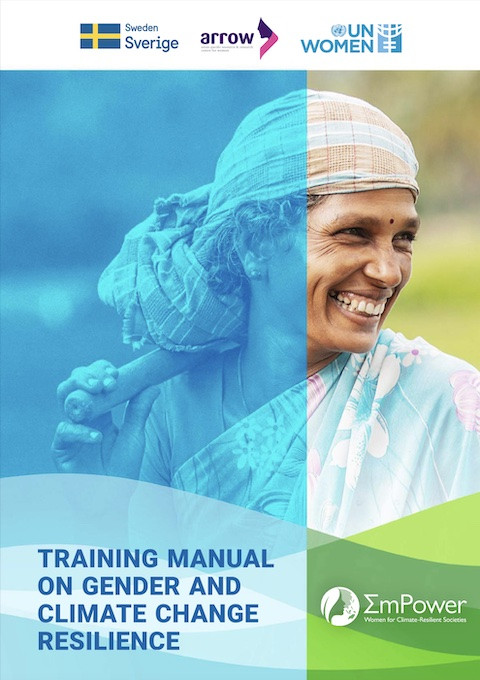 Training Manual on Gender and Climate Change Resilience Año de publicación: 2021 Autor: Dharmistha Chauhan Autor corporativo: Asian-Pacific Resource & Research Centre for Women (ARROW) | United Nations Entity for Gender Equality and the Empowerment of Women (UN Women) This Training Manual on Gender and Climate Change Resilience is designed for use by Civil Society Organizations (CSOs) in Asia working with communities on gender, climate change resilience and disaster risk reduction. The manual aims to strengthen the capacities of CSOs to mainstream gender in their practices and to actively advocate for gender mainstreaming in policies, programmes, projects and legislation. The long-term objective is to promote climate resilience action on the ground with a gender equality perspective in the forefront.
  Practical Legal Guide for Women in Algeria Año de publicación: 2023 Autor: Fériel Khelil | Saadia Gacem Autor corporativo: Fondation Friedrich-Ebert This practical legal guide, in Arabic and French, enables women in Algeria to find out about their rights, the laws that protect them, but also the legislative inequalities they will encounter in their life course, through tools for practical understanding of the laws. It was produced by Feriel Khelil, jurist with the Réseau Wassila/Avife association, and Saadia Gacem, doctoral student in anthropology and feminist activist, and supported by the Friedrich Ebert Foundation. Guide juridique pratique à l'usage des femmes en Algérie Año de publicación: 2023 Autor: Fériel Khelil | Saadia Gacem Autor corporativo: Fondation Friedrich-Ebert Ce guide juridique pratique, en arabe et en français, permet aux femmes en Algérie de connaître leurs droits, les lois qui les protègent mais également les inégalités législatives qu’elles rencontreront dans leur parcours de vie, à travers des outils de compréhension pratique des lois. Il a été réalisé par Feriel Khelil, juriste au sein de l’association Réseau Wassila/Avife et Saadia Gacem, doctorante en anthropologie et militante féministe et soutenu par la Fondation Friedrich Ebert.
  Gender and Recovery Toolkit: Advancing Gender Equality and Women’s Empowerment in Crisis and Recovery Settings; Updated 2024 Año de publicación: 2024 Autor corporativo: United Nations Development Programme (UNDP) The Gender and Recovery toolkit is a practical resource in the hands of UNDP personnel to help government, civil society and other partners put gender equality at the core of immediate and long-term recovery processes. It shows how to incorporate gender perspectives and women’s participation throughout the recovery programme cycle – from assessment, strategic planning and framing of results to budgeting and implementation, and monitoring and evaluation.The toolkit emphasizes the need to address the root causes of gender inequality and fragility by transforming power dynamics. It advocates for approaches that go beyond increasing women’s representation, focusing on tackling masculinities and reshaping institutions, behaviors, and norms. It underscores the importance of holistic strategies to address the interconnected challenges of climate change, peacebuilding, and gender equality in crisis contexts, highlighting the role of technology and innovative programming in empowering women. The seven guidance notes and tip sheets incorporate recent updates to global policy frameworks with updated indicators and robust data sources. While primarily designed for UNDP practitioners, this resource is valuable for all partners in crisis and recovery settings.
 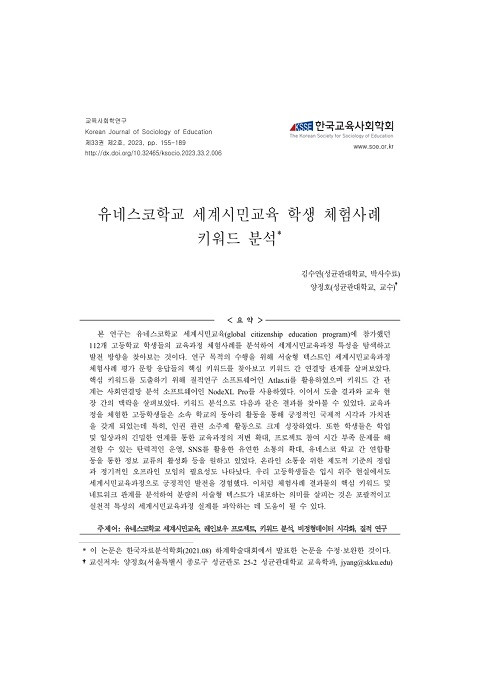 유네스코학교 세계시민교육 학생 체험사례 키워드 분석 (교육사회학연구; Vol. 33, No. 2) Año de publicación: 2023 Autor: 김수연 | 양정호 Autor corporativo: 한국교육사회학회 본 연구는 유네스코학교 세계시민교육(global citizenship education program)에 참가했던 112개 고등학교 학생들의 교육과정 체험사례를 분석하여 세계시민교육과정 특성을 탐색하고 발전 방향을 찾아보는 것이다. 연구 목적의 수행을 위해 서술형 텍스트인 세계시민교육과정 체험사례 평가 문항 응답들의 핵심 키워드를 찾아보고 키워드 간 연결망 관계를 살펴보았다. 핵심 키워드를 도출하기 위해 질적연구 소프트웨어인 Atlas.ti를 활용하였으며 키워드 간 관계는 사회연결망 분석 소프트웨어인 NodeXL Pro를 사용하였다. 이어서 도출 결과와 교육 현장 간의 맥락을 살펴보았다. 키워드 분석으로 다음과 같은 결과를 찾아볼 수 있었다. 교육과정을 체험한 고등학생들은 소속 학교의 동아리 활동을 통해 긍정적인 국제적 시각과 가치관을 갖게 되었는데 특히, 인권 관련 소주제 활동으로 크게 성장하였다. 또한 학생들은 학업 및 일상과의 긴밀한 연계를 통한 교육과정의 저변 확대, 프로젝트 참여 시간 부족 문제를 해결할 수 있는 탄력적인 운영, SNS를 활용한 유연한 소통의 확대, 유네스코 학교 간 연합활동을 통한 정보 교류의 활성화 등을 원하고 있었다. 온라인 소통을 위한 제도적 기준의 정립과 정기적인 오프라인 모임의 필요성도 나타났다. 우리 고등학생들은 입시 위주 현실에서도 세계시민교육과정으로 긍정적인 발전을 경험했다. 이처럼 체험사례 결과물의 핵심 키워드 및 네트워크 관계를 분석하여 분량의 서술형 텍스트가 내포하는 의미를 살피는 것은 포괄적이고 실천적 특성의 세계시민교육과정 실제를 파악하는 데 도움이 될 수 있다.