
Recursos
Exploren una amplia gama de recursos valiosos en GCED para profundizar su comprensión y promover su búsqueda, incidencia, enseñanza y aprendizaje.
518 resultados encontrados
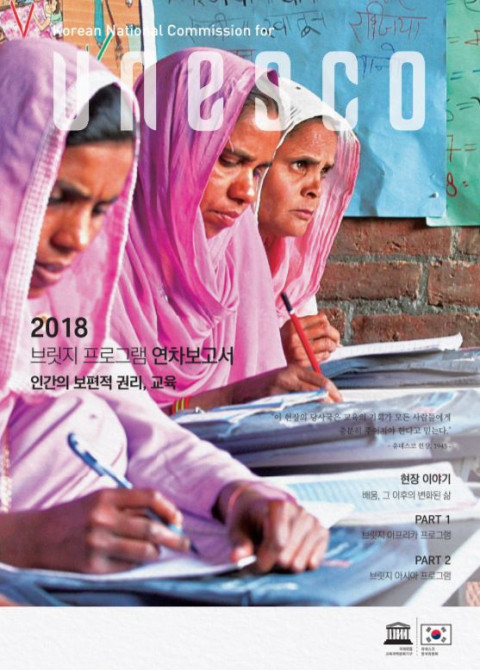 2018-2019 브릿지 프로그램 연차보고서 Año de publicación: 2019 Autor corporativo: 유네스코한국위원회 국제사회는 지속가능발전목표 4번(SDG4)를 통해 2030년까지 모든 이들에게 포용적이고 공평한 양질의 교육을 보장하고, 평생학습의 기회가 증진되도록 노력하자는 교육 기치를 내세웠다.특히 SDG4는 아동의 초등교육 강화에 중심을 둔 '새천년개발목표' 2번(MDG2)과 모든 연령대의 기초교육에 초점을 둔 '모두를위한교육'(EFA)의 미완의 목표를 포괄함은 물론, 기초교육 이후의 교육(중등, 고등) 및 훈련(직업,기술)을 평생학습 차원에서 촉진함으로써 교육의 보편성을 강조하고 있다. 유네스코한국위원회의 브릿지 사업은 이러한 국제사회의 노력에 동참하며, 교육의 보편적 기본권이 확산될 수 있도록 돕기 위해, 전 세계적으로 교육 소외자가 집중되어 있는 사하라 이남 아프리카 지역과 남아시아 지역의 모든 연련대 교육 소외자들을 대상으로 교육권 강화에 이바지하고 있다. 브릿지 사업은 나이, 성별, 종교 그리고 사회적 배경으로 인해 공교육으로부터 배제된 이들이 교육을 받음으로써 자존감을 회복하고 삶의 질을 향상시킬 수 있게 도우며, 이러한 개인의 성장만이 궁극적으로 지역사회의 변화와 발전으로 이어진다는 확신을 갖고 있다.이 보고서에서는 브릿지 아프리카 프로그램, 브릿지 아시아 프로그램과 국별 프로젝트 및 성과를 확인할 수 있다.
 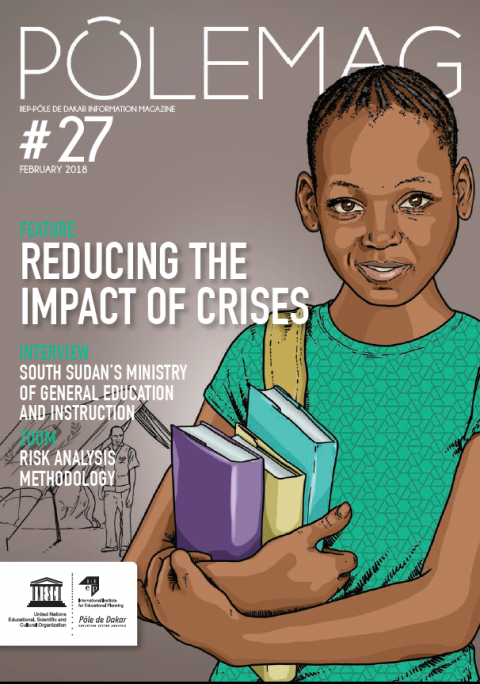 PôleMag n° 27: IIEP Pôle de Dakar information magazine, February 2018 Año de publicación: 2018 Autor corporativo: UNESCO IIEP Regional Office for Africa Strengthening the resilience of education systems through planning that is adapted for crisis situations is a priority for IIEP. Together with our main partners, the institute has developed strategic orientations and tools dedicated to educational planning that is adapted to crisis situations. Based on our experience on this theme in Africa, we are also working with UNICEF to develop a new methodology to analyse risks and vulnerabilities. Mitigating the impact of crises calls for strengthening relationships with partners. Planning adapted to vulnerabilities should facilitate dialogue between development and humanitarian actors so that intervention plans are coordinated and aligned with government priorities. A dollar invested in risk reduction could save up to seven dollars in rebuilding costs. Taking the risks into account in the analysis and planning of education systems is therefore a wise investment. PôleMag: la lettre d'information du Pôle de Dakar Año de publicación: 2018 Autor corporativo: UNESCO IIEP Regional Office for Africa Crise politique, crise sanitaire, crise climatique, les systèmes éducatifs sont rarement suffisamment préparés à faire face aux situations d’urgence.Et si la fréquence des menaces est inconnue, les effets sont généralement dévastateurs pour l’école, conduisant à une rupture des apprentissages, voire à l’abandon scolaire pur et simple. Dans le monde, 75 millions d’enfants vivant dans un pays affecté par une crise ont besoin d’un soutien éducatif1.Comment faire face aux crises ? Comment améliorer les capacités des systèmes à réduire leurs impacts ? Renforcer la résilience des systèmes éducatifs par une planification adaptée aux situations de crise est une priorité de l’IIPE. Notre institut a développé, avec ses principaux partenaires, des orientations stratégiques et des outils dédiés à la planification de l’éducation adaptés aux situations de crises. Forts de notre expérience sur cette thématique en Afrique, nous travaillons également en collaboration avec l’UNICEF au développement d’une nouvelle méthodologie dédiée à l’analyse des risques et vulnérabilités.Atténuer l’impact des crises appelle à renforcer les relations avec les partenaires. Une planification adaptée aux vulnérabilités doit faciliter le dialogue entre les acteurs du développement et ceux de l’humanitaire afin que les plans d’interventions soient coordonnés et alignés sur les priorités gouvernementales des plans sectoriels. Un dollar investi dans la réduction des risques pourrait épargner jusqu’à 7 dollars en coût de reconstruction. Prendre en compte les risques dans l’analyse et la planification des systèmes éducatifs est donc un investissement judicieux.
 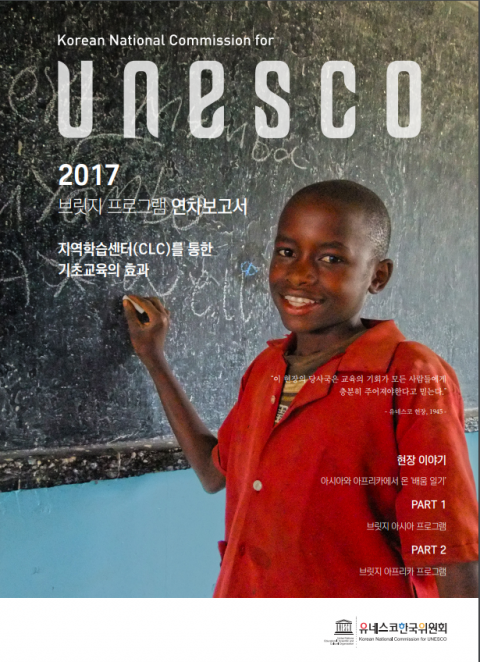 2017-18 브릿지 프로그램 연차보고서 Año de publicación: 2018 Autor corporativo: 유네스코한국위원회 브릿지 프로그램은 유네스코한국위원회가 교육부의 지원과 후원 모금을 통해 남아시아 지역과 사하라 이남 아프리카 지역에 거주하는 비문해자를 포함한 교육소외계층을 대상으로 교육의 기회를 제공하는 사업이다. 이 보고서는 2017년도부터 2018년도 상반기까지 유네스코한국위원회가 아시아 6개국과 아프리카 6개국에서 각국의 정부기관, 시민사회단체 및 유네스코국가위원회 등과 협력하여 추진한 사업들의 세부 활동과 성과를 보여준다. 아울러, 브릿지 프로그램을 통해 삶의 변화를 맞이한 사람들의 이야기도 확인할 수 있다.
 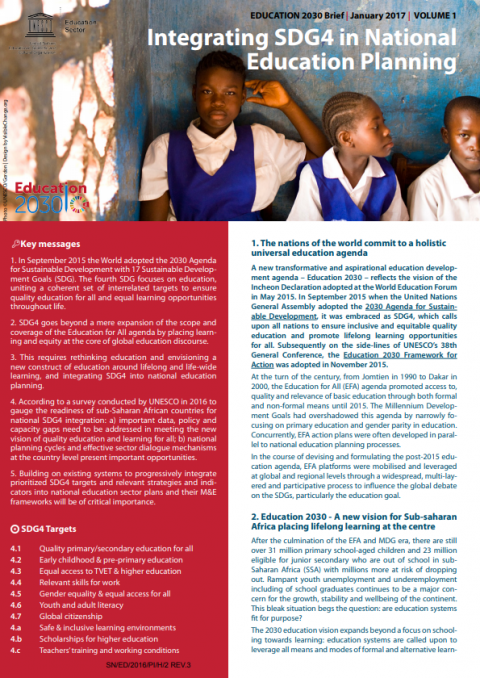 Online programme and meeting document Integrating SDG4 in National Education Planning Año de publicación: 2016 Autor: Neyestani-Hailu, Lily Autor corporativo: UNESCO Dakar Key messages1. In September 2015 the World adopted the 2030 Agenda for Sustainable Development with 17 Sustainable Develop-ment Goals (SDG). The fourth SDG focuses on education, uniting a coherent set of interrelated targets to ensure quality education for all and equal learning opportunities throughout life. 2. SDG4 goes beyond a mere expansion of the scope and coverage of the Education for All agenda by placing learn-ing and equity at the core of global education discourse. 3. This requires rethinking education and envisioning a new construct of education around lifelong and life-wide learning, and integrating SDG4 into national education planning. 4. According to a survey conducted by UNESCO in 2016 to gauge the readiness of sub-Saharan African countries for national SDG4 integration: a) important data, policy and capacity gaps need to be addressed in meeting the new vision of quality education and learning for all; b) national planning cycles and effective sector dialogue mechanisms at the country level present important opportunities. 5. Building on existing systems to progressively integrate prioritized SDG4 targets and relevant strategies and indi-cators into national education sector plans and their M&E frameworks will be of critical importance. Intégration de l'ODD4 dans la planification nationale de l'éducation Año de publicación: 2016 Autor: Neyestani-Hailu, Lily Autor corporativo: UNESCO Dakar Messages clés 1. En septembre 2015, le monde a adopté le Programme de développement durable à l’horizon 2030 et ses 17 objectifs de développement durable (ODD). Le quatrième ODD, relatif à l’éducation, regroupe un ensemble cohérent de cibles inter-dépendantes pour assurer une éducation de qualité pour tous et des possibilités égales d’apprentissage tout au long de la vie. 2. L’ODD4 va au-delà d’une simple expansion de la portée et de la couverture de l’agenda de l’Education pour tous (EPT) en plaçant l’apprentissage et l’équité au cœur du discours mondial sur l’éducation. 3. Cette vision implique de repenser l’éducation et d’envisager une nouvelle conception de l’éducation autour de l’apprentissage tout au long et dans toutes les circonstances de la vie et d’intégrer l’ODD4 dans la planification nationale de l’éducation. 4. Selon une enquête menée par l’UNESCO en 2016 pour mesurer l’état de préparation des pays d’Afrique subsaharienne en vue de l’intégration de l’ODD4 : a) des lacunes considérables en matière de données, de politiques et de capacités doivent être com-blées pour répondre à la nouvelle vision de l’éducation et de l’apprentissage de qualité pour tous ; b) les cycles nationaux de planification et les mécanismes efficaces de dialogue sectoriel au niveau des pays offrent d’importantes opportunités. 5. Il sera capital de s’appuyer sur les systèmes existants pour intégrer progressivement les cibles priorisées de l’ODD4 et les stratégies et indicateurs pertinents dans les plans sectoriels de l’éducation nationaux et leurs cadres de suivi et évaluation. URL:https://unesdoc.unesco.org/ark:/48223/pf0000247239?posInSet=2&queryId=54d6ce36-0065-4dd9-a570-4fe80ac5fcb6
  Pan-African High Level Conference on Education, PACE 2018: conference report Año de publicación: 2018 Autor corporativo: African Union | Government of the Republic of Kenya The Pan-African High-level Conference on Education (PACE 2018) was held in Nairobi, Kenya from 25th to 27th April 2018. PACE 2018 was convened by UNESCO, the Government of Kenya and the African Union, with the collaboration of the Association for the Development of Education in Africa (ADEA) and contributions from the Sustainable Development Goal 4 (SDG4) co-conveners. The initiative to organise the PACE 2018 came in the wake of a number of regional consultations organised in Sub Saharan Africa and the Arab states regions to focus attention on the way forward, following the adoption in 2015 of the United Nations’ Sustainable Development Goal 4 on Education (SDG 4) and of the African Union’s Continental Education Strategy for Africa 2016-2025 (CESA 16-25). Conférence panafricaine de haut niveau sur l'éducation, PACE 2018: rapport de la conférence Año de publicación: 2018 Autor corporativo: African Union | Government of the Republic of Kenya La Conférence panafricaine de haut niveau sur l’éducation (PACE 2018) s’est déroulée à Nairobi, au Kenya, du 25 au 27 avril 2018. Elle a été convoquée par l’UNESCO, le Gouvernement du Kenya et l’Union africaine, avec la collaboration de l’Association pour le Développement de l’Éducation en Afrique (ADEA) et des contributions des coorganisateurs de l’Objectif de développement durable 4 (ODD 4). L’initiative d’organiser la conférence PACE 2018 s’inscrit à la suite de plusieurs consultations régionales organisées dans les régions d’Afrique subsaharienne et des États arabes pour appeler l’attention sur la voie à suivre après l’adoption en 2015 de l’Objectif de développement durable 4 (ODD 4) sur l’éducation et de la Stratégie continentale de l’éducation pour l’Afrique de l’Union africaine (CESA 2016-2025) (CESA 16-25).
  Introducing the Our Rights, Our Lives, Our Future (O3) Programme 2018-2022 Año de publicación: 2019 Autor corporativo: UNESCO Harare Comprehensive sexuality education is a curriculum-based process of teaching and learning about the cognitive, emotional, physical, and social aspects of sexuality. It aims to equip children and young people with the knowledge, skills, attitudes, and values that will empower them to protect their health, well-being, and dignity, as well as to develop respectful social relationships and consider the well-being of others affected by their choices. Importantly, it also helps them to understand and act upon their rights throughout their lives.
  Levels of learning are alarmingly low: if younger generations don't learn, how can they contribute to the sustainable development of Africa? Año de publicación: 2018 Autor corporativo: UNESCO Dakar | Regional Coordination Group on SDG 4-Education 2030 in West and Central Africa | Teaching and Learning Educators’ Network for Transformation With the adoption of The 2030 Agenda for Sustainable Development, UN member states and partner organizations have agreed to ensure inclusive and equitable quality education and promote lifelong learning opportunities for all by 2030. Building on the unfinished agendas of the Millennium Development Goals and Education for All, quality education and learning are at the very core of both SDG4 and CESA 16-25 (see box 1). Five of the seven SDG4 targets are specifically designed with the intention of addressing the global learning crisis. Moreover, CESA 16-25 specifically calls on African Union member states to address issues of quality and equity in education, particularly at the pre-primary level, a neglected area in terms of investment and policy, and at the primary level where geographical disparities indicate that girls and women, the poorest and those leaving in remote areas are still left behind. The next question is whether these international and regional commitments have been translated into national policies and strategies that can address the alarmingly low levels of learning.