
Recursos
Exploren una amplia gama de recursos valiosos en GCED para profundizar su comprensión y promover su búsqueda, incidencia, enseñanza y aprendizaje.
3,448 resultados encontrados
 Le rôle des enseignants dans l’éducation et la démocratie: Impacts d’un projet de recherche sur la perception de futurs enseignants Año de publicación: 2015 Autor: Gina Thésée | Paul R. Carr | Franck Potwora Autor corporativo: McGill University. Faculty of Education Cet article étudie les réflexions suscitées par un questionnaire d’enquête portant sur les liens entre l’éducation et la démocratie. Un échantillon de 157 étudiants d’un programme de formation initiale des enseignants à Montréal a répondu à un questionnaire de suivi (seconde étude) après avoir rempli un questionnaire d’enquête (première étude) portant sur leurs perceptions et leurs expériences des liens entre l’éducation et la démocratie. La première étude révèle une expérience démocratique faible et un parcours éducatif pratiquement sans lien avec la démocratie, ce qui concorde avec les résultats d’études antérieures. Cependant, les résultats du questionnaire de suivi indiquent que la participation à l’enquête a suscité des réflexions d’ordre socioéducatif, épistémologique, pédagogique et méthodologique, qui pourraient avoir des retombées significatives sur leur perception du rôle de l’enseignant.
  Новые тенденции межкультурного диалога в контексте региональной геополитики Año de publicación: 2013 Autor: Munzifa Babadjanova Межкультурный и межрелигиозный диалог между цивилизациями – это начало нового пути к лучшему будущему. Диалог по международным проблемам, по различным вопросам культур и цивилизаций обуславливает устранение непонимания, сближает позиции и создает почву для большего обеспечения прав наций и государств путем установления равноправия и мира на международной арене. Особую актуальность приобретает распространение культурных стандартов сохранение этнокультурного многообразия и самобытных традиций в сочетании с развитием диалога и контактов.
  Study on measures taken by municipalities and recommendations for further action to challenge racism through education Año de publicación: 2006 Autor: Klaus Starl Autor corporativo: European Training and Research Centre for Human Rights and Democracy (Austria) Commitment 8 of the Ten-Point Plan of Action of the European Coalition of Cities against Racism requires the measures “Challenging Racism and Discrimination through Education”. This point aims to improve the access to and enjoyment of all forms of education, as well as the promotion of education in mutual tolerance and understanding. To reach this goal, the members of the coalition have been called to undertake activities, elaborate strategies and establish relevant institutions to influence society and train attitudes, behaviour and skills within the population. They are called to find out causes for racist tendencies among their population and to involve all stakeholders, particularly parents and school officials. As an external expert, the European Training and Research Centre for Human Rights and Democracy in Graz, Austria, (ETC Graz) was commissioned by UNESCO to carry out a study on the measures against racism already in place at a local level and serve as good illustration of “Commitment 8”. A major source of information was the written material provided by the selected cities. Additional or missing information could be obtained through direct exchanges and/or interviews with officers responsible for the municipalities and some NGOs. The material should not to be considered as complete. On the basis of the contributions sent in by the participating cities, the ETC assessed whether these actions/activities meet the objectives of Commitment 8. The authors used the following criteria to make this assessment: Does the action undertaken contribute to a) the improvement of access to education and promote equal opportunities; b) the impact of educational measures on individuals (potential victims and offenders) and on the atmosphere at school and in society. The following recommendations are derived from the eight selected measures documented in Chapter II, and the analysis on their “replicability” in Chapter III. The 12 recommendations explicitly or implicitly refer to the replicable documented measures. Where “replicability” requires specific conditions, or it is recommended to fulfil these conditions firstly, i.e. structural and institutional conditions, these are stated. The 12 recommendations are addressed to municipalities in Europe irrespective of their current membership in the European Coalition of Cities against Racism. As already mentioned the recommendations focus on meeting the requirements of Commitment 8, challenging racism through education.
  المواطنة البيئية العالمية Año de publicación: 2014 Autor: Al husain Amrosh Autor corporativo: Al-Jinan Journal هدفت الدراسة إلى التعرف على المواطنة البيئية العالمية، وقسمت الدراسة إلى ثلاثة مطالب، تناول المطلب الأول آليات الارتقاء بالمواطنة البيئية العالمية، وناقش المطلب الثاني مجالات تعزيز مفاهيم المواطنة البيئية العالمية، وتطرق المطلب الثالث إلى نماذج عن تنظيمات المواطنة البيئية العالمية. واختتمت الدراسة بالإشارة إلى عدة نقاط ومنها، تُعد المواطنة البيئية العالمية من المفاهيم الثورية التي عززت من المركز القانوني للأفراد، في إطار الفضاء الإلكتروني الذي زاد من فرصة التواصل غير المحدود، في عالم أرحب تتعزز فيه الديمقراطية والحرية، وتتكرس من خلاله قوة تنظيمات المجتمع المدني في الارتقاء بالمواطنة البيئية التي تستهدف تكوين إنسان له نفس الهموم والحقوق والواجبات والتطلعات في جميع أنحاء العالم دون أي تمييز، تجسيدًا لمفهوم الإنسانية العالمية، وأنه من الملاحظ أن الارتقاء بمفاهيم المواطنة البيئية على الصعيد العالمي، أصبح من أهم الآليات التي تحظى بأهمية بالغة في سياق تفعيل عالمية الحق في البيئة، باعتباره حقًا إنسانيًا لا يجوز بأي حال من الأحوال انتهاكه أو حتى الاتفاق على انتهاكه، بالإضافة لاعتباره تراثًا مشتركًا للإنسانية، وهذا الأمر يتطلب تضافر الجهود الوطنية والإقليمية والعالمية لتجسيده عمليًا. كُتب هذا المستخلص من قِبل دار المنظومة 2018 The Environmental, Global Citizenship Año de publicación: 2014 Autor: Al husain Amrosh Autor corporativo: Al-Jinan Journal The paper focuses on the concept of global environmental citizenship and its importance in preserving the world. The author discussed mechanisms for advancing global environmental citizenship, and areas for enhancing global environmental citizenship concepts. Finally, he reviewed examples of global environmental citizenship organizations.
  Building Cross-Sectoral Cooperation: Estonian Coalition for Sustainable Development Año de publicación: 2020 Autor corporativo: Estonian Roundtable for Development Cooperation (AKÜ) | Bridge 47 | European Union (EU) This publication presents the members of Estonian Coalition for Sustainable Development, examples of their actions towards a more sustainable future and also some of the activities that the partnerships together have carried over the past few years. It is a great example of a cross-sectoral cooperation and a way of sharing knowledge.
 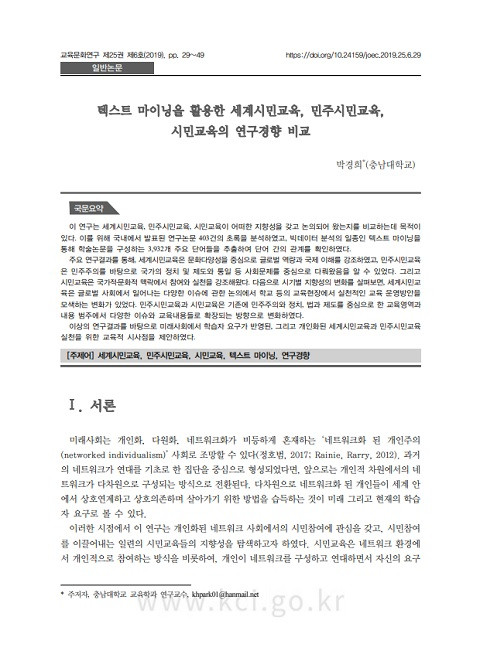 The Comparison of Research Trends on Global Citizenship Education, Democratic Civic Education, and Civic Education Using Text Mining Techniques (Journal of Education & Culture; Vol. 25, No. 6) Año de publicación: 2019 Autor: Kyunghee Park Autor corporativo: Education Research Institute of Inha University The purpose of this study is to compare the research trends of global citizenship education(GCED), democratic civic education(DCED), and civic education(CIED). For this purpose, it was analysed into abstracts of 403 articles, extracted 3,932 key-words through text mining analysis. The results of the study are as follows. First, GCED emphasized global competence and international understanding centering on cultural diversity. DCED was d iscussed mainly on the problems of national politics, and the unification issues on the democracy. CIED emphasized participation and practice in the national and cultural context. Second, with regard to the changes of orientation, GCED has changed to explore the practical education design. And DCED and CIED have changed to deal with various issues and contents. Based on these results, implications of this study were discussed for civic educations reflected future learner's diversity and personality.
 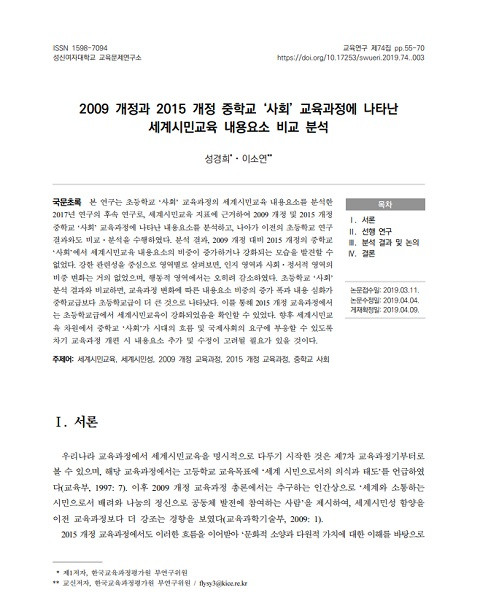 A Comparative Analysis on Content Elements of Global Citizenship Education in 2009 and 2015 Revised Middle School Social Studies Curriculum (Education Research; Vol. 74) Año de publicación: 2019 Autor: Kyunghee Sung | Soyeon Lee Autor corporativo: Sungshin Women's University Educational Research Institute This study is a follow-up study of the 2017 research which analyzed content elements of global citizenship education in elementary school Social Studies. Based on the global citizenship education index, the content elements of are analyzed in the 2009 and 2015 revised middle school Social Studies curriculum, and then it was compared to the results of previous research in elementary school. As a result, it can be found that the content elements of global citizenship education in the middle school Social Studies are not increased or strengthened. In terms of 'strong connection', there was almost no change in the proportion of the cognitive domain and the socio-emotional domain, but rather it decreased in the behavioral domain. Compared with the results of elementary school, it is appeared that elementary school showed a larger increase than the middle school in the proportion of content elements depending on the change of curriculum. Through this, it can be confirmed that the global citizenship education was strengthened in elementary school in the 2015 revised Social Studies curriculum. At the time of next curriculum revision, it will be necessary to consider adding and revising the content elements related to global citizenship education to meet the needs of international community. 2009 개정과 2015 개정 중학교 ‘사회’ 교육과정에 나타난 세계시민교육 내용요소 비교 분석 (교육연구; Vol. 74) Año de publicación: 2019 Autor: Kyunghee Sung | Soyeon Lee Autor corporativo: Sungshin Women's University Educational Research Institute 본 연구는 초등학교 ‘사회’ 교육과정의 세계시민교육 내용요소를 분석한2017년 연구의 후속 연구로, 세계시민교육 지표에 근거하여 2009 개정 및 2015 개정중학교 ‘사회’ 교육과정에 나타난 내용요소를 분석하고, 나아가 이전의 초등학교 연구결과와도 비교⋅분석을 수행하였다. 분석 결과, 2009 개정 대비 2015 개정의 중학교‘사회’에서 세계시민교육 내용요소의 비중이 증가하거나 강화되는 모습을 발견할 수없었다. 강한 관련성을 중심으로 영역별로 살펴보면, 인지 영역과 사회⋅정서적 영역의비중 변화는 거의 없었으며, 행동적 영역에서는 오히려 감소하였다. 초등학교 ‘사회’ 분석 결과와 비교하면, 교육과정 변화에 따른 내용요소 비중의 증가 폭과 내용 심화가중학교급보다 초등학교급이 더 큰 것으로 나타났다. 이를 통해 2015 개정 교육과정에서는 초등학교급에서 세계시민교육이 강화되었음을 확인할 수 있었다. 향후 세계시민교육 차원에서 중학교 ‘사회’가 시대의 흐름 및 국제사회의 요구에 부응할 수 있도록차기 교육과정 개편 시 내용요소 추가 및 수정이 고려될 필요가 있을 것이다.
 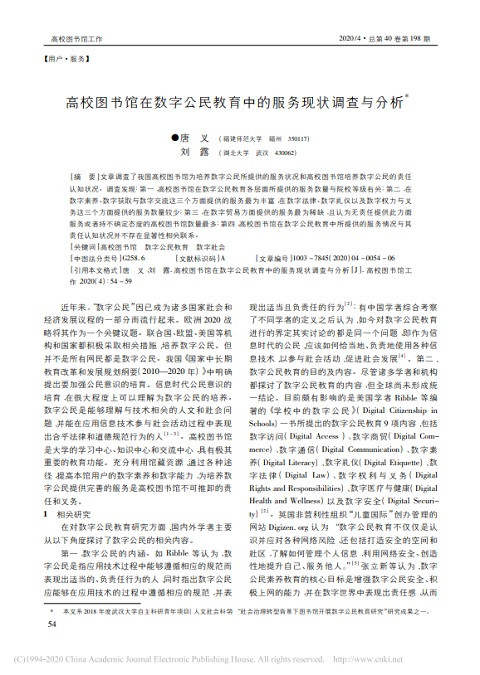 Investigation and Analysis on the Service Status of University Libraries in Digital Citizen Education (Library Work in Colleges and Universities; No. 4) Año de publicación: 2020 Autor: Tangyi | Liulu Autor corporativo: College library and Information Committee of Hunan Provincial This paper investigated the status of the service provided by university libraries in China to cultivate digital citizens and the cognition of responsibility of cultivating digital citizens provided by university libraries. The survey found that: firstly, the number of service in the digital citizen education provided by the university library is related to the university’s level; secondly, university libraries provide the most abundant service in the areas of digital literacy, digital access and digital communication, and less service in the areas of digital law, digital etiquette and digital power; thirdly, university libraries provide the scarcest service in the area of digital trade and most university libraries consider it is no responsible to provide this service or just hold an uncertain attitude; fourthly, there is no significant correlation between the service on digital citizen education provided by university libraries and the cognition status of responsibility.