
Recursos
Exploren una amplia gama de recursos valiosos en GCED para profundizar su comprensión y promover su búsqueda, incidencia, enseñanza y aprendizaje.
3,797 resultados encontrados
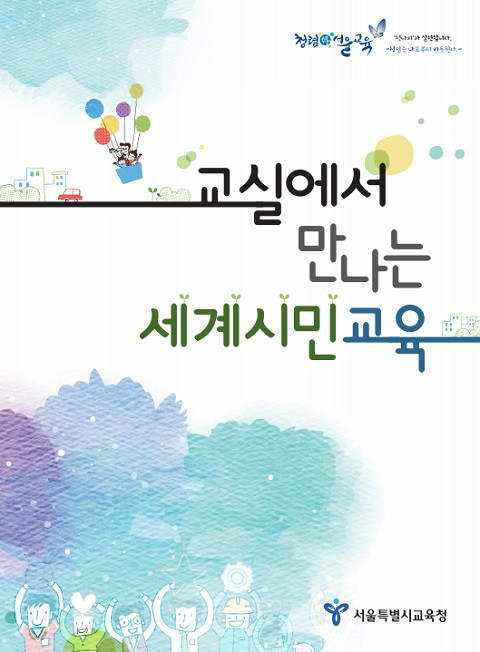 교실에서 만나는 세계시민교육 Año de publicación: 2016 Autor: 정애경 | 윤지아 | 정혜선 | 이근화 | 공석범 | 주예진 | 이원용 | 정용민 Autor corporativo: 서울특별시교육청 본 자료는 학습자로 하여금 인류가 공동으로 직면하고 있는 문제들에 대해 이해하고 지구촌 공동체에 대한 소속감과 연대감을 키워 지구촌의 문제들을 해결할 수 있는 다양한 실천적이고 협력적인 능력을 키우는데 그 목적을 두고 있으며, 직접 교실 현장에서 활용할 수 있도록 교수학습과정안의 형식으로 구성되어 있다. 학습주제로 제시된 것은 국제이해교육과 세계시민교육에서 공통으로 다루는 인권과 평화, 다문화를 비롯하여 2030년까지의 인류 공동의 목표인 지속가능발전의 환경과 사회와 경제 부분, 그리고 세계시민교육의 배경인 세계화와 미래사회의 지향점인 국제협력 다섯 영역이다.
 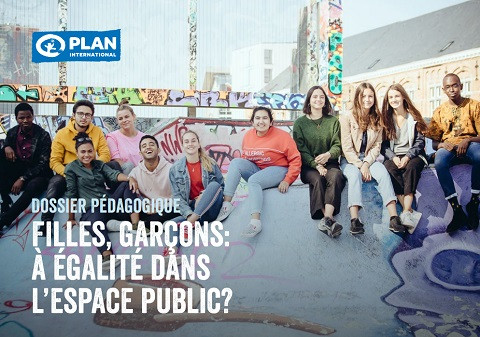 Dossier pédagogique: Filles, garçons, à égalite dans l'espace public? Año de publicación: 2019 Autor corporativo: Plan International Ce dossier pédagogique vise à sensibiliser les adolescent-e-s à propos des inégalités entre garçons et filles et à les faire réfléchir aux conséquences. Le message global est positif: le chemin est porteur d’espoir. Les jeunes peuvent changer les choses. Ils/elles peuvent réfléchir et s’élever contre des normes inadaptées et construire leur avenir. Et nous pouvons, ensemble, briser les stéréotypes de genre, améliorer les modèles de rôles et construire à l’égalité des chances entre garçons et filles. Prendre conscience du poids des stéréotypes et les questionner constamment en les observant à travers le prisme du genre sont des étapes décisives sur la voie de l’égalité. La classe est un cadre idéal pour cette remise en question.
  Confronting White Nationalism in Schools: A Toolkit Año de publicación: 2019 Autor: Nora Flanagan | Jessica Acee | Lindsay Schubiner Autor corporativo: Western States Center This toolkit shows strategies to counter white nationalist organizing in schools through sample scenarios that schools frequently encounter. It also offers advice for parents, students, teachers, school administrators, and the wider community. Many resources currently exist that address diversity, inclusion, and bullying in schools; a few of them are listed in the resources section. This toolkit is specifically focused on responding to white nationalist targeting and recruitment of students.
  Stepping Stones for the Sustainable Development Goals: A Workbook for Community and Adult Education Practitioners Año de publicación: 2020 Autor: Jennifer Harris Autor corporativo: Development Perspectives | Irish Aid The aim of this workbook is to provide a tool for Adult and Community groups and their leaders to understand the Sustainable Development Goals (SDGs) and to take meaningful action on those Goals. It aims to support adult and community educators in integrating the SDGs into their work using the principles and methodologies embraced by Development Education (DE)and Global Citizenship Education (GCE).
 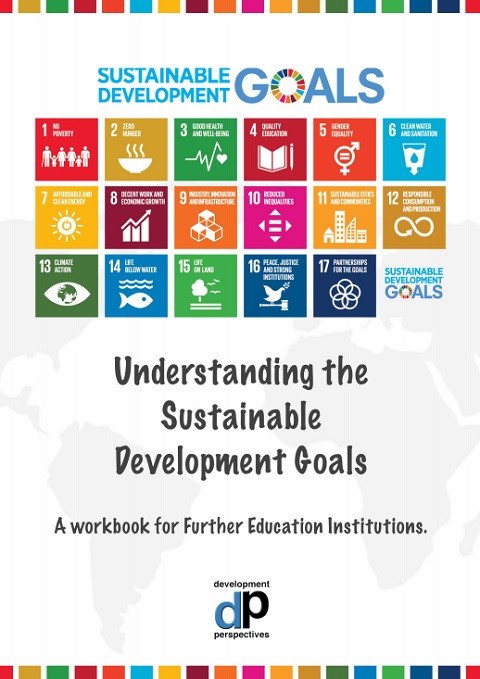 Understanding the Sustainable Development Goals: A Workbook for Further Education Institutions Año de publicación: 2020 Autor: Peggy Flanagan | Stephanie Kirwan Autor corporativo: Development Perspectives | Irish Aid This Sustainable Development Goals (SDG) workbook has been developed and produced specifically for the use of Further Education tutors. Through their partnerships, practitioners have requested that Development Perspectives develop a workbook with sessions on the SDGs specifically for adults in formal and non-formal learning contexts including groups in the community sector. This is an easy to use workbook with sessions for each of the 17 SDGs that could be delivered individually based on the interest of the adults and communities involved in each session.
  The Comparison of Research Trends on Global Citizenship Education, Democratic Civic Education, and Civic Education Using Text Mining Techniques (Journal of Education & Culture; Vol. 25, No. 6) Año de publicación: 2019 Autor: Kyunghee Park Autor corporativo: Education Research Institute of Inha University The purpose of this study is to compare the research trends of global citizenship education(GCED), democratic civic education(DCED), and civic education(CIED). For this purpose, it was analysed into abstracts of 403 articles, extracted 3,932 key-words through text mining analysis. The results of the study are as follows. First, GCED emphasized global competence and international understanding centering on cultural diversity. DCED was d iscussed mainly on the problems of national politics, and the unification issues on the democracy. CIED emphasized participation and practice in the national and cultural context. Second, with regard to the changes of orientation, GCED has changed to explore the practical education design. And DCED and CIED have changed to deal with various issues and contents. Based on these results, implications of this study were discussed for civic educations reflected future learner's diversity and personality.
 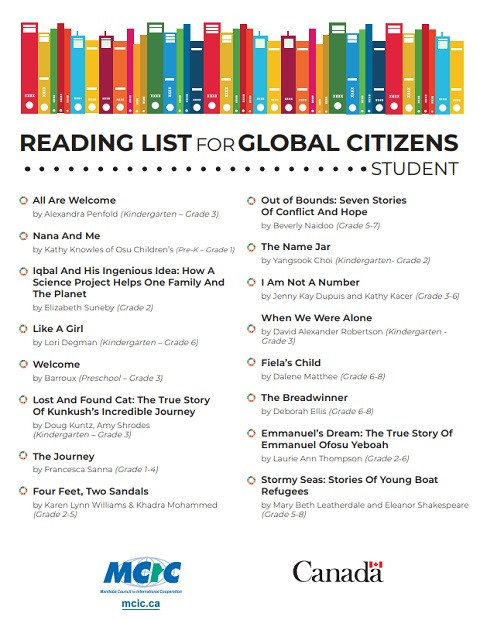 Reading List for Global Citizens: Student Año de publicación: 2020 Autor corporativo: Manitoba Council for International Cooperation (MCIC) | Global Affairs Canada (GAC) This is a reading list for global citizens from Kindergarten to Grade 12. These books will inspire students to take action whether they are passionate about food security, ending poverty, supporting women’s rights, or protecting the environment.
 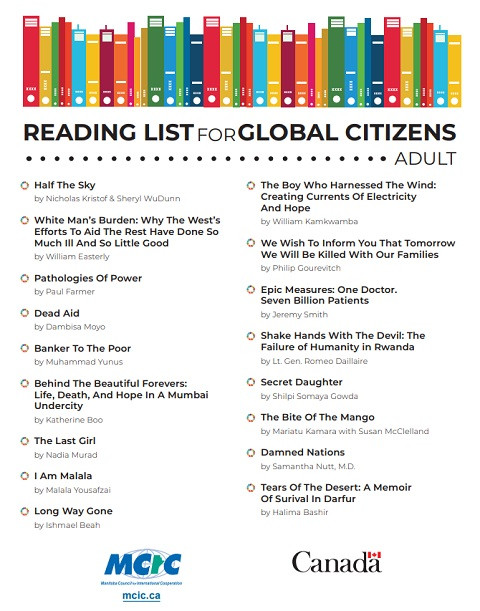 Reading List for Global Citizens: Adult Año de publicación: 2020 Autor corporativo: Manitoba Council for International Cooperation (MCIC) | Global Affairs Canada (GAC) This reading list helps readers to be a global citizen by reading books that are informative and inspiring.
 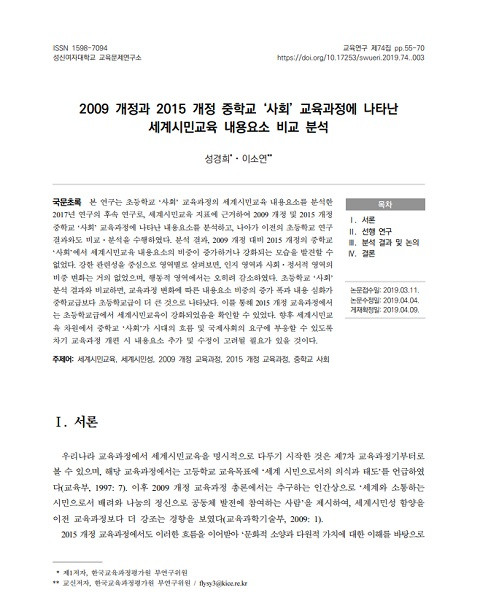 A Comparative Analysis on Content Elements of Global Citizenship Education in 2009 and 2015 Revised Middle School Social Studies Curriculum (Education Research; Vol. 74) Año de publicación: 2019 Autor: Kyunghee Sung | Soyeon Lee Autor corporativo: Sungshin Women's University Educational Research Institute This study is a follow-up study of the 2017 research which analyzed content elements of global citizenship education in elementary school Social Studies. Based on the global citizenship education index, the content elements of are analyzed in the 2009 and 2015 revised middle school Social Studies curriculum, and then it was compared to the results of previous research in elementary school. As a result, it can be found that the content elements of global citizenship education in the middle school Social Studies are not increased or strengthened. In terms of 'strong connection', there was almost no change in the proportion of the cognitive domain and the socio-emotional domain, but rather it decreased in the behavioral domain. Compared with the results of elementary school, it is appeared that elementary school showed a larger increase than the middle school in the proportion of content elements depending on the change of curriculum. Through this, it can be confirmed that the global citizenship education was strengthened in elementary school in the 2015 revised Social Studies curriculum. At the time of next curriculum revision, it will be necessary to consider adding and revising the content elements related to global citizenship education to meet the needs of international community. 2009 개정과 2015 개정 중학교 ‘사회’ 교육과정에 나타난 세계시민교육 내용요소 비교 분석 (교육연구; Vol. 74) Año de publicación: 2019 Autor: Kyunghee Sung | Soyeon Lee Autor corporativo: Sungshin Women's University Educational Research Institute 본 연구는 초등학교 ‘사회’ 교육과정의 세계시민교육 내용요소를 분석한2017년 연구의 후속 연구로, 세계시민교육 지표에 근거하여 2009 개정 및 2015 개정중학교 ‘사회’ 교육과정에 나타난 내용요소를 분석하고, 나아가 이전의 초등학교 연구결과와도 비교⋅분석을 수행하였다. 분석 결과, 2009 개정 대비 2015 개정의 중학교‘사회’에서 세계시민교육 내용요소의 비중이 증가하거나 강화되는 모습을 발견할 수없었다. 강한 관련성을 중심으로 영역별로 살펴보면, 인지 영역과 사회⋅정서적 영역의비중 변화는 거의 없었으며, 행동적 영역에서는 오히려 감소하였다. 초등학교 ‘사회’ 분석 결과와 비교하면, 교육과정 변화에 따른 내용요소 비중의 증가 폭과 내용 심화가중학교급보다 초등학교급이 더 큰 것으로 나타났다. 이를 통해 2015 개정 교육과정에서는 초등학교급에서 세계시민교육이 강화되었음을 확인할 수 있었다. 향후 세계시민교육 차원에서 중학교 ‘사회’가 시대의 흐름 및 국제사회의 요구에 부응할 수 있도록차기 교육과정 개편 시 내용요소 추가 및 수정이 고려될 필요가 있을 것이다.