
Recursos
Exploren una amplia gama de recursos valiosos en GCED para profundizar su comprensión y promover su búsqueda, incidencia, enseñanza y aprendizaje.
2,668 resultados encontrados
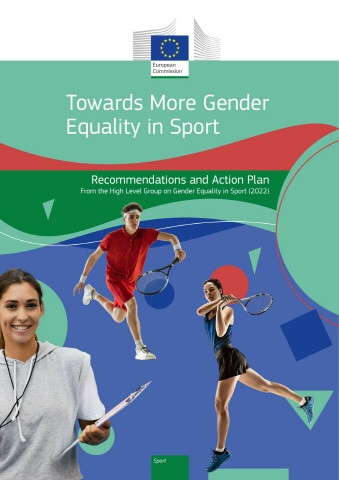 Towards More Gender Equality in Sport: Recommendations and Action Plan From the High Level Group on Gender Equality in Sport (2022) Año de publicación: 2022 Autor corporativo: European Commission | European Union (EU) Gender equality is a fundamental European Union (EU) principle. Enshrined in the Treaties, it is something the EU is actively trying to achieve – most recently through its Gender Equality Strategy 2021-2025. The Strategy aims to give women, men, girls and boys, in all their diversity, the freedom to pursue their chosen path in life and equal opportunities to thrive and to participate in and lead European society. Looking back at the steps already taken, the ‘Gender equality in sport – Proposal for strategic actions 2014-2020’ has certainly led to achievements, but the pace of reforms needs to be accelerated. Firstly, the principle of gender equality now underpins all actions funded under Erasmus+ Sport and projects supporting women’s sport are actively encouraged. Secondly, awareness raising is at the core of EU action in this field, notably through studies or discussions, such as within the Commission Expert Group on Good Governance. Finally, initiatives such as the annual #BeInclusive EU Sport Awards recognise those organisations using sport to increase social inclusion, including gender equality. In 2020, Commissioner Gabriel announced the setting up of an expert group with the aim of discussing the way forward and proposing future actions in the area of gender equality in sport to the European Commission, EU Member States and sports organisations. The work of the experts will lead to the implementation of concrete actions at local, national and European level. This report is the result of the work of the European Commission High-Level Group (HLG) on Gender Equality in Sport. The 15 members of the HLG were appointed in December 2020. Work began in February 2021 and was completed in December 2021. Meetings focused on six areas of engagement identified by the experts. Scientists and practitioners shared findings of their research and good practices. Each meeting was followed by working sessions to summarise the presentations and formulate recommendations. Vers une plus grande égalité des genres dans le sport: Recommandations et plan d'action du groupe de haut niveau sur l’égalité des genres dans le sport (2022) Año de publicación: 2022 Autor corporativo: European Commission | European Union (EU) L’égalité des genres est l’un des principes fondamentaux de l’Union européenne (UE). Inscrite dans les traités, elle constitue un objectif que l’UE s’efforce activement d’atteindre – notamment dans le cadre de sa stratégie en faveur de l’égalité entre les femmes et les hommes 2021-2025. Cette stratégie a pour objectif de donner aux femmes, aux hommes, aux jeunes filles et aux jeunes garçons, dans toute leur diversité, la liberté de suivre le chemin qu’ils ont choisi dans la vie et des chances égales de s’épanouir, de participer à la société européenne et de la diriger. Si l’on considère les mesures déjà prises, le rapport « Égalité des genres dans le sport – Proposition d’actions stratégiques 2014-2020 » a certes permis des avancées, mais le rythme des réformes doit être accéléré. Tout d’abord, le principe de l’égalité des genres sous-tend désormais toutes les actions financées dans le cadre du programme Erasmus+ Sport, et les projets soutenant le sport féminin sont activement encouragés. Ensuite, la sensibilisation est au coeur de l’action de l’UE dans ce domaine, notamment par le biais d’études ou de discussions, comme au sein du groupe d’experts de la Commission sur la bonne gouvernance. Enfin, des initiatives telles que les prix annuels #BeInclusive EU Sport Awards récompensent les organisations qui se servent du sport pour accroître l’inclusion sociale, notamment l’égalité des genres. En 2020, la commissaire Mariya Gabriel a annoncé la création d’un groupe d’experts chargé de déterminer la marche à suivre et de proposer des actions à implémenter dans le domaine de l’égalité des genres dans le sport à la Commission européenne, aux États membres de l’UE et aux organisations sportives. Le travail des experts permettra de mettre en oeuvre des actions concrètes aux niveaux locaux, nationaux et européen. Ce rapport est le résultat du travail du groupe de haut-niveau (GHN) de la Commission européenne sur l’égalité des genres dans le sport. Les 15 membres du groupe de haut-niveau ont été nommés en décembre 2020 Les travaux ont commencé en février 2021 et se sont terminés en décembre 2021. Les réunions ont porté sur six domaines d’engagement identifiés par les experts. Des scientifiques et des praticiens ont partagé le fruit de leurs recherches et leurs bonnes pratiques. Chaque réunion a été suivie par des sessions de travail destinées à résumer les présentations et à formuler des recommandations.
 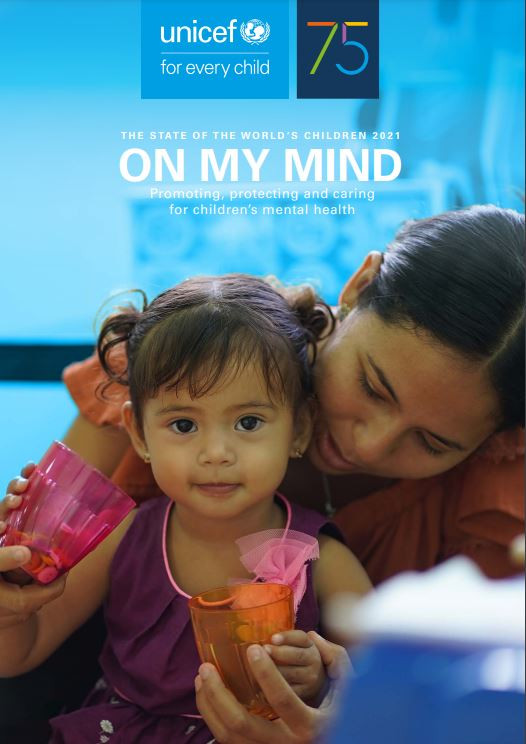 2021年世界儿童状况:心之所想,促进、保护和关爱儿童心理健康 Año de publicación: 2021 Autor corporativo: United Nations Children's Fund (UNICEF) 本报告关注当下世界儿童的心理健康问题,并呼吁全社会对这一议题予以关注并积极干预。
  教育公平视域下特殊儿童随班就读的质量检视与提升路径 (教育进展 第14卷 第8期) Año de publicación: 2024 Autor: 常攀攀 Autor corporativo: 汉斯出版社 随班就读作为我国特殊儿童的主要教育形式,实现了特殊儿童与普通儿童入学机会的公平。在当前教育 需求从“有学上”转向“上好学”的背景下,“公平而有质量”应成为特殊儿童随班就读的价值考量。 鉴于特殊儿童随班就读的低阶公平和质量的不尽人意,应超越入学机会的形式公平,强调特殊儿童与普 通儿童教育过程和结果的实质公平。可通过建构特殊儿童随班就读质量正确认知的观念革新、确保特殊 儿童随班就读实质公平的过程关照、提供特殊儿童随班就读资源保障的差异补偿等路径来确保和提升特 殊儿童的随班就读质量。
  特殊幼儿随班就读的内涵、困境及支持策略探究 (教育进展 第14卷 第9期) Año de publicación: 2024 Autor: 潘莹 Autor corporativo: 汉斯出版社 特殊幼儿随班就读是中国式现代化融合教育的重要表现形式,也是确保特殊幼儿享有公平教育权的主要 实施途径。但随班就读在不断推广的同时也存在诸多问题。因此,如何提高随班就读的质量是当前随班 就读实践中亟需应对的问题。其中,在班教师对特殊幼儿随班就读的适应与发展具有决定性作用,需秉 持一维人本主义思想,以“同理心,定计划,设环境”三方面层层步入,螺旋上升做特殊儿童的四个支 持者,以此推进特殊幼儿随班就读的良好促进与提升。
 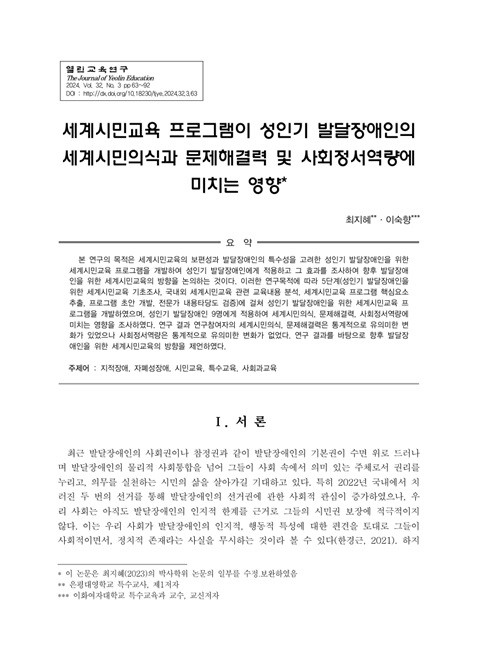 세계시민교육 프로그램이 성인기 발달장애인의 세계시민의식과 문제해결력 및 사회정서역량에 미치는 영향 (열린교육연구; Vol. 32, No. 3) Año de publicación: 2024 Autor: 최지혜 | 이숙향 Autor corporativo: 한국열린교육학회 본 연구의 목적은 세계시민교육의 보편성과 발달장애인의 특수성을 고려한 성인기 발달장애인을 위한 세계시민교육 프로그램을 개발하여 성인기 발달장애인에게 적용하고 그 효과를 조사하여 향후 발달장애인을 위한 세계시민교육의 방향을 논의하는 것이다. 이러한 연구목적에 따라 5단계(성인기 발달장애인을 위한 세계시민교육 기초조사, 국내외 세계시민교육 관련 교육내용 분석, 세계시민교육 프로그램 핵심요소 추출, 프로그램 초안 개발, 전문가 내용타당도 검증)에 걸쳐 성인기 발달장애인을 위한 세계시민교육 프로그램을 개발하였으며, 성인기 발달장애인 9명에게 적용하여 세계시민의식, 문제해결력, 사회정서역량에 미치는 영향을 조사하였다. 연구 결과 연구참여자의 세계시민의식, 문제해결력은 통계적으로 유의미한 변화가 있었으나 사회정서역량은 통계적으로 유의미한 변화가 없었다. 연구 결과를 바탕으로 향후 발달장애인을 위한 세계시민교육의 방향을 제언하였다.
 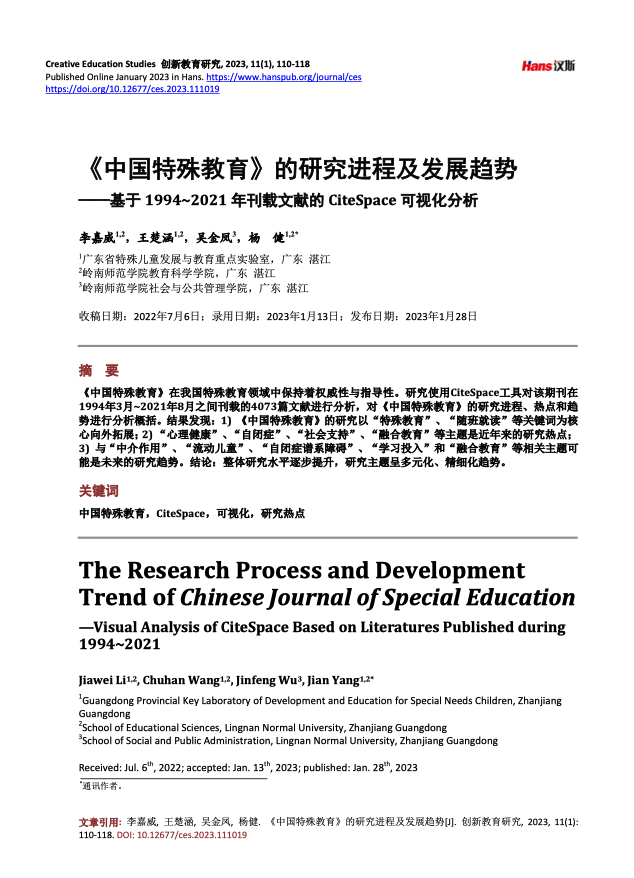 《中国特殊教育》的研究进程及发展趋势 : 基于1994~2021年刊载文献的CiteSpace可视化分析 (创新教育研究 第11卷 第1期) Año de publicación: 2023 Autor: 李嘉威 | 王楚涵 | 杨健 《中国特殊教育》在我国特殊教育领域中保持着权威性与指导性。研究使用CiteSpace工具对该期刊在1994年3月~2021年8月之间刊载的4073篇文献进行分析,对《中国特殊教育》的研究进程、热点和趋势进行分析概括。结果发现:1) 《中国特殊教育》的研究以“特殊教育”、“随班就读”等关键词为核心向外拓展;2) “心理健康”、“自闭症”、“社会支持”、“融合教育”等主题是近年来的研究热点;3) 与“中介作用”、“流动儿童”、“自闭症谱系障碍”、“学习投入”和“融合教育”等相关主题可能是未来的研究趋势。结论:整体研究水平逐步提升,研究主题呈多元化、精细化趋势。
  德国的特殊教育 (教育进展 第11卷 第4期) Año de publicación: 2021 Autor: 沈国琴 Autor corporativo: 汉斯出版社 本文首先阐述了德国学者对残疾的定义及德国对残疾儿童与青少年实施特殊教育的框架条件,随后从德 国特殊教育的运行机制、德国特殊教育的特点及发展趋势等方面对德国的特殊教育作了阐述。
 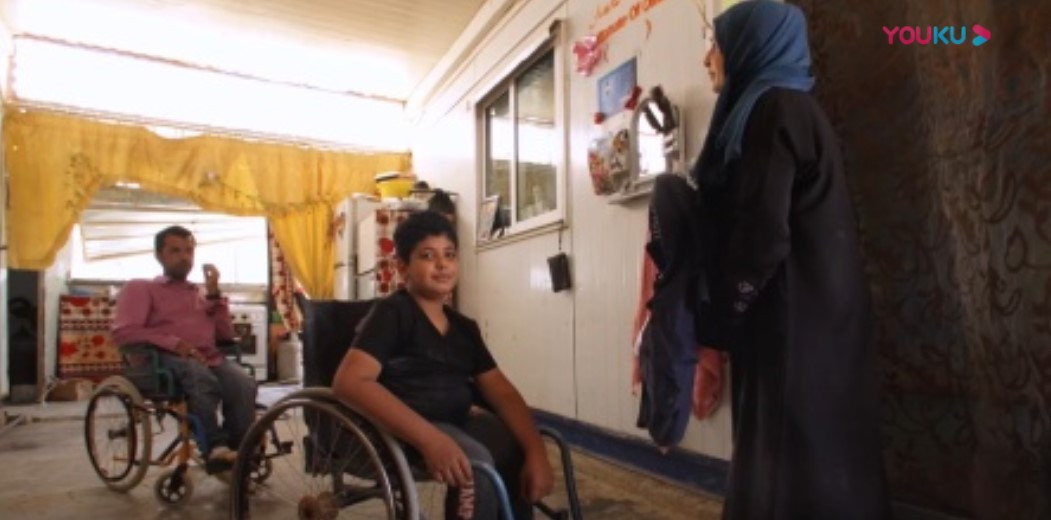 A Small Change That Makes Them Happy in the Refugee Camps! Año de publicación: 2021 Autor corporativo: 联合国儿童基金会 This video presents the difficulties and challenges faced by children with disabilities in a refugee camp in Syria, and UNICEF's efforts to address them. 一个小小改变,让难民营里的他们开心到飞起! Año de publicación: 2021 Autor corporativo: 联合国儿童基金会 本视频介绍了叙利亚难民营中残障儿童所面临的困难与挑战,以及联合国儿童基金会为此所作出的努力。