
Recursos
Exploren una amplia gama de recursos valiosos en GCED para profundizar su comprensión y promover su búsqueda, incidencia, enseñanza y aprendizaje.
2,668 resultados encontrados
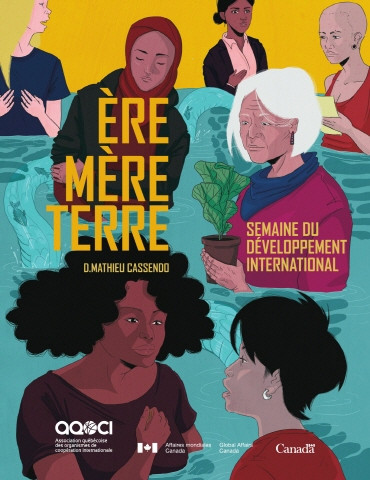 Age, Earth, Sea: International Development Week Año de publicación: 2020 Autor: Dimani Mathieu Cassendo Autor corporativo: Quebec Association of International Cooperation Organizations (AQOCI) Each year, International Development Week (IDW) highlights an international issue of concern to society. In Quebec, the Association québécoise des organismes de coopération internationale (AQOCI) organizes this public awareness week. CRÉDIL plays an active role in this campaign, and has participated in the production of comic strips as educational tools, such as "Ère, Terre, Mer" in 2021, which deals with the impact of the climate change on peoples. Ère, Terre, Mer: Semaine du développement international Año de publicación: 2020 Autor: Dimani Mathieu Cassendo Autor corporativo: Association québécoise des organismes de coopération internationale (AQOCI) La Semaine du développement international (SDI) permet chaque année de souligner un enjeu international qui interpelle les sociétés. Au Québec, c’est l’Association québécoise des organismes de coopération internationale (AQOCI) qui organise cette semaine de sensibilisation auprès du public. Le CRÉDIL participe activement à cette campagne et a participé à la production de bandes dessinées comme outil pédagogique comme “Ère, Terre, Mer” en 2021 qui traite de l'impact de la crise de l'environnement sur les différentes populations.
 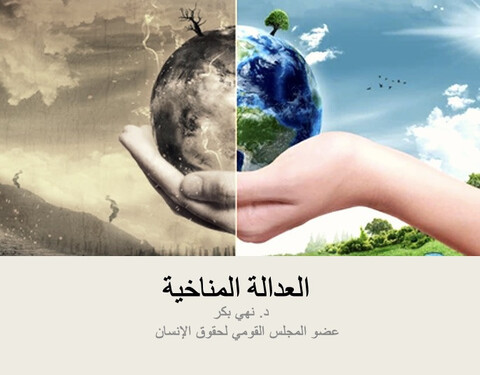 Climate Justice and Human Rights Año de publicación: 2022 Autor: Noha Bakr Climate justice is linking the impacts of global warming with principles of justice, specifically environmental justice and social justice, by exploring issues resulting from global warming such as equality, human rights, collective rights, and historical responsibilities. العدالة المناخية و حقوق الأنسان Año de publicación: 2022 Autor: Noha Bakr العدالة المناخية هي ربط تأثيرات الاحتباس الحراري مع مبادئ العدالة، تحديدًا العدالة البيئية والعدالة الاجتماعية، وعن طريق استكشاف بعض القضايا الناجمة عن الاحتباس الحراري مثل المساواة وحقوق الإنسان والحقوق الجماعية والمسؤوليات التاريخية.
 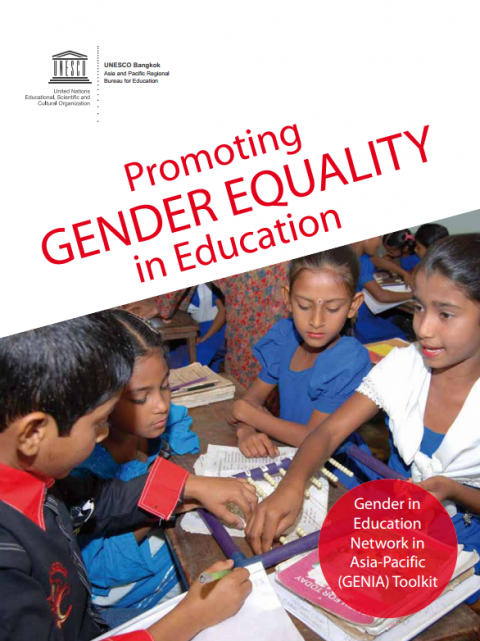 Promoting gender equality in education Año de publicación: 2009 Autor corporativo: UNESCO Kathmandu This publication was originally designed in 2003 when the Gender in Education Network in Asia-Pacific (GENIA) was established. Few gender in education resources were available at that time, and until the 2006 version, documents were mainly intended to be used by GENIA members, who are representatives (gender focal points) from ministries of education in the Asia-Pacific region. GENIA members have been using the Toolkit to sensitize and train their national counterparts ever since. However, the Toolkit has not only been distributed and used by gender focal points, but also by other people who have heard about GENIA, and/or who were interested in the resource materials published by UNESCO Bangkok. For this reason, the Toolkit has been accessible via the UNESCO Bangkok website1 since 2006. As a result, anyone searching the Web for information on gender equality can easily access the Toolkit. This fourth edition of the Toolkit, thus, expands the scope of the target audience. The content has likewise been adapted accordingly in order to meet the needs of all who could potentially access it. The Toolkit also integrates existing information and tools designed by other national or international organizations dedicated to promoting and providing training on gender equality in education and other sectors. Further information from these sources is obtained by consulting the references section at the end of the Toolkit. The Toolkit is designed as a user-friendly resource. As such, a matrix is provided on pages 4 and 5 to indicate each tool’s potential for use, based on its relevance to each prospective user group. Still, every tool will have relevance to many contexts or situations and, therefore, we encourage you to make use of all the materials by adapting them to your country context.
  Girl Rising Año de publicación: 2014 Autor corporativo: Girl Rising Suma's is one of Girl Rising's 9 remarkable stories. Though her brothers went to school, she was forced into bonded labor at age 6, like many other Nepali girls. Watch this chapter of Girl Rising to see how Suma gained her freedom and how she uses her education in a fight to free other girls. Written by Manjushree Thapa and voiced by Kerry Washington.
 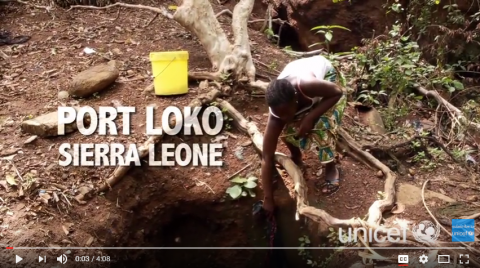 At a club for teenage girls in Sierre Leone, 18-year-old Mbalu leads by example Año de publicación: 2014 Autor: Nerina Penzhorn Teenage pregnancy is one of the most pervasive social problems in Sierra Leone today - more than one third of all pregnancies involve teenage girls. UNICEF, in collaboration with the NGO BRAC, is tackling this complex issue through a simple idea -- providing a place where teenage girls enjoy hanging out while they have training in life skills, gain valuable knowledge and access mentoring from peers. Mbalu Bumbuya, 18, a mentor at one such club for adolescent girls called 'the Wharf Club', is changing lives with her passion to teach and motivate her peers. "I tell them how to protect themselves so that they can excel in life," she says. "And I encourage them not to drop out of school." The club has also helped Mbalu stay focused on her education.
  From Where I Stand: A Gender Equality Project for the Global Goals Autor corporativo: United Nations Children's Fund (UNICEF) This project enables you to think about and contribute to encouraging women and girls to have equal opportunities to be heard and to have real opportunities to participate in all political, economic and public spheres.
  Everybody Wins When Girls Can Stay in School Autor corporativo: United Nations Children's Fund (UNICEF) World’s Largest Lesson is a collaborative education project to support the announcement of the United Nations Global Goals for Sustainable Development.Learning outcomes of the project: • Understand the term ‘gender equality’ • Identify obstacles to girls’ access to education, and secondary education in particular • Recognise the benefits of increased access to secondary education for girls
 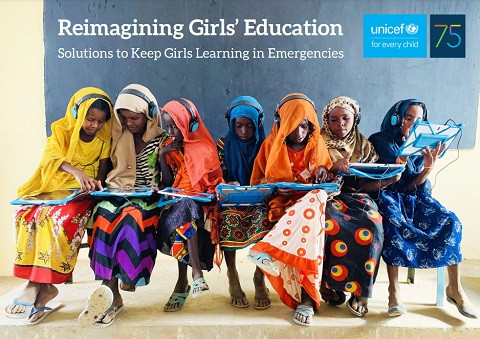 Reimagining Girls’ Education: Solutions to Keep Girls Learning in Emergencies Año de publicación: 2021 Autor corporativo: United Nations Children's Fund (UNICEF) Reimagining Girls’ Education: Solutions to Keep Girls Learning in Emergencies presents an empirical overview of what works to support learning outcomes for girls in emergencies. Research shows that girls in emergencies are disadvantaged at all stages of education and are more likely to be out-of-school than in non-emergency settings. Girls are also struggling to learn.This solutions book seeks to highlight promising evidence-based actions in education for decision makers who are designing and implementing interventions to support girls’ education in low and middle-income country humanitarian settings and settings where education has been interrupted by the COVID‑19 pandemic. It documents practical examples of approaches that have been or are being tested, and from which lessons can be drawn.The overarching aim is that this evidence be used to inform programming in crises and support diverse stakeholders in mitigating the impact of emergencies on girls’ education.