
Recursos
Exploren una amplia gama de recursos valiosos en GCED para profundizar su comprensión y promover su búsqueda, incidencia, enseñanza y aprendizaje.
882 resultados encontrados
 Silver Lining of Pandemic: Redefining Civil Society in Tajikistan Año de publicación: 2020 Autor: Muslimbek Buriev Autor corporativo: Central Asian Bureau for Analytical Reporting (CABAR) | Institute for War and Peace Reporting (IWPR) “Non-governmental organizations, mass media, community groups and initiatives have emerged amidst lockdown as actors actively engaged in assisting the population and addressing the crisis,” political scientist Muslimbek Buriev examines the role of civil society in Tajikistan in an article just for the CABAR.asia. «Светлая» сторона пандемии: будет ли переосмысление гражданского общества в Таджикистане? Año de publicación: 2020 Autor: Muslimbek Buriev Autor corporativo: Central Asian Bureau for Analytical Reporting (CABAR) | Institute for War and Peace Reporting (IWPR) «Неправительственные организации, СМИ, волонтерские группы и инициативы за время изоляции начали проявлять себя как субъекты, активно ведущие свою деятельность в рамках помощи населению и преодоления кризисных ситуаций», – политолог Муслимбек Буриев пишет о важности гражданского общества для Таджикистана в статье, специально для CABAR.asia.
  Tween Cyberbullying in 2020 Año de publicación: 2020 Autor: Justin W. Patchin | Sameer Hinduja Autor corporativo: Cyberbullying Research Center | Cartoon Network This report presents the results of a nationally representative survey of 1,034 children between the ages of 9 and 12 years-old. The survey was conducted online from June 19 through July 6, 2020, and was fielded by Ipsos using their probability-based KnowledgePanel. KnowledgePanel is the largest online panel that is representative of the U.S. population. KnowledgePanel recruitment employs an addressed-based sampling methodology from the United States Postal Service’s Delivery Sequence File—a database with full coverage of all delivery points in the U.S. As such, samples from KnowledgePanel cover all households regardless of their phone status. Member households without Internet access are furnished with a free computing device and Internet service. KnowledgePanel members are randomly recruited through probability-based sampling, and panel members are randomly selected so that survey results can properly represent the U.S. population with a measurable level of accuracy, features that are not obtainable from nonprobability panels. Ipsos currently recruits panel members by using address-based sampling methods (the firm previously relied on random-digit dialing for recruitment). Households without Internet connection are provided with a web-enabled device and free Internet service. In contrast, “convenience” or “opt-in” surveys recruit participants through emails, word-of-mouth, pop-up ads online, or other non-scientific methods.
 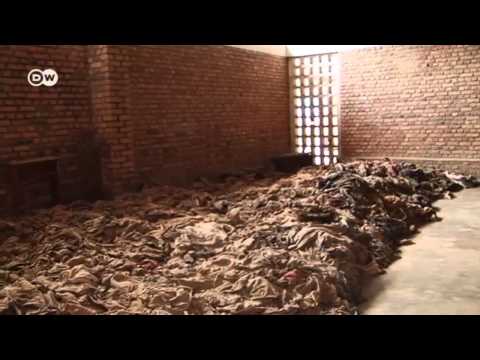 20 Years of the Rwandan Genocide Año de publicación: 2014 Autor corporativo: DW Español The rainy season in Rwanda recalls how 20 years ago the extermination of the tutsi population began by part of the hegemonic Hutu goverment of Rwanda in 1994. 20 años del genocidio de Ruanda Año de publicación: 2014 Autor corporativo: DW Español La temporada de lluvias en Ruanda, recuerda como hace 20 años empezó el exterminio de la poblaicón tutsi por parte del gobierno hegemónico hutu de Ruanda en el año 1994.
  Preventing Youth Violence: An Overview of the Evidence Año de publicación: 2015 Autor corporativo: World Health Organization (WHO) Every year about 200.000 adolescents and young people between the ages of 10 and 29 die, which places homicide in fourth place in the world as cause of death in young population. Several million adolescents and young people suffer from acts of violence, and trauma that require urgent medical and psychological treatment. The emotional imprints that youth volence leaves on its survivors and their loved ones are often profound. Youth violence destroys lives and its consequences have very high economic costs, both for society and for the families of young people. The goal of this manual is to provide a scientific framework that allows us to understand why some people have a greater tendency to be involved in acts of youth violence and how to prevent it. La prevención de la violencia juvenil: Panorama general de la evidencia Año de publicación: 2015 Autor corporativo: World Health Organization (WHO) Cada año mueren unos 200.000 adolescentes y jovenes entre los 10 y los 29 años de edad, lo cual coloca al homicidio en cuarto lugar en el mundo como causa demuerte en la población joven. Varios millones de adolescentes y jovenes sufren por actos de violencia, traumatismos que exijen tratamiento medico y psicologico urgente. Las huellas emocionales que la violencia juvenil deja en sus sobrevivientes y en los seres queridos de estos suelen ser profundas. La violencia juvenil destroza vidas y sus consecuencias tienen costos economicos muy altos,tanto para la sociedad como para las familias de los jovenes. El objetivo de este manual es ayudar a los formuladores de politicas y planificadores en todas partes a contrarrestar la violencia juvenil mediante estrategias respaldadas por la evidencia. El manual proporciona un marco cientifico que permite entender por qué algunas personas tiene una mayor tendencia a verse involucradas en actos de violencia juvenil y cómo prevenirla.
 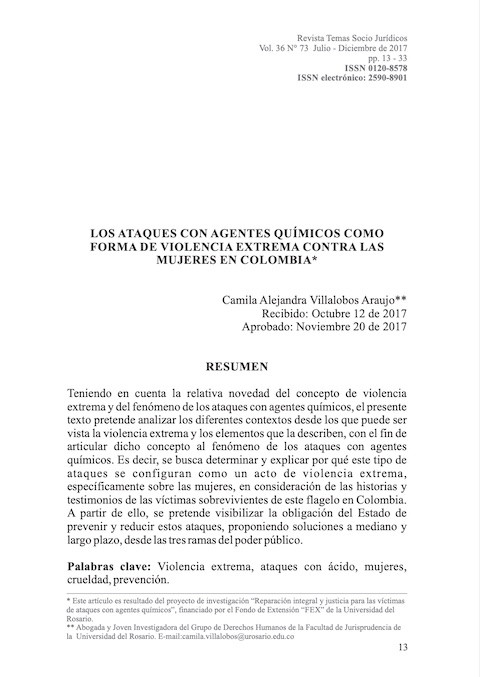 Attacks With Chemical Agents as a Form of Extreme Violence Against Women in Colombia (Revista Temas Socio Jurídicos; Vol. 36 No. 73) Año de publicación: 2017 Autor: Camila Alejandra Villalobos Araujo Autor corporativo: Universidad Autónoma de Bucaramanga (UNAB) This text aims to analyse different contexts from which the extreme violence can be seen and the elements that describe it, in order to articulate this concept to the phenomenon of acid attacks. In other words, the text seeks to determine and explain why such attacks are configured as an act of extreme violence, specifically to women, taking into account the stories and testimonies of surviving victims in Colombia. From it, the text seeks to make visible the obligation of the State to prevent and reduce these attacks, proposing solutions in the medium and long term, from the legislative, judicial and executive power. Los ataques con agentes químicos como forma de violencia extrema contra las mujeres en Colombia (Revista Temas Socio Jurídicos; Vol. 36 No. 73) Año de publicación: 2017 Autor: Camila Alejandra Villalobos Araujo Autor corporativo: Universidad Autónoma de Bucaramanga (UNAB) Este texto pretende analizar los diferentes contextos desde los que puede ser vista la violencia extrema y los elementos que la describen, con el fin de articular dicho concepto al fenómeno de los ataques con agentes químicos. Es decir, se busca determinar y explicar por qué este tipo de ataques se configuran como un acto de violencia extrema, específicamente sobre las mujeres, en consideración de las historias y testimonios de las víctimas sobrevivientes de este flagelo en Colombia. A partir de ello, se pretende visibilizar la obligación del Estado de prevenir y reducir estos ataques, proponiendo soluciones a mediano y largo plazo, desde las tres ramas del poder público.
 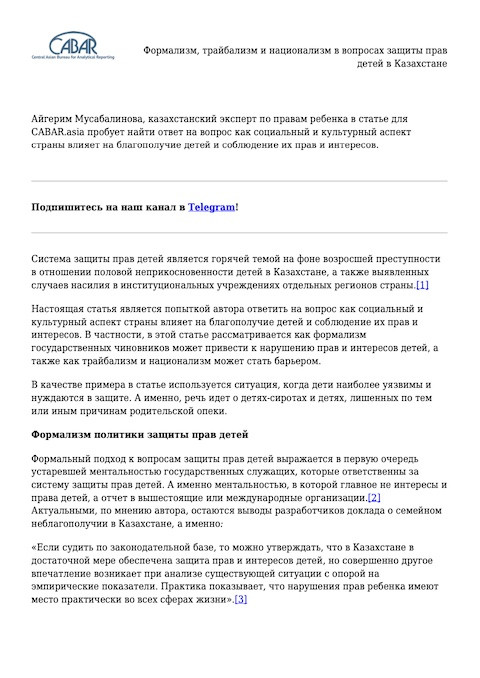 Formalism, Tribalism, and Nationalism in the Protection of Children’s Rights in Kazakhstan Año de publicación: 2020 Autor: Aigerim Musabalinova Autor corporativo: Central Asian Bureau for Analytical Reporting (CABAR) | Institute for War and Peace Reporting (IWPR) Aigerim Musabalinova, an expert on children’s rights tries to find an answer to the question of how the social and cultural aspect of the country affects the well-being of children and the observance of their rights and interests, in an article for CABAR.asia.