
Recursos
Exploren una amplia gama de recursos valiosos en GCED para profundizar su comprensión y promover su búsqueda, incidencia, enseñanza y aprendizaje.
1,725 resultados encontrados
 Empoderamiento digital de las niñas Año de publicación: 2018 Autor corporativo: Plan International Este documento informativo argumenta que mediante la promoción de la alfabetización digital de las niñas y el cierre de la brecha digital de género se podrá conseguir importantes logros con respecto a la igualdad de género y la promoción de los derechos de las niñas y mujeres en todo el mundo.
  Citizenship and Lifelong Learning Monitor 2019: Continuous Digital and Intercultural Education for EU Citizens’ Societal Inclusion and Active Participation Año de publicación: 2020 Autor: Andrei Frank Autor corporativo: SOLIDAR Foundation | Foundation for European Progressive Studies (FEPS) The Citizenship and Lifelong Learning Monitor 2019 is a research report jointly released by SOLIDAR Foundation and FEPS, on the topic of policy developments in the field of attainment of skills, through lifelong learning, for active participation in society.The skills on which it focuses are:digital skillscivic competences andintercultural education competences.The document is composed of an analysis of the policies on the topic, and a presentation of best practices, coming from SOLIDAR Foundation member organisations.It culminates with recommendations, stemming from a comparative analysis of the 8 country reports conducted (featuring Austria, Croatia, Denmark, Germany, Italy, Serbia, Spain, and the UK as investigated countries).The online Conference “Civic responsibilities online and offline: Lifelong learning for digital and traditional citizenship education“, held together with FEPS, presented and discussed the outcomes of the Citizenship & Lifelong Learning Monitor.
  Disinfodemic: Deciphering COVID-19 Disinformation (Policy Brief; 1) Año de publicación: 2020 Autor: Julie Posetti | Kalina Bontcheva Autor corporativo: UNESCO The purpose of this brief is to provide a structure for understanding the COVID-19 disinfodemic and the responses to it, highlighting practices which have a bearing on the UN Sustainable Development Goals (SDGs), the right to health and the right to freedom of expression. SDG 16.10 calls for “public access to information and fundamental freedoms”. Désinfodémie: Déchiffrer la désinformation sur le COVID-19 (Note d’orientation; 1) Año de publicación: 2020 Autor: Julie Posetti | Kalina Bontcheva Autor corporativo: UNESCO Le but de cette note d’orientation est de présenter une structure pour comprendre la désinfodémie sur le COVID-19 et les réponses possibles, en mettant en évidence les pratiques liées aux Objectifs de développement durable (ODD) des Nations Unies, le droit à la santé et le droit à la liberté d’expression. L’ODD 16.10 appelle à « un accès public à l’information et aux libertés fondamentales ». Desinfodemia: Descifrando la desinformación sobre el COVID-19 (Policy Brief; 1) Año de publicación: 2020 Autor: Julie Posetti | Kalina Bontcheva Autor corporativo: UNESCO El propósito de este resumen es presentar una estructura para comprender la ‘desinfodemia’ del COVID-19 y las respuestas respectivas, resaltando las prácticas pertinentes a los Objetivos de Desarrollo Sostenible de la ONU, al derecho a la salud y al derecho a la libertad de expresión. EL ODS16.10 subraya la necesidad de “acceso público a la información y libertades fundamentales”.
 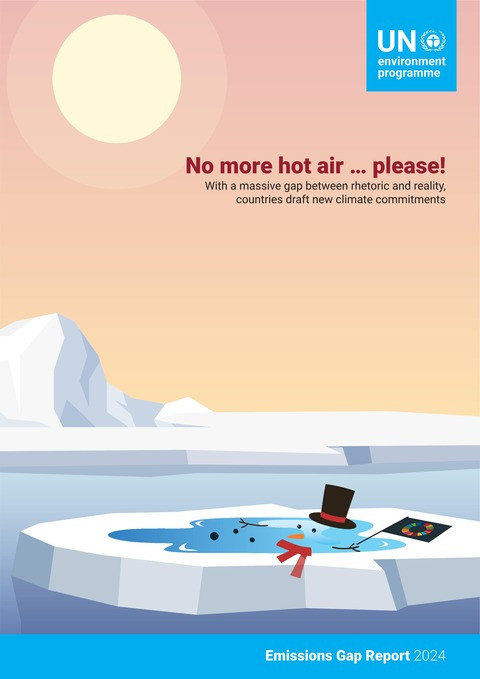 Emissions Gap Report 2024: No More Hot Air … Please! With a Massive Gap Between Rhetoric and Reality, Countries Draft New Climate Commitments Año de publicación: 2024 Autor: Anne Olhoft | John Christensen | William F. Lamb | Minal Pathak | Takeshi Kuramochi | Taryn Fransen | Joeri Rogelj | Michel den Elzen | Joana Portugal-Pereira | Neil rant | Jiang Kejun | Stephanie Roe | Chris Bataille | Kornelis Blok | Kelly Levin | Eleonore Soubeyran | Costanza Strinati Autor corporativo: United Nations Environment Programme (UNEP) As climate impacts intensify globally, the Emissions Gap Report 2024: No more hot air … please! finds that nations must deliver dramatically stronger ambition and action in the next round of Nationally Determined Contributions or the Paris Agreement’s 1.5°C goal will be gone within a few years. The report is the 15th edition in a series that brings together many of the world’s top climate scientists to look at future trends in greenhouse gas emissions and provide potential solutions to the challenge of global warming.
 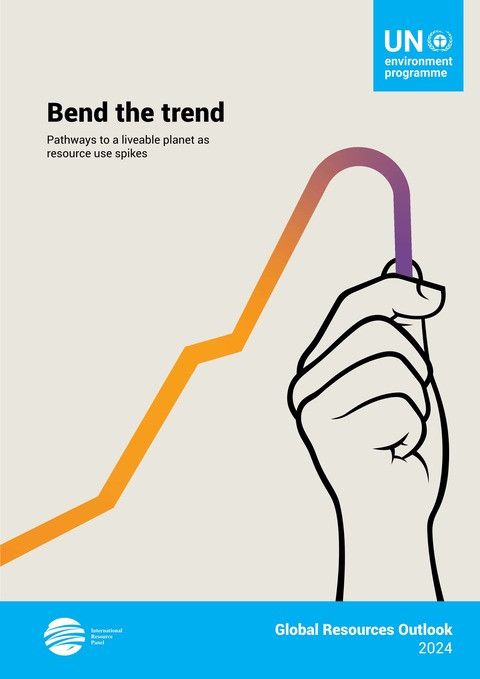 Global Resources Outlook: 2024 Bend the Trend; Pathways to a Liveable Planet as Resource Use Spikes Año de publicación: 2024 Autor: Hans Bruyninckx, Steve Hatfield-Dodds, Stefanie Hellweg, Heinz Schandl Autor corporativo: United Nations Environment Programme (UNEP) | International Resource Panel (IRP) The world is in the midst of a triple planetary crisis of climate change, biodiversity loss and pollution and waste. The global economy is consuming ever more natural resources, while the world is not on track to meet the Sustainable Development Goals. The scientific community has never before been more aligned or more resolute on the need for urgent global transformation towards the sustainable use of resources. This 2024 edition of the Global Resources Outlook sheds light on how resources are essential to the effective implementation of the Agenda 2030 and multilateral environmental agreements to tackle the triple planetary crisis. The report brings together the best available data, modelling and assessments to analyse trends, impacts and distributional effects of resource use. It builds on more than 15 years of work by the International Resource Panel, including scientific assessments and inputs from countries, a vast network of stakeholders in the field and regional experts. The report illustrates how, since the 2019 edition of this report, rising trends in global resource use have continued or accelerated. The report also shows how demand for resources is expected to continue increasing in the coming decades. This means that, without urgent and concerted action, by 2060 resource extraction could rise by 60% from 2020 levels – driving increasing damage and risks. However, this fate is not sealed. The report also describes the potential to turn negative trends around and put humanity on a trajectory towards sustainability. For that, bold policy action is critical to phase out unsustainable activities, speed up responsible and innovative ways of meeting human needs and create conditions conducive to social acceptance and equity within the necessary transitions. This includes urgent action to embed resources in the delivery of multilateral environmental agreements, define sustainable resource use paths and roll out appropriate financial, trade and economic incentives. The pathway towards sustainability is increasingly steep and narrow, and the window of opportunity is closing. The science is clear: The key question is no longer whether a transformation towards global sustainable resource consumption and production is necessary, but how to make it happen now. Addressing this reality, based on evolving concepts of a just transition, is an essential part of any credible and justifiable way forward.
  Our Common Agenda Policy Brief 10: Transforming Education Año de publicación: 2023 Autor corporativo: United Nations (UN) Building on the Transforming Education Summit and the report of the International Commission on the Futures of Education, this policy brief takes a closer look at the current crisis in education and proposes ideas and guiding actions for countries and the international community to transform education. The right to education and lifelong learning is an essential part of the 2030 Agenda for Sustainable Development because education, knowledge and learning are fundamental to human dignity, growth and development. For centuries, education has been the great equalizer, the driving force of nation-building and the engine of social, cultural, economic and technological progress. But today, beset by a dual crisis of equity and relevance, education as we know it is no longer fit for purpose. Informe de políticas de nuestra agenda común 10: Transformar la educación Año de publicación: 2023 Autor corporativo: United Nations (UN) Sobre la base de la Cumbre sobre la Transformación de la Educación y el informe de la Comisión Internacional sobre los Futuros de la Educación, el presente informe de políticas examina con más detalle la crisis actual de la educación y propone unas ideas y una serie de medidas orientativas para que los países y la comunidad internacional transformen la educación. El derecho a la educación y al aprendizaje permanente es una parte esencial de la Agenda 2030 para el Desarrollo Sostenible porque la educación, el conocimiento y el aprendizaje son fundamentales para la dignidad, el crecimiento y el desarrollo de la persona. Durante siglos, la educación ha sido la gran igualadora, la fuerza motriz de la construcción nacional y el motor del progreso social, cultural, económico y tecnológico. Sin embargo, en la actualidad, acosada por una doble crisis de equidad y pertinencia, la educación tal y como la conocemos ya no es idónea.
  L'enseignement supérieur face au défi de la transition écologique Año de publicación: 2023 Autor corporativo: Cour des Comptes Les établissements d’enseignement supérieur occupent une place spécifique dans la transition écologique. Représentant près de la moitié des opérateurs de l’État et accueillant un large public, ils ont un impact environnemental substantiel. De nombreuses initiatives ont été prises ces dernières années en la matière et les politiques menées dans les établissements commencent à se mettre en place. Elles sont cependant encore insuffisantes pour atteindre les objectifs affichés, manquant en particulier de nombreux outils pour développer une démarche rigoureuse, cohérente et efficace. L’enseignement supérieur a pourtant un rôle majeur à jouer, non seulement pour réduire sa propre empreinte écologique, mais aussi pour produire, adapter et diffuser les connaissances nécessaires à la réussite de la transition écologique.Higher education institution occupy a specific place in the ecological transition. Representing nearly half of the state operators and catering to a diverse audience, they have a substantial environmental impact. Numerous initiatives have been undertaken in recent years, and policies within these institutions are beginning to take shae. However, they are still insufficient to achieve the stated objectives, notably lacking many tools to develop a rigorous, coherent and effective approach. Higher education has a crucial role to play, not only in reducing its own ecological footprint but also in generating, adapting, and disseminating th knowledge necessary for the success of the ecological transition.