
Recursos
Exploren una amplia gama de recursos valiosos en GCED para profundizar su comprensión y promover su búsqueda, incidencia, enseñanza y aprendizaje.
2,161 resultados encontrados
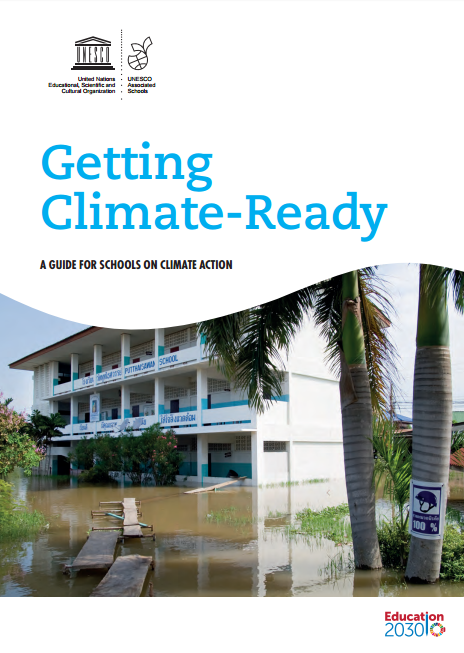 Getting climate ready: a guide for schools on climate action and the whole-school approach Año de publicación: 2016 Autor corporativo: UNESCO Do you want to help create a healthier, fairer, more environmentally sustainable society? Do you want to empower children and young people to do the same? Do you want to make your school more climate-friendly? If so, this guide is for you! The guidelines and examples are based on a survey looking at climate action projects at 55 schools in 12 countries. All schools in the survey are part of UNESCO’s Associated Schools Project Network (ASPnet). In addition, this guide draws on examples and research published in peer-reviewed journals, books, national and international guidelines and frameworks and programme websites. Faire face au changement climatique: guide sur l'action climat destiné aux établissements scolaires Año de publicación: 2016 Autor corporativo: UNESCO Do you want to help create a healthier, fairer, more environmentally sustainable society? Do you want to empower children and young people to do the same? Do you want to make your school more climate-friendly? If so, this guide is for you! The guidelines and examples are based on a survey looking at climate action projects at 55 schools in 12 countries. All schools in the survey are part of UNESCO’s Associated Schools Project Network (ASPnet). In addition, this guide draws on examples and research published in peer-reviewed journals, books, national and international guidelines and frameworks and programme websites.
 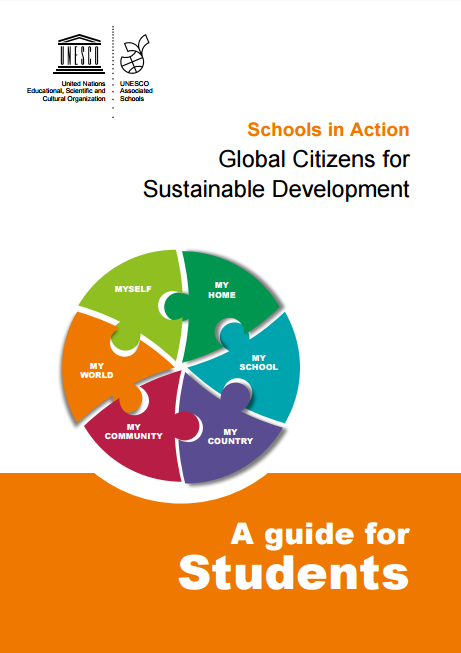 Schools in action, global citizens for sustainable development: a guide for students Año de publicación: 2016 Autor corporativo: UNESCO The UNESCO Associated Schools Project Network (ASPnet) in Action: Global Citizens for Sustainable Development student guide aims to introduce secondary school students to Global Citizenship Education (GCED) and Education for Sustainable Development (ESD) and provide them with ideas and activities to contribute proactively to a more peaceful and sustainable world. The guide draws on the discussions and activities of almost 1,100 participants from 104 countries, including ASPnet National Coordinators, school principals, teachers, students and experts who contributed to the ASPnet Online Collaborative Platform: Global Citizens Connected for Sustainable Development in 2014 and 2015 [http://en.unesco.org/aspnet/globalcitizens]. You will find in this student guide: An overview of what it means to be a global citizen and of how you can contribute to sustainable development. Ideas for getting active yourself, as part of your home, school, community, country and globally. Selected activities on GCED and ESD from ASPnet schools around the world. Le réSEAU en action: Citoyens du monde connectés pour le développement durable: guide à l'intention des enseignants Año de publicación: 2016 Autor corporativo: Organisation des Nations Unies pour l'éducation, la science et la culture (UNESCO) The UNESCO Associated Schools Project Network (ASPnet) in Action: Global Citizens for Sustainable Development student guide aims to introduce secondary school students to Global Citizenship Education (GCED) and Education for Sustainable Development (ESD) and provide them with ideas and activities to contribute proactively to a more peaceful and sustainable world. The guide draws on the discussions and activities of almost 1,100 participants from 104 countries, including ASPnet National Coordinators, school principals, teachers, students and experts who contributed to the ASPnet Online Collaborative Platform: Global Citizens Connected for Sustainable Development in 2014 and 2015 [http://en.unesco.org/aspnet/globalcitizens]. You will find in this student guide: An overview of what it means to be a global citizen and of how you can contribute to sustainable development. Ideas for getting active yourself, as part of your home, school, community, country and globally. Selected activities on GCED and ESD from ASPnet schools around the world. Escuelas en acción Ciudadanos del mundo para el desarrollo sostenible: guía para el alumnado Año de publicación: 2016 Autor corporativo: UNESCO The UNESCO Associated Schools Project Network (ASPnet) in Action: Global Citizens for Sustainable Development student guide aims to introduce secondary school students to Global Citizenship Education (GCED) and Education for Sustainable Development (ESD) and provide them with ideas and activities to contribute proactively to a more peaceful and sustainable world. The guide draws on the discussions and activities of almost 1,100 participants from 104 countries, including ASPnet National Coordinators, school principals, teachers, students and experts who contributed to the ASPnet Online Collaborative Platform: Global Citizens Connected for Sustainable Development in 2014 and 2015 [http://en.unesco.org/aspnet/globalcitizens]. You will find in this student guide: An overview of what it means to be a global citizen and of how you can contribute to sustainable development. Ideas for getting active yourself, as part of your home, school, community, country and globally. Selected activities on GCED and ESD from ASPnet schools around the world.
  Guidelines for educators on countering intolerance and discrimination against Muslims: addressing islamophobia through education Año de publicación: 2013 Autor corporativo: UNESCO | Council of Europe | OSCE. Office for Democratic Institutions and Human Rights (ODIHR) Intolerance and discrimination against Muslims are not new phenomena. However, they have evolved and gained momentum in recent years, particularly under conditions of the “war on terror”, the global economic crisis, anxieties about national identity and difficulties in coping with the increased diversity in many societies. Such developments have contributed to a growth in resentment and fear of Muslims and Islam that often been fuelled by sections of the media and by some political discourse. Muslims are often portrayed as extremists who threaten the security and well-being of others.These stereotypes have impact not only on young people but also on their parents, as well as on teachers and other education professionals. This presents a new challenge for educators. While teachers cannot be expected to resolve the political and social tensions among communities, they can play a central role in shaping the attitudes and behaviours of young people. The actions and approaches adopted by teachers and school administrators can be crucial in promoting respect for diversity and mutual understanding, both in schools and in society.Developed by OSCE/ODIHR, the Council of Europe and UNESCO, these Guidelines aim to support educators in countering intolerance and discrimination against Muslims. They are intended for a wide audience, including teachers, principals and head teachers, education policymakers and officials, teacher trainers, teacher unions and professional associations, and NGOs. The Guidelines are relevant for both primary and secondary education and can also be used in non-formal education settings. Principes directeurs à l'attention des éducateurs pour combattre l'intolérance et la discrimination à l'encontre des musulmans: aborder l'islamophobie à travers l'éducation Año de publicación: 2013 Autor corporativo: UNESCO | Conseil de l'Europe | OSCE. Office for Democratic Institutions and Human Rights (ODIHR) Intolerance and discrimination against Muslims are not new phenomena. However, they have evolved and gained momentum in recent years, particularly under conditions of the “war on terror”, the global economic crisis, anxieties about national identity and difficulties in coping with the increased diversity in many societies. Such developments have contributed to a growth in resentment and fear of Muslims and Islam that often been fuelled by sections of the media and by some political discourse. Muslims are often portrayed as extremists who threaten the security and well-being of others.These stereotypes have impact not only on young people but also on their parents, as well as on teachers and other education professionals. This presents a new challenge for educators. While teachers cannot be expected to resolve the political and social tensions among communities, they can play a central role in shaping the attitudes and behaviours of young people. The actions and approaches adopted by teachers and school administrators can be crucial in promoting respect for diversity and mutual understanding, both in schools and in society.Developed by OSCE/ODIHR, the Council of Europe and UNESCO, these Guidelines aim to support educators in countering intolerance and discrimination against Muslims. They are intended for a wide audience, including teachers, principals and head teachers, education policymakers and officials, teacher trainers, teacher unions and professional associations, and NGOs. The Guidelines are relevant for both primary and secondary education and can also be used in non-formal education settings. Directrices para educadores sobre la manera de combatir la intolerancia y la discriminación contra los musulmanes: afrontar la islamofobia mediante la educación Año de publicación: 2013 Autor corporativo: UNESCO | Council of Europe | OSCE. Office for Democratic Institutions and Human Rights (ODIHR) Intolerance and discrimination against Muslims are not new phenomena. However, they have evolved and gained momentum in recent years, particularly under conditions of the “war on terror”, the global economic crisis, anxieties about national identity and difficulties in coping with the increased diversity in many societies. Such developments have contributed to a growth in resentment and fear of Muslims and Islam that often been fuelled by sections of the media and by some political discourse. Muslims are often portrayed as extremists who threaten the security and well-being of others.These stereotypes have impact not only on young people but also on their parents, as well as on teachers and other education professionals. This presents a new challenge for educators. While teachers cannot be expected to resolve the political and social tensions among communities, they can play a central role in shaping the attitudes and behaviours of young people. The actions and approaches adopted by teachers and school administrators can be crucial in promoting respect for diversity and mutual understanding, both in schools and in society.Developed by OSCE/ODIHR, the Council of Europe and UNESCO, these Guidelines aim to support educators in countering intolerance and discrimination against Muslims. They are intended for a wide audience, including teachers, principals and head teachers, education policymakers and officials, teacher trainers, teacher unions and professional associations, and NGOs. The Guidelines are relevant for both primary and secondary education and can also be used in non-formal education settings. : Противодействие нетерпимости и дискриминации в отношении мусульман: руководящие принципы. Борьба с исламофобией через образование для преподавателей Año de publicación: 2013 Autor corporativo: UNESCO | Council of Europe | OSCE. Office for Democratic Institutions and Human Rights (ODIHR) Intolerance and discrimination against Muslims are not new phenomena. However, they have evolved and gained momentum in recent years, particularly under conditions of the “war on terror”, the global economic crisis, anxieties about national identity and difficulties in coping with the increased diversity in many societies. Such developments have contributed to a growth in resentment and fear of Muslims and Islam that often been fuelled by sections of the media and by some political discourse. Muslims are often portrayed as extremists who threaten the security and well-being of others.These stereotypes have impact not only on young people but also on their parents, as well as on teachers and other education professionals. This presents a new challenge for educators. While teachers cannot be expected to resolve the political and social tensions among communities, they can play a central role in shaping the attitudes and behaviours of young people. The actions and approaches adopted by teachers and school administrators can be crucial in promoting respect for diversity and mutual understanding, both in schools and in society.Developed by OSCE/ODIHR, the Council of Europe and UNESCO, these Guidelines aim to support educators in countering intolerance and discrimination against Muslims. They are intended for a wide audience, including teachers, principals and head teachers, education policymakers and officials, teacher trainers, teacher unions and professional associations, and NGOs. The Guidelines are relevant for both primary and secondary education and can also be used in non-formal education settings.
 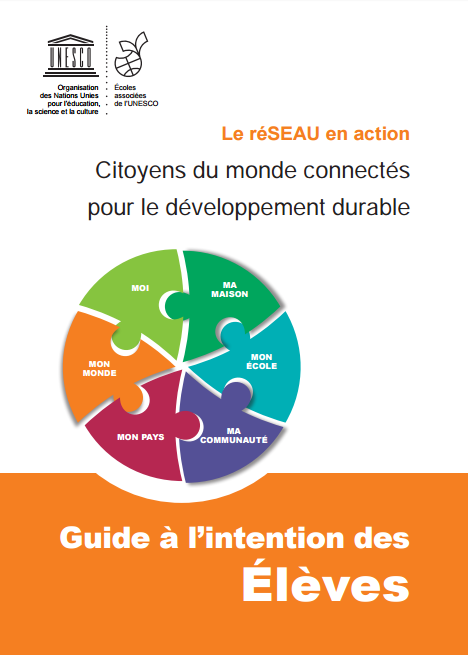 Le réSEAU en action: citoyens du monde connectés pour le développement durable: guide à l'intention des élèves Año de publicación: 2017 Autor corporativo: UNESCO Le guide « Le réSEAU en action : Citoyens du monde connectés pour le développement durable » à l’intention des élèves a pour but d’initier les élèves du secondaire à l’éducation à la citoyenneté mondiale (ECM) et à l’éducation en vue du développement durable (EDD), et de leur proposer des idées et des activités pour qu’ils contribuent activement à la construction d’un monde plus pacifique et durable. Le guide s’appuie sur les discussions et les activités de près de 1 100 participants originaires de 104 pays, notamment des coordinnateurs nationaux du réSEAU, des chefs d’établissement, des enseignants, des élèves et des experts qui ont contribué à la plateforme collaborative en ligne « Le réSEAU en action : Citoyens du monde connectés pour le développement durable » en 2014 et 2015 [http://fr.unesco.org/aspnet/globalcitizens/]. Le guide à l’intention des élèves : donne une idée de ce que signifie « être un citoyen du monde » ainsi que des suggestions pour contribuer au développement durable ; propose des idées pour agir vous-mêmes dans votre foyer, dans votre école, dans votre communauté, dans votre pays et dans le monde ; présente une sélection d’activités sur l’ECM et l’EDD mises en œuvre par des écoles du réSEAU du monde entier.