
Recursos
Exploren una amplia gama de recursos valiosos en GCED para profundizar su comprensión y promover su búsqueda, incidencia, enseñanza y aprendizaje.
2,193 resultados encontrados
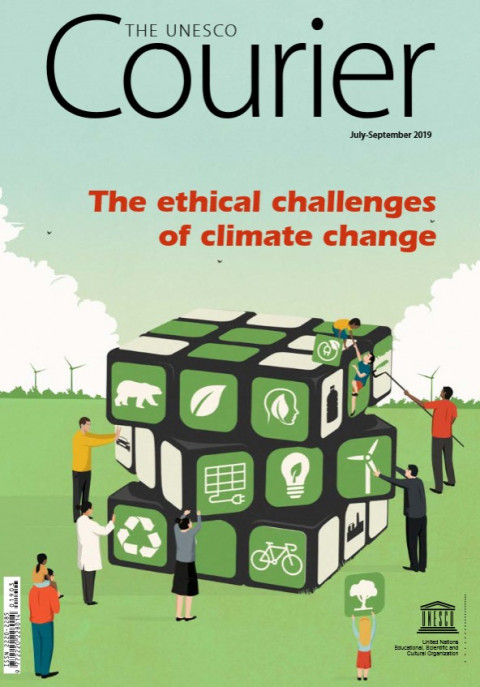 Cambio climático y desafíos éticos (El Correo de la UNESCO 3, July-September 2019) Año de publicación: 2019 Autor corporativo: UNESCO El cambio climático no solo pone en peligro nuestros ecosistemas; también quebranta los cimientos de nuestros derechos fundamentales, agrava la desigualdad y genera nuevas injusticias. La adaptación al cambio climático y la atenuación de sus efectos no es únicamente un asunto de conocimientos científicos y voluntad política, sino que exige además una perspectiva amplia sobre una situación compleja. Con el fin de ayudar a los Estados y demás entidades pertinentes en la toma de las decisiones apropiadas y la ejecución de políticas eficaces en materia de desarrollo sostenible, adaptación al cambio climático y mitigación de sus consecuencias adversas, la UNESCO aprobó en noviembre de 2017 una Declaración de principios éticos en relación con el cambio climático.La ética determina la esencia de todo compromiso. Su capacidad de movilización permite orientar la acción, establecer arbitrajes, decidir entre intereses contradictorios y fijar prioridades. La ética facilita la articulación de la teoría con la práctica, de los principios generales con la voluntad política, y de la toma de conciencia de ámbito mundial con la aplicación de medidas a escala local. The ethical challenges of climate change (The UNESCO Courier no. 3, July-September 2019) Año de publicación: 2019 Autor corporativo: UNESCO Climate change not only threatens our ecosystems, it undermines the foundation of our fundamental rights, deepens inequalities and creates new forms of injustice. Adapting to climate change and trying to mitigate its impacts are not just a matter of scientific knowledge and political will; they also demand a broader view of a complex situation. In order to help Member States and other stakeholders to make appropriate decisions and implement effective policies for sustainable development, adaptation to climate change and the mitigation of its negative effects, UNESCO adopted a Declaration of Ethical Principles in relation to Climate Change in November 2017.Ethics constitute the substantial core of any commitment. As a mobilizing force, ethics can steer action, facilitate arbitration, resolve conflicting interests, and establish priorities. Ethics have the capacity to connect theory with practice, general principles with political will, and global awareness with local actions. Défis climatiques, défis éthiques (Le Courrier de l'UNESCO 3, July-September 2019) Año de publicación: 2019 Autor corporativo: UNESCO Le changement climatique ne met pas seulement en péril nos écosystèmes : il ébranle le socle de nos droits fondamentaux, il creuse les inégalités et crée de nouvelles injustices. S’adapter au changement climatique et tenter d’en atténuer les effets n’est pas seulement affaire de connaissance scientifique et de volonté politique; cela implique une vue d’ensemble sur une situation complexe. Afin d’aider les États et les autres acteurs concernés à prendre des décisions appropriées et à mener des politiques efficaces en matière de développement durable, d’adaptation au changement climatique et d’atténuation de ses effets néfastes, l’UNESCO a adopté, en novembre 2017, une Déclaration de principes éthiques en relation avec le changement climatique.L’éthique constitue le cœur substantiel de tout engagement. Grâce à sa force mobilisatrice, elle permet d’orienter l’action, de faire des arbitrages, de trancher entre des intérêts contradictoires, de fixer des priorités. L’éthique permet d’articuler la théorie et la pratique, les principes généraux et la volonté politique, la prise de conscience globale et les actions locales.
 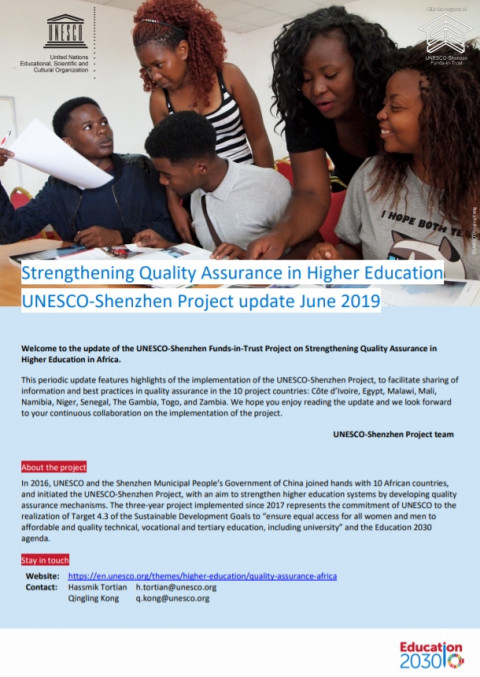 Strengthening Quality Assurance in Higher Education UNESCO-Shenzhen Project Update, June 2019 Año de publicación: 2019 Autor corporativo: UNESCO In 2016, UNESCO and the Shenzhen Municipal People’s Government of China joined hands with 10 African countries, and initiated the UNESCO-Shenzhen Project, with an aim to strengthen higher education systems by developing quality assurance mechanisms. The three-year project implemented since 2017 represents the commitment of UNESCO to the realization of Target 4.3 of the Sustainable Development Goals to “ensure equal access for all women and men to affordable and quality technical, vocational and tertiary education, including university” and the Education 2030 agenda.
 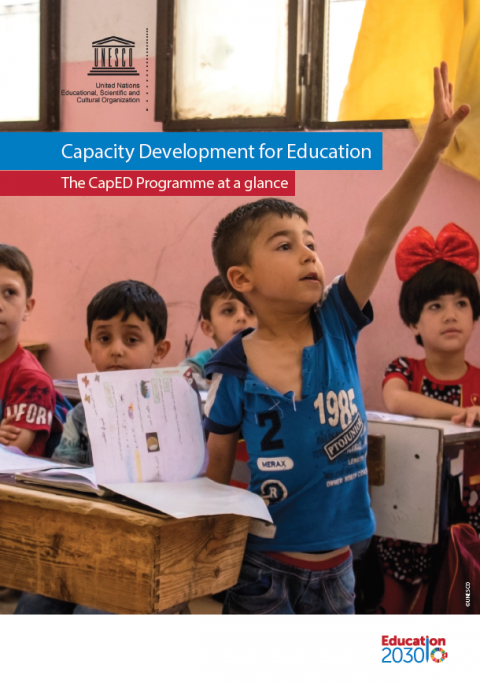 Capacity Develoment for Education: the CapED Programme at a glance Año de publicación: 2019 Autor corporativo: UNESCO Education has the power to transform lives and is at the heart of UNESCO’s mission to build peace, eradicate poverty and drive sustainable development. Right now, 750 million adults – two-thirds women – still lack basic literacy skills. Around 264 million children and youth are out of school and the international community must have almost 69 million new teachers to reach the 2030 education goals. These challenges can be tackled effectively through education reforms. However, these can only take place when countries have the capacities to put this change into action. As well as trained staff, countries need efficient organizational processes, functioning institutions and the tools and resources to design, implement and manage tailored education policies and plans. This is where the CapED Programme steps in. By mobilizing UNESCO’s global network, the Programme provides selected countries with a cohesive package of support. It works alongside stakeholders to reinforce national capacities to undertake evidence-based education reforms that fit into their national priorities and respond to SDG4 commitments, in order to offer quality education opportunities to all.
 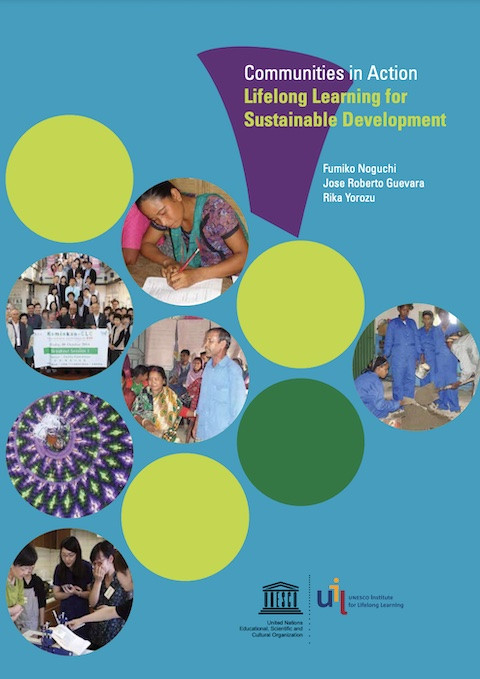 Communities in Action: Lifelong Learning for Sustainable Development Año de publicación: 2015 Autor: Fumiko Noguchi | Jose Roberto Guevara | Rika Yorozu Autor corporativo: UNESCO Institute for Lifelong Learning (UIL) This handbook identifies principles and policy mechanisms to advance communitybased learning for sustainable development, based on the commitments endorsed by the participants of the Kominkan-CLC International Conference on Education for Sustainable Development, which was held in Okayama City, Japan, in October 2014. To inform policymakers and practitioners new to this field, the handbook clarifies the international vision and goals for sustainable development and Education for Sustainable Development (ESD), and identifies the potential contributions of community-based learning centres and organizations. It documents both policy and practice from different regions and concludes with a summary of principles and policy support mechanisms. Communautés en action: Apprendre tout au long de la vie pour le développement durable Año de publicación: 2015 Autor: Fumiko Noguchi | Jose Roberto Guevara | Rika Yorozu Autor corporativo: Institut de l’UNESCO pour l’apprentissage tout au long de la vie (UIL) Ce manuel identifie les principes et les mécanismes politiques de promotion de l’apprentissage communautaire en faveur du développement durable basés sur les engagements pris par les participants à la Conférence internationale des CCA Kominkan sur l’éducation pour le développement durable, accueillie en octobre 2014 par la ville d’Okayama au Japon. Ce manuel clarifie à l’intention des décideurs et des acteurs encore peu familiarisés avec ces problématiques la vision et les objectifs internationaux pour le développement durable et pour l’éducation au développement durable (EDD), et identifie les potentielles contributions des centres et des organisations d’apprentissage communautaire. Il donne des informations à la fois sur les politiques et sur les pratiques des différentes régions et se conclut sur un résumé des principes et mécanismes de soutien politique. Comunidades en acción: Aprendizaje a lo largo de toda la vida para el desarrollo sostenible Año de publicación: 2015 Autor: Fumiko Noguchi | Jose Roberto Guevara | Rika Yorozu Autor corporativo: UNESCO Institute for Lifelong Learning (UIL) En este manual se identifican los principios y los mecanismos asociados a políticas destinados a promover el aprendizaje comunitario para el desarrollo sostenible, sobre la base de los compromisos suscritos por los participantes en la Conferencia Internacional Kominkan-CAC sobre Educación para el Desarrollo Sostenible, celebrada en Okinawa, Japón, en octubre de 2014. Como una manera de poner en antecedentes a los diseñadores de políticas y a los profesionales que se están iniciando en esta área, en el manual se exponen con claridad la visión y los objetivos internacionales respecto del desarrollo sostenible y la educación para el desarrollo sostenible (EDS), y asimismo se identifican las potenciales contribuciones de los centros y las organizaciones de aprendizaje comunitario. El documento entrega información sobre las políticas y las prácticas de distintas regiones, y concluye con un resumen de los principios y los mecanismos de apoyo basados en políticas.
  A Transformative Agenda: Outcomes of the CONFINTEA VII Regional Preparatory Conferences Año de publicación: 2022 Autor corporativo: UNESCO Institute for Lifelong Learning (UIL) In preparation for the Seventh International Conference on Adult Education (CONFINTEA VII), in Marrakech, Morocco, in June 2022, a series of regional conferences took place between February and September 2021, in some cases preceded by sub-regional consultations. Each of the regional preparatory conferences produced an outcome document summarizing the discussion, including key achievements in adult learning and education, crucial challenges and key recommendations. This document provides a synthesis of the outcomes of these regional and subregional consultations and will contribute to the Marrakech Framework for Action, the main outcome document from CONFINTEA VII, as well as providing a guide for all relevant stakeholders and UNESCO Member States to the key current issues in adult learning and education.
  Citizenship Education for Democratic and Sustainable Communities Año de publicación: 2021 Autor: Dimitris Deligiannis | Kleoniki Tsiougou | Vicky Goutha | Antonis Moutselos | Ted Fleming Autor corporativo: UNESCO Institute for Lifelong Learning (UIL) | City of Larissa (Greece) | City of Yeonsu-Gu (Republic of Korea) This publication aims to make readers aware of the importance of citizenship education (CE) in local communities within the framework of lifelong learning. It supports cities and citizens in advancing their work on this critical aspect of formal and non-formal education, and in striving for progress in the provision of CE for youth and adult learners. It is mainly based on information from the 2020 survey of cluster members, as well as on case studies and inputs from the conference, ‘Strengthening citizenship education at local level’, which was held virtually on 12 and 13 November 2020.