
Recursos
Exploren una amplia gama de recursos valiosos en GCED para profundizar su comprensión y promover su búsqueda, incidencia, enseñanza y aprendizaje.
3,224 resultados encontrados
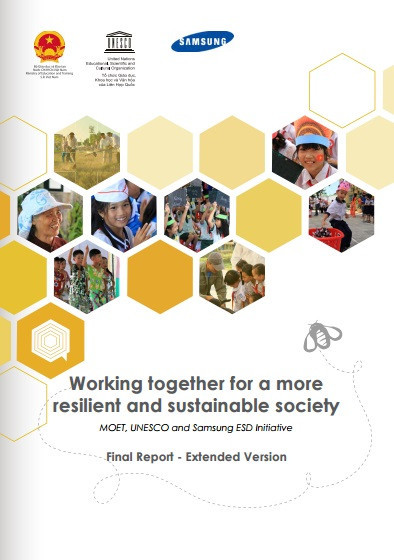 Working Together for a More Resilient and Sustainable Society: MOET, UNESCOand Samsung ESD Initiative; Final Report - Extended Version Año de publicación: 2015 Autor corporativo: UNESCO Hanoi The overarching aim of the ESD Initiative is to support Viet Nam in shaping a more resilient and sustainable learning society. The strategy for the ESD Initiative was developed to establish enabling environments for students to better apply what they learn in school within their homes and communities, and to enhance the education of parents and the community through students. The strategy applies to various themes under ESD. In the case of the current implementation of the Initiative, the key areas are: climate change mitigation and adaptation, disaster risk reduction and biodiversity conservation and restoration, in line with the United Nations Decade of Education for Sustainable Development (UN DESD) and national needs and strategies.
  UNESCO World Conference on Education for Sustainable Development: Conference Report by the General Rapporteur Año de publicación: 2015 Autor: Heila Lotz-Sisitka Under the banner of ‘Learning Today for a Sustainable Future’, the World Conference on Education for Sustainable Development (WCESD), hosted in Aichi-Nagoya, from 10–12 November 2014, marked and celebrated the end of the United Nations (UN) Decade of Education for Sustainable Development (DESD, 2005–2014). It also saw the launch of the Global Action Programme on Education for Sustainable Development and adoption of the Aichi-Nagoya Declaration. The DESD was established out of an agreement amongst Member States to strengthen the role of education in achieving sustainable development at the World Summit on Sustainable Development in 2002. Through the adoption of Resolution 57/254 in 2002, the UN General Assembly declared the DESD, to take place from 2005 to 2014, and tasked UNESCO as the lead agency. The WCESD, organized at the end of the DESD by UNESCO and the Government of Japan, provided an important opportunity to consolidate the outcomes of the DESD, and to frame the way forward for Education for Sustainable Development (ESD) at global level.
  Teachers' guide for education for sustainable development in the Caribbean Año de publicación: 2008 Autor: Gillian Cambers | Grace Chapman | Paul Diamond | Lorna Down | Anthony D. Griffith | Winthrop Wiltshire Autor corporativo: UNESCO Santiago The publication “Teachers’ Guide for Education for Sustainable Development in the Caribbean” is geared towards regional teacher-trainers and teachers active at every level of education. Its purpose is two-fold: contribute to the integration of education for sustainable development into teaching practices through education initiatives, originally implemented in the Caribbean that may be feasible to replicate in the various classrooms, schools and communities; promote reflection, discussion and creation of innovative practices that involve all teachers in Decade activities and contribute to the making of sustainable societies. This document illustrates how different wills can come together moved by a desire to materialise common projects. Thus, this effort represents the work of regional specialists working in close cooperation with UNESCO Regional Bureau for Education in Latin America and the Caribbean, as well as the financial support of the Government of Japan. Guide pédagogique pour l'éducation pour le développement durable dans les Caraïbes Año de publicación: 2008 Autor: Gillian Cambers | Grace Chapman | Paul Diamond | Lorna Down | Anthony D. Griffith | Winthrop Wiltshire Autor corporativo: UNESCO Santiago La publication «Guide des enseignants pour l'éducation pour le développement durable dans les Caraïbes» s'adresse aux formateurs et enseignants régionaux actifs à tous les niveaux de l'enseignement. Son objectif est double: contribuer à l'intégration de l'éducation pour le développement durable dans les pratiques d'enseignement à travers des initiatives éducatives, initialement mises en œuvre dans les Caraïbes, qui peuvent être répliquées dans les différentes classes, écoles et communautés; Promouvoir la réflexion, le débat et la création de pratiques novatrices qui impliquent tous les enseignants dans les activités de la Décennie et contribuent à la création de sociétés durables. Ce document illustre la façon dont des volontés différentes peuvent se rencontrer par le désir de concrétiser des projets communs. Cet effort représente donc le travail de spécialistes régionaux travaillant en étroite coopération avec le Bureau régional de l'UNESCO pour l'éducation en Amérique latine et dans les Caraïbes, ainsi que le soutien financier du Gouvernement japonais. Regional guiding framework of education for sustainable development in the Arab Region Año de publicación: 2008 Autor corporativo: UNESCO Beirut The Regional Guiding Framework of Education for Sustainable Education in the Arab Region (2005-2014) provides a general and reference vision of the activities that could be implemented by any of the partners such as education and training institutions, production and services, international and regional organizations, civil society and NGOs, within the framework of the DESD. The Framework highlighted the role of partners and beneficiaries in the implementation of joint activities related to society, life and work within the UN DESD. Annex (3) in the Arabic text provides details description of the expected role of partners in the region. Cadre directeur régional de l'éducation pour le développement durable dans la région Arabe Año de publicación: 2008 Autor corporativo: UNESCO Beirut Le Cadre directeur régional de l'éducation pour une éducation durable dans la région arabe (2005-2014) fournit une vision générale et de référence des activités qui pourraient être mises en œuvre par l'un ou l'autre des partenaires tels que les établissements d'enseignement et de formation, la production et les services, Organisations, la société civile et les ONG, dans le cadre du DEDD. Le Cadre a souligné le rôle des partenaires et des bénéficiaires dans la mise en œuvre des activités conjointes liées à la société, à la vie et au travail au sein du DEDD de l'ONU. L'annexe (3) du texte arabe fournit une description détaillée du rôle attendu des partenaires dans la région.
  Orienting technical and vocational education and training for sustainable development: a discussion paper Año de publicación: 2006 Autor corporativo: UNESCO International Centre for Technical and Vocational Education and Training (UNEVOC) The current Discussion Paper on “Orienting Technical and Vocational Education and Training (TVET) for Sustainable Development” presents an overview of key concepts, trends and issues in the field of TVET for sustainable development. It has been prepared by the UNESCO-UNEVOC International Centre, in consultation with a number of UNEVOC Centres and partner agencies and several leading researchers, policy-makers and practitioners working in this field. This paper reflects the outcomes of discussions that took place at the UNESCO International Experts Meeting on “Learning for Work, Citizenship and Sustainability”, which was held in Bonn, Germany, in October 2004. The current document is based on the discussion paper prepared for the UNESCO International Experts Meeting, and was modified in the light of the outcomes of this important meeting.
  Globalization and education for sustainable development: sustaining the future Año de publicación: 2006 Autor: Laura Wong Autor corporativo: United Nations University This publication presents the contributions and outcomes of the stimulating two day gathering in Nagoya, where representatives of governments, academia and civil society gathered to share their experiences and develop their ideas about how to ensure ESD within the context of globalizing societies. La mondialisation et l'éducation pour le développement durable: le maintien de l'avenir Año de publicación: 2006 Autor: Laura Wong Autor corporativo: United Nations University Cette publication présente les contributions et les résultats de la stimulation de la collecte de deux jours à Nagoya, où les représentants des gouvernements, des universités et de la société civile se sont réunis pour partager leurs expériences et de développer leurs idées sur la façon d'assurer l'EDD dans le contexte des sociétés de mondialisation. Envisioning education beyond 2015: Asia-Pacific regional perspectives; final report Año de publicación: 2014 Autor corporativo: UNESCO Bangkok This report provides a thorough account of the discussions and deliberations that led to the construction of the Asia-Pacific Statement on Education Beyond 2015 (Bangkok Statement), the outcome document of this historic event. Participants reviewed in fine detail EFA progress across the Asia-Pacific region and debated key thematic areas of basic education, skills and competencies, global citizenship education, education for sustainable development, teachers, governance and finance. Participants also looked into implementation strategies, and education ministers from across the region shared their views on remaining challenges, future priorities and strategies for education beyond 2015.