
Recursos
Exploren una amplia gama de recursos valiosos en GCED para profundizar su comprensión y promover su búsqueda, incidencia, enseñanza y aprendizaje.
2,681 resultados encontrados
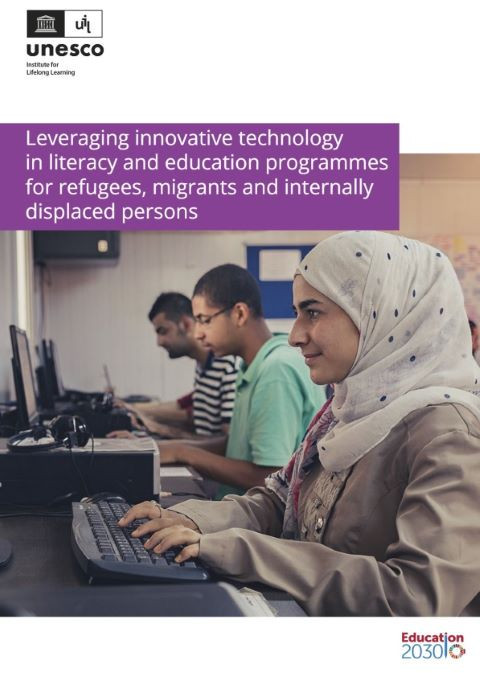 Leveraging Innovative Technology in Literacy and Education Programmes for Refugees, Migrants and Internally Displaced Persons Año de publicación: 2022 Autor corporativo: UNESCO Institute for Lifelong Learning (UIL) The publication Leveraging innovative technology in literacy and education programmes for refugees, migrants and internally displaced persons brings together a selection of 21 case studies showcasing how ICTs can be integrated both innovatively and effectively into literacy and education programmes for refugees, migrants and IDPs. The case studies in this compilation demonstrate the potential of technology to support learners’ acquisition of literacy skills through arts-based learning, integrated literacy programmes, entrepreneurship training or in combination with tertiary education opportunities. They highlight the multitude of stakeholders that have come together across sectors to shape innovative responses that can make a real difference to learners’ lives. At the same time, the compilation shows the various modalities through which technology can be harnessed to deliver effective literacy and educational opportunities in diverse and challenging environments while recognizing and remaining sensitive to the needs of learners, be they refugees, IDPs or migrants.
  Gender Digital Divide Assessment: Uzbekistan Año de publicación: 2023 Autor corporativo: UNDP Uzbekistan The Government of the Republic of Uzbekistan, realizing the negative impact of the gender digital divide on the development of the country, has included the issue of ensuring gender digital equality among its priorities. The United Nations Development Programme in Uzbekistan conducted an assessment to measure and analyze the main factors affecting the digital inclusion (or isolation) of women and girls, and recommended a number of actions that the Government can take to address existing gaps. Оценка гендерного цифрового разрыва: Республика Узбекистан Año de publicación: 2023 Autor corporativo: UNDP Узбекистан Правительство Республики Узбекистан, осознавая негативное влияние гендерного цифрового разрыва на развитие страны, включило вопрос обеспечения гендерного цифрового равенства в число своих приоритетов. Программа развития ООН в Узбекистане провела оценку с целью измерения и анализа основных факторов, влияющих на цифровую инклюзию (или изоляцию) женщин и девочек, и рекомендовала ряд действий, которые правительство может предпринять для устранения существующих разрывов.
  Curriculum GlobALE: Competency Framework for Adult Educators Año de publicación: 2021 Autor corporativo: DVV International | German Institute for Adult Education, Leibniz Centre for Lifelong Learning | International Council for Adult Education | UNESCO Institute for Lifelong Learning (UIL) This publication introduces Curriculum globALE, a basic com- petence framework for the training of adult educators worldwide. By providing a modular, competency-based framework and cross-curricular approach, Curriculum globALE is unique in its aim to professionalize adult learning and education (ALE) on an international scale, via the competencies that support adult educators to work in any educational setting, field or form.It strives to ensure that educators’ knowledge, competencies, skills and attitudes are of a professional standard.Curriculum globALE is suitable to different contexts and its character and structure enables its inclusion in diverse national education systems.Curriculum globALE aims to: enhance the professionalization of ALE by providing a common reference framework for adult learning programmes and a suggested standard of competencies for adult educators; support ALE providers in the design and implementation of ‘train-the-trainer’programmes; foster knowledge exchange and mutual understanding between adult educators worldwide. Curriculum GlobALE: Un curriculum mondial sur l’apprentissage et l’éducation des adultes Año de publicación: 2021 Autor corporativo: DVV International | German Institute for Adult Education, Leibniz Centre for Lifelong Learning | International Council for Adult Education | Institut de l’UNESCO pour l’apprentissage tout au long de la vie (UIL) Cette publication présente Curriculum globALE, un cadre de compétences de base pour la formation des éducateurs d'adultes dans le monde. En fournissant un cadre modulaire basé sur les compétences et une approche interdisciplinaire, Curriculum globALE est unique dans son objectif de professionnaliser l'apprentissage et l'éducation des adultes (ALE) à l'échelle internationale, via les compétences qui aident les éducateurs d'adultes à travailler dans n'importe quel cadre éducatif, champ ou formulaire. Il s'efforce de veiller à ce que les connaissances, les compétences, les aptitudes et les attitudes des éducateurs soient d'un niveau professionnel. Curriculum globALE est adapté à différents contextes et son caractère et sa structure permettent son inclusion dans divers systèmes éducatifs nationaux. Curriculum globALE vise à : améliorer la professionnalisation de l'AEA en fournissant un cadre de référence commun pour les programmes d'apprentissage des adultes et une proposition de norme de compétences pour les éducateurs d'adultes soutenir les prestataires d'AEA dans la conception et la mise en œuvre de programmes de « formation des formateurs » favoriser l'échange de connaissances et la compréhension mutuelle entre les éducateurs d'adultes du monde entier.
  학교 수준 민주시민교육을 위한 교육과정 개선 방안 Año de publicación: 2020 Autor: 장의선 | 김기철 | 박진용 | 박태준 | 이인태 | 강대현 | 정윤미 Autor corporativo: 한국교육과정평가원 본 연구의 목적은 먼저 세계화가 이미 일상화 된 21세기의 학생들에게 요구되는 민주시민성을 폭넓게 성찰하고, 이를 측정할 수 있는 민주시민성 지표를 구안한 후, 구안한 지표를 준거로 민주시민성 인식 및 교육과정 현황 등 민주시민교육 관련 주요 실태와 요구를 분석하여, 민주시민교육 강화를 위한 교육과정 개선안을 도출하는 데 있다.
 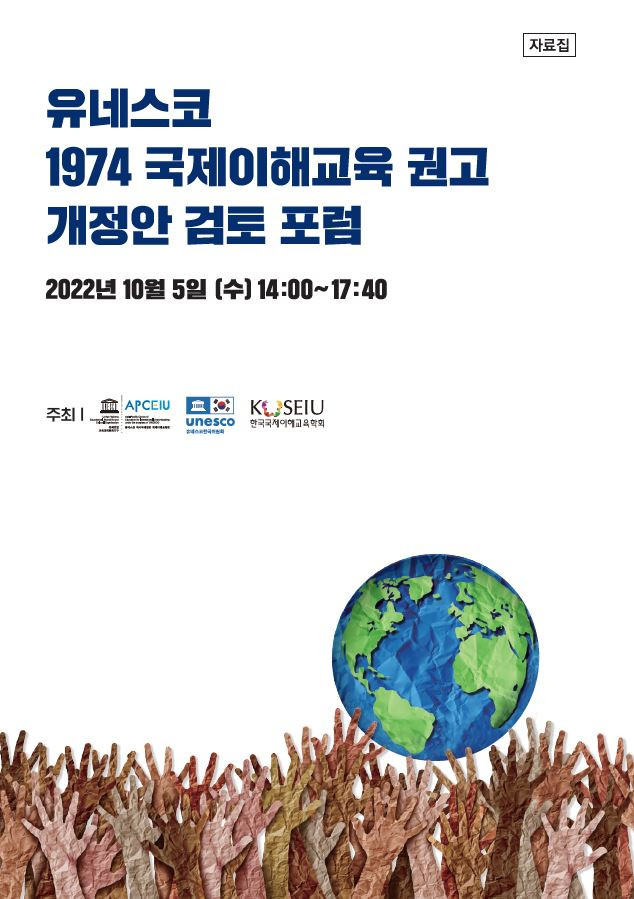 유네스코 1974 국제이해교육 권고 개정안 검토 포럼 자료집 Año de publicación: 2022 Autor corporativo: 한국국제이해교육학회 | 유네스코 아시아태평양 국제이해교육원 | 유네스코한국위원회 2022년 10월 5일 유네스코 아태교육원과 유네스코한국위원회, 한국국제이해교육학회가 공동으로 개최한 <유네스코 1974 국제이해교육 권고 개정안 검토 포럼> 자료집 입니다. 본 포럼은 유네스코의 「국제이해, 협력, 평화를 위한 교육과 인권, 기본 자유에 관한 교육 권고( 1974 국제이해교육 권고)」가 오늘날 변화된 시대 상황과 지구촌의 새로운 과제 등을 반영할 수 있도록 개정안 초안에 대한 전문적 검토 요지 발표와 토론을 실시한 후, 참가자들의 의견을 수렴하였습니다. <목차> I. 인사말 한경구 (유네스코한국위원회 사무총장) 임현묵 (유네스코 아시아태평양 국제이해교육원장) 박순용 (한국국제이해교육학회장) II. [1부] 1974 국제이해교육 권고 개정 배경 및 현황 1974 국제이해교육 권고 개요와 개정 추진 현황 - 유네스코 아시아태평양 국제이해교육원 / 유네스코한국위원회 국제전문가그룹의 주요 활동 및 1974 국제이해교육 권고 개정안 초안의 주요 내용 / 강순원 (한신대학교 교수) III. [2부] 1974 국제이해교육 권고 개정안 초안 검토 조대훈 (성신여자대학교 교수) 김병연 (양재고등학교 교사) 권혁장 (국가인권위원회 인권교육기획과장) 이선경 (청주교육대학교 교수) 변순용 (서울교육대학교 교수) 이동연 (한국예술종합학교 교수) 손동빈/장경희 (서울시교육청 민주시민생활교육과 과장/장학사) 부록 Recommendation concerning Education for International Understanding, Co-operation and Peace and Education relating to Human Rights and Fundamental Freedoms 국제이해, 협력, 평화를 위한 교육과 인권, 기본 자유에 관한 교육 권고 REVISED RECOMMENDATION CONCERNING EDUCATION FOR INTERNATIONAL UNDERSTANDING, CO-OPERATION AND PEACE AND EDUCATION RELATING TO HUMAN RIGHTS AND FUNDAMENTAL FREEDOMS (‘1974 RECOMMENDATION’)
  한국의 세계시민교육 이행 현황 및 향후 실천과제 (국제이해교육연구; Vol. 19, No. 2) Año de publicación: 2024 Autor: 김종훈 Autor corporativo: 한국국제이해교육학회 본 연구는 유엔(UN) SDG 4.7 글로벌 지표에서 제시하는 4가지 영역인 국가 교육정책, 교육과정, 교사교육, 학생평가 측면에서 2015년 이후 한국의 세계시민교육 이행 현황을 분석하고, SDG 4.7 달성을 더욱 효과적으로 이행하기 위한 향후 실천과제를 제시하는 데 목적을 두었다. 연구 목적을 달성하기 위해 관련 법령 정보, 교육부 및 17개 시도교육청과 유관 기관에서 생산한 세계시민교육 관련 정책 문서와 보고서, 세계시민교육 관련 문헌 등을 활용하였다. 연구 결과, 세계시민교육은 2015년 이후 한국 교육의 기본 원칙과 방향으로 그 정당성을 확보해 가면서 한국의 국가 교육정책, 교육과정, 교사교육, 학생평가에서 점차 주류로서 그 지위를 확보해 가고 있는 것으로 나타났다. 이에 따른 향후 실천과제로는 세계시민교육을 한국의 교육 시스템에 안착시키고 SDG 4.7을 이행하기 위해 필요한 국가적 차원의 정책 마련과 실천을 제시하였다.
  ‘평화, 인권, 국제이해, 협력, 기본적 자유, 세계시민성, 지속가능발전을 위한 교육 권고’에서 제시한 지속가능발전교육 내용과 향후 실천 과제 (국제이해교육연구; Vol. 19, No. 2) Año de publicación: 2024 Autor: 김다원 Autor corporativo: 한국국제이해교육학회 본 연구는 2023년 11월 유네스코 제42차 총회에서 개정된 1974 국제이해교육 개정 권고에 제시된 지속가능발전교육의 내용과 향후 과제를 파악하는 데 목적을 두었다. 본 개정 권고에서는 새롭게 ‘세계시민성’, ‘지속가능발전’을 위한 교육을 적극적으로 포함하였다. 유엔과 유네스코에서는 1992년 리우 선언 발표, 2004년 ‘지속가능발전교육 10년(2005~2014)’ 추진, 2015년 ‘지속가능발전을 위한 2030 어젠더’에서 글로벌 추진 과제로 지속가능발전목표(SDGs)를 제시하여 전 세계에 적극적인 지속가능발전교육의 실행을 요청해 왔다. 이러한 흐름에서 1974 국제이해교육 개정 권고는 그간의 지속가능발전을 위한 교육의 흐름을 반영하면서도 최근의 글로벌 사회에서 나타나고 있는 기후변화, 분쟁과 갈등, 심화되는 불평등 등의 문제를 해결하고 인류 평화와 지구 생태계 유지를 위해 필요한 지속가능발전교육이 무엇인지를 제시했다는 데 각별한 의미가 있다. 이러한 배경에서 본 연구는 1974 국제이해교육 개정 권고에 제시된 지속가능발전교육의 성격, 목표, 방법을 분석적 시각으로 살펴보았다. 그리고 이를 토대로 향후 한국 지속가능발전교육의 해결해야 할 과제와 방향을 모색하였다.
  Integrating Gender into Global Citizenship Education (Journal of Education for International Understanding; Vol. 14, No. 1) Año de publicación: 2019 Autor: Hyeseung Cho Autor corporativo: Korean Society of Education for International Understanding (KOSEIU) The purpose of this study is to explore the contents of global citizenship education(GCE) from a gender perspective, and to lay the theoretical foundation to integrate gender issues into GCE. To this end, this research analyzes GCE textbooks published by four Metropolitan City Offices of Education employing content analysis. As results, GCE textbooks rarely include contents related to gender (in)equality by representing 5.26%, 3.81%, and 8.97% of the textbooks of elementary, middle and high school respectively. In terms of topics, although a word of gender (in)equality is mentioned as an international agenda or a global problems in textbooks, the specific concept of it or various worldwide gender inequalities issues such as gender-based violence, women in poverty, reproductive rights were excluded. In terms of format aspects of the textbooks, the textbooks present gender perspective by describing woman as an independent global citizen, and by ensuring the equality of gender composition of characters. In some cases, however, the roles of women and men in textbooks are still divided, and gender stereotype was recognized through sex=segregated activities. Based on these results, this research argues that it is required to expand the contents of GCE by including the importance of gender equality and global structural gender inequality problems, and that it is necessary to review the discourse and practice of GCE in Korea from a gender perspective.