
Recursos
Exploren una amplia gama de recursos valiosos en GCED para profundizar su comprensión y promover su búsqueda, incidencia, enseñanza y aprendizaje.
3,401 resultados encontrados
 2014 GEM Final Statement: The Muscat Agreement Año de publicación: 2014 Autor corporativo: UNESCO This statement is agreed by Ministers, heads of delegations, leading officials of multilateral and bilateral organizations, and senior representatives of civil society and private sector organizations at the Global Education for All (EFA) Meeting in Muscat, Oman on May 12-14, 2014. Recalling the GEM 2012 Final Statement, the conference took note of the 2013/14 EFA Global Monitoring Report, the regional EFA reports, the Resolution of the 37th session of UNESCO's General Conference on Education Beyond 2015, the Decision of the Executive Board of UNESCO at its 194th session and the Joint Proposal of the EFA Steering Committee on Education Post-2015. 2014 GEM Final Statement: The Muscat Agreement Año de publicación: 2014 Autor corporativo: Organisation des Nations Unies pour l'éducation, la science et la culture (UNESCO) Cette déclaration est acceptée par les Ministres, les chefs de délégation, de hauts responsables d'organisations multilatérales et bilatérales, et les hauts représentants de la société civile et des organisations du secteur privé à l'Education pour tous (EPT) Réunion à Muscat, Oman du 12 au 14 mai 2014 . Rappelant la Déclaration finale SEM 2012, la conférence a pris note de l'EPT Rapport mondial de suivi 2013/14, rapporte l'EPT régional, la résolution de la 37e session de la Conférence générale de l'UNESCO sur l'éducation au-delà de 2015, la décision du Conseil exécutif de l'UNESCO à sa 194e session et la proposition conjointe du Comité directeur de l'EPT sur l'éducation post-2015. 2014 무스카트 협약, ‘모두를 위한 교육(EFA)’에 관한 세계 회의 최종 선언문 Año de publicación: 2014 Autor corporativo: 유네스코 본 성명서는 2014년 5월 12일에서 14일까지 오만(Oman)의 무스카트(Muscat)에서 이루어진 유네스코 ‘모두를 위한 교육(이하 EFA)’을 위한 글로벌 교육 회의에서 장관, 대표단, 다자 및 양자간 조직의 주요 관계자, 시민 사회 및 민간 부분 조직의 수석 대표들이 모여 합의한 것이다. 본 회의에선 2012 글로벌 교육현황(이하 GEM) 보고서, 2013/14 ‘EFA 글로벌 모니터링 회의 보고서’, 지역 EFA 보고서, 2015년 이후 제 37차 세션 유네스코 총회의 결의안, post-2015 유네스코 운영 위원회의 공동 제안 및 194차 유네스코 집행위원회 결정 회의에 관한 결의안을 재작성 하였다.
 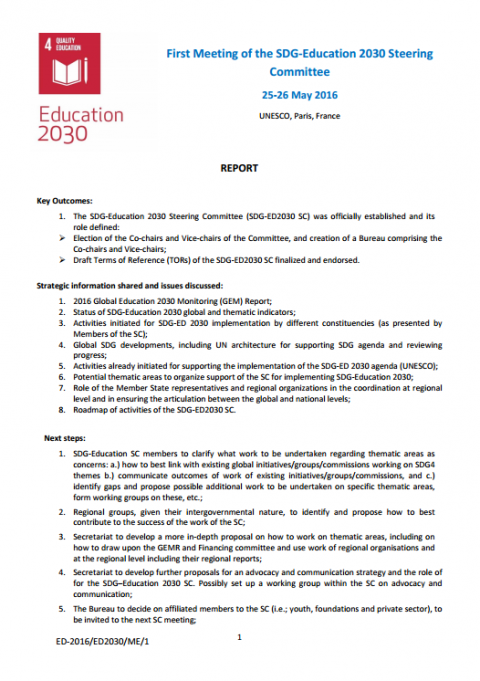 First Meeting of the SDG-Education 2030 Steering Committee: report Año de publicación: 2016 Autor corporativo: منظمة الأمم المتحدة للتربية والعلم والثقافة (UNESCO) The present report provides the first SDG-education 2030 Steering Committee meeting programme, a short summary of key outcomes and decisions, as well as a second part including a more detailed summary of deliberations reflecting the themes, issues and understandings emerging from the discussions.
 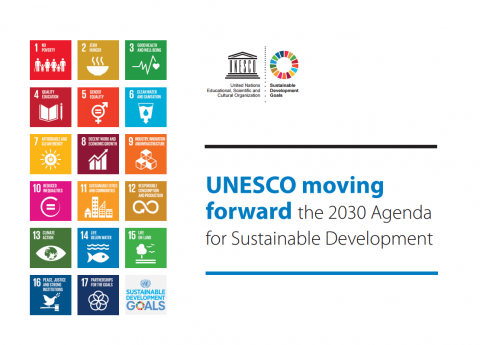 UNESCO moving forward the 2030 Agenda for Sustainable Development Año de publicación: 2017 Autor corporativo: UNESCO The United Nations 2030 Agenda for Sustainable Development, with its 17 Sustainable Development Goals, sets forth a bold new framework for development cooperation over the next 15 years. This agenda aspires to ensure prosperity and well-being for all women and men, while protecting our planet and strengthening the foundations for peace. L'UNESCO fait avancer le Programme de développement durable à l'horizon 2030 Año de publicación: 2017 Autor corporativo: Organisation des Nations Unies pour l'éducation, la science et la culture (UNESCO) The United Nations 2030 Agenda for Sustainable Development, with its 17 Sustainable Development Goals, sets forth a bold new framework for development cooperation over the next 15 years. This agenda aspires to ensure prosperity and well-being for all women and men, while protecting our planet and strengthening the foundations for peace.
  Education Transforms Lives Año de publicación: 2017 Autor corporativo: UNESCO This brochure explores UNESCO’s role in leading and coordinating the Education 2030 Agenda, which is part of a global movement to eradicate poverty through 17 Sustainable Development Goals by 2030. Education, essential to achieve all of these goals, has its own dedicated Goal 4, which aims to “ensure inclusive and equitable quality education and promote lifelong learning opportunities for all”. UNESCO is the United Nations’ specialized agency for education and the Education Sector provides global and regional leadership in education and responds to contemporary global challenges through education with a special focus on gender equality and Africa. L’éducation transforme la vie Año de publicación: 2017 Autor corporativo: Organisation des Nations Unies pour l'éducation, la science et la culture (UNESCO) Grâce au nouveau Programme audacieux de développement durable entériné par la communauté internationale en septembre 2015, le monde s’est fixé pour objectif d’éradiquer la pauvreté à l’horizon 2030 à travers 17 Objectifs de développement durable (ODD). Ces objectifs ambitieux ont été adoptés à l’unanimité par les 193 États membres de l’Organisation des Nations Unies. C’est à ces derniers qu’incombe en premier lieu la responsabilité de les réaliser. L’éducation, cruciale pour atteindre l’ensemble des ODD, bénéficie d’un objectif dédié, l’ODD 4, visant à « assurer l’accès de tous à une éducation de qualité, sur un pied d’égalité, et promouvoir les possibilités d’apprentissage tout au long de la vie ».L’UNESCO est la seule agence des Nations Unies chargée de tous les aspects de l’éducation et possède également un réseau mondial d’instituts et de bureaux spécialisés. C’est pourquoi elle s’est vue confier la direction et la coordination de cet objectif, aux côtés de ses partenaires, par le biais de l’agenda Éducation 2030.
 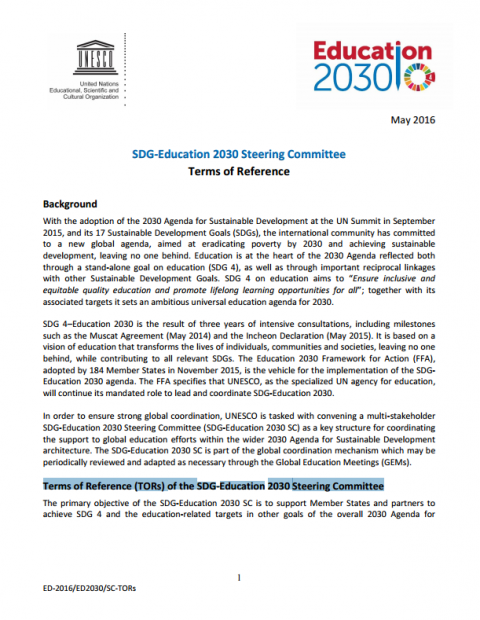 SDG-Education 2030 Steering Committee: Terms of Reference Año de publicación: 2016 Autor corporativo: 유네스코 This paper is the terms of reference of the SDG-Education 2030 Steering Committee.
 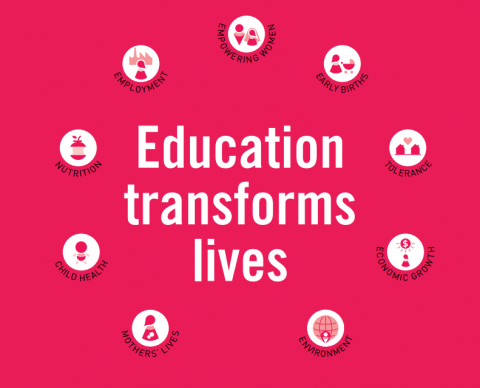 Education Transforms Lives Año de publicación: 2013 Autor corporativo: UNESCO Education lights every stage of the journey to a better life, especially for the poor and the most vulnerable. Education’s unique power to act as a catalyst for wider development goals can only be fully realized, however, if it is equitable. That means making special efforts to ensure that all children and young people – regardless of their family income, where they live, their gender, their ethnicity, whether they are disabled – can benefit equally from its transformative power. Education empowers girls and young women, in particular, by increasing their chances of getting jobs, staying healthy and participating fully in society – and it boosts their children’s chances of leading healthy lives. To unlock the wider benefits of education, all children need the chance to complete not only primary school but also lower secondary school. And access to schooling is not enough on its own: education needs to be of good quality so that children actually learn. Given education’s transformative power, it needs to be a central part of any post-2015 global development framework.