
Recursos
Exploren una amplia gama de recursos valiosos en GCED para profundizar su comprensión y promover su búsqueda, incidencia, enseñanza y aprendizaje.
2,661 resultados encontrados
 Education in Africa: placing equity at the heart of policy; executive summary Año de publicación: 2023 Autor corporativo: UNESCO Dakar | Union Africaine This report follows the request made by the Member States of the African Union during the 2018 Pan-African High-Level Conference on Education. It aims to support the efforts undertaken by African countries to accelerate the achievement of the targets and strategic objectives set out in the 2030 Agenda and the Continental Education Strategy for Africa (CESA). This first report highlights the need to place equity at the heart of efforts to improve access to and the quality of education, without which efforts to improve access to and the quality of education could inadvertently widen existing inequalities. L’éducation en Afrique: Placer l’équité au cœur des politiques Año de publicación: 2023 Autor corporativo: UNESCO Dakar | Union Africaine Ce rapport fait suite à la demande formulée par les États membres de l'Union Africaine au cours de la Conférence panafricaine de haut niveau sur l’éducation de 2018. Il vise à soutenir les efforts entrepris par les pays africains afin d’accélérer la réalisation des cibles et des objectifs stratégiques fixés dans le Programme 2030 et la Stratégie continentale de l’éducation pour l’Afrique (CESA). Ce premier rapport met en lumière la nécessité d’accorder une place centrale à l’équité, sans laquelle les efforts d’amélioration de l’accès à l’éducation et de sa qualité pourraient involontairement creuser les inégalités existantes. This report follows the request made by the Member States of the African Union during the 2018 Pan-African High-Level Conference on Education. It aims to support the efforts undertaken by African countries to accelerate the achievement of the targets and strategic objectives set out in the 2030 Agenda and the Continental Education Strategy for Africa (CESA). This first report highlights the need to place equity at the heart of efforts to improve access to and the quality of education, without which efforts to improve access to and the quality of education could inadvertently widen existing inequalities. A Educação na África: colocar a igualdade no cerne da política; sumário executivo Año de publicación: 2023 Autor corporativo: UNESCO Dakar | Union Africaine Ce rapport fait suite à la demande formulée par les États membres de l'Union Africaine au cours de la Conférence panafricaine de haut niveau sur l’éducation de 2018. Il vise à soutenir les efforts entrepris par les pays africains afin d’accélérer la réalisation des cibles et des objectifs stratégiques fixés dans le Programme 2030 et la Stratégie continentale de l’éducation pour l’Afrique (CESA). Ce premier rapport met en lumière la nécessité d’accorder une place centrale à l’équité, sans laquelle les efforts d’amélioration de l’accès à l’éducation et de sa qualité pourraient involontairement creuser les inégalités existantes. This report follows the request made by the Member States of the African Union during the 2018 Pan-African High-Level Conference on Education. It aims to support the efforts undertaken by African countries to accelerate the achievement of the targets and strategic objectives set out in the 2030 Agenda and the Continental Education Strategy for Africa (CESA). This first report highlights the need to place equity at the heart of efforts to improve access to and the quality of education, without which efforts to improve access to and the quality of education could inadvertently widen existing inequalities.
  Rising Beyond: Aiming towards a Brighter Future Año de publicación: 2021 Autor: Aarya Chavda As children, how do we truly define a better understanding towards the right to choose, right to dream and right to self-express? This book emphasizes on the true meaning that there is no duty more important than ensuring that children’s rights are respected. التعليم في أفريقيا: إدماج الإنصاف في صميم السياسات التعليمية; ملخص تنفيذي Año de publicación: 2023 Autor corporativo: UNESCO Dakar | Union Africaine Ce rapport fait suite à la demande formulée par les États membres de l'Union Africaine au cours de la Conférence panafricaine de haut niveau sur l’éducation de 2018. Il vise à soutenir les efforts entrepris par les pays africains afin d’accélérer la réalisation des cibles et des objectifs stratégiques fixés dans le Programme 2030 et la Stratégie continentale de l’éducation pour l’Afrique (CESA). Ce premier rapport met en lumière la nécessité d’accorder une place centrale à l’équité, sans laquelle les efforts d’amélioration de l’accès à l’éducation et de sa qualité pourraient involontairement creuser les inégalités existantes. This report follows the request made by the Member States of the African Union during the 2018 Pan-African High-Level Conference on Education. It aims to support the efforts undertaken by African countries to accelerate the achievement of the targets and strategic objectives set out in the 2030 Agenda and the Continental Education Strategy for Africa (CESA). This first report highlights the need to place equity at the heart of efforts to improve access to and the quality of education, without which efforts to improve access to and the quality of education could inadvertently widen existing inequalities.
 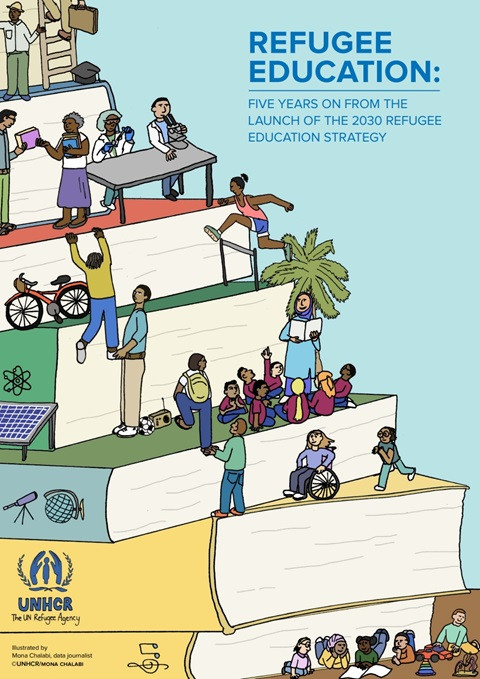 Refugee Education; Five Years on from the Launch of the 2030 Refugee Education Strategy Año de publicación: 2024 Autor: Cirenia Chavez Villegas | Kate Bond Autor corporativo: UN. Office of the United Nations High Commissioner for Refugees (UNHCR) The 2024 UNHCR Refugee Education Report draws on data from more than 65 countries worldwide to provide the most detailed picture yet of the state of refugee education and enrolment. The report reflects on the 2030 Refugee Education Strategy (launched in 2019) and where notable progress has been made as well as areas where greater investment and enhanced collaboration are needed to meet the strategic objectives of the Strategy.
  Report on the Right to Education in Human Mobility in Central America, the Dominican Republic and Mexico: Towards Inclusive, Equitable, Quality Education With Lifelong Learning Opportunities Año de publicación: 2024 Autor corporativo: UNESCO San José | Central American Educational and Cultural Coordination | Central American Integration System Although human mobility is not a new phenomenon, data indicate that the number of people in this situation has reached its highest point since records began and there are no signs that the trend will decrease in the coming years. This scenario threatens to become a structural situation, strongly impacting the right to education and educational systems. Therefore, it is imperative that States and other key actors make a deep commitment to guarantee the fundamental right to education of people in situations of mobility through urgent measures, in line with the provisions of Sustainable Development Goal (SDG) 4 of the United Nations 2030 Agenda. For this reason, the preparation of this Report on the right to education of people in situations of mobility in Belize, Costa Rica, El Salvador, Guatemala, Honduras, Mexico, Nicaragua, Panama and the Dominican Republic has been undertaken. The Report is an effort by UNESCO and the Central American Educational and Cultural Coordination (CECC/SICA) in collaboration with UNHCR, IOM, UNICEF, the Norwegian Refugee Council and RET International, and with the technical support of the SES Foundation and the UNESCO Chair for the Development of International Education at George Washington University (United States). Informe sobre el derecho a la educación en la movilidad humana en América Central, República Dominicana y México: Hacia una educación inclusiva, equitativa, de calidad y con oportunidades de aprendizaje permanente Año de publicación: 2024 Autor corporativo: UNESCO San José | Central American Educational and Cultural Coordination | Central American Integration System Si bien la movilidad humana no es un fenómeno nuevo, los datos indican que la cantidad de personas en esta situación ha alcanzado su punto más alto desde que se tiene registro y no hay indicios de que la tendencia vaya disminuyendo en los próximos años. Este escenario amenaza con volverse una situación estructural, impactando fuertemente en el derecho a la educación y los sistemas educativos. Por ello, es perentorio el compromiso profundo de los Estados y otros actores clave para garantizar el derecho fundamental a la educación de las personas en situación de movilidad a través de medidas urgentes, en sintonía con lo estipulado en el Objetivo de Desarrollo Sostenible (ODS) 4 de la Agenda 2030 de las Naciones Unidas. Por ello se ha emprendido la elaboración del presente Informe sobre el derecho a la educación de las personas en situación de movilidad en Belice, Costa Rica, El Salvador, Guatemala, Honduras, México, Nicaragua, Panamá y República Dominicana. El Informe constituye un esfuerzo de la UNESCO y la Coordinación Educativa y Cultural Centroamericana (CECC/SICA) en colaboración con ACNUR, OIM, UNICEF, el Consejo Noruego para Refugiados y RET International, y con el apoyo técnico de la Fundación SES y la Cátedra UNESCO para el Desarrollo de la Educación Internacional en la Universidad George Washington (Estados Unidos)
  Gender and Rural Development in Eastern Europe and Central Asia: Key Issues Año de publicación: 2016 Autor corporativo: Food and Agriculture Organization of the United Nations (FAO) This report provides a brief overview and description of the critical issues affecting the situation of rural women in the region. This overview has been compiled with the aim of informing all stakeholders and using this information in public campaigns and to achieve greater impact of interventions for development.
  Гендер и развитие сельских районов в Восточной Европе и Центральной Азии: Основные проблемы Año de publicación: 2016 Autor corporativo: Продовольственная и сельскохозяйственная организация Объединённых Наций (ФАО) В данном отчете представлен краткий обзор и описание важнейших вопросов, оказывающих влияние на положение женщин в сельских районах в регионе. Данный обзор составлен с целью информирования всех заинтересованных сторон и использования этой информации в общественных кампаниях и для достижения большей результативности интервенций по развитию.