
Recursos
Exploren una amplia gama de recursos valiosos en GCED para profundizar su comprensión y promover su búsqueda, incidencia, enseñanza y aprendizaje.
2,661 resultados encontrados
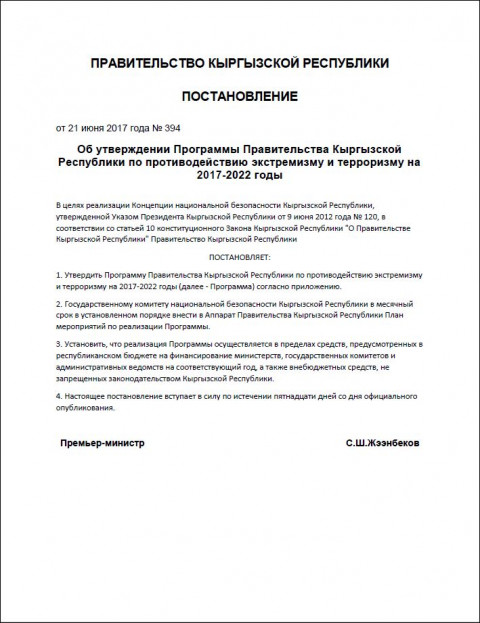 The Program of the Government of the Kyrgyz Republic on Countering Extremism and Terrorism for 2017-2022 Año de publicación: 2017 Autor corporativo: Government of the Kyrgyz Republic The document contains the main provisions of the program of the Government of the Kyrgyz Republic on countering extremism and terrorism for 2017-2022.The program provides a set of measures to ensure effective countering the threats of extremism and terrorism, rigorous observance of human rights and freedoms, the rule of law and others constitutional principles of the Kyrgyz Republic. Purpose of this program is changing the current situation in the field countering extremism and preventing terrorism.Successful implementation of the program depends on coherence government bodies, organizations and institutions of the Kyrgyz Republic to counter extremism and terrorism. Программа Правительства Кыргызской Республики по противодействию экстремизму и терроризму на 2017-2022 годы Año de publicación: 2017 Autor corporativo: Government of the Kyrgyz Republic Документ содержит основные положения программы Правительства Кыргызской Республики по противодействию экстремизму и терроризму на 2017-2022 годы.Программа предусматривает комплекс мер, обеспечивающих эффективное противодействие угрозам экстремизма и терроризма, неукоснительное соблюдение прав и свобод человека, верховенства закона и других конституционных принципов Кыргызской Республики. Целью настоящей Программы является изменение складывающейся ситуации в области противодействия экстремизму и профилактики терроризма.Успешная реализация Программы зависит от согласованности действий государственных органов, организаций и учреждений Кыргызской Республики для противодействия экстремизму и терроризму.
  Dialogue Protocols (Fawaz and Nora Series, Episode 29) Año de publicación: 2018 Autor corporativo: Tatweer Company | Saudi Arabia. Ministry of Education The clip is a short video that talks about etiquette of dialogue between children. The teacher enters the classroom and finds quarrels between the children and begins to teach them etiquette of dialogue. آداب الحوار (مسلسل فواز ونورة - الحلقة 29) Año de publicación: 2018 Autor corporativo: Tatweer Company | Saudi Arabia. Ministry of Education المقطع عبارة عن فيديو قصير يتحدث عن اداب الحوار بين الأطفال. يدخل المعلم الصف ويجد التخاصم بين الأطفال ويبدأ بتعليمهم اداب الحوار.
  The Role of Education Towards Enhancing the Peaceful Coexistence Culture and Devoting the Citizenship Values of Postmodern Society Año de publicación: 2019 Autor: Lilia Bensouilah Autor corporativo: Research & Development of Human Resources Center REMAH This study aims to examine the role of education in creation the peaceful coexistence culture, promote opportunities for cosmopolitan openness to the other, preserve mutual respect and legitimize culture of difference, tolerance and pluralism of religions, beliefs and ideologies away from all manifestations of intolerance, hatred and destructive conflicts that violate human rights. دور التعليم في تعزيز ثقافة التعايش السلمي وتكريس قيم المواطنة في سياق مجتمع ما بعد الحداثة Año de publicación: 2019 Autor: Lilia Bensouilah Autor corporativo: Research & Development of Human Resources Center REMAH تركز الورقة على تحليل دور التعليم وبحث المجهودات العالمية والمساعي الدولية في سياق مجتمعي لما بعد الحداثة نحو تعزيز ثقافة التعايش السلمي وتكريس قيم المواطنة بما يتوافق مع المنظور الحقوقي الإنساني، وما ينبثق عنه من احترام وتقبل لتعددية واختلاف المذاهب والأديان والأيديول وجيات والثقافات بعيدا عن كل مظاهر التعصب الفكري المذهبي والعرقي والذي يمكن أن يهيأ بيئة محفزة لنشوب النزاعات المسلحة والصراعات المدمرة المنتهكة الكيان الحقوقي للبشرية قاطبة.
  A Pedagogical Guide on Global Citizenship Education in Korean Context Año de publicación: 2015 Autor corporativo: APCEIU APCEIU has published a pedagogical guide on Global Citizenship Education (GCED) for Korean readers, which is the Korean adaptation of the UNESCO pedagogical guide, GCED: Topics and Learning Objectives (a.k.a. TLOs).Following the recently launched Korean translation of the TLOs, this Korean adaptation contextualizes the TLOs in Korean education, aligns its terminologies with Korean curriculum, and provides further explanations for Korean readers. This guide was developed by professors in the field of teacher education, primary and secondary school teachers, and curriculum developers with special expertise in GCED/EIU.It is hoped that this guide will help Korean educators and key stakeholders better understand GCED as a new pedagogy and also reflect on traditional teaching-learning experiences in various respects. Éducation Mondiale à la citoyenneté: Sujets et objectifs d'apprentissage Año de publicación: 2015 Autor corporativo: APCEIU APCECI a publié un guide pédagogique sur l'éducation à la citoyenneté Mondiale (ECM) pour les lecteurs coréens, qui est l'adaptation coréenne du guide pédagogique de l'UNESCO, ECM: Sujets et objectifs d'apprentissage (TLO) alias.Après la traduction coréenne a récemment lancé le TLO, cette adaptation coréenne contextualise les TLO dans l'éducation coréenne, aligne ses terminologies avec curriculum coréen, et fournit d'autres explications pour les lecteurs coréens. Ce guide a été élaboré par des professeurs dans le domaine de la formation des enseignants, les enseignants des écoles primaires et secondaires, et les développeurs de programmes d'études avec une expertise particulière dans ECM / ECI.Il est à espérer que ce guide aidera les éducateurs coréens et les principaux intervenants de mieux comprendre ECM comme une nouvelle pédagogie et de réfléchir également sur les expériences d'enseignement et d'apprentissage traditionnelles à divers égards. 세계시민교육 교수학습 길라잡이: 「Global Citizenship Education: Topics and Learning Objectives」 한국판 해제본 Año de publicación: 2015 Autor corporativo: 유네스코 아시아태평양 국제이해교육원 이 책은 유네스코가 2015년에 발간한 세계시민교육 교수·학습 지침서 『세계시민교육: 학습 주제 및 학습 목표 Global Citizenship Education: Topics and Learning Objectives(이하 유네스코 지침서)』를 한국 교육현장의 맥락과 독자의 이해를 고려하여 필요한 설명을 덧붙인 한국판 해제본이다. 주로 학교교육과 국가교육과정을 염두에 두고 구성된 이 해제본은 유네스코 지침서의 내용을 한국 교육과정 용어에 맞게 풀어쓰고 맥락화하였으며, 개발 과정에는 세계시민교육/국제이해교육 분야의 전문성을 갖춘 교대와 사범대학 교수, 초·중·고 전현직 교사, 교육과정 전문가 등이 참여하였다. 이 해제본을 바탕으로 교육정책 및 현장의 관계자들이 세계시민교육에 대한 이해를 넓히고 기존의 전통적인 교수·학습 경험을 다각적으로 성찰해보는 기회를 가질 수 있길 기대한다.
 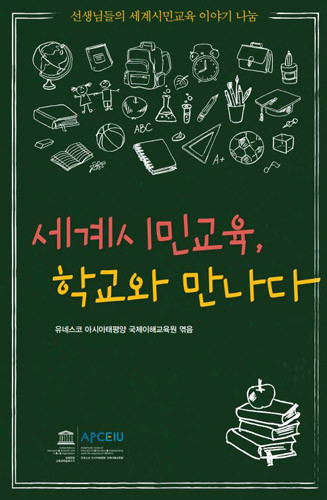 Encountering Global Citizenship Education in Schools: Stories of School Teachers on GCED Año de publicación: 2016 Autor corporativo: APCEIU Titled “Encountering Global Citizenship Education in Schools: Stories of School Teachers on GCED,” the book includes stories of 11 GCED Lead Teachers focusing on the practical implementation of GCED in real educational setting. Readers will be able to learn from the experiences of those teachers, who worked to implement GCED in the field of education. Moreover, this publication provides an opportunity for educators from small primary schools in rural areas to the high schools in big cities, to think about the implications associated with GCED and how GCED can be used for students from diverse backgrounds and various ages. The stories included in the book are as follows: • GCED Starts from the Horizontal Relationships • GCED Practices in Small Schools • Doing by Learning, Learning by Doing • To View Social Issues from the Children's Perspective • Living through Communication with the People of Earth • Meeting Global Citizens in Jeju • Beginning of GCED with Students and Teachers • Starting with a Slow Change : The Story of a Candle • GCED with the views of the Children • A Path to the Future, Walking with Teachers to GCED • GCED is to Search for Values in Daily Lives