
Recursos
Exploren una amplia gama de recursos valiosos en GCED para profundizar su comprensión y promover su búsqueda, incidencia, enseñanza y aprendizaje.
2,661 resultados encontrados
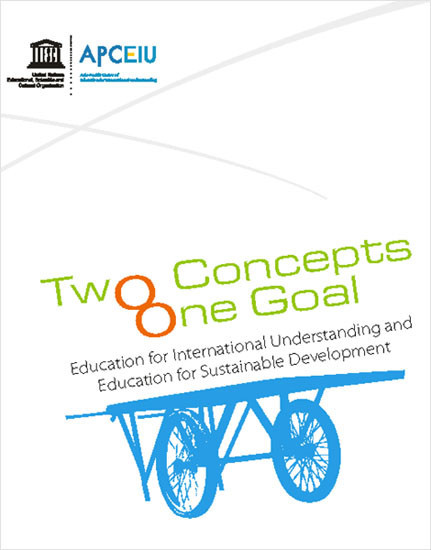 두 개념들, 하나의 목표: EIU와 ESD Año de publicación: 2007 Autor corporativo: 유네스코 아시아태평양 국제이해교육원 | UNESCO Bangkok 본 책자는 2007년, 아시아태평양 국제이해교육원(APCEIU)과 아시아태평양지역 발전을 위한 교육혁신 프로그램(UNESCO APEID)에서 함께 제작하였으며 EIU와 ESD의 개념과 핵심교육 분야를 설명하고, 그들 간의 시너지 효과를 강조하기 위해 만들어졌다. 크게 다섯 파트로 나눠져 있는 본 책자는 각각 EIU와 ESD, 인권교육, 환경교육, 평화교육 그리고 양성 평등 교육에 대해서 그들의 등장배경, 의의, 목표 등을 설명하고 있다. 그리고 각 파트 끝에는 더 심도 있는 정보를 얻을 수 있는 자료 리스트를 제공하고 있다. 또한 이 교육들과 EIU, ESD가 어떻게 맞닿아 있는지를 서술하고 있어 독자들은 EIU와 ESD라는 큰 개념과 그 하위 교육들이 어떻게 연결되는지 쉽게 파악할 수 있을 것이다
  EIU Best Practice Series No. 5: Peace and human rights education through education for sustainable development: lessons from four case studies in the Philippines Año de publicación: 2007 Autor corporativo: APCEIU The four case studies showed that EIU through peace and human rights education in the context of education for sustainable development can build a critical mass of Filipinos who will reject wars and promote social security. Education can play a role to direct the children, youth, and adults toward peace building and better understanding of cultural differences. It should also be noted that when institutions adopt a peace culture, establishing local and international organizations and putting up resources for various peace-building initiatives become possible. Educational intervention can effect changes in the minds of men and build a lasting and substantive foundation for peace based on justice and respect for human rights. La paix et les droits de l'éducation par l'éducation pour le développement durable: les leçons de quatre études de cas aux Philippines (Meilleure série ECI de cas d'étude no. 5) Año de publicación: 2007 Autor corporativo: APCEIU Les quatre études de cas ont montré que ECI par l'éducation de la paix et les droits de l'homme dans le contexte de l'éducation pour le développement durable peut constituer une masse critique de Philippins qui rejettent les guerres et promouvoir la sécurité sociale. L'éducation peut jouer un rôle pour diriger les enfants, les jeunes et les adultes vers la construction de la paix et une meilleure compréhension des différences culturelles. Il convient également de noter que lorsque les institutions adoptent une culture de la paix, la création d'organisations locales et internationales et de mettre en place des ressources pour diverses initiatives de consolidation de la paix deviennent possibles. L'intervention éducative peut effectuer des changements dans l'esprit des hommes et de construire une base durable et de fond pour la paix fondée sur la justice et le respect des droits de l'homme. EIU Best Practice Series No. 5: Peace and human rights education through education for sustainable development: lessons from four case studies in the Philippines Año de publicación: 2007 Autor corporativo: 유네스코 아시아태평양 국제이해교육원 The four case studies showed that EIU through peace and human rights education in the context of education for sustainable development can build a critical mass of Filipinos who will reject wars and promote social security. Education can play a role to direct the children, youth, and adults toward peace building and better understanding of cultural differences. It should also be noted that when institutions adopt a peace culture, establishing local and international organizations and putting up resources for various peace-building initiatives become possible. Educational intervention can effect changes in the minds of men and build a lasting and substantive foundation for peace based on justice and respect for human rights.
 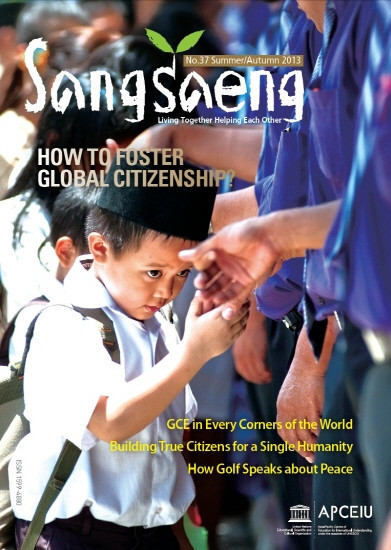 Building a global community out of the ashes of poverty (SangSaeng no. 37 summer autumn 2013) Año de publicación: 2013 Autor corporativo: APCEIU SangSaeng No. 37- How to Foster Global Citizenship? has been published. In order to help our readers better grasp the concept of global citizenship and provide useful information and new ideas, this issue deals with various aspects of global citizenship education.3 Director’s Message4 Special ColumnBuilding True Citizens for a Single Humanity8 Focus: How to Foster Global Citizenship?8 Eliminating World Challenges through Global Citizenship Education 13 Developing Global Citizens with a Global Perspective18 Living in a New World Starts with Education23 GCE in Every Corners of the World28 Best Practices28 Hands-on Hand Print for Environmental Sustainability32 Bhutan Teachers Learn New Models of Education35 Comic Relief: Song of the City36 Special ReportPaving the Way Together for Global Citizenship Education40 InterviewBuilding a Global Community out of the Ashes of Poverty42 LetterCapturing Moments of Living in Harmony44 Peace in My MemoryHow Golf Speaks about Peace47 Understanding the Asia-Pacific RegionDiscovering Locks beyond the Function of Opening and Closing50 APCEIU in Action
 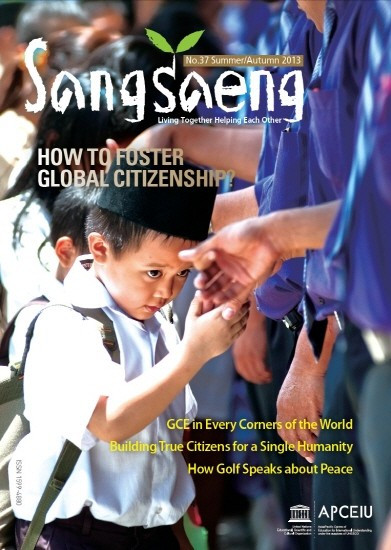 Paving the way together for global citizenship education (SangSaeng no. 37 summer autumn 2013) Año de publicación: 2013 Autor corporativo: APCEIU SangSaeng No. 37- How to Foster Global Citizenship? has been published. In order to help our readers better grasp the concept of global citizenship and provide useful information and new ideas, this issue deals with various aspects of global citizenship education.3 Director’s Message4 Special ColumnBuilding True Citizens for a Single Humanity8 Focus: How to Foster Global Citizenship?8 Eliminating World Challenges through Global Citizenship Education 13 Developing Global Citizens with a Global Perspective18 Living in a New World Starts with Education23 GCE in Every Corners of the World28 Best Practices28 Hands-on Hand Print for Environmental Sustainability32 Bhutan Teachers Learn New Models of Education35 Comic Relief: Song of the City36 Special ReportPaving the Way Together for Global Citizenship Education40 InterviewBuilding a Global Community out of the Ashes of Poverty42 LetterCapturing Moments of Living in Harmony44 Peace in My MemoryHow Golf Speaks about Peace47 Understanding the Asia-Pacific RegionDiscovering Locks beyond the Function of Opening and Closing50 APCEIU in Action
 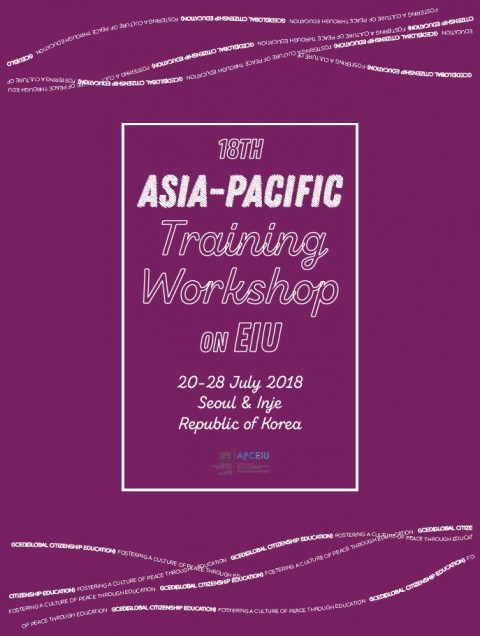 Final Report: 18th Asia-Pacific Training Workshop on EIU Año de publicación: 2018 Autor corporativo: APCEIU This report is the summary of the 18th Asia-Pacific Workshop on EIU (APTW) held in the Republic of Korea from 20 to 28 July 2018. Designed as TOT (Training of Trainers), the Workshop has invited 31 teacher educators/trainers from the Asia-Pacific region, strengthening their capacities to carry out Global Citizenship Education in their respective institutions and countries.
  Global Citizenship Education: A Guide for Trainers Año de publicación: 2018 Autor corporativo: APCEIU APCEIU has published Global Citizenship Education: A Guide for Trainers in order to aid trainers to conduct introductory workshops for educators on Global Citizenship Education (GCED). Designed as a training manual for trainers, the Guide offers overview of GCED, including backgrounds and core concepts as well as pedagogical principles, but also provides guidelines on the workshop design and facilitation. Consisting of five chapters, the Guide first introduces the rise of GCED within the latest shift in education and global development agendas. Under this framework, the next chapter explores the meanings of a ‘global citizen’ and ‘global citizenship,’ and introduces key concepts and principles of GCED. The next two chapters deal with how to teach GCED, presenting topic areas and themes as well as pedagogies and strategies. The Guide concludes with the last chapter that summarizes and integrates the contents learned in previous chapters by sharing case studies as examples and providing guidelines on how to design GCED activities.The Guide is available in English and French. <Contents> Chapter 1- Why GCED Now?Chapter 2- What is GCED?Chapter 3- GCED: What to Teach?Chapter 4- How to Teach GCED?Chapter 5- Preparing for ActionAnnex: Global Education AgendasUNESCO’s Topics and Learning ObjectivesGCED Resources & Reference Materials ECM: Un guide pour les formateurs Año de publicación: 2018 Autor corporativo: Centre Asie-Pacifique d'éducation pour la compréhension internationale (APCEIU) Ce guide est un manuel de formation pour les formateurs qui organiseront un atelier de formation des éducateurs en éducation à la citoyenneté mondiale (ECM) avec les objectifs suivants: - Présenter les informations de base et les concepts clés de l’ECM aux participants de l’atelier- Aider les participants à découvrir les notions de base de l’ECM et les méthodes constructifs connexes en termes d’enseignement/apprentissage - Encourager les participants à explorer les méthodes et les opportunités à travers lesquelles ils peuvent pratiquer l’ECM à l’école et dans d’autres contextes éducatifs
  International Understanding and Cooperation in Education in the Post-Corona World Año de publicación: 2020 Autor: Dongjoon Jo | Edward Vickers | Dina Kiwan | Fei Yan | Kyujoo Seol | Kyoko Nakayama Autor corporativo: APCEIU Research Report of International Understanding and Cooperation in Education in the Post-Corona World APCEIU has published a report, including research studies from 6 experts in order to figure out the role of education in promoting international understanding and cooperation in the education sector in the post-pandemic world. Through this research project, APCEIU mainly sought to answer the following questions; ▲What will be the implications of COVID-19 for international exchange and cooperation especially in education?▲What should we as educators, researchers, and practitioners do to counter the rise of populist nationalism?▲What should be the focus and direction of international cooperation in education during and after the pandemic in order to promote international understanding and GCED? This research project is expected to provide insightful views on the desirable direction for international understanding and cooperation in the education sector. Table of Contents 1. The development of UNESCO’s exchange programmes and their possible rearrangements in the post-pandemic years (Dong-Joon Jo, Professor at Department of Political Science and International Relations, Seoul National University, Korea) 2. ‘Rethinking Schooling’ once again: Post-corona challenges for education for peace and sustainability in Asia (Edward Vickers, Professor of Comparative Education at Kyushu University, Japan) 3. Race, gender, disability, and their intersections under the impact of COVID-19 (Dina Kiwan, Professor in Comparative Education, University of Birmingham, United Kingdom) 4. Competition or cooperation: Configuring ‘International’ in Chinese school textbooks (Fei Yan, Post-Doctoral Research Fellow, South China University, China) 5. The implications of democratic citizenship education and global citizenship education in South Korea for the post-corona era (Kyujoo Seol, Professor of Social Studies Education, Kyeongin National University of Education, Korea) 6. What can we learn from the pandemic of COVID-19?: An attempt to develop teaching materials for international understanding and cooperation based on Japanese educational issues (Kyoko Nakayama, Professor of Social Studies Education and Multicultural Education, Teikyo University, Japan)