
Recursos
Exploren una amplia gama de recursos valiosos en GCED para profundizar su comprensión y promover su búsqueda, incidencia, enseñanza y aprendizaje.
883 resultados encontrados
 Роль ШОС в противодейтсвии терроризму в странах Центральной Азии (Постсоветские исследования; Vol.5, No.8) Año de publicación: 2022 Autor: А. К. Румянцева | К. Х. Рахимов Терроризм является одним из главных угроз безопасности человечества в современном мире. Усиление деятельности террористического подполья в странах Центральной Азии и ухудшение ситуации в Афганистане поднимает проблему терроризма на новый уровень и призывает стран данного региона к содействию международных и региональных организаций в решении данного вопроса. Среди наиболее активно развивающих межрегиональных организаций в регионе Центральной Азии можно выделить Шанхайскую организацию сотрудничества. Центральная цель ШОС непосредственно связано в противодействии и в борьбе против «трех зол»: терроризма, сепаратизма и экстремизма. Актуальность данной работы связана с ростом радикализации в регионе Центральной Азии, вследствие чего в предлагаемой статье анализируется роль Шанхайской организации сотрудничества в противодействии терроризму в странах Центрально – Азиатского региона, рассматривается история зарождения и появления терроризма в данном регионе, подробно раскрываются ключевые направления организации. Кроме того, изучены основные принятые международно-правовые документы по борьбе с терроризмом, на основе которых наблюдаются основные этапы развития сотрудничества между государствами-членами организации по осуществлению антитеррористической деятельности ШОС. Особенно успешное сотрудничество по борьбе с терроризмом отмечается в проведении совместных антитеррористических учений в рамках деятельности организации, а также подробно рассматривается деятельность РАТС ШОС. Целью статьи является оценивание потенциала ШОС с точки зрения реагирования на новые вызовы безопасности стран-членов, прежде всего на пространстве ЦА. Для достижения цели использовались следующие методы исследования: теоретико-методологический анализ, описательный метод и контент-анализ. Авторы приходят к выводу, что на современном этапе ШОС является наиболее влиятельной интеграцией в пространстве ЦА. Антитеррористическая деятельность организации показывает, что данное направление является наиболее успешной сферой работы ШОС.
  Podcast: Right to Education Against Hate Speech (SAME 2024) Año de publicación: 2024 Autor corporativo: Global Campaign for Education (GCE) The Global Action Week for Education (GAE) 2024 has been the perfect setting for children and adolescents to contribute their voice and perspective to the issue of hate speech. Through awareness-raising and reflection workshops, children and adolescents have shared complex personal situations and cases of hate that they have witnessed, reproduced or experienced first-hand. Guided by their reflections, the participants designed a two-chapter podcast, where they addressed the issues that concern them most. This process not only allowed them to deepen their understanding of the normalization of hate speech and structural violence, but also to prepare for the production of the podcast, where they were able to express their thoughts and proposals in a creative and accessible way for a wider audience. Podcast: Derecho a la educación contra los discursos de odio (SAME 2024) Año de publicación: 2024 Autor corporativo: Global Campaign for Education (CME) La Semana de Acción Mundial por la Educación (SAME) 2024, ha sido el escenario perfecto para que las niñas, niños y adolescentes aporten su voz y perspectiva a la problemática sobre los discursos de odio. A través de talleres de sensibilización y reflexión, las niñas, niños y adolescentes han compartido situaciones personales complejas y casos de odio que han presenciado, reproducido o vivido en sus propias carnes. Guiados por sus reflexiones, los participantes diseñaron un podcast, de dos capítulos, donde abordaron los temas que más les preocupan. Este proceso no solo les permitió profundizar en su comprensión de la normalización de discursos de odio y violencia estructural, sino también a prepararse para la producción del podcast, donde pudieron expresar sus pensamientos y propuestas de una manera creativa y accesible para un público más amplio.
  Social Education in the Face of Hate Speech: Intercultural Competences in University Education (Journal of Supranational Policies of Education; Vol. 1, No. 19) Año de publicación: 2024 Autor: Teresa Rebolledo Gámez | Rocío Rodríguez-Casado Autor corporativo: Autonomous University of Madrid The spread of hate speech against immigrants, people of foreign origin or ethnic minorities is one of the most serious threats to peaceful coexistence in today's society. This is especially true in media contexts and social networks, where the boundaries between the right to freedom of expression and hate speech or hate crimes are often blurred. Therefore, we need educational professionals with intercultural competences whohave strategies to combat these discourses. In this article, we present an experience of a pedagogical innovation that works on these competences in the Degree in Social Education, which received very positive evaluations in terms of improving conceptual and attitudinal learning, as well as the acquisition of socio-educational strategies to act against the emergence of hate speech. On the basis of this experience, we reflect on different aspects that should be present in intercultural university training in the field of hate speech and hate crimes, concluding that there is still an urgent need for universities to promote the training of socio-educational professionals based on a human rights, equality, justice, culture of peace and non-violence approach. Educación social ante los discursos de odio: Competencias interculturales en la formación universitaria (Journal of Supranational Policies of Education; Vol. 1, Núm. 19) Año de publicación: 2024 Autor: Teresa Rebolledo Gámez | Rocío Rodríguez-Casado Autor corporativo: Autonomous University of Madrid La propagación de discursos de odio hacia las personas inmigrantes, de origen extranjero o pertenecientes a minorías étnicas son uno de los peligros más graves para la convivencia pacífica en la sociedad actual. Existe una gran preocupación sobre las consecuencias discriminatorias e incluso delictivas que generan la propagación de los discursos de odio. Las normas legales establecen cuándo se traspasa la línea que convierte estas expresiones en actos condenables como delito, si bien en el ámbito de las redes sociales y los medios de comunicación, a veces, encontramos límites difusos entre el derecho a la libertad de expresión y los discursos o delitos de odio. Es por ello que necesitamos profesionales educativos con competencias interculturales que dispongan de estrategias para combatir estas situaciones. A partir de una experiencia de innovación docente en el Grado en Educación Social, en este trabajo reflexionamos sobre distintos aspectos que deberían estar presente en la formación universitaria intercultural en el ámbito de los discursos y delitos de odio, concluyendo que sigue existiendo una necesidad acuciante de que los profesionales del ámbito socioeducativo estén preparados para abordar esta realidad.
 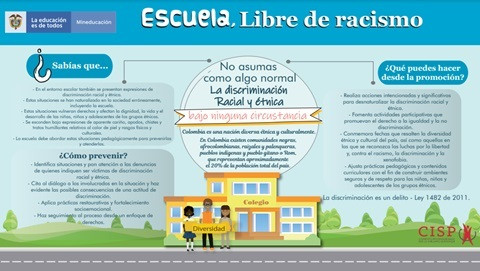 School Coexistence Toolkit: Preventing Racism Autor corporativo: Ministry of Education of Colombia Xenophobia and racism are forms of intolerance and discrimination and, in both cases, are violations of human rights. These infographics address this social phenomenon and relational situation, extending the message and intention of the protocol on the same subject, which is why it constitutes a roadmap to respond from a comprehensive perspective to situations in which discrimination occurs due to ethnic and racial aspects or that promote exclusionary or stigmatizing acts against girls, boys, and adolescents because of their ethnic or racial affiliation. Kit de herramientas para la convivencia escolar: Prevención del racismo Autor corporativo: Ministry of Education of Colombia La xenofobia y el racismo constituyen formas de intolerancia y discriminación y, en ambos casos, son vulneraciones de los derechos humanos. Estas infografías abordan este fenómeno social y situación relacional, hacen extensivo el mensaje y la intencionalidad que tiene el protocolo del mismo tema, por lo cual se constituye en una hoja de ruta para dar respuesta desde un perspectiva integral a situaciones en las que se presente discriminación por aspectos étnicos y raciales o que promuevan actos excluyentes o de estigmatización en contra de niñas, niños, y adolescentes por causa de su pertenencia étnica o racial.
  School Coexistence Toolkit: Prevention of Xenophobia Autor corporativo: Ministry of Education of Colombia The infographics guide the actions that should be developed in the school environment in the face of situations that incite or configure acts of xenophobia, exclusion or stigmatization against migrant girls, boys and adolescents. This message aims to have a positive impact on those who, beyond any nationality and any other migratory origin, should be welcomed and their rights guaranteed. Kit de herramientas para la convivencia escolar: Prevención de la xenofobia Autor corporativo: Ministry of Education of Colombia Las infografías orientan las acciones que deben desarrollarse en el entorno escolar frente a situaciones que inciten o configuren actos de xenofobia, exclusión o estigmatización en contra de niñas, niños, y adolescentes migrantes. Este mensaje pretende tener un impacto positivo hacia quienes, más allá de cualquier nacionalidad y de cualquier otro origen migratorio, se les debe acoger y garantizar sus derechos.
  Educating Against Hate Año de publicación: 2016 Autor corporativo: United Kingdom. Department of Education, United Kingdom. Home Office As children grow and become more independent, it is not unusual for them to take risks, explore new things and push boundaries. This can mean that they are particularly vulnerable to extremist groups, who may claim to offer answers, as well as identity and a strong social network. And because they know young people are vulnerable, extremist groups often target them using the internet and social media to spread their ideology. The purpose of this website is to provide practical advice and support to help all individuals with an interest in keeping children safe from the dangers of extremism.