
Recursos
Exploren una amplia gama de recursos valiosos en GCED para profundizar su comprensión y promover su búsqueda, incidencia, enseñanza y aprendizaje.
1,725 resultados encontrados
 Encuentro nacional de educación para la paz: documento de trabajo; memorias Año de publicación: 2015 Autor corporativo: Encuentro de Educacion para la Paz y los Derechos Humanos This document presents the most relevant reflections and commitments made up from the First National Encounter of Education for Peace and Human Rights, which took place on July 29th of 2014, with the participation of the Mayors, Secretaries of Education from the different territories of Colombia, governmental organizations, NGO's and multilateral agencies. Memorias del Segundo encuentro nacional sobre educación para la paz y los derechos humanos en los territorios Año de publicación: 2015 Autor corporativo: Encuentro de Educacion para la Paz y los Derechos Humanos The discussions and reflections of the Second National Encounter of Education for Peace and Human Rights were focused on the reality of schools, their dynamics and the territorial problems, taking into account those territories were the armed Colombian conflict has been deeply developed and the politic and administrative relations between the local-national dynamics present important challenges. These memories gather those discussions that lead to actions, new challenges and commitments, specially focused on the construction of public policy for education for peace and human rights.
 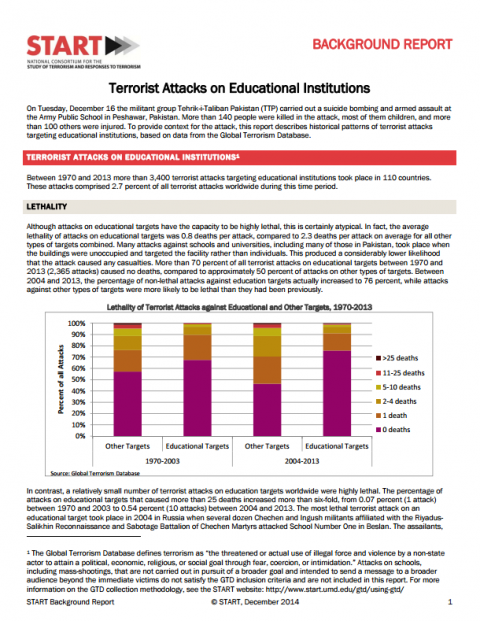 Terrorist Attacks on Educational Institutions Año de publicación: 2014 Autor: Erin Miller Autor corporativo: National Consortium for the Study of Terrorism and Responses to Terrorism (START) | Department of Homeland Security Science and Technology The report describes historical patterns of terrorist attacks targeting educations institutions dating back to 1970. Since that year, more than 3,400 terrorist attacks targeting educations institutions took place in 110 countries. These attacks comprised 2.7 percent of all terrorist attacks worldwide during this time period. Terrorist Attacks on Educational Institutions Año de publicación: 2014 Autor: Erin Miller Autor corporativo: National Consortium for the Study of Terrorism and Responses to Terrorism (START) | Department of Homeland Security Science and Technology Le rapport revient sur les attaques terroristes qui ont ciblé les institutions éducatives depuis 1970. A partir de cette année, on dénombre plus de 3.400 attaques terroristes qui avaient pour cible les institutions éducatives, dans 110 pays. Ces attaques représentent 2,7 % de l’ensemble des attaques terroristes perpétrées à travers le monde au cours de cette période.
  Streamlining the Global Path to Gender Equality: The Role of Feminist Foreign Policy Año de publicación: 2023 Autor corporativo: UN WOMEN Europe and Central Asia As of June 2023, 15 UN Member States introduced feminist lenses to their foreign policies (FFPs). The policy brief examines the various FFPs and identifies shared aspects and gaps across seven key themes: WPS, political participation, economic empowerment, diplomacy, official development assistance, human rights/humanitarianism, violence against women and girls. Ускорение глобального движения к гендерному равенству: роль феминистской внешней политики Año de publicación: 2023 Autor corporativo: UN WOMEN Europe and Central Asia По состоянию на июнь 2023 года 15 государств - членов ООН внедрили феминистские подходы в свою внешнюю политику. В аналитической записке рассматриваются различные FFP и выявляются общие аспекты и пробелы по семи ключевым темам: ЖМБ, участие в политической жизни, расширение экономических прав и возможностей, дипломатия, официальная помощь в целях развития, права человека/ гуманитарная деятельность, насилие в отношении женщин и девочек.
  КАРМАННОЕ ПОСОБИЕ для участковых уполномоченных и инспекторов по делам несовершеннолетних Службы общественной безопасности МВД Кыргызской Республики по выявлению и направлению жертв торговли людьми Año de publicación: 2023 Autor corporativo: УНП ООН В сентябре 2021 года Глобальная инициатива против транснациональной организованной преступности The Global Organized Crime Index – 2021, впервые в мировом масштабе признала торговлю людьми крупнейшим и превалирующим криминальным рынком. В связи с этим в мире важное внимание уделяется борьбе с торговлей людьми и вовлечению в этот процесс государственных органов, международных и общественных организаций. Кыргызская Республика не является исключением и особую роль в борьбе с торговлей людьми отводит правоохранительным органам, от действий которых во многом зависит эффективность пресечения этого вида преступной деятельности.
  Singapore’s educational reforms toward holistic outcomes: (Un)intended consequences of policy layering Año de publicación: 2023 Autor: Dennis Kwek | Jeanne Ho | Hwei Ming Wong Autor corporativo: Center for Universal Education at Brookings In the transition from economic imperatives to holistic drivers, there has been a gradual move over five policy phases (from 1965 to 2022 and beyond) toward curriculum and school diversification to cater to different students, with more autonomy given to schools to innovate their pedagogy and improve instructional quality to meet their students’ unique needs. Importantly, there has been a shift in policy rhetoric from focusing on educational structures to focusing on pedagogy and instructional quality. To shift pedagogy from being mainly didactic in nature—with emphasis on preparing students for national examination—the Singapore government recognized the need to focus on school leaders’ and teachers’ capacity building to enable new curricula and teaching practices. The school cluster structure was initiated in 1997 to enable collaboration and learning among school leaders, key personnel, and teachers. Opportunities for collaborative teacher learning are provided at different ecological levels: professional learning communities (PLCs) within schools and networked learning communities (NLCs) across schools. Beyond the education system, the Singapore government works with other ministries and community organizations, such as ethnic self-help organizations, to tackle educational equity issues. Ultimately, even though the official policy narrative post-1997 has been a de-emphasis on examination results and educational infrastructure to help improve the instructional quality in schools toward holistic outcomes and improved student well-being have been developed, education systems building co-exists with an alternative underlying shadow education system valued by parents who continue to chase narrow academic outcomes. Tuition and enrichment centers in Singapore constitute the shadow education system.
  A Geographical - Political Analysis of the Determinants of women's empowerment in Iraq Año de publicación: 2020 Autor: Zainab Ali Mazloum, Lateef Kamel Kelaiwy Empowering women is one of the modern topics that geopolitics is concerned with, especially after the United Nations adopted in the eighties of the twentieth century the strategy of empowering women against the background of discrimination against them on the basis of gender and depriving them of equal opportunities compared to males in the fields of learning and work as well as drawing state policy, that empowerment The political status of women is based on two main variables: the first is the removal of legislative, administrative, and social determinants that hinder women's political participation, and the second is the creation of political measures and measures that support women's participation and increase their effectiveness by developing their capabilities, nah As for employing those capabilities in the institutional framework of political units, so states at various levels and orientations, including Iraq, are keen to eliminate gender differences and women's empowerment through achieving comprehensive development in general and political development in particular because they mimic political empowerment, however Iraq has said a lot in this field by doing The many political transformations and wars that affected the state, as well as the great challenges that faced and still face the Iraqi political decision-maker with its various political, security, economic and social dimensions.
  The Comprehensive Learning Diagnosis: Chile’s approach to assess socio-emotional learning in schools Año de publicación: 2023 Autor: José Weinstein | Juan Bravo Autor corporativo: Center for Universal Education at Brookings Education in Chile has important challenges of quality, equity, and social integration. For decades, policies tried to respond to these concerns with a high-stakes accountability institutional framework, which has not had success. The underlying vision of educational quality was limited. The assessment system in place privileged cognitive and academic dimensions of educational results. Socio-emotional learning had been neglected or considered secondary, without an infrastructure of assessment tools that allowed teachers and principals to diagnosis students’ situations and monitor their progress. The COVID-19 crisis was an opportunity for change: Students’ socioemotional needs were a main concern for schools and society, and the regular accountability system based on standardized tests was interrupted. Subsequently, the Comprehensive Learning Diagnosis (DIA) was launched by the Education Quality Agency. The DIA is a voluntary assessment tool made available to all Chilean schools. The DIA promotes the comprehensive development of students, providing timely information and guidance to internally monitor students’ learning in the academic and socio-emotional domains at several points during the school year. Specifically, with respect to socio-emotional learning, three areas were considered: personal, community, and citizenship. In each of these areas, a set of socioemotional skills were defined, operationalized, and became possible to monitor by school communities. The DIA also collects students’ opinions of school management practices regarding socio-emotional skills. The DIA has received a wide acceptance in school communities. Despite being voluntary, an ample majority of schools decided to participate. The information collected from the DIA allows for practical use by principals and teachers. Moreover, the DIA provides the opportunity for students to inform school management. The new Chilean government has decided to strengthen DIA as an important component in a four-year national plan for reactivating academic and socio-emotional learning in schools. The previous high-stakes accountability system, which involved external assessments, has been suspended and is under discussion. The DIA experience has shown that critical social and educational situations can provide fertile ground to motivate deep and rapid transformation, if an educational actor (in this case the Education Quality Agency) is capable of enacting a pertinent, timely, and practical response to school needs. The DIA is not only an example of productive uses of students´ assessment by schools, but also a demonstration that it is possible to build an institutional arrangement among local, intermediate, and national levels of school systems, where a vertical hierarchy is changed by a collaborative relationship based on local agency, mutual trust, and differentiated technical contributions.