
Recursos
Exploren una amplia gama de recursos valiosos en GCED para profundizar su comprensión y promover su búsqueda, incidencia, enseñanza y aprendizaje.
3,446 resultados encontrados
 Education, Citizenship and National Integration Año de publicación: 2014 Autor: Radwa Ammar Autor corporativo: Social Contract Center This research paper is an introduction that explains the role of citizenship education as a basis for building a cohesive society capable of facing challenges. The paper reviews various international concepts and experiences to shed light on the importance of conducting in-depth field studies to discuss the relationship between citizenship education and national integration among members of society. It also aims to identify the most important topics, and ways of offering that It is compatible with the targeted communities by these educational programs, and to develop a strategy for educational institutions in the country to adopt this type of studies. التعليم والمواطنة والاندماج الوطني Año de publicación: 2014 Autor: Radwa Ammar Autor corporativo: Social Contract Center تعتبر هذه الورقة البحثية مقدمة توضح دور تعليم المواطنة كأساس لبناء مجتمع متماسك قادر على مواجهة التحديات من خلال استعراض مفاهيم وتجارب دولية مختلفة لإلقاء الضوء على أهمية إجراء دراسات متعمقة ميدانية لبحث العلاقة بين تعليم المواطنة والاندماج الوطني بين أفراد المجتمع، وتحديد أهم الموضوعات، وسُبل الطرح التي تتوافق مع المجتمعات المستهدفة من قبل هذه البرامج التعليمية، ووضع استراتيجية للمؤسسات التعليمية في الدولة لكي تتبنى هذا النوع من الدراسات.ولا تتعرض هذه الورقة بالرصد والتحليل للواقع المصري لأن أي دراسة وصفية دون البحث الميداني في الوقت الراهن لن تعرض سوى آراء مبنية بالأساس على انطباعات لا تُمكِّن من التصدي للأزمات التي يواجهها الواقع في ظل غياب دراسات متعمقة تتناول العلاقة بين تعليم المواطنة والتغييرات التي شهدها المجتمع مؤخرًا، وسُبل مواجهة التحديات.
  Democracy in the Educational Institution: Between the Qualification of Schooling and the Rooting of Training Año de publicación: 2017 Autor: Abdel Karim Belhadj | Abd al-Ilah Shrayat Autor corporativo: Supreme Council for Education, Training, and Scientific Research This paper discusses the relationship between school and democracy. It shows the intersection between them. Then the paper turns on how to educate for democracy. The paper concludes with a vision for global citizenship education. الديمقراطية بالمؤسسة التعليمية : بين تأهيل التمدرس وتأصيل التمرس Año de publicación: 2017 Autor: Abdel Karim Belhadj | Abd al-Ilah Shrayat Autor corporativo: Supreme Council for Education, Training, and Scientific Research تناقش الورقة العلاقة بين المدرسة والديمقراطية. وتوضح التقاطع بينهما. ثم تعرج الورقة علي كيفية التربية من أجل الديمقراطية. تنتهي الورقة بوضع تصور للتربية من أجل المواطنة العالمية.
  NISSEM Global Briefs (Volume II): Educating for the Social, the Emotional and the Sustainable; Pedagogy, Practice and Materials Año de publicación: 2020 Autor: Andy Smart | Margaret Sinclair Autor corporativo: Networking to Integrate SDG Target 4.7 and SEL skills into Educational Materials (NISSEM) The timeframe for achieving the Sustainable Development Goals (SDGs) is tight, and the world also faces the consequences of Covid-19. NISSEM Global Briefs aim to show how SDG Target 4.7 themes and social and emotional learning (SEL) can be embedded in education policies, programs, curricula, materials, and practice, to help make progress towards sustainable development.
  Becoming Citizens in a Changing World: IEA International Civic and Citizenship Education Study 2016 International Report Año de publicación: 2017 Autor: Wolfram Schulz, John Ainley, Julian Fraillon, Bruno Losito, Gabriella Agrusti, Tim Friedman Autor corporativo: International Association for the Evaluation of Educational Achievement (IEA) The International Civic and Citizenship Education Study 2016 (ICCS 2016) investigated the ways in which young people are prepared to undertake their roles as citizens in a range of countries in the second decade of the 21st century. It studied students’ knowledge and understanding of civics and citizenship as well as students’ attitudes, perceptions, and activities related to civics and citizenship. Based on nationally representative samples of students, the study also examined differences among countries in relation to these outcomes of civic and citizenship education, and explored how cross-national differences relate to student characteristics, school and community contexts, and national characteristics. As the second cycle of this study, ICCS 2016 is a continuation and an extension of ICCS 2009.
 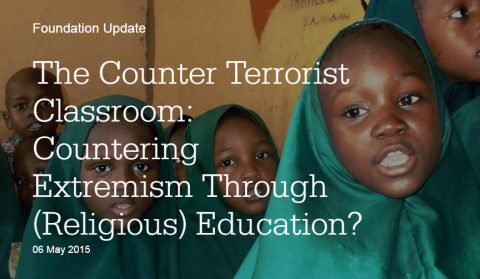 The Counter Terrorist Classroom: Countering Extremism Through (Religious) Education? Año de publicación: 2015 Autor: Liam Gearon The article identifies international cases– from the United States, Europe, and the United Nations– of an emergent interface of religion, education and security. This is manifest in the uses of religion in education to counter religious extremism, the notional “counter terrorist classroom”. To avoid an over-association of extremism with religion, the article provides some historical reminders that the post-Enlightenment centuries were marked by political extremism, particularly in the phenomenon that came to be known as totalitarianism. The Counter Terrorist Classroom: Countering Extremism Through (Religious) Education? Año de publicación: 2015 Autor: Liam Gearon Cet article identifie des cas d’interaction croissante entre les sphères du religieux, de l’éducation et le domaine sécuritaire - aux États-Unis, en Europe, et au sein des Nations Unies. Par exemple, l’intégration du religieux dans l’éducation afin de lutter contre l’extrémisme religieux, la théorique « lutte contre le terrorisme au sein des salles de classe ». Pour éviter une trop forte association entre extrémisme et religion, l’auteur procède à quelques rappels historiques et souligne le fait qu’à la fin du siècle des Lumières et jusqu’à aujourd’hui, les sociétés ont été marquées par diverses formes d’extrémisme politique, comme le montre notamment l’exemple les totalitarismes du XXe siècle. Countering Terrorism through Education of Populations: The Case of African Countries Año de publicación: 2011 Autor: Simon M. Lelo Terrorism has become a major concern of current governments. African countries are also involved in counter- terrorism but, due to several internal security and development problems, their effective participation in the combat against terrorism is very limited. They need capacity and skills in order to participate actively in countering terrorism. Education is one of the most appropriate ways for preparing African countries to prevent terrorism. Education provides not only knowledge but also capacity to make informed decisions, strategies and policies. The international community should help African countries to strengthen their education through specialized and general training programmes. Countering Terrorism through Education of Populations: The Case of African Countries Año de publicación: 2011 Autor: Simon M. Lelo Le terrorisme est devenu un enjeu de premier ordre pour les gouvernements actuels. Les pays africains prennent également part à la lutte contre le terrorisme ; cependant, à cause de problèmes de sécurité nationale et de développement, leur participation effective dans le combat contre le terrorisme reste très limitée. Ces pays manquent de moyen pour pouvoir y participer de manière plus active. Ainsi, l'éducation doit être privilégiée afin de soutenir les efforts de prévention dans les pays africains. L’éducation n'apporte pas seulement des connaissances aux apprenants, elle permet également de prendre des décisions, et de mettre en place des stratégies et des mesures de manière informée. La communauté internationale doit aider les pays africains à renforcer leurs systèmes éducatifs à travers divers programmes de formation.