
Recursos
Exploren una amplia gama de recursos valiosos en GCED para profundizar su comprensión y promover su búsqueda, incidencia, enseñanza y aprendizaje.
3,229 resultados encontrados
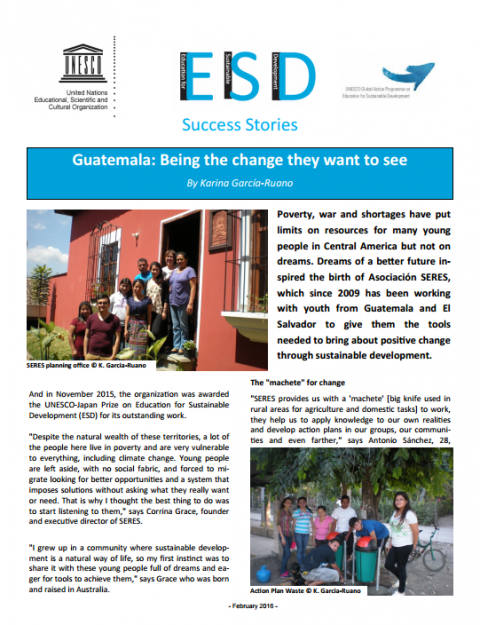 Guatemala: being the change they want to see Año de publicación: 2016 Autor: Karina García-Ruano Autor corporativo: UNESCO ESD Success Stories are showcasing compelling stories with a personal/human dimension from all five UNESCO regions (Africa, Arab States, Asia and Pacific, Europe & North America and Latin America & the Caribbean). The stories illustrate the wide diversity of ESD approaches and initiatives taking place in different parts of the world. They show how involvement with ESD has changed the lives of specific individual persons and how they have become more active in their community. Each story centers on one individual or a group of individuals.Asociación SERES, from Guatemala and El Salvador, works with youth to give them the skills needed to bring about positive change through sustainable development. Guatemala: être le changement qu'ils veulent voir Año de publicación: 2016 Autor: Karina García-Ruano Autor corporativo: Organisation des Nations Unies pour l'éducation, la science et la culture (UNESCO) ESD Success Stories are showcasing compelling stories with a personal/human dimension from all five UNESCO regions (Africa, Arab States, Asia and Pacific, Europe & North America and Latin America & the Caribbean). The stories illustrate the wide diversity of ESD approaches and initiatives taking place in different parts of the world. They show how involvement with ESD has changed the lives of specific individual persons and how they have become more active in their community. Each story centers on one individual or a group of individuals.Asociación SERES, from Guatemala and El Salvador, works with youth to give them the skills needed to bring about positive change through sustainable development. Guatemala: se el cambio que quieres ver Año de publicación: 2016 Autor: Karina García-Ruano Autor corporativo: Organización de las Naciones Unidas para la Educación, la Ciencia y la Cultura (UNESCO) ESD Success Stories are showcasing compelling stories with a personal/human dimension from all five UNESCO regions (Africa, Arab States, Asia and Pacific, Europe & North America and Latin America & the Caribbean). The stories illustrate the wide diversity of ESD approaches and initiatives taking place in different parts of the world. They show how involvement with ESD has changed the lives of specific individual persons and how they have become more active in their community. Each story centers on one individual or a group of individuals.Asociación SERES, from Guatemala and El Salvador, works with youth to give them the skills needed to bring about positive change through sustainable development.
  التعليم من أجل تحقيق أهداف التنمية المستدامة: أهداف التعلم Año de publicación: 2017 Autor corporativo: منظمة الأمم المتحدة للتربية والعلم والثقافة (UNESCO) تروج اليونسكو التعليم من أجل التنمية المستدامة منذ عام .١٩٩٢ وتولت اليونسكو قيادة عقد الأمم المتحدة للتعليم من أجل التنمية المستدامة بين عامي ٢٠٠٥ و٠١٤٢ وتقود حاليا الجهود الرامية إلى متابعة هذا العقد من خلال برنامج العمل العالمي للتعليم من أجل التنمية المستدامة. وثمة زخم لم يسبق له مثيل في مجال التعليم من أجل التنمية المستدامة. إن معالجة القضايا العالمية، كتغير المناخ مثلا، تتطلب تغيير أنماط عيشنا على نحو عاجل وإحداث تغيير جذري في طريقة تفكيرنا وتصرفنا. ولإحداث هذا التغيير، لا بد من توافر مهارات وقيم ومواقف جديدة تفضي إلى مجتمعات تنعم بقدر أكبر من الاستدامة. ويتعين على نظم التعليم تلبية هذه المتطلبات الملحة من خلال تحديد أهداف تعلم ومضامين تعليمية مجدية. وتطبيق أساليب تربوية هدفها تمكين الدارسين، وحث المؤسسات التعليمية على إدراج مبادئ الاستدامة في هياكلها الإدارية. وتتجلى هذه الرؤية التي تبرز أهمية اعتماد الحلول التعليمية المناسبة في جدول الأعمال الجديد للتنمية المستدامة لعام ٢٠٢٠ الذي يخصص للتعليم هدفا صريحا ومنفصلا يتمثل في الهدف ٤ من أهداف التنمية المستدامة، كما يتضمن العديد من الغايات والمؤشرات المتصلة بالتعليم التي تندرج في إطار أهداف التنمية المستدامة الأخرى. ويمثل التعليم هدفا في حد ذاته ووسيلة لبلوغ سائر أهداف التنمية المستدامة الأخرى. ولا يشكل التعليم جزءا لا يتجزأ من عملية التنمية المستدامة فحسب، بل هو أيضا عامل رئيسي يساعد على تحقيق التنمية المستدامة. وعليه، يمثل التعليم استراتيجية بالغة الأهمية لتحقيق سائر أهداف التنمية المستدامة. ويرمي هذا المنشور إلى توفير دليل يسترشد به المهنيون العاملون في حقل التعليم بشأن الاستعانة بالتعليم من أجل التنمية المستدامة لبلوغ مستويات التعلم الضرورية لتحقيق أهداف التنمية المستدامة، أي أنه يسعى للإسهام في بلوغ هذه الأهداف. ويحدد هذا الدليل عددا من أهداف التعلم الإرشادية ويقترح عددا من الموضوعات وأنشطة التعلم الخاصة بكل واحد من أهداف التنمية المستدامة، كما يعرض طائفة من أساليب التنفيذ على شتى المستويات، بدءأ بتصميم المساقات الدراسية ووصولا إلى رسم الاستراتيجيات الوطنية. ولا يسعى هذا الدليل لأن يكون ملزما بأي شكل كان، وإنما يرمي إلى توفير التوجيهات والاقتراحات التي يمكن للمربين الانتقاء منها وتكييفها لتلائم سياقات التعلم الفعلية السائدة لديهم. 教育促进实现可持续发展目标: 学习目标 Año de publicación: 2017 Autor corporativo: 联合国教科文组织 (UNESCO) 自1992年起,教科文组织一直致力于促进可持续发展教育(ESD)。教科文组织引领了联合国可持续发展教育十年(2005‒2014年),目前本组织正大力倡导其后续工作“全球可持续发展教育行动计划”(GAP)。 可持续发展教育的势头从未如此强劲。气候变化等全球问题迫切要求我们转变生活、思维和行动的方式。要实现这种改变,我们需要新的技术、价值观和态度,增加社会的可持续性。 面对这种迫切的需求,教育系统必须厘清相关的学习目标和学习内容,引进能增强学习者能力的教学法,敦促各教育机构在其管理结构中纳入可持续性原则。 新的《2030年可持续发展议程》清楚体现对适当教育重要性的认识。教育被单独作为一个明确的目标——可持续发展目标4。其他可持续发展目标(SDG)中也涵盖了多个与教育有关的具体目标和指标。 教育不仅本身是我们孜孜以求的目标,还是实现所有其他可持续发展目标的手段。它既是可持续发展的内在组成部分,也是推动实现可持续发展的关键因素。因此,教育是实现可持续发展目标的一项关键战略。 本出版物旨在为教育专家们提供一部指南,以便他们在学习过程中利用可持续发展教育促进实现可持续发展目标,从而为实现可持续发展目标作出贡献。对于每项可持续发展目标,这部指南都标明了指示性学习目标,并提出了拟议的专题和学习活动。指南中还介绍了从课程设计到国家战略等不同层级的实施方法。 这部指南不是为了作出任何硬性规定,而是要提供指导和建议,以便教育者根据具体的学习环境作出选择和调整。
  Accountability in Education: Meeting Our Commitments: Global Education Monitoring Report, 2017/8 Año de publicación: 2017 Autor corporativo: UNESCO The second edition of the Global Education Monitoring Report (GEM Report) presents the latest evidence on global progress towards the education targets of the UN Sustainable Development Goals.With hundreds of millions of people still not going to school, and many not achieving minimum skills at school, it is clear education systems are off track to achieve global goals. The marginalized currently bear the most consequences but also stand to benefit the most if policy-makers pay sufficient attention to their needs. Faced with these challenges, along with tight budgets and increased emphasis on results-oriented value for money, countries are searching for solutions. Increased accountability often tops the list.The 2017/8 GEM Report shows the entire array of approaches to accountability in education. It ranges from countries unused to the concept, where violations of the right to education go unchallenged, to countries where accountability has become an end in itself instead of a means to inclusive, equitable and high-quality education and lifelong learning for all.The report emphasizes that education is a shared responsibility. While governments have primary responsibility, all actors – schools, teachers, parents, students, international organizations, private sector providers, civil society and the media – have a role in improving education systems.The report emphasizes the importance of transparency and availability of information but urges caution in how data are used. It makes the case for avoiding accountability systems with a disproportionate focus on narrowly defined results and punitive sanctions. In an era of multiple accountability tools, the report provides clear evidence on those that are working and those that are not.
  Education for All 2000-2015: Achievements and Challenges; EFA Global Monitoring Report, 2015; Summary Año de publicación: 2015 Autor corporativo: UNESCO At the World Education Forum in Dakar, Senegal, in 2000, governments from 164 countries, together with representatives of regional groups, international organizations, donor agencies, non-government organizations (NGOs) and civil society, adopted a Framework for Action to deliver Education for All (EFA) commitments. The Dakar Framework comprised 6 goals and their associated targets to be achieved by 2015, and 12 strategies to which all stakeholders would contribute. The EFA Global Monitoring Report (GMR) has monitored progress on an almost annual basis towards the EFA goals and the two education-related Millennium Development Goals (MDGs). The 2015 GMR provides a complete assessment of progress since 2000 towards the target date for reaching the Dakar Framework’s goals. It takes stock of whether the world achieved the EFA goals and stakeholders upheld their commitments. It explains possible determinants of the pace of progress. Finally, it identifies key lessons for shaping the post-2015 global education agenda. L'Education pour tous 2000-2015: progrès et enjeux, rapport mondial de suivi sur l'EPT, 2015, résumé Año de publicación: 2015 Autor corporativo: Organisation des Nations Unies pour l'éducation, la science et la culture (UNESCO) At the World Education Forum in Dakar, Senegal, in 2000, governments from 164 countries, together with representatives of regional groups, international organizations, donor agencies, non-government organizations (NGOs) and civil society, adopted a Framework for Action to deliver Education for All (EFA) commitments. The Dakar Framework comprised 6 goals and their associated targets to be achieved by 2015, and 12 strategies to which all stakeholders would contribute. The EFA Global Monitoring Report (GMR) has monitored progress on an almost annual basis towards the EFA goals and the two education-related Millennium Development Goals (MDGs). The 2015 GMR provides a complete assessment of progress since 2000 towards the target date for reaching the Dakar Framework’s goals. It takes stock of whether the world achieved the EFA goals and stakeholders upheld their commitments. It explains possible determinants of the pace of progress. Finally, it identifies key lessons for shaping the post-2015 global education agenda.
  Rethinking Education: Towards a Global Common Good? Año de publicación: 2015 Autor corporativo: UNESCO The changes in the world today are characterized by new levels of complexity and contradiction. These changes generate tensions for which education is expected to prepare individuals and communities by giving them the capability to adapt and to respond. This publication contributes to rethinking education and learning in this context. It builds on one of UNESCO’s main tasks as a global observatory of social transformation with the objective of stimulating public policy debate.It is a call for dialogue among all stakeholders. It is inspired by a humanistic vision of education and development, based on respect for life and human dignity, equal rights, social justice, cultural diversity, international solidarity, and shared responsibility for a sustainable future. These are the fundamentals of our common humanity. This book enhances the vision provided by the two landmark UNESCO publications: Learning to Be: The world of education today and tomorrow (1972), the ‘Faure Report’, and Learning: The treasure within (1996), the ‘Delors Report’.
  A Decade of progress on education for sustainable development: reflections from the UNESCO Chairs Programme Año de publicación: 2017 Autor: Michelsen, Gerd | Wells, Peter J. Autor corporativo: UNESCO The UNITWIN/UNESCO Chairs Programme, launched in 1992, today forms an extensive network of inter-university cooperation involving more than 700 higher education institutions in 128 countries worldwide. Through knowledge sharing and collaborative research in the priority areas of UNESCO’s work in education, the natural and social sciences, culture, communication and information, the Chairs provide a vital contribution to the Organization’s mission. The current volume focuses on the activities undertaken by UNESCO Chairs dedicated to the field of Education for Sustainable Development (ESD) within the context of the UN Decade of ESD which culminated in the UNESCO World Conference on ESD, held in AichiNagoya, Japan, 2014. The case studies included, showcase the good practices, applied research and curricula innovations pioneered by the individual UNESCO Chairs, as well as highlighting the challenges and lessons learned both for the new follow-up Global Action Programme (GAP) on ESD and the wider Education 2030 Agenda.