
Recursos
Exploren una amplia gama de recursos valiosos en GCED para profundizar su comprensión y promover su búsqueda, incidencia, enseñanza y aprendizaje.
3,229 resultados encontrados
 ASPnet strategy for 2014-2021 global network of schools addressing global challenges: building global citizenship and promoting sustainable development Año de publicación: 2014 Autor corporativo: UNESCO Associated Schools Project Network (ASPnet) Over the next 8 years (2014-2021), ASPnet needs to respond to the needs of education in a rapidly changing and increasingly complex world. The following strategy, therefore, has to remain flexible and requires regular re-evaluation in the light of a changing environment. Globalization and growing interconnectedness ask for increased networking and cooperation. ASPnet has proven to have a great potential for global school networking and educational innovations, which remain largely untapped. UNESCO can make much fuller use of ASPnet in its quest for and implementation of a successful Post-2015 Global Education Agenda. Stratégie du réSEAU pour 2014-2021 Un réseau mondial d’Ecoles pour répondre aux défis mondiaux : renforcer la citoyenneté mondiale et promouvoir le développement durable Año de publicación: 2014 Autor corporativo: UNESCO Associated Schools Project Network (ASPnet) Au cours des huit prochaines années, le réSEAU devra répondre aux besoins de l'éducation dans un monde en évolution rapide et de plus en plus complexe. C’est pourquoi, la stratégie ci-après doit rester flexible et nécessite une réévaluation régulière à la lumière des changements de l'environnement. La mondialisation et l’interdépendance croissante requièrent le renforcement des réseaux et de la coopération. Le réSEAU a démontré un potentiel important pour la mise en réseau mondiale d’écoles et d’innovations éducatives, qui demeurent largement inexploitées. L’UNESCO peut tirer beaucoup plus parti du réSEAU dans sa quête d’un agenda mondialperformant pour l’éducation après-2015 et lors de la mise en œuvre de celui-ci.
  The right to higher education and gender equality: briefing note compendium Año de publicación: 2023 Autor corporativo: UNESCO International Institute for Higher Education in Latin America and the Caribbean (IESALC) The right to higher education and gender equality Table of ContentsForeword ................................................................................................................................................................................4Introduction ..........................................................................................................................................................................5UNESCO and the right to higher education ..............................................................................................................5Aim of this compendium..................................................................................................................................................6Key findings...........................................................................................................................................................................7Gender equality in Higher Education - Maximising impacts– Gillian Cowell................................................8Gender equality and higher education: The Afghan case – Aisha Khurram............................................... 12An analysis of gender equality policies and practices in higher education institutions and their effectiveness in promoting gender equity – Angel Mbuthia........................................................ 14Gender identity and access to higher education – Martin Perea.................................................................... 16What can be done to ensure the right to higher education? – Bhavani Rao.............................................. 18Gender equality in higher education still a pending issue in Peru – Patricia Ruiz Bravo ....................... 22Gender equality in higher education: state of play and implications across OECD countries, and reflections on potential responses for policy and practice – François Staring.................................. 24
  Gender and Rural Development in Eastern Europe and Central Asia: Key Issues Año de publicación: 2016 Autor corporativo: Food and Agriculture Organization of the United Nations (FAO) This report provides a brief overview and description of the critical issues affecting the situation of rural women in the region. This overview has been compiled with the aim of informing all stakeholders and using this information in public campaigns and to achieve greater impact of interventions for development.
  Гендер и развитие сельских районов в Восточной Европе и Центральной Азии: Основные проблемы Año de publicación: 2016 Autor corporativo: Продовольственная и сельскохозяйственная организация Объединённых Наций (ФАО) В данном отчете представлен краткий обзор и описание важнейших вопросов, оказывающих влияние на положение женщин в сельских районах в регионе. Данный обзор составлен с целью информирования всех заинтересованных сторон и использования этой информации в общественных кампаниях и для достижения большей результативности интервенций по развитию.
 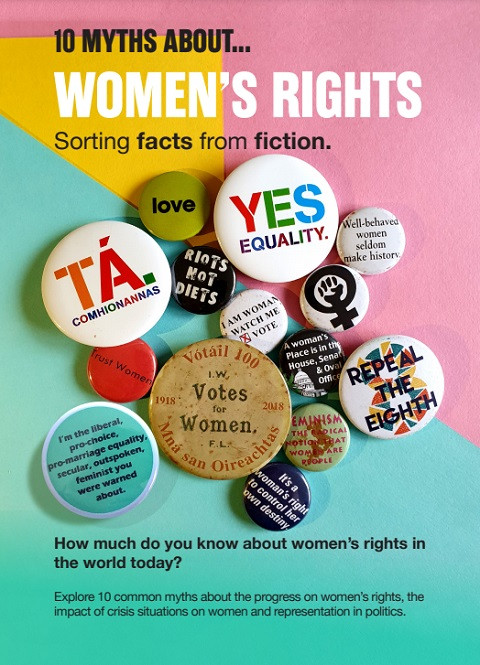 10 Myths About Women’s Rights: Sorting Facts From Fiction Año de publicación: 2020 Autor: Toni Pyke | Colm Regan Autor corporativo: DevelopmentEducation.ie Gender-based inequality is one of the most enduring and deep-seated discriminations. It affects all regions, classes and sectors. In most countries, it is maintained and defended in most of the same ways. One key component of that maintenance is a set of myths that are repeated time and time again.This pocket-size booklet includes:Why thinking about women’s rights matters10 short myths about progress on equality, who benefits from feminism, the realities of women’s health and the impact of COVID-19.Links to the Sustainable Development GoalsReferences per each myth following a fact or fiction approach and an explainerThe 10 Myths About…. series looks to sort facts from fiction on key global development, human rights and justice issues.Download 10 Myths About Women’s Rights PDFTest your knowledge and take the 10 Myths About Women’s Rights quiz or share with your group / class / friends For the latest fact checks and factsheets more on the fact checking project and development ideas, issues and debates, visit our What The Fact? project.
  Education in a Post-COVID World: Additional Considerations (In-Progress Reflection; No.43, 2021) Año de publicación: 2021 Autor: Renato Opertti Autor corporativo: UNESCO International Bureau of Education (IBE) This discussion document analyses some implications of the ideas proposed in the seminal UNESCO document “Education in a post-COVID world: Nine ideas for public action” (2020). Based on the work of the International Commission on the Futures of Education, the documents’ contributors included prominent figures with a wide range of professional and policy experience who hail from various regions of the world. The set of nine interconnected ideas illuminates the way forward toward the transformation of education and education systems and a reimagined future seen through a progressive lens. On one hand, it reaffirms basic principles, understandings, and commitments with regard to education as a global common good and universal human right; it also articulates the need to both reinvent multilateralism for a new global order and, crucially, to mobilize ideas and funding for transforming education. On the other hand, the document advocates for a comprehensive educational agenda, including the following critical issues: (i) visualizing educators as decision-makers in educational systems; (ii) appreciating students as active actors with rights; (iii) recognizing the value and specificity of the school space; (iv) addressing the dilemmas around technology’s ability to serve as an equalizer of opportunities; and (v) revisiting educational content for the sustainability of younger generations. L’éducation dans un monde post-Covid: considérations supplémentaires (Réflexion en cours; No. 43, 2021) Año de publicación: 2021 Autor: Renato Opertti Autor corporativo: UNESCO International Bureau of Education (IBE) Ce document de discussion analyse certaines implications des idées proposées dans le document initial « L’éducation dans un monde post-COVID : Neuf idées pour l’action publique » (2020) produit par la Commission internationale sur les futurs de l’éducation. Parmi les contributeurs de ce document figurent des experts éminents ayant une large expérience professionnelle et politique, provenant de diverses régions du monde. L’ensemble de ces neuves idées interconnectées éclaire la voie à suivre pour transformer l’éducation et les systèmes éducatifs et concevoir l’avenir dans une optique progressiste. D’une part, il réaffirme les principes de base, la compréhension et les engagements concernant l’éducation en tant que bien commun mondial et droit de l’homme universel ; il exprime également la nécessité de réinventer le multilatéralisme pour un nouvel ordre mondial et, surtout, de mobiliser des idées et des fonds pour transformer l’éducation. D’autre part, le document plaide en faveur d’un programme éducatif global, incluant les questions critiques suivantes: (i) visualiser les éducateurs comme des décideurs dans les systèmes éducatifs ; (ii) considérer les étudiants comme des acteurs actifs ayant des droits ; (iii) reconnaître la valeur et la spécificité de l’espace scolaire ; (iv) aborder les dilemmes autour de la capacité de la technologie à combler les inégalités ; et (v) revoir les contenus d’enseignement pour la durabilité des jeunes générations. Educación en un mundo post-COVID: consideraciones adicionales (Reflexiones en Progreso; No.43, 2021) Año de publicación: 2021 Autor: Renato Opertti Autor corporativo: UNESCO International Bureau of Education (IBE) Este documento de discusión analiza algunas implicaciones de las ideas propuestas en el documento seminal “Educación en un mundo post-COVID: Nueve ideas para la acción pública” (2020) producido por la Comisión Internacional sobre el Futuro de la Educación. Entre los colaboradores del informe se encuentran destacadas figuras con una amplia experiencia profesional y política procedentes de diversas regiones del mundo. El conjunto de nueve ideas interconectadas ilumina el camino a seguir hacia la transformación de la educación y los sistemas educativos y hacia un futuro reinventado visto a través de una lente progresista. Por un lado, reafirma los principios, entendimientos y compromisos básicos con respecto a la educación como bien común global y derecho humano universal. También, articula la necesidad tanto de reinventar el multilateralismo para un nuevo orden global como, fundamentalmente, de movilizar ideas y financiación para transformar la educación. Por otro lado, el documento aboga por una agenda educativa integral que incluya los siguientes aspectos críticos: (i) visualizar a los educadores como tomadores de decisiones en los sistemas educativos; (ii) valorar a los estudiantes como agentes activos con derechos; (iii) reconocer el valor y la especificidad del espacio escolar; (iv) abordar los dilemas en torno a la capacidad de la tecnología para servir como igualadora de oportunidades; y (v) revisar los contenidos educativos para la sostenibilidad de las generaciones más jóvenes.
  International Symposium on Cultivating Wisdom, Harvesting Peace: Educating for a Culture of Peace through Values, Virtues, and Spirituality of Diverse Cultures, Faiths, and Civilizations; Symposium Recommendations Año de publicación: 2005 Autor corporativo: Griffith University. Multi-Faith Centre On the 10-13th August 2005, over 120 delegates from 25 countries gathered at the International Symposium to share their inspirational insights and experiences on the theme of “Cultivating Wisdom, Harvesting Peace.” The Symposium was organized and hosted by the Multi-Faith Centre of Griffith University, Brisbane, Australia with the support of Pure Land Learning College, UNESCO and various UNESCO National Commissions, centres or offices, and numerous faith, interfaith, educational and civil society organizations and institutions. Reflecting a diversity of cultures, faiths and spirituality traditions, the delegates presented rich and empowering stories as well as critical analyses of how communities, institutions, civil society organizations, and international or global agencies have organized educational projects and programs to address the root causes of violence and conflicts and build a culture of peace at all levels of life. Over four intensive days of inter-faith and intra-faith dialogue, the Symposium participants engaged with humility and passion in sharing their wisdoms on ways to promote mutual understanding, solidarity, and cooperation across cultures and national boundaries. While recognizing that differences between faiths and cultures need to be understood, the dialogue also clearly showed that all faiths, cultures, and civilizations have, at their core, key values, virtues, and ethical principles that inspire and sustain peaceful relationships, communities and societies.The Symposium also highlighted the urgent need for exemplars and possibilities for transforming principles, values and visions into personal and social actions and practices in all the multiple dimensions of a culture of peace. In this first decade of the 21st century, it is clear that there are still many formidable challenges of building peace posed by prevailing realities of conflicts and violence in local, national, international and global contexts. The Symposium on “Cultivating Wisdom, Harvesting Peace” was therefore a most timely and relevant event, not only for promoting the urgent dialogue needed, but also most importantly in proposing constructive policies for educational transformation worldwide. This Summary of the Symposium Recommendations will hopefully be a very helpful document for the implementation of effective and creative strategies and practices of educating for wisdom towards a culture of peace. It is offered to government leaders, policy makers, educators, and leaders and members of diverse faith and interfaith institutions and communities in all societies and regions, in the hope that we will join our minds, hearts and spirit in solidarity to build a “one world” of peace, compassion, justice, love and diverse shared values for the well being of a common humanity and earth community