
Recursos
Exploren una amplia gama de recursos valiosos en GCED para profundizar su comprensión y promover su búsqueda, incidencia, enseñanza y aprendizaje.
3,229 resultados encontrados
 글로벌 시민 교육: 새 천년의 목표와 도전 Año de publicación: 2013 Autor: 박순용 Autor corporativo: 유네스코 아시아태평양 국제이해교육원 이 연구 보고서는 새로운 신흥 교육 이니셔티브인 글로벌 시민 교육을 제공하는 데에 어떤 문제가 있는지를 조사하고 있다. 글로벌 시민 교육의 운영 체제와 개념을 다시 살펴보면, 독자는 글로벌 시민 교육의 현 상태와 이를 효과적으로 이를 구현할 수 있는 방법에 관한 폭넓은 그림을 그릴 수 있다.
  Coding global citizenship in the digital era (SangSaeng no. 44 winter 2015) Año de publicación: 2015 Autor corporativo: APCEIU Summary:The 44th issue of SangSaeng, “Coding Global Citizenship in the Digital Era,” has been released. The advancement of digital technology has connected the world, accelerating globalization. In this global digital age, Global Citizenship Education (GCED) is drawing enormous attention. Recognizing its significance, this Winter edition brings out the topic of GCED for digital citizens through the lens of education policymakers, children and youth, and corporations. In particular, the articles suggest actively participating in and contributing to the information society through ethical, safe, and responsible use of digital technology as the core competency for global citizens in the digital era.8 Striking a Balance Between Digital Opportunities & Related Risks12 Young People as Active Citizens in the Digital Age16 Empowering Children to Become Creative Digital Leaders20 Fostering Inclusive Innovation for a Better World38 Interview38 Understanding Culture through Media and Language40 Embracing Diversity to Live Together42 Peace in My MemoryTo achieve Peace, Must Understand Peace46 Understanding the Asia-Pacific RegionGlimpse into Ancient Healing Ritual of Ulik Mayang50 APCEIU in Action Codage de la citoyenneté mondiale à l'ère du numérique (SangSaeng no 44 hiver 2015) Año de publicación: 2015 Autor corporativo: Centre Asie-Pacifique d'éducation pour la compréhension internationale (APCEIU) Le 44e numéro de SangSaeng, intitulé «Codage de la citoyenneté mondiale à l'ère numérique», a été publié. L'avancement de la technologie numérique a connecté le monde, l'accélération de la mondialisation. À l'ère numérique mondiale, l'éducation à la citoyenneté mondiale (ECM) attire l'attention. Reconnaissant son importance, cette édition d'hiver met en évidence le thème du ECM pour les citoyens numériques à travers l'optique des responsables de l'éducation, des enfants et des jeunes et des entreprises. En particulier, les articles proposent de participer activement à la société de l'information et de contribuer à celle-ci par une utilisation éthique, sûre et responsable des technologies numériques comme compétence fondamentale pour les citoyens du monde à l'ère du numérique.8 Trouver un équilibre entre les Débouchés Numériques et les Risques Connexes12 Les Jeunes en tant que Citoyens Actifs à l'ère du Numérique16 Permettre aux enfants de devenir des leaders numériques créatifs20 Favoriser l'innovation inclusive pour un monde meilleur38 Entretien38 Comprendre la Culture par le biais des Médias et de la Langue40 Adopter la Diversité pour Vivre Ensemble42 La Paix dans ma MémoirePour atteindre la paix, il faut comprendre la paix46 Comprendre la région Asie-PacifiqueDécouvrez le rituel de guérison antique d'Ulik Mayang50 APCEIU en action
 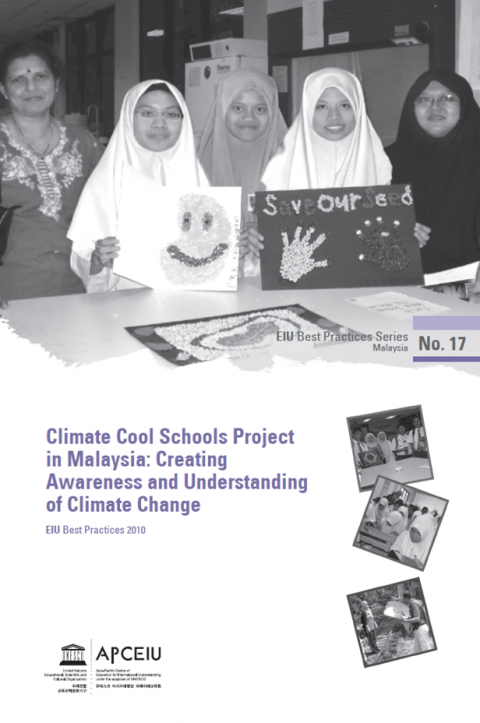 EIU Best Practice Series No. 17: Climate cool schools project in Malaysia: creating awareness and understanding of climate change Año de publicación: 2010 Autor: Maria Salih Autor corporativo: APCEIU The Climate Cool Schools (CCS)-Global Platform project is a multilateral learning portal for students in Malaysia, the UK, and Hong Kong to work together to explore local and global climate change issues. The learning portal enables these students to learn from each other about what actions are possible, and to find a voice to advocate wider actions at the local and global levels. The project was initiated in late 2007 and in early 2008 embarked on a two year trial basis with the British Council (BC), Sultan Idris Education University (SIEU), and the Perak State Education Department (JPN, Perak) as the partners. This project is a follow-up from the ZeroCarbonCity project launched in 2005 by the British Council. Projet d’Écoles Fraîches Climatique en Malaisie: la sensibilisation et la compréhension des changements climatiques (ECI Série des Meilleures Pratiques n ° 17 ) Año de publicación: 2010 Autor: Maria Salih Autor corporativo: Centre Asie-Pacifique d'éducation pour la compréhension internationale (APCEIU) Le Projet d'Écoles Fraîches Climatique (EFC)) - Plate-Forme Mondiale est un portail d'apprentissage multilatéral pour les étudiants en Malaisie, au Royaume-Uni, et à Hong Kong à travailler ensemble pour explorer les enjeux locaux et mondiaux du changement climatique. Le portail d'apprentissage permet à ces étudiants d'apprendre les uns des autres sur les actions sont possibles, et de trouver une voix pour préconiser des actions plus larges aux niveaux local et mondial. Le projet a été lancé à la fin de 2007 et au début de 2008 a lancé à titre d'essai de deux ans avec le British Council (BC), Sultan Idris Université Education (SIEU), et l'État de Perak Département de l'éducation (JPN, Perak) que les partenaires. Ce projet est un suivi du projet ZeroCarbonCity lancé en 2005 par le British Council.
  함께 사는 세상 만들기 Año de publicación: 2004 Autor corporativo: APCEIU This book, in essence, aims to introduce Education for International Understanding (EIU) to high school students, college students and teachers at all levels as well as the general public. The growing interconnectedness and interdependence compels all of us to understand the world beyond our immediate living space, to critically reflect on issues affecting us and others, and to work together to make our world a more peaceful and sustainable one. It requires values education that is transformative and participatory in nature to arouse genuine interests and passions to learn more and eventually to make positive changes. The book is comprised of five parts, organized by five thematic areas of EIU, namely, intercultural understanding, globalization, human rights, peace and Education for Sustainable Development (ESD). It introduces carefully chosen topics and discussions which may pique readers’ interest in some of the issues at stake, thus, encourage them to critically reflect on the complexities surrounding the issues and motivate them to engage further. Using an interdisciplinary lens, the book also borrows some ideas and approaches commonly practiced in critical anthropology. 함께 사는 세상 만들기 Año de publicación: 2004 Autor corporativo: 유네스코 아시아태평양 국제이해교육원 유네스코 아시아태평양 국제이해교육원에서는 국제이해교육을 가르치는 교사와 배우고자 하는 고등학생들에게 도움을 주기 위하여 고등학생을 위한 국제이해교육 교재를 출간하게 되었습니다우리 교육원은 아시아·태평양 지역의 45개 나라들과 함께 국제이해교육을 학교와 시민사회에서 강화하고 발전시킬 책임을 부여받았기 때문에, 여러가지 국제 회의와 연수과정, 전문가 협의회 등을 통해 이 과목의 교육 내용과 교과 과정에 대한 그림을 그려보는 노력을 부단히 전개하고 있습니다. 우리 교육원은 국내·외 여러 전문가들과 함께 많은 토론을 거쳐 국제이해교육의 기본 골격을 ① 문화 간 이해, ② 세계화, ③ 인권, ④ 평화, ⑤ 지속가능발전의 다섯 가지로 정했으며, 이를 바탕으로 초·중·고 국제이해교육 교육과정을 개발했습니다.우리 교육원은 앞으로 수년간 이러한 토대 위에서 교육자료나 수업 모형 등을 개발해보려고 합니다. 이번에 발간되는 교재 『함께 사는 세상 만들기』도 이러한 노력의 한 결실입니다. 이 책이 세계화 시대의 사회구조와 문제들을 파악하고, 함께 살 수 있는 가치관과 태도를 길러주는 데 크게 도움이 될 수 있기를 바랍니다.
  Electronic resources on education for sustainable development Año de publicación: 2007 Autor corporativo: APCEIU | UNESCO Bangkok The Asia-Pacific Programme of Educational Innovation for Development (APEID) of UNESCO Bangkok and the Asia-Pacific Centre of Education for International Understanding (APCEIU) collaborated to produce this document listing these electronic resources. The value of such resources is not limited to teachers alone; it is also useful to policy and decision makers, teacher educators, researchers and academics as well as students themselves. Les ressources électroniques sur l'éducation pour le développement durable Año de publicación: 2007 Autor corporativo: Centre Asie-Pacifique d'éducation pour la compréhension internationale (APCEIU) | UNESCO Bangkok Le Programme d'innovation éducative en vue du développement en Asie et dans le Pacifique(APEID)e l'UNESCO à Bangkok et le Centre d'Asie-Pacifique pour la Compréhension Internationale(APCECI) ont collaboré pour produire ce document énumérant ces ressources électroniques. La valeur de ces ressources ne se limite pas aux seuls enseignants; il est également utile pour les politiques et les décideurs, formateurs d'enseignants, des chercheurs et des universitaires ainsi que des étudiants eux-mêmes.
  Two concepts, one goal: education for international understanding and education for sustainable development Año de publicación: 2007 Autor corporativo: APCEIU | UNESCO Bangkok EIU and ESD are not dogmas but evolving concepts that can contribute to social learning and transformation. EIU and ESD share many common issues, supporting each other’s scope of work and focus. This series of information sheets has been prepared to highlight key complementary areas and synergies.