
Recursos
Exploren una amplia gama de recursos valiosos en GCED para profundizar su comprensión y promover su búsqueda, incidencia, enseñanza y aprendizaje.
2,657 resultados encontrados
 Son Atlas: Outil de plaidoyer interactif sur le droit à l’éducation des filles et des femmes Año de publicación: 2023 Autor corporativo: UNESCO De nombreuses filles et femmes ne peuvent pas exercer leur droit à l'éducation en raison des inégalités entre les genres et des pratiques discriminatoires. La pauvreté, les mariages précoces et les violences basées sur le genre ne sont que quelques-unes des nombreuses raisons qui expliquent le pourcentage élevé d'analphabétisme et de décrochage scolaire chez les filles et les femmes dans le monde. Le renforcement du droit des filles et des femmes pour une éducation de qualité est essentiel pour éliminer la discrimination et parvenir à l'égalité des droits entre les genres. Ceci ne peut être réalisé sans des cadres juridiques nationaux solides, basés sur les droits, sensibles au genre et inclusifs. C'est là qu'intervient SonAtlas. SonAtlas est un outil en ligne, le premier du genre, qui cartographie le droit à l'éducation des filles et des femmes. Il vise à améliorer les connaissances du public et à surveiller le statut des constitutions, législations et réglementations nationales relatives aux droits à l'éducation des filles et des femmes, afin d'encourager les pays à agir, à renforcer leurs lois et leurs politiques et à entraîner un changement à long terme. Des changements concrets sont déjà visibles. En 2019, 4 % des pays restreignaient explicitement le droit à l'éducation des filles mariées, enceintes et jeunes mères. Ce chiffre a chuté à 2 % en 2022, au profit de millions de filles qui peuvent désormais aller à l'école en toute légalité lorsqu'elles se marient ou sont enceintes ou jeunes mères.
  Protect Her Rights, Strengthen Your Laws: Her Atlas; Status Report on Girls’ and Women’s Right to Education Año de publicación: 2022 Autor corporativo: UNESCO UNESCO’s Her Education, our future initiative, Her Atlas was launched in 2019 with the aim to enhance public knowledge and monitor the status of national constitutions, legislation and regulations related to girls’ and women’s education rights in order to encourage countries to take actions to improve their legal frameworks. Three years after its launch, the research phase has been completed: overall, the legal frameworks of 196 countries have been thoroughly analyzed to evaluate the level of protection of girls’ and women’s right to education around the world. In an interactive world map format, Her Atlas uses a color-coded scoring system to monitor 12 indicators of legal progress towards gender equality in the right to education. This report marks the completion of the first research phase and intends to highlight some key trends outlined by the research work, and to emphasize examples of legal provisions regarding some aspects of girls’ and women’s right to education guaranteed by States’ domestic laws.
 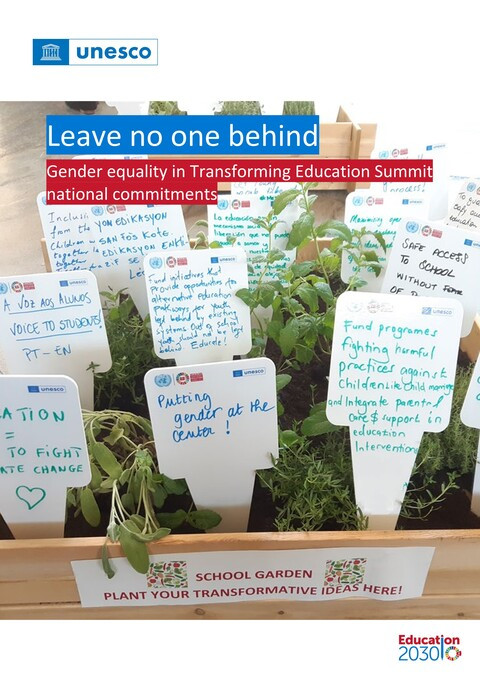 Leave No One Behind: Gender Equality in Transforming Education Summit National Commitments Año de publicación: 2023 Autor corporativo: UNESCO The Transforming Education Summit was convened in response to a global crisis in education – one of equity and inclusion, quality and relevance. This paper applies a gender lens to the national statements of commitments made by countries during the Summit. It considers the scope of commitments to gender equality and gender- transformative education, common gender themes and considerations emerging across commitments, and notable gaps. It aims to inform future actions by the Global Platform to Drive Leadership and Accountability for Gender Equality and Girls’ and Women’s Empowerment in and through Education, and support to country action to transform education systems to advance gender equality.
 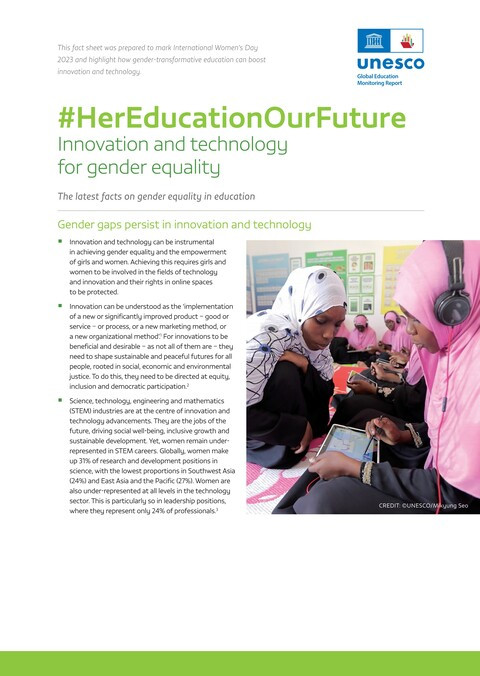 #HerEducationOurFuture: Innovation and Technology for Gender Equality; the Latest Facts on Gender Equality in Education Año de publicación: 2023 Autor corporativo: UNESCO | Global Education Monitoring Report Team Gender gaps persist in innovation and technology Innovation and technology can be instrumental in achieving gender equality and the empowerment of girls and women. Achieving this requires girls and women to be involved in the fields of technology and innovation and their rights in online spaces to be protected. #SuEducaciónNuestroFuturo: Innovación y tecnología para la igualdad de género: últimos datos sobre la igualdad de género en la educación Año de publicación: 2023 Autor corporativo: UNESCO | Global Education Monitoring Report Team La brecha de género persiste en la innovación y la tecnología La innovación y la tecnología pueden ser decisivas a la hora de lograr la igualdad de género y empoderar a las niñas y las mujeres. Para lograrlo, es necesario que las niñas y las mujeres participen en los ámbitos de la tecnología y la innovación y que se protejan sus derechos en los espacios en línea. #SonÉducationNotreAvenir: l’innovation et la technologie au service de l’égalité des genres: derniers développements sur l’égalité des genres dans l’éducation Año de publicación: 2023 Autor corporativo: UNESCO | Global Education Monitoring Report Team Les inégalités entre les genres persistent dans les domaines de l’innovation et de la technologie L’innovation et la technologie peuvent jouer un rôle essentiel en faveur de l’égalité des genres et de l’autonomisation des filles et des femmes. Pour que ces objectifs soient atteints, il faut que les filles et les femmes participent dans les domaines de la technologie et de l’innovation, mais aussi que leurs droits dans les espaces en ligne soient protégés.
 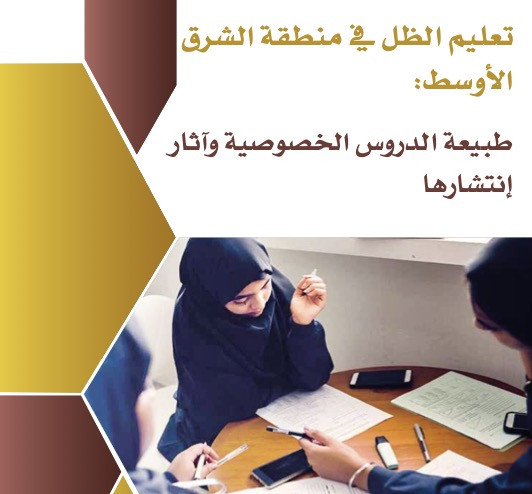 تعليم الظل في منطقة الشرق الأوسط: طبيعة الدروس الخصوصية وآثار إنتشارها Año de publicación: 2023 Autor: Mark Bray | Anas Hajar Autor corporativo: منظمة الأمم المتحدة للتربية والعلم والثقافة (UNESCO) يتلقى عدد متزايد من لطلبة فيجميع أنحاء العالم دروًسا خصوصية لاستكمال تعليمهما لمدرسي.وفيكثيرمنا لمؤلفات الأكاديمية، يسمى ذلك بتعليم الظل؛ لأن محتوى الدروس الخصوصية يحاكي بشكل كبير محتوى التعليم المدرسي، حيث يتغير محتواه بتغير المنهاج في المدارس. قد تأخذ الدروس الخصوصية أنماط عديدة، فمن الممكن تقديمها بشكل فردي، أو في مجموعات صغيرة، أو في صفوف كبيرة، أو عبر الإنترنت. و يتم توفير بعض الدروس الخصوصية من قبل معلمي الوزارة من أجلا لحصولعل ىدخل إضافي، كما تقوم- أيًضا- بعض المؤسسات التجارية بتوفيرتلك الدروس.أما الفئة الثالثة من مقدمي الدروس الخصوصية فتشمل طلاب الجامعات والمتقاعدين و العمال الموسميين.ففي حين أن الكثير من الأبحاث والسياسات قد ركزت على نظام تعليم الظل في شرق آسيا وبعض مناطق العالم الأخرى، كان الاهتمام أقلب الموضوع في منطقة الشرق الأوسط. ولكن الموضوع يستحق تركيًزا أكبر بسبب آثاره بعيدة المدى على الهيكليات الاجتماعية وأنظمة التعليم السائدة. تبدأ هذه الدراسة بالصورة العالمية قبل مقارنة الأنماط ضمن وبين 12 دولة ناطقة باللغة العربية في الشرق الأوسط.
 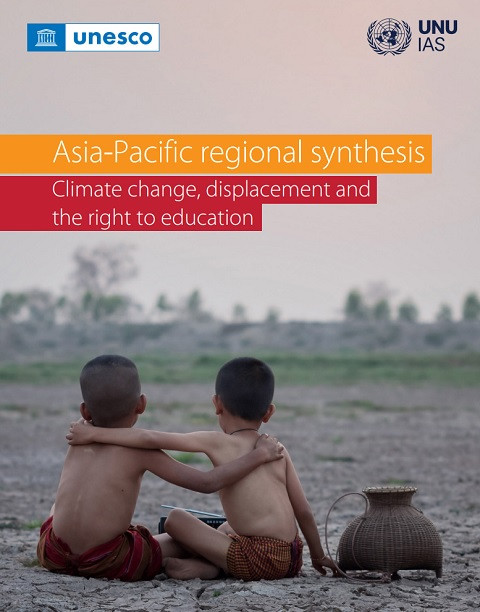 Asia-Pacific Regional Synthesis: Climate Change, Displacement and the Right to Education Año de publicación: 2023 Autor corporativo: UNESCO | United Nations University Institute for the Advanced Study of Sustainability (UNU-IAS) | UNESCO Bangkok In 2020, 30.7 million people were displaced by natural disasters – disasters which the scientific community acknowledges are more frequent and more intense as a result of climate change. In Asia and the Pacific alone, 21.3 million people were displaced, making it the region the most impacted by national disasters and climate change in the world. Therefore, country case studies were carried out in Bangladesh, India, Indonesia, Tuvalu, and Viet Nam to examine not only specific vulnerabilities to climate change and related mobility, but also the impacts of climate change on the right to education in Asia and the Pacific. These case studies show that climate change directly threatens education – through the destruction of schools and property – but also indirectly puts education in peril by forcing people to cross borders, ensuring neither legal residency nor the right to education. This regional synthesis report aims to guide policy-makers through providing operational policy recommendations on how to ensure education is protected in Asia and the Pacific in the face of climate change and displacement from a human rights-based approach. The report is one of four being developed and will contribute to the global initiative on climate change and displacement and the right to education – launched by UNESCO in 2020 – by informing the development of a Global Report with global policyrecommendations.How climate change impacts the right to education in Asia and the Pacific21.3million displacementstook place in Asia and the Pacific
 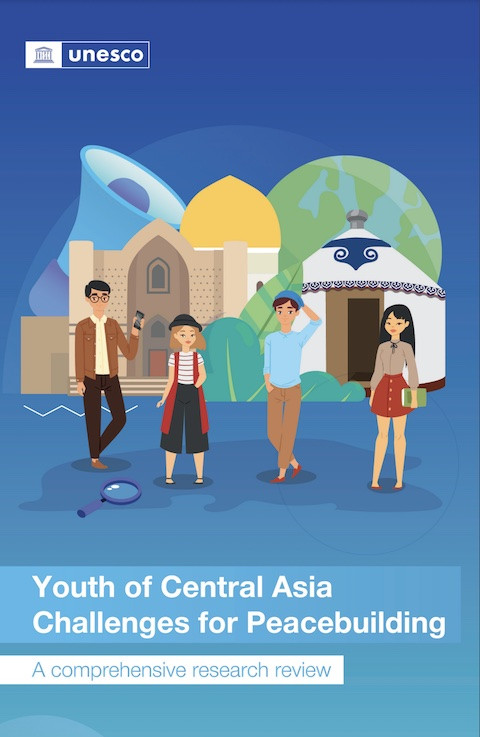 Youth of Central Asia, Challenges for Peacebuilding: A Comprehensive Research Review Año de publicación: 2021 Autor: Laura Yerekesheva Autor corporativo: UNESCO The estimations are that by 2030, the world will be home to 1.3 billion young people. This speaks about the importance of the youth for development in various parts of the globe, particularly in developing countries which constitute 90% of the global youth population. From comprehensive holistic perspective peace, peacebuilding and dialogue embrace all aspects and dimensions of life – inter-generational, social, economic, political, ethnic, religious, civic, ideological, cultural, and natural. The youth related issues are directly linked with the SDGs agenda. Central Asian states are also on the list of developing countries, with an increasing demographic share of the youth in the general population, meaning that the countries of the region are “young.” As of 2020, the total population of the four countries of Central Asia (Kazakhstan, Kyrgyzstan, Tajikistan and Uzbekistan) was 68.46 million, of which youth comprised 16.55 million or 24,1%. What Challenges for Peacebuilding the Youth of Central Asia Face? This highlights the urgency required for elaborating and implementing special policies on youth development. For Central Asia, the peace and peacebuilding agenda is the development agenda, and vice versa, as neither is possible without the other, and these in turn are intrinsically linked with youth-related issues. This report provides a detailed overview of the existing challenges to the youth of the 4 countries of the region – Kazakhstan, Kyrgyzstan Tajikistan, Uzbekistan – structured around three main themes of peacebuilding: (1) an education and learning environment; (2) economic and social participation; and (3) civic engagement. Governments, international organizations, professionals and policymakers in the youth, peacebuilding and development sectors, academia and NGOs are invited to join forces to accelerate the achievement of youth development for a more just, sustainable and peaceful future. Молодежь Центральной Азии, Вызовы миростроительству : Комплексный исследовательский обзор Año de publicación: 2021 Autor: Laura Yerekesheva Autor corporativo: Организация Объединенных Наций по вопросам образования, науки и культуры (UNESCO) По оценкам, к 2030 году в мире будут проживать 1,3 миллиарда молодых людей. Это говорит о важной роли, которую будет играть молодежь, особенно в развивающихся странах, в которых проживает 90% общего мирового населения молодежи. В рамках всеобъемлющего системного подхода, мир, миростроительство и диалог подразумевают все аспекты и измерения жизни - межпоколенческие, социальные, экономические, политические, этнические, религиозные, гражданские, идеологические, культурные и природные. Вопросы, связанные с молодежью, напрямую связаны с повесткой в области достижения Целей устойчивого развития (ЦУР). Государства Центральной Азии относятся к развивающимся странам с высокой долей молодежи в общем составе населения, что делает эти страны «молодыми». По состоянию на 2020 год общая численность населения четырех стран Централь ной Азии (Казахстана, Кыргызстана, Таджикистана и Узбекистана) - 68,46 миллиона человек, из которых молодежь составляла 16,55 миллиона человек или 24,1%.Это свидетельствует о важности разработки и реализации специальных стратегий и мер по развитию молодежи. Для Центральной Азии повестка дня в области мира и миростроительства – это, прежде всего, повестка дня в области развития, и наоборот, поскольку обе они взаимосвязаны между собой, а также с проблемами молодежи.В данном отчете представлен подробный обзор существующих вызовов, с которыми сталкивается молодежь четырех стран региона - Казахстана, Кыргызстана, Таджикистана, Узбекистана. Данные вызовы структурированы вокруг трех основных тем миростроительства: (1) образование и обучающая среда; (2) экономическое и социальное участие; и (3) гражданское участие.Правительствам, международным организациям, специалистам и политикам, работающим в сферах молодежи, миростроительства и развития, академическим кругам и неправительственным организациям предлагается объединить усилия для ускорения достижения целей развития молодежи для более справедливого, устойчивого и мирного будущего.