
Recursos
Exploren una amplia gama de recursos valiosos en GCED para profundizar su comprensión y promover su búsqueda, incidencia, enseñanza y aprendizaje.
3,446 resultados encontrados
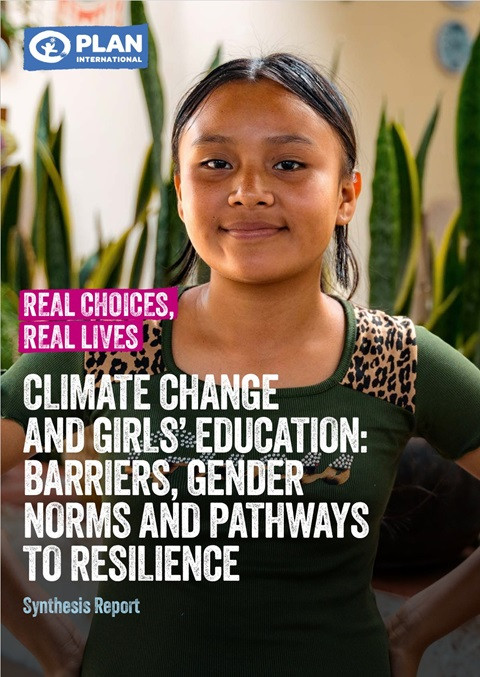 [Synthesis Report] Climate Change and Girls' Education: Barriers, Gender Norms and Pathways to Resilience Año de publicación: 2023 Autor corporativo: Plan International This research explores the relationship between climate change and girls' education: what are the direct and indirect impacts of climate change on girls' access to school and completion of their education? How do these impacts intersect with existing gender barriers to education? And how does your education help girls respond and adapt to climate change in their communities? A synthesis report and summary are also available, along with the technical report for more details on the conclusions and the research itself. [Rapport de synthèse] Changement climatique et éducation des filles: entraves, normes sexistes et chemins vers la resilience Año de publicación: 2023 Autor corporativo: Plan International This research explores the relationship between climate change and girls' education: what are the direct and indirect impacts of climate change on girls' access to school and completion of their education? How do these impacts intersect with existing gender barriers to education? And how does your education help girls respond and adapt to climate change in their communities? A synthesis report and summary are also available, along with the technical report for more details on the conclusions and the research itself. [Informe de síntesis] Cambio climático y educación de las niñas: barreras, normas de género, y rutas hacia la resiliencia Año de publicación: 2023 Autor corporativo: Plan International Esta investigación explora la relación entre el cambio climático y la educación de las niñas: ¿cuáles son los impactos directos e indirectos del cambio climático sobre el acceso de las niñas a la escuela y la finalización de su educación? ¿Cómo se cruzan estos impactos con las barreras de género existentes a la educación? ¿Y cómo ayuda su educación a las niñas a responder y adaptarse al cambio climático en sus comunidades? Se incluye un informe de síntesis y un resumen, junto con el informe técnico para más detalles sobre las conclusiones y la propia investigación.
 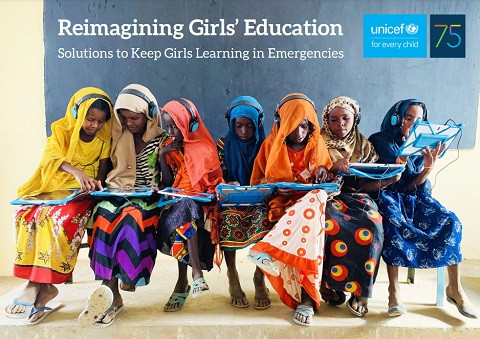 Reimagining Girls’ Education: Solutions to Keep Girls Learning in Emergencies Año de publicación: 2021 Autor corporativo: United Nations Children's Fund (UNICEF) Reimagining Girls’ Education: Solutions to Keep Girls Learning in Emergencies presents an empirical overview of what works to support learning outcomes for girls in emergencies. Research shows that girls in emergencies are disadvantaged at all stages of education and are more likely to be out-of-school than in non-emergency settings. Girls are also struggling to learn.This solutions book seeks to highlight promising evidence-based actions in education for decision makers who are designing and implementing interventions to support girls’ education in low and middle-income country humanitarian settings and settings where education has been interrupted by the COVID‑19 pandemic. It documents practical examples of approaches that have been or are being tested, and from which lessons can be drawn.The overarching aim is that this evidence be used to inform programming in crises and support diverse stakeholders in mitigating the impact of emergencies on girls’ education.
 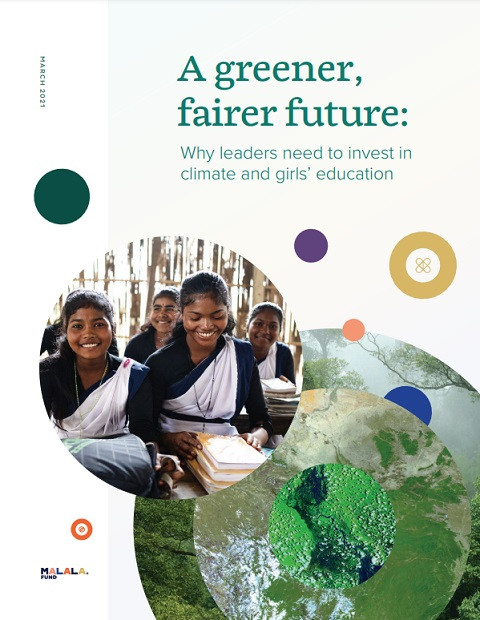 A Greener, Fairer Future: Why Leaders Need to Invest in Climate and Girls’ Education Año de publicación: 2021 Autor: Lucia Fry | Philippa Lei Autor corporativo: Malala Fund The world is on the brink of a climate catastrophe — and girls are disproportionately bearing the impact. Climate-related events like flooding, droughts and increased exposure to zoonotic diseases amplify the inequalities girls face and further limit their ability to access and complete their education. Malala Fund’s new report, A greener, fairer future: Why leaders need to invest in climate and girls' education, estimates that in 2021 climate-related events will prevent at least four million girls in low- and lower-middle-income countries from completing their education. If current trends continue, by 2025 climate change will be a contributing factor in preventing at least 12.5 million girls from completing their education each year.Yet evidence shows that closing gender gaps in education can help countries better adapt to the effects of climate change and decrease the rate and impact of global warming.“Girls in lower-income countries are the least responsible for the climate crisis, so it’s a travesty that it now threatens their very lifeline to a brighter future: quality education,” said Lucia Fry, Director of Research and Policy at Malala Fund. “Malala Fund wants leaders at COP26 to hear young people’s demands around education. They know that climate action helps girls stay in school, which in turn helps countries tackle the climate crisis. Young people are demanding an education that will prepare them to adapt to the effects of climate change and challenge the root causes of the crisis.”A greener, fairer future outlines the origins of the climate emergency and explains how confronting issues like the legacy of colonialism, racial discrimination and gender inequality through education is key to finding a sustainable solution to the crisis. The paper introduces the Gender-Equal Green Learning Agenda, a new framework to help leaders address the climate crisis through education.In this report, Malala Fund recommends how leaders can take urgent climate action at meetings this year, like COP26. This includes reducing carbon emissions, improving girls’ access to education, helping communities adapt to the realities of climate change and transforming education systems to provide all students with the knowledge, skills and values needed to challenge the social and economic inequalities fuelling the climate crisis.For more about the links between climate change and girls’ education, read the full paper below.
 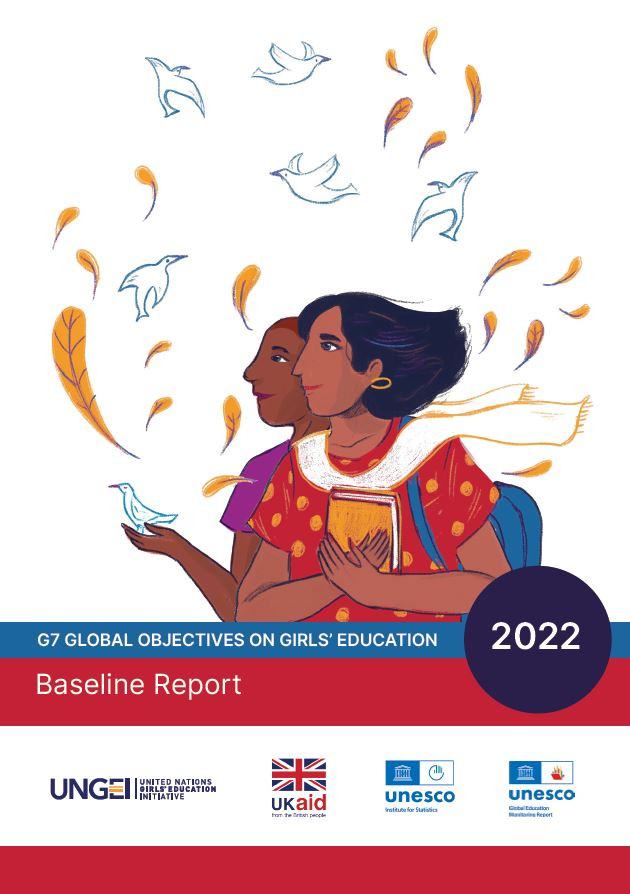 G7 Global Objectives On Girls’ Education: Baseline Report Año de publicación: 2022 Autor corporativo: United Nations Girls' Education Initiative (UNGEI) This publication serves as a baseline report to accompany efforts of the G7 Accountability Working Group to monitor progress towards the two global objectives. It presents evidence on low- and lower-middle-income countries’ progress in achieving the two global objectives and what remains to be done.It is important to stress that the two G7 global objectives on girls’ education are measures of gender parity, which are necessary but not sufficient as measures of gender equality. Assessing progress towards the latter requires information, which tends not to be available systematically enough to allow a comparative perspective. However, this report provides insights to remaining challenges.
  Integrating sustainable development in technical and vocational education and training: six case studies from Southern and Eastern Africa Año de publicación: 2010 Autor: Roland Dubois | Koontee Balgobin | Modesto Sylvester Gomani | Joy Kasandi Kelemba | Gabriel S. Konayuma | Matthews Lebogang Phiri | John W. Simiyu Autor corporativo: UNESCO International Centre for Technical and Vocational Education and Training (UNEVOC) The case studies in Southern and Eastern Africa were commissioned in Botswana, Kenya, Malawi, Mauritius and Zambia. They were carried out by writers connected with the UNEVOC Network as part of capacity building and of contributing to knowledge building and sharing. They have described and have analysed experiences, practices relating to integrating ESD in TVET programmes, primarily. Also, they have identified gaps for additional action so that the integration can be satisfactorily done. Through the case studies it is intended to build a pool of resources and tools of what works as part of the UNESCO-UNEVOC International Centre’s clearinghouse. Intégration du développement durable dans l'enseignement et la formation techniques et professionnels: six études de cas en Afrique australe et orientale Año de publicación: 2010 Autor: Roland Dubois | Koontee Balgobin | Modesto Sylvester Gomani | Joy Kasandi Kelemba | Gabriel S. Konayuma | Matthews Lebogang Phiri | John W. Simiyu Autor corporativo: UNESCO International Centre for Technical and Vocational Education and Training (UNEVOC) Les études de cas en Afrique australe et orientale ont été commandées au Botswana, au Kenya, au Malawi, à Maurice et en Zambie. Ils ont été réalisés par des auteurs liés au Réseau UNEVOC dans le cadre du renforcement des capacités et de la contribution à la construction et au partage des connaissances. Ils ont décrit et analysé les expériences, les pratiques relatives à l'intégration de la EDD dans les programmes d'EPT, principalement. De plus, ils ont identifié des lacunes pour des actions supplémentaires afin que l'intégration puisse être effectuée de manière satisfaisante. Grâce aux études de cas, il est prévu de constituer un pool de ressources et d'outils de ce qui fonctionne dans le cadre du centre d'échange du Centre international UNESCO-UNEVOC.
  Securitising Education to Prevent Terrorism or Losing Direction? Año de publicación: 2016 Autor: Bill Durodie Autor corporativo: Society for Educational Studies | Taylor & Francis This article examines the growing relationship between security and education, particularly in the light of the UK government’s Prevent Duty that seeks to tackle radicalization in a variety of milieus, including universities. However, rather than seeing this process as being merely one-way, through a so-called securitization of education, what is explored here is the dialectic between these two spheres. It is suggested that a heightened sensitivity to the supposed consequences of inflammatory rhetoric on the well-being of supposedly suggestible or vulnerable students has been in existence within education for quite some time. Securitising Education to Prevent Terrorism or Losing Direction? Año de publicación: 2016 Autor: Bill Durodie Autor corporativo: Society for Educational Studies | Taylor & Francis Cet article examine le lien grandissant entre la sécurité et l'éducation, à la lumière, en particulier, du programme « Prevent Duty » du gouvernement britannique, qui vise à lutter contre la radicalisation dans différents milieux, tels que les universités. Cependant, plutôt que de voir un simple processus de sécurisation de l'éducation, il s’agit ici d’explorer la dialectique entre ces deux éléments. On pose comme hypothèse qu'une sensibilité accrue aux soi-disant conséquences d’un discours enflammé sur le bien-être des élèves prétendus influençables ou vulnérables existe au sein de l'éducation depuis un certain temps.