
Recursos
Exploren una amplia gama de recursos valiosos en GCED para profundizar su comprensión y promover su búsqueda, incidencia, enseñanza y aprendizaje.
3,446 resultados encontrados
 “We did also save people”: A Study of Holocaust Education in Romania After Decades of Historical Silence Año de publicación: 2008 Autor: Thomas Misco This research study seeks to understand the current state of Holocaust education in Romanian classrooms and the variety of forces that influence its treatment. By identifying obstacles, challenges, and successes, this study provides a generative knowledge base for curriculum proposals, symposia, and other initiatives that seek to disrupt reticence on this topic. Given the wide range of possible influences on Holocaust instruction, this study employs ethnographic methods to seek out constructed meanings among students, teachers, subject matter, and numerous forces within the milieu. The findings reveal some promise for addressing this history in schools, including teacher autonomy, institutional support, and teacher trainings. Yet Romania faces a number of challenges, such as the legacy of communism, the role of Antonescu in the curriculum, few opportunities to address controversies, limited instructional time, and other institutional and community forces. Holocaust education is a relatively new phenomenon in Romania and understanding its evolution can inform other societies and cultures that are working to introduce Holocaust studies or controversial issues into their curricula. As more post-Soviet and post-communist states attempt to build pluralistic, tolerant and open-minded societies, their treatment of historical silences and the renegotiation of their past become critical features for the development of democratic citizens. (By the author)
  Globalising the school curriculum: gender, EFA and global citizenship education (RECOUP working paper 17) Año de publicación: 2008 Autor: Harriet Marshall | Madeleine Arnot Autor corporativo: Research Consortium on Educational Outcomes and Poverty (RECOUP) This paper aims to bring the school curriculum into the analysis of gender, education and development. There is a marked absence of discussion both in the academic field of development studies and in the political domain of educational policy making around Education for All about what is required of the school curriculum so that it could help promote gender equality. All too often national school curricula reproduce gender inequalities in the public and private sphere and sustain hegemonic male regimes on a national and global scale (Arnot, 2002). Curriculum research, however, can challenge these social messages embedded in curricular formations as well as raise deeper questions about whose forms of knowledge should be transmitted through official forms of schooling. Critical sociological research, for example, recognises the importance of the rules governing the access and redistribution of knowledge, and also the politics behind the selection, organisation and evaluation of legitimate knowledge through formal national educational institutions within developing economies and the impact these have on indigenous social stratifications. It can also critically assess new global interventions into the school curriculum whether in the name of economic progress, human rights or social justice. These global developments are controversial not least because of the challenge they represent to what has been considered the prerogative of national governments – to transmit its own selection of educational knowledge to its citizens, using its own contextualised pedagogic style. The study of national curricula therefore offers the possibility of exploring the equity dimensions of global–national and local educational interfaces and policy agendas. The paper has limited but hopefully valuable ambitions. It aims to initiate discussion of the curriculum in relation to gender, education and development by exploring the global significance of recent interventions on gender, and in particular girls’ education. The first section briefly considers the implications of globalisation as a transformative process on the development of educational knowledge and queries whether the school curricula could address persistent worldwide gender disparities, inequalities and female subjugation. In the second section, we focus specifically on whether new global declarations around gender equality such as those analysed in the UNESCO Education for All Global Monitoring Reports imply certain roles for the school curriculum. The final section addresses the possibilities for gender equality implied by recent interest global citizenship education – a new curriculum subject and approach that promises much. We consider in a preliminary way whether these new developments represent a move towards forms of educational knowledge that are critical rather than legitimating and ‘normalising’ in relation to gender inequalities. Mondialiser le programme scolaire: le sexe, l'EPT et L'éducation à la Citoyenneté Mondiale (ECM) (papier de travail 17) Año de publicación: 2008 Autor: Harriet Marshall | Madeleine Arnot Autor corporativo: Research Consortium on Educational Outcomes and Poverty (RECOUP) Ce document vise à amener le programme scolaire dans l'analyse de genre, l'éducation et le développement. Il y a une absence marquée de la discussion à la fois dans le domaine académique des études de développement et dans le domaine politique de la politique en matière d'éducation autour de l'éducation pour tous à propos de ce qui est requis du programme scolaire afin qu'il puisse aider à promouvoir l'égalité des sexes. Tous les programmes scolaires nationaux trop souvent reproduisent les inégalités entre les sexes dans le domaine public et privé et de soutenir les régimes de sexe masculin hégémonique à l'échelle nationale et mondiale (Arnot, 2002). la recherche des programmes, cependant, ne peut contester ces messages sociaux intégrés dans les formations scolaires ainsi que soulever des questions plus profondes sur dont les formes de connaissances doivent être transmises par le biais des formulaires officiels de scolarité. recherche sociologique critique, par exemple, reconnaît l'importance des règles régissant l'accès et la redistribution des connaissances, ainsi que la politique derrière la sélection, l'organisation et l'évaluation des connaissances légitimes par les institutions éducatives nationales officielles dans les économies en développement et de l'impact qu'elles ont sur autochtones stratifications sociales. Il peut également évaluer de façon critique les nouvelles interventions mondiales dans le programme scolaire que ce soit au nom du progrès économique, les droits de l'homme ou de la justice sociale. Ces développements mondiaux sont controversés pas moins à cause du défi qu'ils représentent pour ce qui a été considéré comme la prérogative des gouvernements nationaux - de transmettre sa propre sélection de connaissances sur l'éducation de ses citoyens, en utilisant son propre style pédagogique contextualisée. L'étude des programmes nationaux offre donc la possibilité d'explorer les dimensions d'équité des interfaces éducatives globales nationales et locales et les agendas politiques. Le papier a des ambitions limitées mais nous espérons précieux. Il vise à engager un débat sur le programme d'études en fonction du sexe, de l'éducation et le développement en explorant l'importance mondiale des récentes interventions sur le sexe, et en particulier l'éducation des filles. La première section examine brièvement les implications de la mondialisation comme un processus de transformation sur le développement des connaissances et des requêtes si les programmes scolaires pourraient remédier aux disparités persistantes entre les sexes dans le monde, les inégalités et la subordination des femmes de l'éducation. Dans la deuxième section, nous nous concentrons particulièrement sur le fait de nouvelles déclarations globales autour de l'égalité des sexes, tels que ceux analysés dans UNESCO sur l'Education pour tous rapports globaux Suivi impliquent certains rôles pour le programme scolaire. La dernière section porte sur les possibilités d'égalité entre les sexes impliqués par l'intérêt récent L'éducation à la citoyenneté Mondiale (ECM) - un nouveau sujet de curriculum et de l'approche qui promet beaucoup. Nous considérons de façon préliminaire si ces nouveaux développements représentent une évolution vers des formes de connaissances pédagogiques qui sont essentielles plutôt que légitimant et «normalisation» par rapport aux inégalités entre les sexes. Global citizenship: abstraction or framework for action Año de publicación: 2006 Autor: Lynn Davies Autor corporativo: Educational Review This paper explores whether the notion of ‘global citizenship’ is too abstract to be valuable in driving curriculum policy and active citizenship for students. The paper looks firstly at three of the key aspects of an active role: a concern for social justice; rights; and culture and cultural conflict. It then examines actual curricula and programmes of study for global citizenship, and compares the conceptual frameworks, progression routes and emphases within these curricula. It moves on to review the research on teachers’ practices and orientations in teaching global citizenship, finding some variation and problems, particularly in areas such as teaching controversial issues. Factors in successful impact of global citizenship education are outlined, such as various forms of democratic decision-making and community service. Constraints are nonetheless identified of curriculum overload, resources, time and confidence. The paper then describes existing research on the needs and wishes of learners within global citizenship. The conclusion confirms the consensus on the importance of global citizenship and argues that it can be turned into a more radical and politicised curriculum area; however, more research is needed on impact of the learning, including research by students themselves. Global citizenship: abstraction or framework for action Año de publicación: 2006 Autor: Lynn Davies Autor corporativo: Educational Review Cet article examine si la notion de ‘citoyenneté mondiale’ est trop abstraite pour être utile dans la conduite de la politique des programmes et la citoyenneté active pour les étudiants. Le document examine tout d'abord à trois des aspects clés d'un rôle actif: un souci de justice sociale; droits; et de la culture et de conflits culturels. Il examine ensuite les programmes et les programmes d'études à la citoyenneté mondiale réelle, et compare les cadres conceptuels, des voies de progression et emphases au sein de ces programmes. Il se déplace en revue les recherches sur les pratiques et les orientations des enseignants dans l'enseignement de la citoyenneté mondiale, de trouver une certaine variation et des problèmes, en particulier dans des domaines tels que l'enseignement des questions controversées. Facteurs de succès de l 'éducation à la citoyenneté mondiale sont exposés, tels que les diverses formes de prise de décision démocratique et le service communautaire. Les contraintes sont néanmoins identifiées de la surcharge des programmes, les ressources, le temps et la confiance. Le document décrit ensuite les recherches existantes sur les besoins et les souhaits des apprenants au sein de la citoyenneté mondiale. La conclusion confirme le consensus sur l'importance de la citoyenneté mondiale et fait valoir qu'il peut être transformé en une zone de curriculum plus radicale et politisée; cependant, plus de recherche est nécessaire sur l'impact de l'apprentissage, y compris la recherche par les étudiants eux-mêmes.
 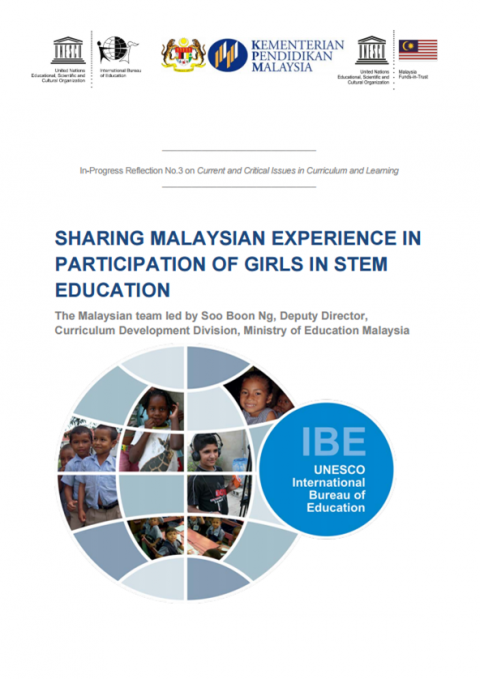 Sharing Malaysian experience in participation of girls in STEM education Año de publicación: 2016 Autor corporativo: UNESCO International Bureau of Education (IBE) The Malaysia government has placed STEM as a focus in developing the country towards achieving the status of a developed nation. The government acknowledges the role of women as equal partners in nation building. Thus, various policies ranging from economy, education, women’s welfare and human resources have been formulated through the years. These policies have resulted in among others, the increase in women researchers from 35.8% in 2004 to 49.9% in 2012 as well as more women’s participation in selected STEM courses at the tertiary level. A total of 84 girls’ day schools with 6 of them as residential STEM Girls’ schools have been built since 1939. There are many female role models in STEM for the girls to emulate. This has been made possible by the successful implementation of the various policies related to women in STEM as well as innovative measures in facing the continuing challenges in STEM education.
  Good practices in education for sustainable development: teacher education institutions Año de publicación: 2007 Autor: Rosalyn McKeown Autor corporativo: UNESCO Chair in Reorienting Teacher Education towards Sustainability | International Network of Teacher Education Institutions The case studies in this document reflect individual and institutional efforts to reorient curriculum, programs, practices, and policies to address sustainability at institutions of teacher education. The studies come from Africa, Asia, the Caribbean, Europe, and North America. The case studies deal with professional development for in-service teachers, curriculum revision at the pre-service level, research with students in a local school, greening of a building and its garden, creating a network of universities, starting a journal, and creating new undergraduate and graduate programs. The diversity of efforts is broad; the impact is deep. The dedication of teacher educators around the world is evident on every page of this document. Les bonnes pratiques en matière d'éducation pour le développement durable: institutions de formation des enseignants Año de publicación: 2007 Autor: Rosalyn McKeown Autor corporativo: UNESCO Chair in Reorienting Teacher Education towards Sustainability | International Network of Teacher Education Institutions Les études de cas présentées dans ce document reflètent les efforts individuels et institutionnels pour réorienter le curriculum, les programmes, les pratiques et les politiques de lutte contre le développement durable dans les établissements de formation des enseignants. Les études viennent d'Afrique, d'Asie, des Caraïbes, en Europe et en Amérique du Nord. Les études de cas portent sur le développement professionnel des enseignants en service, la révision des programmes au niveau pré-services, la recherche avec les étudiants dans une école locale, l'écologisation d'un bâtiment et son jardin, la création d'un réseau d'universités, à partir d'un journal, et la création de nouveaux programmes de premier cycle et des cycles supérieurs. La diversité des efforts est large; l'impact est profond. Le dévouement des formateurs d'enseignants à travers le monde est évident sur chaque page de ce document.
  세계시민 양성을 위한 교육과정 모형 개발 연구: 2015 개정교육과정 성취기준 분석을 중심으로 Año de publicación: 2017 Autor: 강혜영 | 장준호 | 하은나 | 양은주 | 임윤정 | 최은정 | 최윤경 | 하승관 | 홍근태 Autor corporativo: 인천교육과학연구원 교육정책연구소 세계시민교육에 대한 중요성이 점차 강조되고 있음에도 현재 단위학교 현장에서는 세계시민교육의 개념과 관점이 혼재되어 있고 이를 교육과정 속에서 운영하는 사례도 부족한 실정이다. 이에 세계시민교육에 대한 방향을 제시하고 교육 현장에 보편적 가치를 반영하면서도 국가와 지역의 특수성을 기반으로 하는 경험중심의 세계시민교육이 뿌리 내릴 수 있도록 다양한 연구와 함께 시도교육청 차원의 노력이 시도되고 있다.인천광역시 교육청 역시 이러한 노력의 일환으로 다양한 연구를 수행하였고 본 연구는 학교가 교육과정 내에서 세계시민을 양성할 수 있는 교육과정 모형으로서 국가수준 교육과정에 해당하는 2015 개정교육과정의 성취기준 분석과 수업설계방법에 대한 제안을 목적으로 하고 있다.
 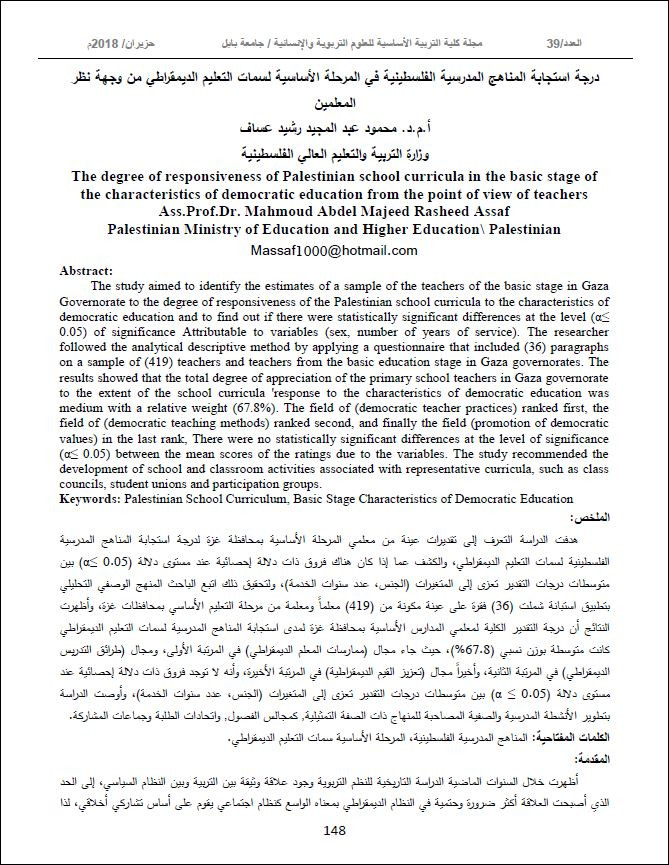 The Degree of Responsiveness of Palestinian School Curricula in the Basic stage of the Characteristics of Democratic Education from the Point of View of Teachers Año de publicación: 2018 Autor: Mahmoud Abdel Majeed Rasheed Assaf Autor corporativo: University of Babylon The study aimed to identify the estimates of a sample of the teachers of the basic stage in Gaza Governorate to the degree of responsiveness of the Palestinian school curricula to the characteristics of democratic education and to find out if there were statistically significant differences at the level (α≤ 0.05) of significance Attributable to variables (sex, number of years of service). The researcher followed the analytical descriptive method by applying a questionnaire that included (36) paragraphs on a sample of (419) teachers and teachers from the basic education stage in Gaza governorates. The results showed that the total degree of appreciation of the primary school teachers in Gaza governorate to the extent of the school curricula 'response to the characteristics of democratic education was medium with a relative weight (67.8%). The field of (democratic teacher practices) ranked first, the field of (democratic teaching methods) ranked second, and finally the field (promotion of democratic values) in the last rank, There were no statistically significant differences at the level of significance (α≤ 0.05) between the mean scores of the ratings due to the variables. The study recommended the development of school and classroom activities associated with representative curricula, such as class councils, student unions and participation groups.