
Recursos
Exploren una amplia gama de recursos valiosos en GCED para profundizar su comprensión y promover su búsqueda, incidencia, enseñanza y aprendizaje.
2,668 resultados encontrados
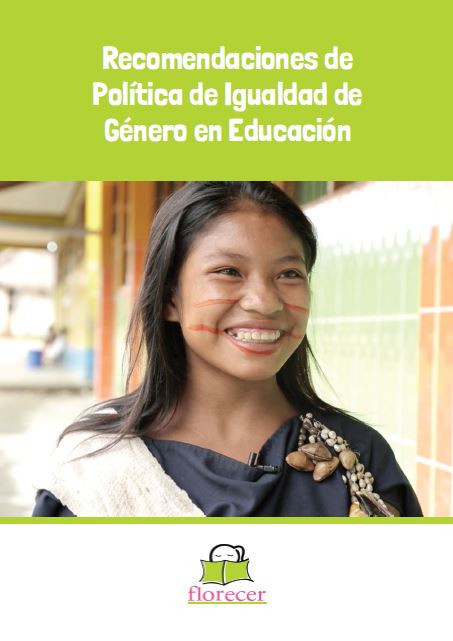 Recomendaciones de Política de Igualdad de Género en Educación Año de publicación: 2015 Autor: Teresa Tovar Samanez Autor corporativo: United Nations Children's Fund (UNICEF) Este documento sintetiza las propuestas de la Red Florecer para avanzar en la igualdad de género, porque estamos convencidas y convencidos de que la apuesta por un mundo más justo y más humano implica necesariamente por la asunción de la igualdad entre hombres y mujeres.
 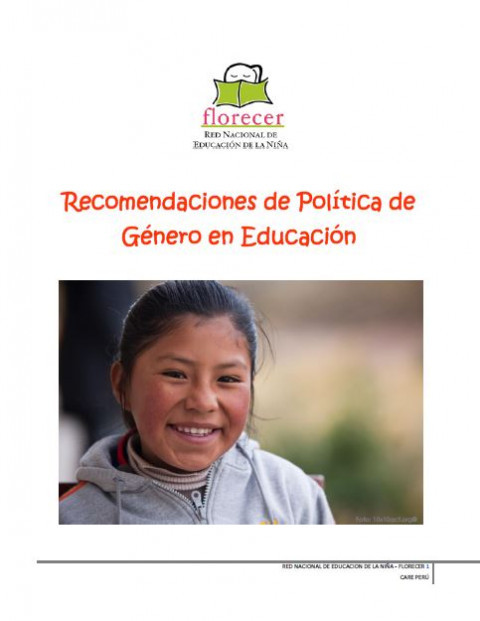 Gender Policy Recommendations in Education Año de publicación: 2015 Autor corporativo: Red Nacional de Educación de la Niña This document synthesizes the proposals of the Florecer Network to advance in gender equality, convinced that the commitment to a more just and more human world necessarily involves the assumption of equality between men and women. The principle that the rights of women and girls are an integral, inalienable and indivisible part of universal human rights has been reaffirmed from the various international forums. Greater equity between men and women is also beneficial for the development of the country. A country with educated girls and women has a lower birth rate, improves their health and productivity conditions. This document synthesizes the main proposals of the Gender and Citizenship Forum: imperative for a quality education, organized by Red Florecer in May 2013 year. We want to put them in the hands of decision-makers and citizens in general to help concretize the mandates of equality between men and women in education. It is time not to give up dreams because they have become possible. Recomendaciones de Política de Género en Educación Año de publicación: 2015 Autor corporativo: Red Nacional de Educación de la Niña Este documento sintetiza las propuestas de la Red Florecer para avanzar en la igualdad de género, convencidos de que la apuesta por un mundo más justo y más humano pasa necesariamente por la asunción de la igualdad entre hombres y mujeres. Desde los diversos foros internacionales se ha reafirmado el principio que los derechos de las mujeres y las niñas son parte integral, inalienable e indivisible de los derechos humanos universales. Una mayor equidad entre hombres y mujeres es además beneficiosa para el desarrollo del país. Un país con niñas y mujeres educadas tiene menor tasa de natalidad, mejora sus condiciones de salud y productividad.Este documento sintetiza las principales propuestas del Foro Género y Ciudadanía: imperativo para una educación de calidad, organizado por la Red Florecer en mayo del 2013 año. Queremos ponerlas en manos de los decisores y de la ciudadanía en general para contribuir a concretar los mandatos de igualdad entre hombres y mujeres en la educación. Es el momento de no desistir de los sueños porque estos se han tornado posibles.
  IX and X Days of Educational Cooperation with Iberoamerica on Special Education and Educational Inclusion Año de publicación: 2015 Autor corporativo: UNESCO Santiago This publication includes the main presentations made by experts in educational inclusion presented at the IX and X Conference on Educational Cooperation with Ibero-America on special education and educational inclusion, held in Cartagena de Indias, Colombia (2012) and Santa Cruz, Bolivia ( 2013), respectively. The workshops have been organized by the Ministry of Education of Spain with the support of the Regional Office of Education for Latin America and the Caribbean (OREALC / UNESCO Santiago). We hope that this publication will contribute to the dissemination of the reflections that RIINEE has developed on critical issues in the field of the educational inclusion of people with disabilities and / or special educational needs, and in this way, constitute a contribution to advance in the guarantee of the rights indicated in the Convention on the Rights of Persons with Disabilities, approved in 2006 by the Member States of the United Nations Organization. IX y X Jornadas de Cooperación Educativa con Iberoamérica sobre Educación Especial e Inclusión Educativa Año de publicación: 2015 Autor corporativo: UNESCO Santiago En esta publicación se incluyen las principales ponencias realizadas por personas expertas en inclusión educativa presentadas en las IX y X Jornadas de Cooperación Educativa con Iberoamérica sobre educación especial e inclusión educativa, realizadas en Cartagena de Indias, Colombia (2012) y Santa Cruz, Bolivia (2013), respectivamente. Las jornadas han sido organizadas por el Ministerio de Educación de España con el apoyo de la Oficina Regional de Educación para América Latina y el Caribe (OREALC/UNESCO Santiago). Esperamos que con esta publicación se contribuya a la difusión de las reflexiones que la RIINEE ha desarrollado sobre nudos críticos en el ámbito de la inclusión educativa de personas con discapacidades y/o necesidades educativas especiales, y de esta forma, constituya un aporte para avanzar en la garantía de los derechos señalados en la Convención sobre los Derechos de las Personas con Discapacidad, aprobada el año 2006 por los Estados Miembro de la Organización de las Naciones Unidas.
  Feasibility study: establishment of an international centre for the promotion of human rights at the local and regional levels in Graz, Austria, under the auspices of UNESCO Año de publicación: 2017 Autor: Vandenhole, Wouter On 3 November 2016, the Government of the Republic of Austria requested (annexed to this report) the Director-General of UNESCO to initiate all necessary steps for the establishment of an International Centre for the Promotion of Human Rights at the Local and Regional Levels (hereafter: ‘the Centre’) in Graz (Styria, Austria) as a UNESCO Category 2 Centre, in application of the Integrated Comprehensive Strategy for Category 2 Institutes and Centres under the Auspices of UNESCO, adopted by the General Conference at its 37th session (res. 37 C/Resolution 93). This application stems from the long-standing commitment and efforts by the Government of the Republic of Austria, the Federal State of Styria and the City of Graz to further the implementation of human rights, both within the country and globally. The Centre will contribute, through research, capacity-building, information-sharing and international collaboration, to UNESCO programmes relating to Sustainable Development Goals 10, 11 and 16 of the 2030 Agenda for Sustainable Development, as well as to urban inclusion-related commitments of the New Urban Agenda. As regards the latter, the Centre is equally expected to feed into the work of the International Coalition of Inclusive and Sustainable Cities – ICCAR and its European Chapter, as well as into UNESCO urban initiatives and platforms. Feasibility study: establishment of an international centre for the promotion of human rights at the local and regional levels in Graz, Austria, under the auspices of UNESCO Año de publicación: 2017 Autor: Vandenhole, Wouter On 3 November 2016, the Government of the Republic of Austria requested (annexed to this report) the Director-General of UNESCO to initiate all necessary steps for the establishment of an International Centre for the Promotion of Human Rights at the Local and Regional Levels (hereafter: ‘the Centre’) in Graz (Styria, Austria) as a UNESCO Category 2 Centre, in application of the Integrated Comprehensive Strategy for Category 2 Institutes and Centres under the Auspices of UNESCO, adopted by the General Conference at its 37th session (res. 37 C/Resolution 93). This application stems from the long-standing commitment and efforts by the Government of the Republic of Austria, the Federal State of Styria and the City of Graz to further the implementation of human rights, both within the country and globally. The Centre will contribute, through research, capacity-building, information-sharing and international collaboration, to UNESCO programmes relating to Sustainable Development Goals 10, 11 and 16 of the 2030 Agenda for Sustainable Development, as well as to urban inclusion-related commitments of the New Urban Agenda. As regards the latter, the Centre is equally expected to feed into the work of the International Coalition of Inclusive and Sustainable Cities – ICCAR and its European Chapter, as well as into UNESCO urban initiatives and platforms. Feasibility study: establishment of an international centre for the promotion of human rights at the local and regional levels in Graz, Austria, under the auspices of UNESCO Año de publicación: 2017 Autor: Vandenhole, Wouter On 3 November 2016, the Government of the Republic of Austria requested (annexed to this report) the Director-General of UNESCO to initiate all necessary steps for the establishment of an International Centre for the Promotion of Human Rights at the Local and Regional Levels (hereafter: ‘the Centre’) in Graz (Styria, Austria) as a UNESCO Category 2 Centre, in application of the Integrated Comprehensive Strategy for Category 2 Institutes and Centres under the Auspices of UNESCO, adopted by the General Conference at its 37th session (res. 37 C/Resolution 93). This application stems from the long-standing commitment and efforts by the Government of the Republic of Austria, the Federal State of Styria and the City of Graz to further the implementation of human rights, both within the country and globally. The Centre will contribute, through research, capacity-building, information-sharing and international collaboration, to UNESCO programmes relating to Sustainable Development Goals 10, 11 and 16 of the 2030 Agenda for Sustainable Development, as well as to urban inclusion-related commitments of the New Urban Agenda. As regards the latter, the Centre is equally expected to feed into the work of the International Coalition of Inclusive and Sustainable Cities – ICCAR and its European Chapter, as well as into UNESCO urban initiatives and platforms.
  Teaching Two Lessons about UNESCO and Other Writings on Human Rights Año de publicación: 2017 Autor: Fernando Reimers This book presents two lessons for use in college or high school, to educate students on the mission and work of UNESCO as it relates to the advancement of Human Rights. It includes also a series of a short essays on Human Rights, the Right to Education, Teaching Human Rights and the role of Teachers and Universities in Teaching Human Rights which will be useful to educators interested in educating their students to advance the values of freedom and justice. For more information about this book, please visit the link below.URL: https://www.amazon.com/Teaching-Lessons-Unesco-writings-Rights/dp/1978367996#reader_1978367996 The lessons(Two Lessons About UNESCO) are designed to help high school and college students understand the mission of UNESCO, the reason the organization was created, the work it does, how it is structured and funded, and how its work relates to the Universal Declaration of Human Rights. The lessons can be taught at the High School or College level. They can be taught in a variety of courses including social studies, history, humanities, and can be integrated in courses in other disciplines. For more information, please visit the link below.URL: https://medium.com/@fernandomreimers/teaching-two-lessons-about-unesco-7531c5fe9395
  Collected: Educational Project about “Learning from Biographies” in General Sciences in Primary School Año de publicación: 2006 Autor: A. Becher Original Title: Eingesammelt: Ein Unterrichtsprojekt zum‚ “Lernen an Biographien” im Sachunterricht der Grundschule(In D. Pech, M. Rauterberg, & K. Stocklas, (Eds.). Möglichkeiten und Relevanz der Auseinandersetzung mit dem Holocaust im Sachunterricht der Grundschule, Supplement 3, pp. 17–34) The article presents a project aimed at developing suitable methods for Holocaust Education already in the German primary school. Based on Ido Abram’s three-step-program as well as Wolfgang Klafki’s critical didactics, the project has developed a biographical approach to create possibilities for identification among the students. This is tested in a 3rd grade class and is thereafter evaluated.The above abstract is taken from the International Holocaust Remembrance Alliance Education Research Project. Please also consult the full list of abstracts in 15 languages and the accompanying publication Research in Teaching and Learning about the Holocaust: A Dialogue Beyond Borders. Ed: IHRA, Monique Eckmann, Doyle Stevick, Jolanta Ambrosewicz-Jacobs, 2017, Metropol Verlag at www.holocaustremembrance.com/resources/publications.