
Recursos
Exploren una amplia gama de recursos valiosos en GCED para profundizar su comprensión y promover su búsqueda, incidencia, enseñanza y aprendizaje.
1,402 resultados encontrados
 Un cadre pour guider une réponse éducative à la Covid-19 en cas de pandémie de 2020 Año de publicación: 2020 Autor: Fernando Reimers | Andreas Schleicher Autor corporativo: Organisation for Economic Co-operation and Development (OECD) Ce rapport vise à appuyer la décision de l'éducation faisant de développer et mettre en œuvre des réponses éducatives efficaces au Covid-19 en cas de pandémie. Le rapport explique pourquoi les mesures d'isolement social nécessaires perturberont l'éducation en milieu scolaire pendant plusieurs mois dans la plupart des pays à travers le monde. En l'absence d'une stratégie délibérée et efficace pour protéger l'occasion d'apprendre au cours de cette période, cette perturbation entraîne des pertes sévères d'apprentissage pour les étudiants.Le rapport propose que les dirigeants des systèmes d'éducation et les organisations à élaborer des plans pour la poursuite de l'éducation des modalités alternatives, au cours de la période d'isolement social nécessaire. Il offre un cadre de zones à couvrir par ces plans.
  Supporting the Continuation of Teaching and Learning during the COVID-19 Pandemic: Annotated Resources for Online Learning Año de publicación: 2020 Autor: Fernando Reimers | Andreas Schleicher | Jaime Saavedra | Saku Tuominen Autor corporativo: Organisation for Economic Co-operation and Development (OECD) | Global Education Innovation Initiative | HundrED This resource discusses the second module of a series which presents the results of a comparative analysis of emerging educational needs and responses as the pandemic unfolds across countries around the world. The overall goal of this series is to facilitate the rapid design process and implementation of adaptive responses to the emerging education challenges, and to protect young people’s educational opportunities during and following the pandemic. This second module presents a first set of online educational resources to support the continuity of teaching and learning during the 2019-20 COVID-19 Pandemic with education leaders around the world. The resources were compiled from responses to the same survey used to produce the first module: A framework to guide an education response to the COVID-19 Pandemic, and additional online sources were included to enhance the list in order to support the continuity of learning for students who have access to the internet and digital devices.
  Citoyenneté mondiale et laïcité Año de publicación: 2018 Autor: Nicolas Cadène Autor corporativo: ACTISCE Patronage Laique Jules Vallès La laïcité fait, de chacune et de chacun d’entre nous, au-delà de nos appartenances ou de nos origines, des citoyennes et des citoyens à égalité de droits et de devoirs. Elle nous permet d’aller au-delà de nos différences et de les dépasser tout en les respectant. Par la volonté de vivre ensemble, notre laïcité garantit la liberté de croire ou de ne pas croire et la possibilité de l’exprimer dans les limites de la liberté d’autrui. Elle permet la pluralité dans le respect mutuel et assise sur une citoyenneté commune. Au travers de nombreux exemples dont les cas de la Belgique, la Turquie, l’Inde, le Brésil, le Mexique et le Sénégal, Nicolas Cadène nous montre en quoi la laïcité est source de liberté pour tous les peuples.
  La pédagogie de projet au cœur de l'éducation pour un développement durable Año de publicación: 2016 Autor corporativo: Université Virtuelle Environnement et Développement durable (UVED) Dans cette vidéo, Francine Pellaud discute des intérêts et des conditions de réussite de la pédagogie de projet, dans le cadre d'une éducation à l'environnement et au développement durable.
  Preparing Our Youth for an Inclusive and Sustainable World: The OECD PISA Global Competence Framework Año de publicación: 2018 Autor corporativo: Organisation for Economic Co-operation and Development (OECD) OECD Programme for International Student Assessment (PISA), the global yardstick for educational success, includes global competence in its metrics for quality, equity and effectiveness in education. The global competence assessment in PISA 2018 is composed of two parts: a cognitive assessment and a background questionnaire. The cognitive assessment is designed to elicit students' capacities to critically examine global issues; recognise outside influences on perspectives and world views; understand how to communicate with others in intercultural contexts; and identify and compare different courses of action to address global and intercultural issues. In the background questionnaire, students will be asked to report how familiar they are with global issues; how developed their linguistic and communication skills are; to what extent they hold certain attitudes, such as respect for people from different cultural backgrounds; and what opportunities they have at school to develop global competence. Answers to the school and teacher questionnaires will provide a comparative picture of how education systems are integrating global, international and intercultural perspectives throughout the curriculum and in classroom activities.
  Education at a Glance 2019: OECD Indicators Año de publicación: 2019 Autor corporativo: Organisation for Economic Co-operation and Development (OECD) Education at a Glance is the authoritative source for information on the state of education around the world. It provides data on the structure, finances and performance of education systems across OECD countries and a number of partner economies.The 2019 edition includes a focus on tertiary education with new indicators on tertiary completion rates, doctoral graduates and their labour market outcomes, and on tertiary admission systems, as well as a dedicated chapter on the Sustainable Development Goal 4. Regards sur l'éducation 2019: Les indicateurs de l'OCDE Año de publicación: 2019 Autor corporativo: Organisation for Economic Co-operation and Development (OECD) Regards sur l’éducation est la publication de référence sur l’état de l’éducation dans le monde. Elle fournit des données clés sur la structure, le financement et la performance des systèmes d’éducation des pays de l’OCDE, ainsi que d’un certain nombre de pays partenaires. Avec plus de 100 tableaux et graphiques – et des liens vers de nombreuses données supplémentaires sur notre base de données consacrée à l’éducation – cette publication présente des données clés sur les résultats des établissements d’enseignement ; l’impact de l’apprentissage dans les différents pays ; l’accès, la participation et la progression au sein des systèmes d’éducation ; les ressources financières investies dans l’éducation ; et les enseignants, l’environnement d’apprentissage et l’organisation scolaire.L'édition 2019 inclut un éclairage spécifique sur l'enseignement tertiaire, avec de nouveaux indicateurs sur le taux de réussite à ce niveau, sur les doctorants et leurs perspectives sur le marché du travail, sur les systèmes d'admission dans l'enseignement tertiaire, ainsi qu'un chapitre dédié au quatrième Objectif de développement durable.
  Do All Students Have Equal Opportunities to Learn Global and Intercultural Skills at School? (PISA in Focus; No.109) Año de publicación: 2020 Autor: Tarek Mostafa Autor corporativo: Organisation for Economic Co-operation and Development (OECD) Many education systems seek to create an open, diverse and tolerant society, as education can play a significant role in countering racial, ethnic and national prejudice among children and adolescents. Education for living in an interconnected and diverse world could also contribute to forming generations of citizens who care about global and intercultural issues and who are able and willing to take action for sustainable development and collective well-being.In its 2018 assessment, PISA assessed the competences needed to live in an interconnected and diverse world. Global competence is defined in PISA 2018 as a multi-dimensional capacity that encompasses the ability to: 1) examine issues of local, global and cultural significance; 2) understand and appreciate the perspectives and worldviews of others; 3) engage in open, appropriate and effective interactions across cultures; and 4) take action for collective well-being and sustainable development. This PISA in Focus examines the equity of the learning opportunities for global and intercultural skills.
 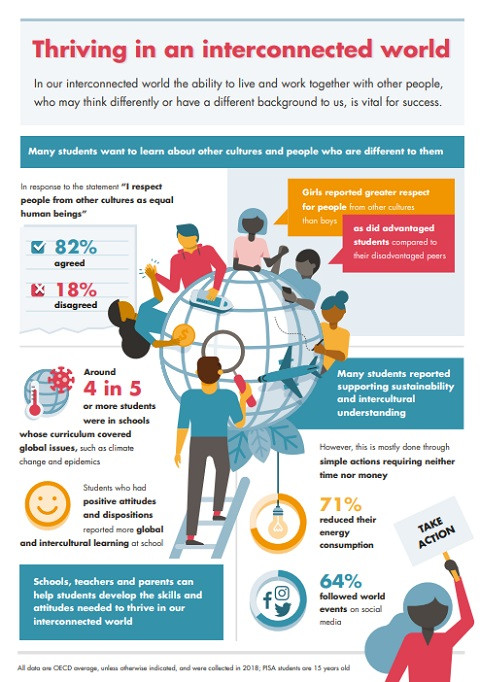 Thriving in an Interconnected World Año de publicación: 2020 Autor corporativo: Organisation for Economic Co-operation and Development (OECD) This infographic shows how ready students are to thrive in an interconnected world. All data were collected from PISA 2018 survey.
 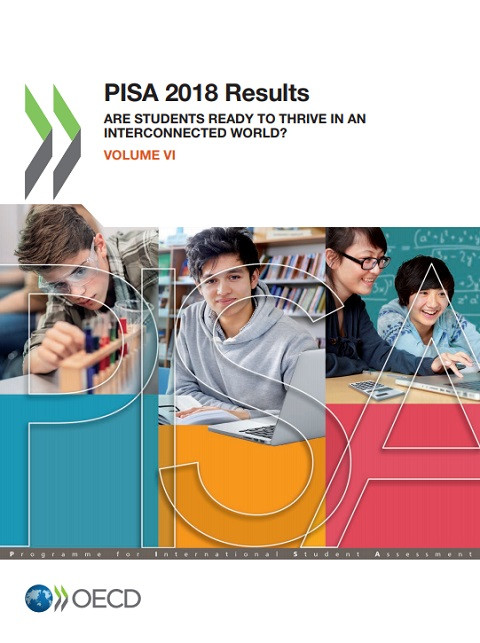 PISA 2018 Results (Volume VI): Are Students Ready to Thrive in an Interconnected World? Año de publicación: 2020 Autor corporativo: Organisation for Economic Co-operation and Development (OECD) The OECD Programme for International Student Assessment (PISA) examines what students know in reading, mathematics and science, and what they can do with what they know. It provides the most comprehensive and rigorous international assessment of student learning outcomes to date. Results from PISA indicate the quality and equity of learning outcomes attained around the world, and allow educators and policy makers to learn from the policies and practices applied in other countries. This is one of six volumes that present the results of the PISA 2018 survey, the seventh round of the triennial assessment. Volume VI: Are Students Ready to Thrive in an Interconnected World? explores students’ ability to examine issues of local, global and cultural significance; understand and appreciate the perspectives and worldviews of others; engage in open, appropriate and effective interactions across cultures; and take action for collective well-being and sustainable development. The volume explores students’ outcomes on the cognitive test and corresponding questionnaire in addition to their experiences of global and intercultural learning at school and beyond.