
Recursos
Exploren una amplia gama de recursos valiosos en GCED para profundizar su comprensión y promover su búsqueda, incidencia, enseñanza y aprendizaje.
3,446 resultados encontrados
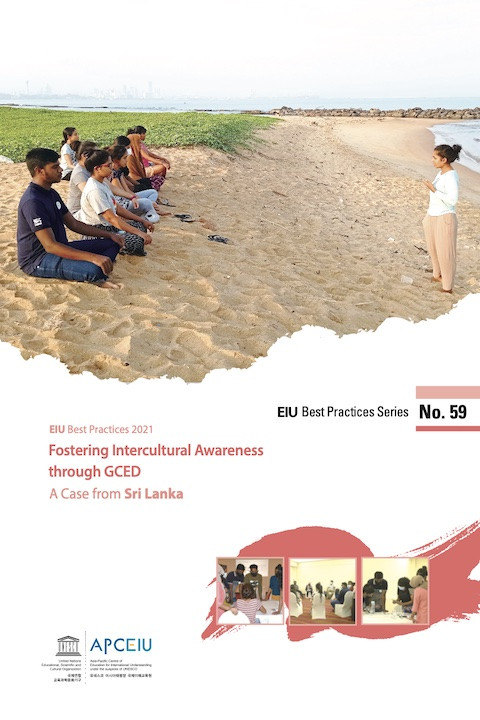 EIU Best Practices 2021: Fostering Intercultural Awareness through GCED; A Case from Sri Lanka (EIU Best Practices Series; no.59) Año de publicación: 2021 Autor: Oshan Madushanka Gunathilake Autor corporativo: APCEIU This monograph is one of APCEIU's EIU Best Practices Series, which aims to encourage educators, scholars, and activists to implement and share local initiatives on EIU. The Series No.59 introduces ‘Citizen Culture’ which is designed to foster intercultural and interreligious understanding within youth communities through the theories and learnings of GCED. The programme focused on a selected group of young individuals who are representing both vulnerable communities as well as privileged, also belonging to a diverse mixture of cultural, religious, social and ethnic backgrounds. The learners will go into their respective communities and spread this message as agents of positive change and actively contribute to the social cohesion, trust and awareness building through volunteer participation for transforming popular harmful narratives and practices which are structured in our society - cultivating a culture of peace.
  Peace Education in Northeast Asia: A Situational Analysis Año de publicación: 2021 Autor: Soonwon Kang | Cheng Liu | Ketei Matsui | Batbaatar Monkhooroi | Boyoung Park | Muyu Huang | Oyuntsetseg Dugarsuren Autor corporativo: APCEIU Being central to education for international understanding and global citizenship, peace education has always been an important theme in UNESCO. For effective delivery of peace education, it is critical to examine and understand the relevance of peace education and its key issues and approaches at a given juncture. With this in mind, in 2020, APCEIU conducted a study on peace education in South Korea to review its current state and suggest some policy recommendations. Following up on this study, APCEIU initiated in 2021 a research project on peace education in Northeast Asia in order to identify how peace education is interpreted and practised in the countries of the region and explore possibilities of cooperation among peace educators, researchers, and practitioners in the region. Building on this research, APCEIU hopes to develop and carry out joint projects for peace education in the region.
 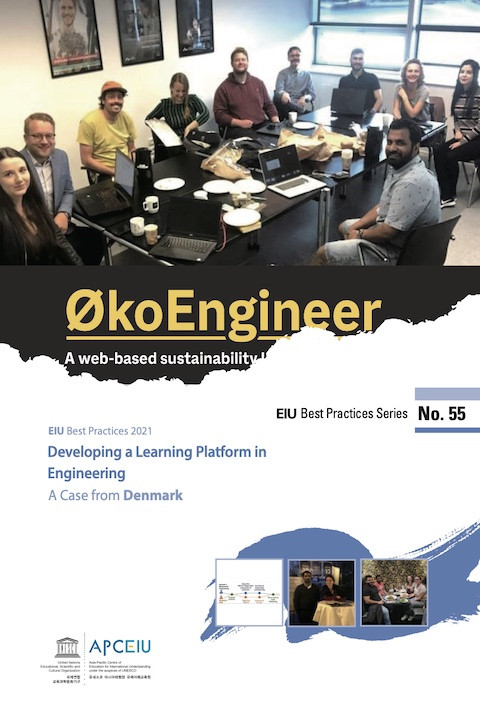 EIU Best Practices 2021: Developing a Learning Platform in Engineering; A Case from Denmark (EIU Best Practices Series; no.55) Año de publicación: 2021 Autor: Serena Leka Autor corporativo: APCEIU This monograph is one of APCEIU's EIU Best Practices Series, which aims to encourage educators, scholars, and activists to implement and share local initiatives on EIU. The Series No.55 introduces ‘ØkoEngineer’ which is a sustainability learning platform created to educate engineering students in Aarhus on sustainability concepts and how they couple with engineering design through the gamification of project-based learnings. The project aims to prepare the future engineers to play their crucial role in the significant global issues that we face. In response to the above challenges, future engineers, today's students are embracing initiatives that stimulate sustainability education. The students are motivated by the urge to relate sustainability with their domain-specific engineering theories. ØkoEngineer is a web-based game platform designed for integrating sustainability learning in engineering curricula.
 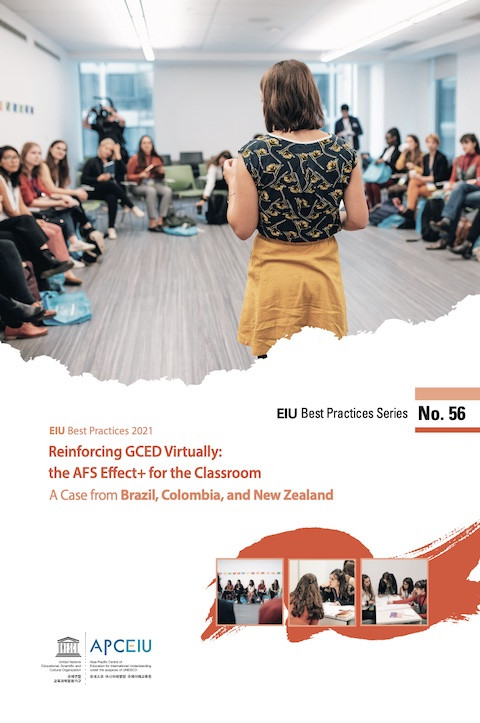 EIU Best Practices 2021: Reinforcing GCED Virtually; the AFS Effect+ for the Classroom, a Case from Brazil, Colombia, and New Zealand (EIU Best Practices Series; no.56) Año de publicación: 2021 Autor: Ana Carolina Cassiano Autor corporativo: APCEIU This monograph is one of APCEIU's EIU Best Practices Series, which aims to encourage educators, scholars, and activists to implement and share local initiatives on EIU. The Series No.56 introduces ‘the AFS Effect+ for the Classroom Programme’ which is launched in September 2020. The programme has engaged 150+ high-school teachers from Brazil, Colombia, and New Zealand who completed 20 hours of virtual teacher training, collaborated virtually with each other and piloted activities developed by AFS with their classrooms, reaching over 2,500 students. As a result of the programme, the AFS Effect+ for the Classroom: Toolkit for Educators is now available to teachers worldwide to use as a resource for teaching Active Global Citizenship & the SDGs for high school students. The toolkit is currently available in English, Spanish and Portuguese, and being disseminated through AFS Network Organizations which are present in 50+ countries.
 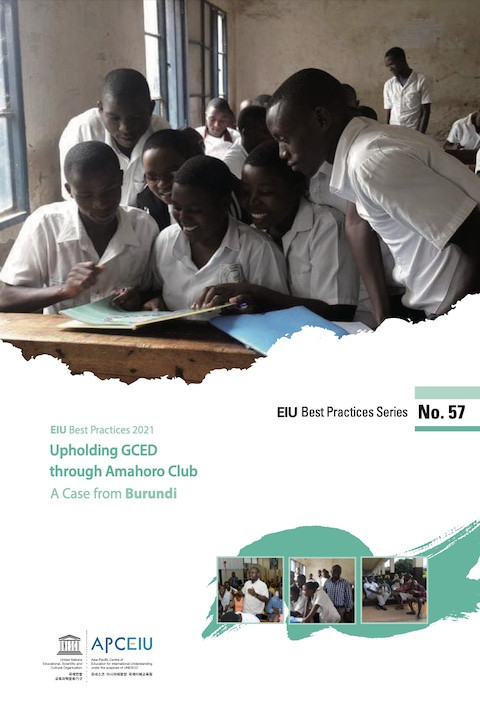 EIU Best Practices 2021: Upholding GCED through Amahoro Club; A Case from Burundi (EIU Best Practices Series; no.57) Año de publicación: 2021 Autor: Sinai Bakanibona Autor corporativo: APCEIU This monograph is one of APCEIU's EIU Best Practices Series, which aims to encourage educators, scholars, and activists to implement and share local initiatives on EIU. The Series No.57 introduces ‘Amahoro Clubs’ which means Peace Education Clubs. It is a project that has been initiated in other secondary schools of Burundi in terms of consolidating culture of peace and stability in Burundian society by applying different concepts of Global Citizenship Education in our life. This programme influence positively different social stratifications of people to know how to live together and be united by facing diverse challenges which can somber the population in violent conflicts. Amahoro Clubs serve as a platform in which people become aware of the various social issues. Students and teachers are gaining the necessary knowledge and skills that will help prevent the occurrence of conflicts.
 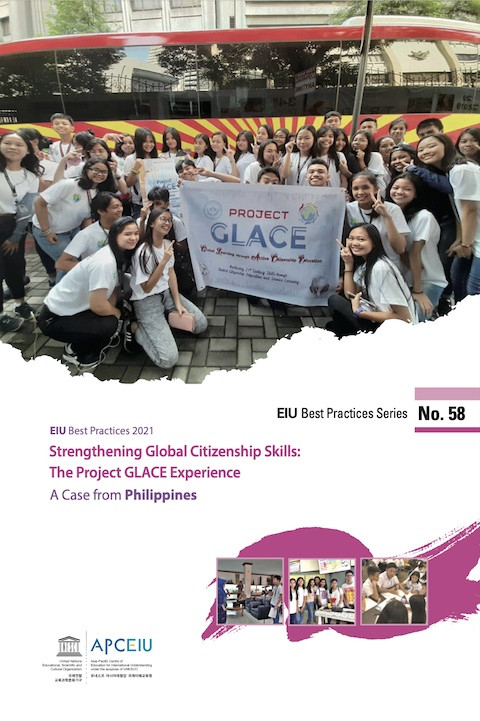 EIU Best Practices 2021: Strengthening Global Citizenship Skills; The Project GLACE Experience, A Case from Philippines (EIU Best Practices Series; no.58) Año de publicación: 2021 Autor: Marco Meduranda Autor corporativo: APCEIU This monograph is one of APCEIU's EIU Best Practices Series, which aims to encourage educators, scholars, and activists to implement and share local initiatives on EIU. The Series No.58 introduces ‘Project GLACE’ or ‘Global Learning through Active Citizenship Education’. It is an after-school enhancement program that sought to enhance students' global citizenship skills through afterschool learning sessions, off-campus intercultural education experiences, and service-learning or community outreach activities. Using the 4-I's (Inquire, Investigate, Innovate and Impact), selected teachers taught global citizenship education concepts for a span of 12 - 15 weeks with the first six to ten weeks exploring the themes of social justice and equity, identity and diversity, self-awareness and reflection, concern for the environment, commitment to sustainable development, and commitment to participation and inclusion.
 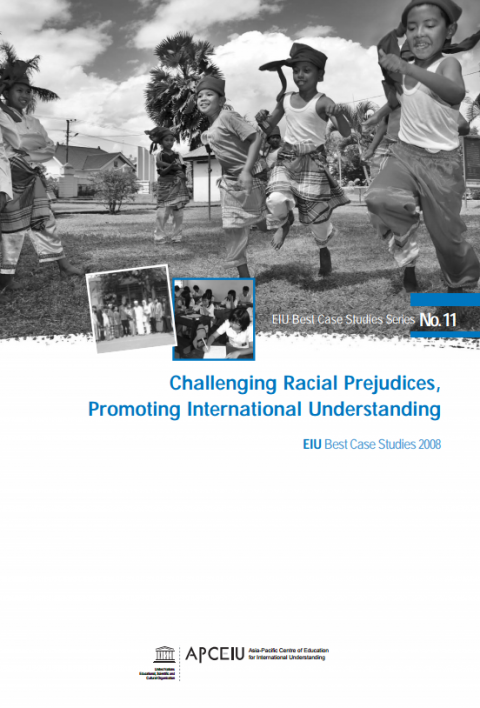 EIU Best Practices Series No. 11: Challenging Racial Prejudices, Promoting International Understanding Año de publicación: 2008 Autor corporativo: APCEIU This monograph is one of APCEIU's EIU Best Practices Series, which aims to encourage educators, scholars, and activists to implement and share local initiatives on EIU. The Series No.11 introduces a case study of the SMA Taman Harapan High School in Indonesia, conducted to explore prevalent issues of racial prejudices and devise methods to reduce racism. Research revealed that students held a degree of racist perception against people of certain heritage. Activities were conducted thenceforth, allowing participants to have direct and extended interactions with people of different cultures. Despite the short timeframe of the activity, perception on stereotypes did not change altogether, yet progress was evident in students’ understanding of the severity of the issue. As educators also learned ways to help alleviate the problem of racism, the case is an exemplary example of increasing cultural awareness and international understanding.
  EIU Best Practices Series No. 13: Integrating Organic Waste Management In Fijian Schools Año de publicación: 2009 Autor: Bulou Daiana Taoba Autor corporativo: APCEIU This monograph is one of APCEIU's EIU Best Practices Series, which aims to encourage educators, scholars, and activists to implement and share local initiatives on EIU. The Series No.13 introduces a case study of University of the South Pacific PACE’s projects, which showcase students learning about waste management that contribute to environmental protection. As issues of water disposition, rapid urbanization, limited land areas, consumer behavior change, and vulnerable ecosystems are increasingly concerning in the Pacific Island nations, the case highlights the need to educate students on the importance of solid waste management, social responsibility, and global citizenship.
 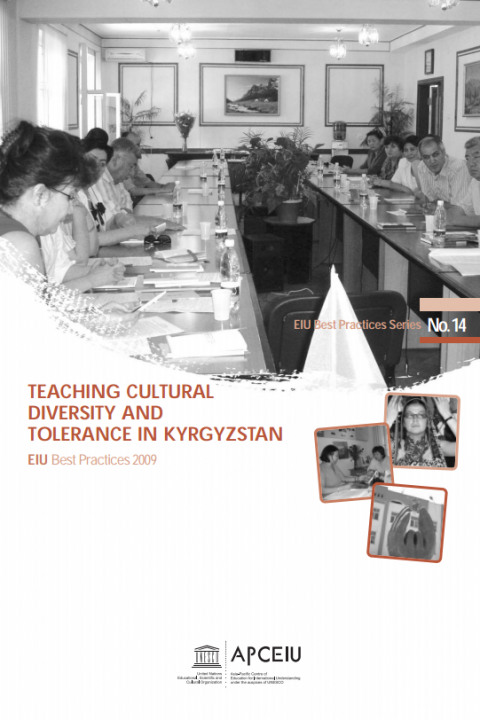 EIU Best Practices Series No. 14: Teaching Cultural Diversity and Tolerance in Kyrgyzstan Año de publicación: 2009 Autor: Erkeayim Jorobekavo | Almakan Naizabekova Autor corporativo: APCEIU This report is one of APCEIU's EIU Best Practices Series, which aims to encourage educators, scholars, and activists to implement and share local initiatives on EIU. The Series No.14 introduces ‘Culturology,’ a mandatory course instituted in Kyrgyz-Uzbek University, designed and implemented to teach cultural diversity and tolerance to students. Given the nation’s recent history of independence and racial and religious diversity, the University chose to develop the course program and methodology guidebook to foster understanding of international education and multiculturalism.
  EIU Best Practices Series No. 16: A Korean Agricultural Village's Communal Movement for Education for Sustainable Development Año de publicación: 2009 Autor: Seungkwan Jung Autor corporativo: APCEIU This monograph is one of APCEIU's EIU Best Practices Series, which aims to encourage educators, scholars, and activists to implement and share local initiatives on EIU. The Series No.16 introduces the Poolmoo School, which turns surrounding economy, ecology, culture into educational learning material, and endeavor to create a school culture with emphasis on sustainable development. Students of Poolmoo School learn about organic farming, ecological village, and agricultural sustainability, essentially raising awareness of environmental preservation for the next generation.