
Recursos
Exploren una amplia gama de recursos valiosos en GCED para profundizar su comprensión y promover su búsqueda, incidencia, enseñanza y aprendizaje.
1,447 resultados encontrados
 Sobre la educación y la democracia: 25 lecciones de la profesión docente Año de publicación: 2019 Autor: Susan Hopgood | Fred van Leeuwen Autor corporativo: Education International (EI) Con motivo del 25o aniversario de la Internacional de la Educación, que actualmente reúne a los sindicatos de la educación de 170 países, que representan a 32,5 millones de docentes y personal de apoyo educativo, hemos seleccionado 25 lecciones sobre la educación y la democracia que el personal docente y sus organizaciones han aprendido a lo largo de la historia. Nuestras lecciones ofrecen una serie de recomendaciones destinadas a todo el personal docente que trabaja en todos los niveles de nuestros sistemas educativos y en sus sindicatos de la educación. Estas lecciones son una invitación a posicionarse en favor de la democracia y sus instituciones y a analizar las contribuciones que el profesorado, las escuelas, las universi- dades y las organizaciones que los representan pueden aportar para consolidar y hacer progresar la vida democrática. Éducation & démocratie: 25 leçons de la profession enseignante Año de publicación: 2019 Autor: Susan Hopgood | Fred van Leeuwen Autor corporativo: Education International (EI) À l’occasion du 25e anniversaire de l’Internationale de l’Éducation, qui regroupe actuellement les syndicats nationaux de l’éducation de 170 pays représentant 32,5 millions d’éducateur·rice·s et de membres des personnels de soutien à l’éducation, les auteurs ont sélectionné 25 leçons que les éducateur·rice·s et leurs organisations ont tirées sur l’éducation et la démocratie au long de l’histoire. Ces leçons établissent une série de recommandations destinées à tou·te·s les enseignant·e·s travaillant à tous les niveaux de nos systèmes éducatifs et de leurs syndicats d’ensei- gnement. Les leçons sont une invitation à prendre position en faveur de la démocratie et de ses institutions et à examiner les contributions que les enseignant·e·s, les écoles, les universités et les organisations représentatives peuvent apporter pour consolider et faire avancer la vie démocratique.
  联合国 教科文组织 绿色学院: 气候适应型学校指南 Año de publicación: 2019 Autor corporativo: UNESCO Bangkok 本手册鼓励社区进行能力建设,并朝着适应气候变化的方向 过渡。它以科学知识为基础,按照“人与生物圈计划”的规 定改善人与环境之间的关系。
  What’s the Evidence?: Youth Engagement and the Sustainable Development Goals Año de publicación: 2018 Autor corporativo: Asian Development Bank (ADB) | Plan International UK This study represents an encouraging body of evidence, both primary and secondary, which will inform future practice and policymaking with regard to young women and men’s contributions towards the Sustainable Development Goals (SDGs). The learnings from this study provide important insight that will support the design and implementation of youth programming. It examines five programs across three youth-focused or youth-led organisations: Plan International UK, the Asian Development Bank (ADB), and AIESEC.
 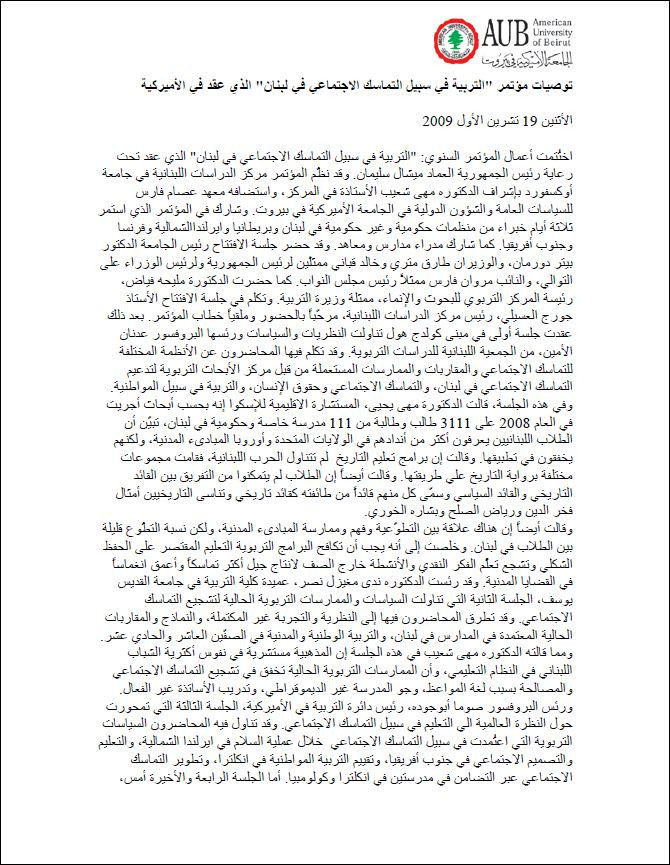 توصيات مؤتمر " التربية في سبيل التماسك الاجتماعي في لبنان " Año de publicación: 2009 Autor corporativo: American University of Beirut الملف عبارة عن التوصيات التي خرج بها مؤتمر "التربية والتماسك الاجتماعي في لبنان"، والذي أقيم بالجامعة الامريكية في بيروت. التوصيات تتعاطى مع تحديات التماسك الاجتماعي في لبنان باختلاف طوائفه ومكوناته العرقية. أستمر هذا المؤتمر ثلاث أيام وحضرها مجموعة من المشاركين من لبنان وخارجه. Recommendations of the Conference on "Education for Social Cohesion in Lebanon" Año de publicación: 2009 Autor corporativo: American University of Beirut The file is a summary of the recommendations that came out of the "Education and Social Cohesion in Lebanon" conference, which was held at the American University in Beirut. The recommendations deal with the challenges of social cohesion in Lebanon with its different sects and ethnic components. This conference lasted for three days and was attended by a group of participants from Lebanon and abroad.
  ARC8 Outlook Report 2030: Inclusive and Diverse Higher Education in Asia and Europe Año de publicación: 2021 Autor corporativo: Asia-Europe Foundation (ASEF) The ARC8 Outlook Report 2030 on ʻInclusive and Diverse Higher Education in Asia and Europe’ was initiated with the objective of better understanding the current state, policies and practices of inclusion in higher education and identifying actions that could accelerate greater inclusion in a post-pandemic era.The ARC8 Outlook Report outlines emerging issues that could grow into major challenges and/ or opportunities in the coming 10 years related to inclusion in higher education. Inputs for the report came from an in-depth consultation process and from previous research done by Asian and European stakeholders. The Report consists of 4 chapters which analyse the future of inclusion from different perspectives: Inclusive Learning and Teaching in a Digital World Inclusive and Flexible Lifelong Learning Pathways Inclusive International Mobility of People and Knowledge Equitable Access and Success in Higher Education
  مظاهر المواطنة المجتمعية في المقررات الدراسية في العلوم الاجتماعية من وجهة نظر المعلمين Año de publicación: 2011 Autor: Zeiad Barakat | Laila Abu Ali Autor corporativo: Jerash Universtiy هدفت هذه الدراسة التعرف إلى مظاهر المواطنة المجتمعية في المجالات الاجتماعية والقانونية والاقتصادية والسياسية في المقررات الدراسية الفلسطينية المتعلقة بالعلوم الاجتماعية (التاريخ والجغرافية والتربية المدنية والتربية الوطنية ) من وجهة نظر المعلمين لهذ ه المقررات، لهذا الغرض طبقت استبانة مكونة من ( 40 ) فقرة لقياس مظاهر المواطنة المجتمعية في المظاهر المختلفة على عينة من المعلمين في المدارس الحكومية في محافظة طولكرم يدرسون هذه المقررات قو امها ( 134 ) معلمًا ومعلمة. Manifestations of Community Citizenship in the Curriculums in Social Sciences from the Viewpoint of the Teachers Año de publicación: 2011 Autor: Zeiad Barakat | Laila Abu Ali Autor corporativo: Jerash Universtiy The purpose of this study was to investigate the manifestations of community citizenship in domains of social, legal, economic and political in the Palestinian social science curriculum (history, geography, civic education and national education) from the viewpoint of the teachers of these courses, for this purpose applied a questionnaire consisting of (40) items to measure aspects of community citizenship, in the various manifestations on a sample of teachers in government schools in the province of Tulkarem who teach these courses consisted of (134) teachers.
  Итоги оценки: Потребностей людей с ограниченными возможностями по социальным и гендерным факторам, с акцентом на особые нужды женщин с инвалидностью, переживших насилие в туркестанской области и Г.шымкент Año de publicación: 2020 Autor corporativo: ЮНФПА Данный отчет содержит результаты оценки потребностей людей с инвалидностью по социальным и гендерным вопросам, с акцентом на особые нужды женщин с инвалидностью, подвергшихся насилию, в г. Шымкент и в Туркестанской области (в г. Туркестан и в 3-х районах области - Сайрамский, Шардаринский, Сарыагашский).