
Recursos
Exploren una amplia gama de recursos valiosos en GCED para profundizar su comprensión y promover su búsqueda, incidencia, enseñanza y aprendizaje.
3,441 resultados encontrados
 Education pour le développement durable: bonnes pratiques en matière de biodiversité Año de publicación: 2012 Autor corporativo: UNESCO To support the growing interest in biodiversity issues and ESD, UNESCO is publishing this volume containing 24 examples of programmes addressing biodiversity in ESD settings and practices. These good practices and shared experiences, which were provided by a range of different stakeholders, are concrete examples of successful implementation of ESD in different fields and sectors, from the political to the school level, and including formal, non-formal and informal learning situations. Education for sustainable development; good practices in addressing biodiversity Año de publicación: 2012 Autor corporativo: UNESCO To support the growing interest in biodiversity issues and ESD, UNESCO is publishing this volume containing 24 examples of programmes addressing biodiversity in ESD settings and practices. These good practices and shared experiences, which were provided by a range of different stakeholders, are concrete examples of successful implementation of ESD in different fields and sectors, from the political to the school level, and including formal, non-formal and informal learning situations.
  Fighting racism and discrimination: identifying and sharing good practices in the International Coalition of Cities Año de publicación: 2012 Autor corporativo: UNESCO Since the establishment of the International Coalition, UNESCO has headed the regional scientific committees. In this role, UNESCO receives reports from cities in fulfilment of formal or informal requirements of their membership. These reports showcase the efforts of cities showcase the efforts of cities in addressing the Ten Point Plan of commitments for their respective region. UNESCO undertakes its efforts based on the information provided by the city in its report. First, it provides feedback to the cities on their efforts. The report identifies promising practices and highlights areas where additional work can be undertaken. Second, the reports from cities provide information that can be used for a variety of purposes including the publication of this report of good practices in anti-discrimination. The contents of this report reflect the information shared by Member Cities and as current Member Cities become increasingly active and new ones join the Coalition, the collection of good practices will undoubtedly expand.The purpose of this good practices report is two-fold. First, it draws together a collection of good practices in anti-discrimination of Member Cities so that they can inspire and inform the policies and practices of other cities. Second, the report uses major themes related to the different roles and domains of cities to inform and indeed, encourage critical reflection on anti-discrimination work in these areas. Several key objectives underlie the report:• Reflect on the different roles and capacities of cities and provide a framework to understand and assess their policies and practices;• Present, in one publication, examples of a wide variety of good practices; Provide a useful resource on anti-discrimination for stakeholders including city staff and representatives, community organisations, researchers, as well as interested individuals and groups; • Contribute to the successful networking of cities underway through the coalition;• Highlight the fact that even if there are challenges to engaging in anti-discrimination work, and that city representatives may feel limited, there are multiple actions that they can undertake.
  Un Lexique du racisme: étude sur les définitions opérationnelles relatives au racisme et aux phénomènes connexes Año de publicación: 2006 Autor: Micheline Labelle Autor corporativo: UNESCO | Centre de recherche sur l'immigration, l'ethnicité et la citoyenneté (Canada). Observatoire international sur le racisme et les discriminations Qu'est-ce que la « race »? Qu'est-ce que le racisme? Le racisme est-il universel et existet-il de toute éternité? Comment distinguer racisme, ethnocentrisme et xénophobie? Quelles sont les manifestations ou les formes élémentaires du racisme? Quels sont ses niveaux? Quelles sont ses logiques discursives? On observe dans diverses sociétés contemporaines l’expression du racisme et de l’ethnisme. Le déplacement sournois du racisme classique au néo-racisme pose différents types de problèmes pour l'analyse sociologique et politique et l’intervention sociale. L’une de ces difficultés concerne les critères de définition du racisme : le racisme existe-t-il seulement lorsque le mot « race » est présent? Est-il légitime de qualifier de racisme les préjugés et les discriminations contre les jeunes, les personnes âgées, les femmes, les homosexuels, les patrons, les policiers? Y a-t-il lieu de référer à des « racismes spécifiques » dans ses manifestations, soit un racisme qui touche des groupes cibles particuliers : Autochtones, Afrodescendants, Juifs, Arabes, etc.? Comment éviter une hiérarchisation des expressions du racisme et des cibles du racisme, tout en rendant compte de leur spécificité? Enfin, s’ajoute la question de la spécificité des sociétés (allemande, américaine, française, guadeloupéenne, japonaise, rwandaise, sud-africaine, etc.) qui fournissent le contexte politique et le répertoire culturel à partir desquels s'alimentent les expressions du racisme et de l'antiracisme. Il n’existe dans le système des Nations Unies définition du racisme. Dans son article 1, la Convention pour l’élimination du racisme et de la discrimination raciale (CERD) se limite à définir la seule discrimination raciale, qu’elle fonde sur « la race, la couleur, l’ascendance ou l’origine nationale ou ethnique ». Cette vision très large aboutit sur le plan opérationnel à faire du racisme une sorte de fourre-tout où se retrouve tout ce qui a « pour but ou pour effet de détruire ou de compromettre la reconnaissance, la jouissance ou l’exercice, dans des conditions d’égalité, des droits de l’homme et des libertés fondamentales dans les domaines politique, économique, social et culturel ou dans tout autre domaine de la vie publique ». Les instruments internationaux et nationaux recourent largement à la notion de « race » pour combattre le racisme et par le fait même, ils contribuent à la reproduction des représentations qui y sont associées. Les cibles du racisme sont souvent confondues dans une même totalité. Les préjugés ne sont pas distingués des pratiques sociales. Sous couvert d’analyser le néo-racisme, on oublie que les représentations liées au racisme « colonial » perdurent dans nos sociétés. La « gestion de la diversité » est confondue avec la lutte contre le racisme.De tout ce flou, il résulte une confusion terminologique dans les concepts lorsqu’on regarde le terrain opérationnel où la lutte contre le racisme, la xénophobie, la discrimination et toutes les formes d’intolérance se trouve unifiée. Des campagnes de prévention contre le racisme confondent les cibles du racisme et celles de l’ethnocentrisme ou de la xénophobie. Ceci a un impact sur l’efficacité de la lutte contre le racisme et contre les racismes que l’on peut qualifier de spécifiques ─ anti autochtone, anti afro-descendant, antisémitisme, arabophobie, islamophobie, etc. ─, soit ceux qui se sont manifestés historiquement et à un niveau ultime, sous la forme d’une biopolitique de haine et de violence et du racisme d’État (Le Cour Grandmaison, 2005, p.128). Étant donné ce manque de clarté conceptuel, il apparaît important de réfléchir sur les définitions du racisme et de la discrimination et sur les termes utilisés pour les combattre. La première partie propose d’entrée de jeu un commentaire critique sur la notion de « race » et distingue ensuite les fonctions, les manifestations, les niveaux et les logiques du racisme. La seconde partie contient un glossaire des termes adoptés par les experts des sciences humaines et juridiques, les institutions internationales et nationales, de même que par certains organismes de combat, dans le domaine du racisme et de la discrimination. Plusieurs de ces définitions font problème, on le constatera par comparaison. Nous illustrons ainsi la difficulté que pose la présentation d’une définition extraite ou séparée de son contexte et d’un cadre théorique sur l’interprétation du racisme que les limites de cette étude ne nous permettent pas d’analyser et de mettre en relief. Cette étude s’inscrit dans le cadre de l’action de l’UNESCO pour promouvoir le renforcement des politiques contre le racisme et la discrimination dans les villes et les municipalités. L’UNESCO a appuyé la mise sur pied de la Coalition internationale des villes contre le racisme. Le cadre de départ de cette Coalition est la proposition d’un Plan d’action en 10 points, adopté à Nuremberg, en décembre 2004 (UNESCO, 2004).
  Study on measures taken by municipalities and recommendations for further action to achieve greater vigilance against racism: Commitment 1 of the Ten-Point Plan of Action Año de publicación: 2006 Autor: Klaus Starl Autor corporativo: UNESCO | European Training and Research Centre for Human Rights and Democracy (Austria) Commitment 1 of the Ten-Point Plan of Action of the European Coalition of Cities against Racism requires ‘Greater Vigilance against Racism’. This point aims at setting up a monitoring, vigilance and solidarity network against racism at the municipal level. To reach this goal, the members of the coalition are called to undertake activities, elaborate strategies and establish relevant institutions to monitor the local situation concerning structures in society, attitudes within the population and racist incidents. They are called to find out causes for racist tendencies among their population and establish solidarity networks involving all stakeholders, particularly civil society organisations. As an external expert, the European Training and Research Centre for Human Rights and Democracy in Graz, Austria, (ETC Graz) was commissioned by UNESCO to carry out a study on the measures already taken against racism at the local level that serve as good illustration of ‘Commitment 1’. Major information resource was the written material provided by the selected cities. Through direct exchange and/or interviews with responsible officers of the municipalities and some NGOs, additional or missing information could be obtained. The material is not to be considered as complete. On the basis of the contribution sent in by the participating cities, the ETC made an assessment whether these actions/activities meet the objective of the Commitment 1. The authors used the following criteria to make this assessment: does the action undertaken contribute to a) creating and promoting vigilance directly; b) creating and promoting vigilance indirectly through awareness raising; c) creating and promoting vigilance through a monitoring measure or d) the establishment and maintenance of a solidarity network. The authors presumed that c) and d) will lead directly to greater vigilance. The following recommendations are derived from the eight selected measures documented in Chapter II, and the analysis on their replicability in Chapter III. The 10 recommendations expicitly or implicitly refer to the replicable documented measures. Where the replicability requires specific conditions, these are stated or it is recommended to fulfil these conditions firstly, i.e. structural and institutional conditions. The 10 recommendations are addressed to municipalities in Europe irrespective of their current membership in the European Coalition of Cities against Racism. As already mentioned the recommendations focus on meeting the requirement of Commitment 1, creating greater vigilance against racism.
 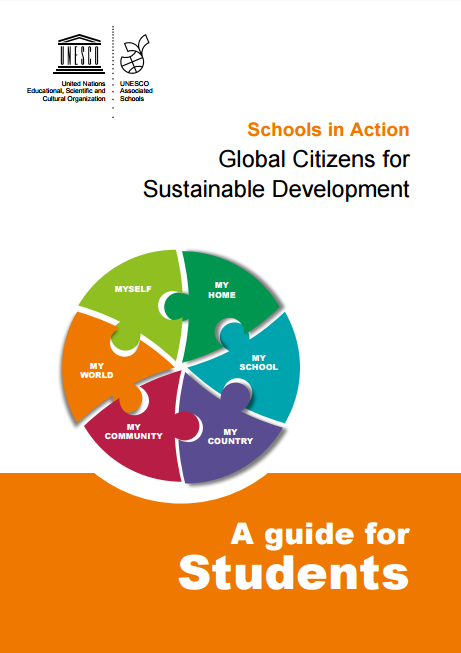 Schools in action, global citizens for sustainable development: a guide for students Año de publicación: 2016 Autor corporativo: UNESCO The UNESCO Associated Schools Project Network (ASPnet) in Action: Global Citizens for Sustainable Development student guide aims to introduce secondary school students to Global Citizenship Education (GCED) and Education for Sustainable Development (ESD) and provide them with ideas and activities to contribute proactively to a more peaceful and sustainable world. The guide draws on the discussions and activities of almost 1,100 participants from 104 countries, including ASPnet National Coordinators, school principals, teachers, students and experts who contributed to the ASPnet Online Collaborative Platform: Global Citizens Connected for Sustainable Development in 2014 and 2015 [http://en.unesco.org/aspnet/globalcitizens]. You will find in this student guide: An overview of what it means to be a global citizen and of how you can contribute to sustainable development. Ideas for getting active yourself, as part of your home, school, community, country and globally. Selected activities on GCED and ESD from ASPnet schools around the world. Le réSEAU en action: Citoyens du monde connectés pour le développement durable: guide à l'intention des enseignants Año de publicación: 2016 Autor corporativo: Organisation des Nations Unies pour l'éducation, la science et la culture (UNESCO) The UNESCO Associated Schools Project Network (ASPnet) in Action: Global Citizens for Sustainable Development student guide aims to introduce secondary school students to Global Citizenship Education (GCED) and Education for Sustainable Development (ESD) and provide them with ideas and activities to contribute proactively to a more peaceful and sustainable world. The guide draws on the discussions and activities of almost 1,100 participants from 104 countries, including ASPnet National Coordinators, school principals, teachers, students and experts who contributed to the ASPnet Online Collaborative Platform: Global Citizens Connected for Sustainable Development in 2014 and 2015 [http://en.unesco.org/aspnet/globalcitizens]. You will find in this student guide: An overview of what it means to be a global citizen and of how you can contribute to sustainable development. Ideas for getting active yourself, as part of your home, school, community, country and globally. Selected activities on GCED and ESD from ASPnet schools around the world. Escuelas en acción Ciudadanos del mundo para el desarrollo sostenible: guía para el alumnado Año de publicación: 2016 Autor corporativo: UNESCO The UNESCO Associated Schools Project Network (ASPnet) in Action: Global Citizens for Sustainable Development student guide aims to introduce secondary school students to Global Citizenship Education (GCED) and Education for Sustainable Development (ESD) and provide them with ideas and activities to contribute proactively to a more peaceful and sustainable world. The guide draws on the discussions and activities of almost 1,100 participants from 104 countries, including ASPnet National Coordinators, school principals, teachers, students and experts who contributed to the ASPnet Online Collaborative Platform: Global Citizens Connected for Sustainable Development in 2014 and 2015 [http://en.unesco.org/aspnet/globalcitizens]. You will find in this student guide: An overview of what it means to be a global citizen and of how you can contribute to sustainable development. Ideas for getting active yourself, as part of your home, school, community, country and globally. Selected activities on GCED and ESD from ASPnet schools around the world.
  The United Nations world water development report 2016: water and jobs Año de publicación: 2016 Autor corporativo: UNESCO Three out of four jobs worldwide rely on water. As such, water shortages and lack of access may limit economic growth in the years to come, according to the World Water Development Report 2016. From its collection, through various uses, to its ultimate return to the natural environment, water is a key factor in the development of job opportunities either directly related to its management (supply, infrastructure, wastewater treatment, etc.) or in economic sectors that are heavily water-dependent such as agriculture, fishing, power, industry and health. In its analysis of the economic impact of access to water, the report cites numerous studies that show a positive correlation between investments in the water sector and economic growth. It also highlights the key role of water in the transition to a green economy. Rapport mondial des Nations Unies sur la mise en valeur des ressources en eau 2016: l'eau et l'emploi Año de publicación: 2016 Autor corporativo: UNESCO Three out of four jobs worldwide rely on water. As such, water shortages and lack of access may limit economic growth in the years to come, according to the World Water Development Report 2016. From its collection, through various uses, to its ultimate return to the natural environment, water is a key factor in the development of job opportunities either directly related to its management (supply, infrastructure, wastewater treatment, etc.) or in economic sectors that are heavily water-dependent such as agriculture, fishing, power, industry and health. In its analysis of the economic impact of access to water, the report cites numerous studies that show a positive correlation between investments in the water sector and economic growth. It also highlights the key role of water in the transition to a green economy.