
Recursos
Exploren una amplia gama de recursos valiosos en GCED para profundizar su comprensión y promover su búsqueda, incidencia, enseñanza y aprendizaje.
3,790 resultados encontrados
 Promouvoir l’education a la citoyennete mondiale en afrique de l’ouest : Atelier international de renforcement de capacités des pays de la CEDEAO 07 – 09 Juillet 2015, Dakar, Sénégal Año de publicación: 2015 Autor corporativo: Organisation des Nations Unies pour l'éducation, la science et la culture (UNESCO) Ce rapport est le fruitde l’atelier international de renforcement de capacités organisé par l’UNESCO dans l’objectif de renforcer les capacités des pays membres de la Communauté économique des États de l'Afrique de l'Ouest (CEDEAO) pour la promotion de l’Education à la citoyenneté mondiale aux niveaux nationaux et régionaux. Autonomiser des citoyens du mon de actifs et construire un sens d’appartenance à une humanité commune ne font pas uniquement partie du mandat de l’UNESCO mais sont aussi des problèmes prioritaires pour l’Afrique de l’Ouest. Ce rapport d’atelier fournit des ressources, stratégies et feuilles de routes pour l’avancée et une meilleure intégration de l’ECM dans les politiques et les programmes éducatifs en Afrique de l’Ouest. Les feuilles de route ont été proposées par les Etats membres eux-mêmes et leur mise en œuvre dépendra de la disponibilité des ressources et des partenariats potentiels.
 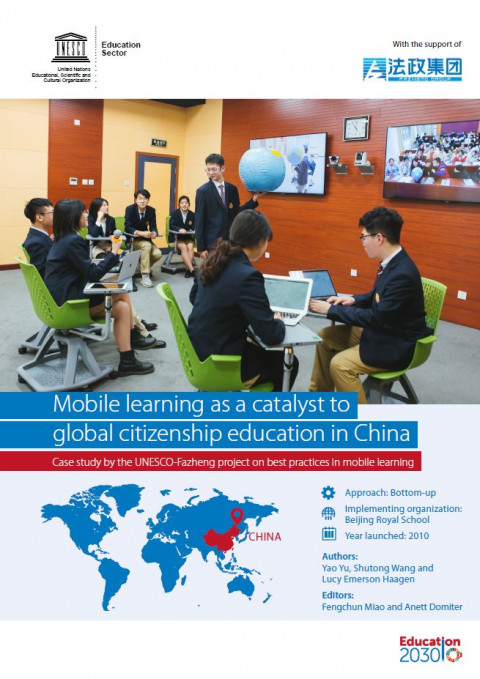 Mobile Learning as a Catalyst to Global Citizenship Education in China: Case Study by the UNESCO-Fazheng Project on Best Practices in Mobile Learning Año de publicación: 2019 Autor: Yao Yu | Shutong Wang | Lucy Emerson Haagen Autor corporativo: UNESCO The Beijing Royal School was one of the pioneer schools in China in incorporating mobile learning into pedagogical transformation. Its mobile learning programme started in 2010. Stemming from the school’s orientation towards global citizenship education, the Beijing Royal School recognizes mobile learning as both driver and enabler for supporting the development of students’ cognitive, socio-emotionaland behavioural dimensions, organized around knowledge acquisition, understanding and respect for difference and diversity, and responsible engagement with global issues. It takes advantage of a variety of mobile apps to support students’ multilingual education, and uses open educational resources (OER) to support multicultural education, taking advantage of the up-to-date worldwide data and information available on the web. It also engages with students from other countries in projects and courses that help the students to widen their understanding of diverse cultures and social contexts. Overall, this case study illustrates how to use mobile technologies to support the implementation of a well-defined and clearly structured educational vision by embedding the use of mobile technologies in students’ daily learning lives.
  Measuring Global Citizenship Education: A Collection of Practice and Tools Año de publicación: 2017 Autor corporativo: Center for Universal Education at Brookings | UNESCO | UN Global Education First Initiative - Youth Advocacy Group (YAG) The idea of global citizenship has existed for several millennia. In ancient Greece, Diogenes declared himself a citizen of the world,1 while the Mahaupanishads of ancient India spoke of the world as one family.2 Today, education for global citizenship is recognized in many countries as a strategy for helping children and youth prosper in their personal and professional lives and contribute to building a better world.This toolkit is intended to shed light on one aspect of operationalizing global citizenship education (GCED): how it can be measured. This toolkit is the result of the collective efforts of the Global Citizenship Education Working Group (GCED-WG), a collegium of 90 organizations and experts co-convened by the United Nations Educational, Scientific, and Cultural Organization (UNESCO), the Center for Universal Education (CUE) at the Brookings Institution, and the United Nations Secretary General’s Global Education First Initiative’s Youth Advocacy Group (GEFI-YAG). To gather the measurement tools in this collection, the working group surveyed GCED programs and initiatives that target youth (ages 15–24).3 For the purposes of this project, GCED was defined as any educational effort that aims to provide the skills, knowledge, and experiences and to encourage the behaviors, attitudes, and values that allow young persons to be agents of long-term, positive changes in their own lives and in the lives of people in their immediate and larger communities (with the community including the environment).This toolkit begins with a brief review of opinions on why GCED is important and the variety of definitions of GCED. We follow the report with a catalog of 50 profiles of assessment efforts, each describing practices and tools to measure GCED at the classroom, local, and national levels. Note that the survey does not represent an exhaustive list but may be regarded as a living document that will grow as the field of GCED itself grows around the world.Broadly speaking, the assessment efforts in this survey may be categorized across achieving three goals: (1) fostering the values/attitudes of being an agent of positive change; (2) building knowledge of where, why, and how to take action toward positive change; and (3) developing self-efficacy for taking effective actions toward positive change.Today, global challenges such as climate change, migration, and conflict will require people to do more than just think about solutions. They will require effective action, by both individuals and communities. Education for global citizenship is one means to help young people develop the knowledge, skills, behaviors, attitudes, and values to engage in effective individual and collective action at their local levels, with an eye toward a long-term, better future at the global level. We offer this toolkit to provide guidance for educators, policymakers, non-governmental organizations, civil society, and researchers, and to inform this conversation.
 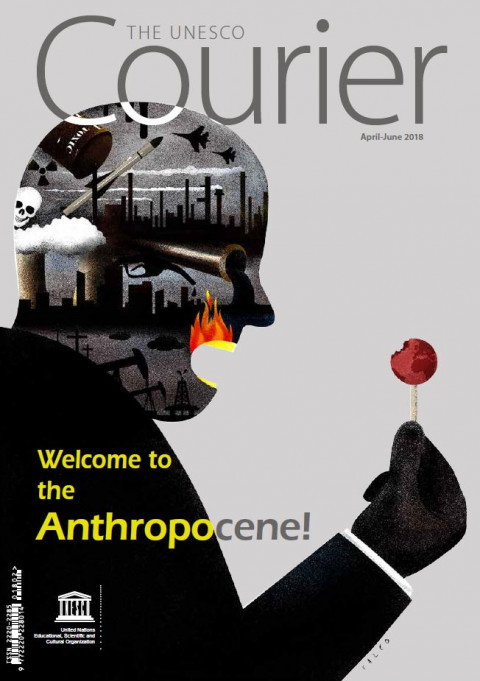 Welcome to the Anthropocene! (The UNESCO Courier no. 2, April-June 2018) Año de publicación: 2018 Autor corporativo: UNESCO In the Ideas section of this issue, three internationally celebrated academics consider the notion of diversity – Mireille Delmas-Marty, a member of the Institut de France; Souleymane Bachir Diagne, Senegalese philosopher; and Abdourahman Waberi, novelist and diarist from Djibouti. With these articles, the Courier marks the celebrations of the World Day for Cultural Diversity for Dialogue and Development (21 May) and the International Day for Biological Diversity (22 May).Our Guest for this issue is Bibi Russell, a fashion designer from Bangladesh. A former top model in London, she quit the catwalk to devote herself to using fashion for development. She is currently working in India, helping young women, some of whom were trafficked as children, to find their bearings and start a new life.To mark UNESCO’s Africa Week in May, we focus on youth in the West and the South of the continent, in our Current Affairs section. After visiting Athens, World Book Capital 2018, we travel to Canada’s Northwest territories, on the other side of the world, to discover the people of Great Bear Lake, in the Tsá Tué biosphere reserve – established and looked after by the indigenous community that lives there.Finally, Zoom invites us to follow an ordinary day in the life of Qello, a 13-year old girl in Ethiopia, hour by hour.The UNESCO Courier celebrates its 70th birthday in 2018. Each issue this year will feature an article that looks back at this extraordinary adventure. In this issue, Roberto Markarian, Rector of the University of the Republic, Uruguay, recounts the story of the role the Courier has played in his life. Bienvenue dans l'Anthropocène! (Le Courrier de l'UNESCO no. 2; Avril-Juin 2018) Año de publicación: 2018 Autor corporativo: Organisation des Nations Unies pour l'éducation, la science et la culture (UNESCO) Selon les uns, l’Anthropocène n’est qu’un autre nom pour l’époque que nous appelons Holocène, les humains ayant commencé à exercer une pression sur l’environnement depuis 10 000ans, c’est-à-dire depuis leur sédentarisation et l’invention de l’agriculture. Selon d’autres, l’Anthropocène commencerait autour de 1800, avec la révolution industrielle. D’autres encore voient l’Anthropocène éclore dupremier champignon atomique de 1945. Malgré ces divergences, très rares sont ceux qui ne reconnaissent pas qu’au cours du dernier demi-siècle l’état de la planète s’est dégradé plus rapidement et plus dramatiquement que jamais : amasgigantesques de plastique sur les plages et dans les mers, développement sans précédent de nouveaux matériaux qui couvrent la surface terrestre et ne se recyclent que très peu, sols gorgés d’engrais, augmentation du taux d’acidité des mers, tauxde pollution sans précédent, érosion des forêts tropicales, dérèglement desécosystèmes, extinction massive des espèces et diminution drastique de la biodiversité, réchauffement climatique...À qui la faute ? Auxhumains – répond lamajorité des scientifiques. Reste à savoir si nous devrions tous porter la même charge deresponsabilité. Certains blâmant avant tout le système capitaliste né en Occident, parlent de Capitalocène ou d’Occidentalocène. Courons-nous à la catastrophe? Des voix s’élèvent pour prophétiser la fin du monde! Des notions comme Chtulhucène ou Thanatocène sont avancées pour signifier que le monstre rôde, quela mort nous guette... Des experts, bien plus modérés, n’en sont pas moins inquiets face à l’indécision des décideurs. «Tout se passe comme si l’humanité, léthargique, attendait la fin du film et le moment où les héros viendront tout arranger et où nous serons tous heureux pour toujours», lira-t-on dans ces pages.Le débat fait rage, les solutions tardent à venir. Le Courrier fait le point.
  Educational Content up Close Examining the Learning Dimensions of Education for Sustainable Development and Global Citizenship Education Año de publicación: 2019 Autor corporativo: UNESCO In taking ESD and GCED forward, UNESCO seeks to advance a holistic approach to education that emphasizes three inter-related dimensions of learning – the cognitive, social and emotional and behavioural.This publication summarizes the findings of a study commissioned by UNESCO to examine if and how these three dimensions of learning and teaching of ESD and GCED are reflected in pre-primary, primary and secondary educational content (ie. national laws, policies and the intended curriculum) in Costa Rica, Japan, Kenya, Lebanon, Mexico, Morocco, Portugal, Republic of Korea, Rwanda and Sweden. The outcome of this work shows a major pattern of commitment to the three learning dimensions in the selected countries and across the four education levels, with noteworthy nuances between ESD and GCED. 지속가능발전교육 및 세계시민교육의 학습 영역 연구: 국가별 교육 과정 분석을 중심으로 Año de publicación: 2019 Autor corporativo: 유네스코 이 보고서는 유네스코가 의뢰한 연구 결과를 요약한 것으로, ESD 및 GCED의 교수·학습에 있어서 이 세 가지 영역이 취학전교육, 초등교육, 중등교육의 내용 (예: 국가법, 정책 및 의도된 교육과정)에 반영되고 있는지 여부와 어떻게 반영되고 있는지를 검토하고 있다. 연구 대상 국가로는 코스타리카, 일본, 케냐, 레바논, 멕시코, 모로코, 포르투갈, 한국, 르완다, 스웨덴 등 10개국이다. 이 연구결과는 선정 국가별, 교육단계별로 나타나는 세 가지 학습 영역에 대한 주요 양상을 보여주고 있으며, ESD와 GCED 사이의 미묘한 차이는 주목할 만하다.
  Issues and Trends in Education for Sustainable Development Año de publicación: 2018 Autor: Alexander Leicht | Julia Heiss | Wonjung Byun Autor corporativo: UNESCO Education for Sustainable Development (ESD) is globally acknowledged as a powerful driver of change, empowering learners to take the decisions and actions needed to build a just and economically viable society respectful of both the environment and cultural diversity.This publication comes at a moment of heightened global interest in addressing sustainability challenges through education in order to achieve the targets of the 2030 Sustainable Development Agenda. ESD is not only recognized as a key enabler of sustainable development but an integral element of all quality education. By exploring key issues related to ESD policy and practice, UNESCO aims to help accelerate the reorientation of education towards achieving a sustainable and resilient world. Enjeux et tendances de l'éducation en vue du développement durable Año de publicación: 2018 Autor: Alexander Leicht | Julia Heiss | Wonjung Byun Autor corporativo: Organisation des Nations Unies pour l'éducation, la science et la culture (UNESCO) L’éducation en vue du développement durable (EDD) est universellement considérée comme un puissant vecteur de changement qui donne aux apprenants les moyens de prendre les décisions nécessaires et d’agir pour bâtir une société juste et économiquement viable, respectueuse de l’environnement et de la diversité culturelle. Cet ouvrage paraît dans un contexte mondial marqué par un intérêt accru pour les efforts visant à relever les défis du développement durable par le biais de l’éducation, afin d’atteindre les objectifs du Programme de développement durable à l’horizon 2030. L’EDD est non seulement reconnue comme un moteur indispensable du développement durable, mais aussi comme un élément constitutif d’une éducation de qualité. En explorant les principaux enjeux liés aux politiques et aux pratiques d’EDD, l’UNESCO entend accélérer la réorientation de l’éducation vers un monde plus durable et plus résilient.
  Права человека: назад в будущее (Курьер ЮНЕСКО no. 4, октябрь-декабрь 2018 года) Año de publicación: 2018 Autor corporativo: Организация Объединенных Наций по вопросам образования, науки и культуры (UNESCO) Среди авторов этого номера «Курьера ЮНЕСКО» – Морис Добб, Гарольд Дж. Ласки, Бенедетто Кроче, Олдос Хаксли, Ло Чун-Шу, Арнольд Шёнберг и другие выдающиеся деятели прошлого столетия. По случаю 70-летия Всеобщей декларации прав человека, принятой 10 декабря 1948 года, мы решили вернуться в прошлое, чтобы с большей ясностью смотреть в будущее. Поэтому текущий номер так и называется: «Назад в будущее». Представим же, что сейчас вновь 1946 год. Над миром витает жуткий призрак тотальной войны, и международное сообщество испытывает «потребность выступить с совместным заявлением морального характера, в котором оно могло бы в должной мере выразить всеобщее негодование и надежду на лучшее будущее, какой бы утопичной она ни казалась», – поясняет специалист по социальной антропологии Марк Гудэйл во вступительной статье к подготовленной с его помощью рубрике «Широкий обзор». Материалы этой рубрики знакомят читателей с малоизвестным фактом из истории Всеобщей декларации прав человека – всемирным опросом, проведенным ЮНЕСКО по инициативе первого Генерального директора Джулиана Хаксли с целью определения философских принципов, лежащих в основе прав человека. Решение о его проведении было принято на 1-й сессии Генеральной конференции ЮНЕСКО, состоявшейся в ноябре-декабре 1946 года, а сам опрос был проведен годом позже. Руководство этим масштабным проектом осуществлял молодой французский философ Жак Аве. В опросе, призванном заложить основы для размышлений о правах человека, приняли участие яркие представители интеллектуальной элиты послевоенного общества. Несмотря на прошедшие с тех пор 70 лет, поднятые в ходе этого проекта вопросы по-прежнему чрезвычайно актуальны. Столь же актуальны и рисунки нашего гостя, перуанского художника Фернандо Брисе, черпающего вдохновение в «том особом периоде, когда идея прогресса действительно открывала многочисленные перспективы». Этому периоду он посвятил серию под названием The Book of Needs («Книга потребностей»), рисунки из которой виртуозно воспроизводят страницы «Курьера ЮНЕСКО» за 1948-1954 год. Большую часть из них можно увидеть в приложении к текущему номеру журнала.