
Recursos
Exploren una amplia gama de recursos valiosos en GCED para profundizar su comprensión y promover su búsqueda, incidencia, enseñanza y aprendizaje.
3,225 resultados encontrados
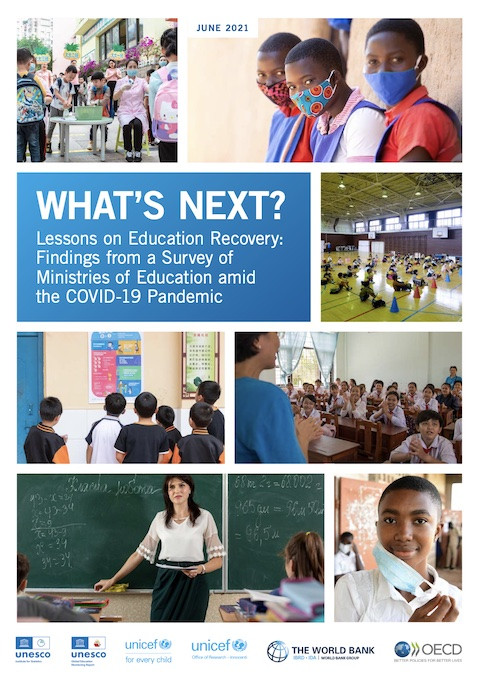 What’s Next? Lessons on Education Recovery: Findings From a Survey of Ministries of Education Amid the COVID-19 Pandemic Año de publicación: 2021 Autor corporativo: UNESCO | United Nations Children's Fund (UNICEF) | World Bank | Organisation for Economic Co-operation and Development (OECD) United Nations Educational, Scientific and Cultural Organization (UNESCO), the United Nations Children’s Fund (UNICEF), the World Bank and the Organisation for Economic Co-operation and Development (OECD) have collaborated in the third round of the Survey on National Education Responses to COVID-19 School Closures, administered by the UNESCO Institute for Statistics (UIS) and OECD to Ministry of Education officials. The questions covered four levels of education: preprimary, primary, lower secondary and upper secondary. While the first two rounds of the survey were implemented during the periods May–June and July–October 2020, respectively, the third round was implemented during the period February–June 2021. In total, 143 countries responded to the questionnaire. Thirty-one countries submitted responses to the OECD (“OECD survey”) and 112 countries responded to the UIS (“UIS survey”). Seven countries responded to both surveys. In these instances, the more complete set responses were used in analysis.
  Roadmap for Integrating Global Citizenship and Liberation History in Teaching and Learning in SADC Member States Año de publicación: 2021 Autor corporativo: UNESCO The Roadmap for integrating GCED and SALH in teaching and learning in SADC member states is grounded in two visions: Identify common values and learning outcomes that can be advanced by GCED and SALH, with a view of promoting the sense of belonging, solidarity, and regional identity and integration. Guide education planners and practitioners to mobilize the GCED and SALH contents to contribute to the SADC vision of reconciliation, social cohesion, resilience, peace, solidarity, development, and freedom for future generations through promoting an education that equips young people with skills, values, knowledge, behaviours, and attitudes that critically and creatively address today’s local, national, regional, and global challenges through an inclusive lens. The objectives of this Roadmap are to: Provide general guidance and steps for the integration of SALH and GCED in curricula and teaching and learning practices in SADC member states; Provide articulations between the regional and local philosophical concepts and the GCED core values, such as ubuntu, to support a contextualized teaching of GCED values; Support countries to identify priority topics and steps towards integrating GCED and SALH in education policies in a manner that highlights the regional dimensions of liberation history, as well as universal values; Propose learning outcomes and competencies as well as teaching and learning approaches for GCED and SALH; Provide guidance on integration of GCED and SALH in teacher education programmes, as well as possible assessment methods.
 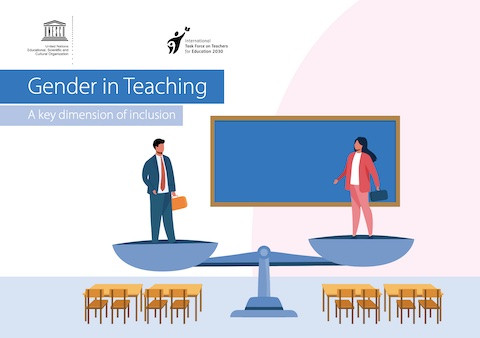 Gender in Teaching: A Key Dimension of Inclusion Año de publicación: 2020 Autor corporativo: UNESCO | International Task Force on Teachers for Education 2030 Without teachers, Sustainable Development Goal 4 to ensure inclusive and equitable, quality education for all by 2030 will not be achieved.Since teachers act as role models for students, inclusion in education means that the teaching workforce mirror the diversity of the classroom. As countries look to recruit more teachers to meet SDGs, one significant factor important to creating inclusive classrooms is gender.This document has been prepared for the 2020 World Teachers’ Day celebrated by UNESCO and the Teacher Task Force with the theme Teachers: Leading in crisis, reimagining the future. Le genre dans l’enseignement: Un élément essentiel de l’inclusion Año de publicación: 2020 Autor corporativo: Organisation des Nations Unies pour l'éducation, la science et la culture (UNESCO) | International Task Force on Teachers for Education 2030 Sans enseignant(e)s, il sera impossible d’atteindre l’objectif de développement durable 4 qui vise à assurer l’accès de tous à une éducation inclusive de qualité, sur un pied d’égalité, d’ici à 2030.Les enseignant(e)s sont des exemples pour les élèves ; à ce titre, l’inclusion dans l’éducation signifie que la composition ducorps enseignant doit refléter la diversité des élèves. À l’heure où les pays cherchent à recruter davantage d’enseignant(e)s pour atteindre les ODD, le genre constitue l’un des facteurs les plus importants pour créer des classes inclusives.Le présent document a été préparé en vue de la Journée mondiale des enseignant(e)s 2020, célébrée par l’UNESCO et l’Équipe spéciale sur les enseignants autour du thème Enseignants : leaders en temps de crise et façonneurs d’avenir.
  Communication and Information Programme Año de publicación: 2021 Autor corporativo: UNESCO UNESCO is the UN specialized agency building peace in the minds of people through education, the sciences, culture, communication and information. Our mission is to foster intercultural dialogue and sustainable development, by promoting the free flow of ideas.By adopting a multi-disciplinary and inclusive approach, UNESCO works with both duty-bearers and rights-holders across the world to develop and implement targeted actions that are born out of local needs, which ensures a holistic and results-based approach for sustainable change.In the field of communication and information, UNESCO defends and promotes freedom of expression, media independence and pluralism, and the building of inclusive knowledge societies underpinned by universal access to information and the innovative use of digital technologies.Through capacity-building, policy advice, international cooperation, monitoring and foresight in the fields of freedom of expression, access to information, and digital transformation, UNESCO will continue to empower key actors with a view to ensuring that fundamental freedoms are guaranteed online and offline, in line with international standards.This is all the more relevant to ensure the ethical development and use of emerging technologies, which have a growing impact on all aspects of the world’s societies. Citizens will also be empowered to enjoy these fundamental freedoms through the development of 21st century skills and the fostering of enabling environments for media pluralism and diversity.
  Getting the Message Across: Reporting on Climate Change and Sustainable Development in Asia and the Pacific; A Handbook for Journalists Año de publicación: 2018 Autor corporativo: UNESCO Getting the Message Across, Reporting on Climate Change and Sustainable Development in Asia and the Pacific: A Handbook for Journalists has been customized for journalists to tell the climate change story specific to the region. It explores the essential aspects of climate change, including its injustices to vulnerable communities, especially women and girls and least developed countries, and provides examples of best practices and stories of hope unique to the region. It can be used as a resource for journalists to understand the science of climate change, as well as helping journalists to improve their reporting of the environmental, social, economic ̧ political, technological and other angles of the story. Донесение сути темы Освещение темы: об изменении климата и устойчивом развитии в Азиатско-Тихоокеанском регионе; Пособие для журналистов Año de publicación: 2018 Autor corporativo: Организация Объединенных Наций по вопросам образования, науки и культуры (UNESCO) Пособие для журналистов "Донесение сути темы Освещение темы об изменении климата и устойчивом развитии в Азиатско-Тихоокеанском регионе" было разработано для журналистов, так чтобы рассказать историю изменения климата, характерную для региона. В нем рассматриваются основные аспекты изменения климата, в том числе его несправедливость по отношению к уязвимым общинам, особенно женщинам и девочкам и наименее развитым странам, и приводятся примеры передовой практики и истории надежды, уникальные для региона. Он может быть использован в качестве ресурса для журналистов, чтобы понять науку об изменении климата, а также помочь журналистам улучшить свои репортажи об экологических, социальных, экономических, политических, технологических и других аспектах истории.
  Not Just Hot Air: Putting Climate Change Education Into Practice Año de publicación: 2015 Autor corporativo: UNESCO This publication presents UNESCO’s work on Climate Change Education for Sustainable Development in 2012/2013, and intends to serve as a reference for similar work in the future.It provides: National case studies on five CCESD country pilots conducted by UNESCO in 2012/2013 in: Dominican Republic, Guyana, Mauritius, South Africa and Tuvalu. The case studies include an analysis and assessment of the undertaken CCESD capacity-building work for policy makers and teacher educators, lessons learnt about the implementation of the programme, and conclusions. 16 short country profiles from around the world on policy development regarding ESD and Climate Change Education. Recommendations on Climate Change Education in the context of Education for Sustainable Development, developed by UNESCO in order to establish a common understanding of what needs to be done to enhance education responses to climate change. This publication is intended to provide policy makers and teacher educators with a compact source of information on how to mobilize education to address climate change.
  "Sustainable Development Goals and Gender in Kyrgyzstan" New Statistical Publication Año de publicación: 2023 Autor corporativo: National Statistical Committee of the Kyrgyz Republic | United Nations Entity for Gender Equality and the Empowerment of Women (UN Women) This publication is intended to inform the public and government officials about the current status and progress towards achieving sustainable development in Kyrgyzstan, promote informed policy and management decisions, and help identify further priority steps to achieve the SDGs and women’s empowerment. Статистический сборник "Цели в области устойчивого развития и гендер в Кыргызской Республике" Año de publicación: 2023 Autor corporativo: National Statistical Committee of the Kyrgyz Republic | United Nations Entity for Gender Equality and the Empowerment of Women (UN Women) Целью настоящего издания является информирование общественности и работников государственного управления о текущем состоянии и прогрессе в достижении устойчивого развития в Кыргызской Республике, а также для принятия обоснованных политических и управленческих решений и содействия в определении дальнейших приоритетных шагов для достижения успеха в реализации ЦУР и расширения прав и возможностей женщин.