
Recursos
Exploren una amplia gama de recursos valiosos en GCED para profundizar su comprensión y promover su búsqueda, incidencia, enseñanza y aprendizaje.
518 resultados encontrados
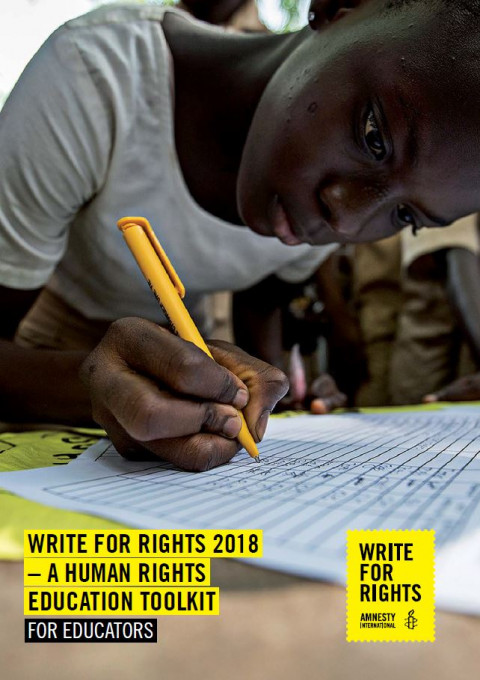 Escribe por los derechos 2018: Carpeta de materiales de educación en derechos humanos para educadores/as Año de publicación: 2018 Autor corporativo: Amnesty International La campaña anual Escribe por los Derechos es uno de los mayores eventos de derechos humanos de Amnistía Internacional. En 2018, la campaña se centra en defensoras de los derechos humanos que han sufrido violaciones de derechos humanos o corren grave riesgo a causa de la postura que han adoptado respecto a ciertas cuestiones de derechos humanos.Esta carpeta de materiales de Educación en Derechos Humanos se creó para ayudar a profesores y profesoras a participar con sus estudiantes en la campaña Escribe por los Derechos. Ofrece una amplia perspectiva de cuestiones de derechos humanos y brinda la oportunidad de abrir la mente de los y las jóvenes a cuestiones de preocupación mundiales. Al aprender sobre estas cuestiones y escribir cartas convincentes para ayudar a poner fin a las violaciones de derechos humanos y lograr justicia, los profesores y profesoras y sus estudiantes contribuyen al movimiento internacional de derechos humanos y ven con sus propios ojos cómo las palabras pueden hacer cambiar las cosas en el mundo.Esta carpeta se creó para estudiantes de a partir de 13 años y está concebida principalmente para utilizarla en un entorno escolar: tanto dentro del aula como en clubes o eventos de toda la escuela. Las actividades también se pueden adaptar para utilizarlas en otros contextos de educación no formal, como grupos de jóvenes y entornos comunitarios. La carpeta contiene actividades generales sobre derechos humanos y destaca el caso de seis defensoras de los derechos humanos de la campaña Escribe por los Derechos que han hecho contribuciones extraordinarias al progreso de los derechos humanos en todo el mundo.
  دليل لفائدة المكونين و الوسطاء لإستعمال " دليل شباب تونس في تعلم الديمقراطية " Año de publicación: 2013 Autor corporativo: UNESCO Rabat The main aim of these manual and guide is to raise awareness among Tunisian youth about the values of democracy, human rights and responsible citizenship, and empower youth to make their voice heard during this critical period in the Tunisian democratic transition.
  EDUCATION A LA CULTURE DE LA PAIX, AUX DROITS HUMAINS, A LA CITOYENNETE, A LA DEMOCRATIE ET A L’INTEGRATION REGIONALE MANUEL DE REFERENCE DE LA CEDEAO A L’USAGE DE LA FORMATRICE / DU FORMATEUR DE FORMATEURS/FORMATRICES Año de publicación: 2013 Autor corporativo: UNESCO Dakar | Economic Community of West African States (ECOWAS) The manual comprises seven modules dealing with the Culture of Peace and Conflict Management; Human Rights; Civism and Citizenship; Democracy and Good Governance; Gender and Development; Public Health, Environment and Sustainable Development; and Regional Integration. Each module has sub-themes with introductions, reference materials, general objectives to guide the trainer and generic pedagogical tables that are flexible enough to be adapted to available teaching resources in the different ECOWAS countries. It is also suitable and adaptable to the training of teachers involved in both formal and non-formal education delivery at different levels of teaching and learning. The ultimate goal of the Manual is to build a critical mass of ECOWAS citizens equipped with competent skills, not only for cognitive and psycho-motor domains of education, but also affective skills for positive values, attitudes and behaviors that promote peace, tolerance and peaceful co-existence of community citizens. Guide d'utilisation du manuel d'apprentissage de la démocratie pour les jeunes en Tunisie, à l'attention des formateurs et adultes-relais Año de publicación: 2013 Autor corporativo: UNESCO Rabat The main aim of these manual and guide is to raise awareness among Tunisian youth about the values of democracy, human rights and responsible citizenship, and empower youth to make their voice heard during this critical period in the Tunisian democratic transition.
  Lessons from a Transformative Pedagogy Project for Peace, Resilience, and the Prevention of Violent Extremism: Part I; Country-Level Implementation Año de publicación: 2024 Autor: Eyerusalem Azmeraw | Quentin Wodon | Eleonora Mura | Kasumi Moritani Autor corporativo: UNESCO International Institute for Capacity-Building in Africa (IICBA) From 2017 to 2022, UNESCO’s International Institute for Capacity Building in Africa (IICBA) led a series of projects for peacebuilding and the prevention of violent extremism through education with support from the Government of Japan. This two-part paper draws lessons from the projects. The first part of the paper briefly explains the transformative pedagogy approach that guided project implementation and provides examples of changes that were implemented at the country level under the projects. The analysis is qualitative, with the aim being to outline, through country examples, what can be achieved through such projects. Lessons on factors contributing to impact are also outlined.
 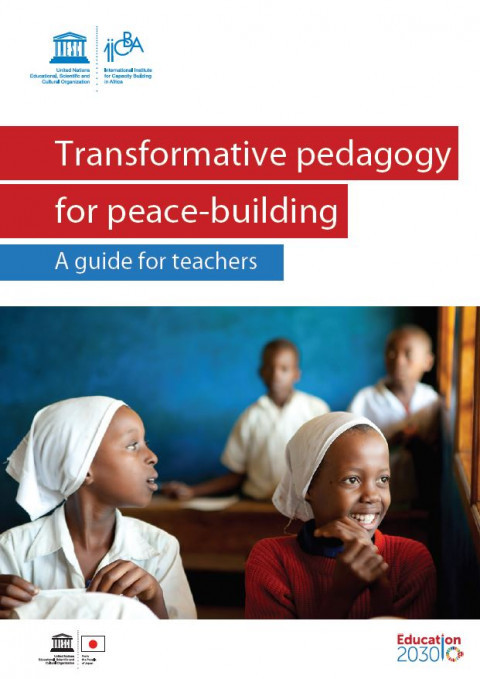 Transformative Pedagogy for Peace-building: A Guide for Teachers Año de publicación: 2017 Autor corporativo: UNESCO International Institute for Capacity-Building in Africa (IICBA) This publication is a guide for teachers and teacher trainers on transformative pedagogy so that they are able to empower youth with peace-building knowledge, skills and competencies necessary to develop into advocates and actors of peace.The guide particularly aims to introduce teachers to the foundation of conflict analysis and peace-building and to equip them with a learner-centered approach to peace education and community engagement.This guide is a resource for educators to engage and support youth in their journey to becoming active peace-builders and fostering transformation in the Horn of Africa and Surrounding Countries.
  Education à la citoyenneté et aux droits de l'homme: manuel pour les jeunes en Mauritanie Año de publicación: 2015 Autor: Abdel-Wedoud (dit Deddoud Ould Abdallah) | Mohamed El Moctar Ould Sidina | Bamariam Koita | Sidi Mohamed Ould Mohamed Abdellahi Autor corporativo: Mauritania. Ministère de la culture et de l'artisanat | Mauritanian National Commission for Education, Science and Culture | UNESCO Rabat Ce Manuel, composé de 20 fiches thématiques, offre de manière inédite des connaissances sur les conventions et standards internationaux en matière de démocratie et de droits de l’homme, ainsi qu’une contextualisation aux cadres normatifs nationaux de la Mauritanie. Des questions clés, des exercices interactifs, et des références pour aller plus loin sont autant d’outils pédagogiques pour familiariser les jeunes avec des notions fondamentales, dans le cadre de l’éducation aussi formelle que non formelle. Car Si l’éducation à la citoyenneté est rattachée à un territoire national dans la mesure où est citoyenne toute personne disposant de droits et de devoirs attachés à une nationalité, à un État, à une histoire sociale et culturelle, l’éducation aux droits de l’homme se réfère quant à elle à un cadre normatif universel et déterritorialisé : sa mission est de cultiver le sentiment d’appartenance de chacun(e) à l’humanité, caractérisée par une dignité propre. Dans une démarche éducative, ce Manuel conjugue les deux dimensions, les interpé- nètre et les met en perspective. L’objectif est de permettre aux jeunes, avec l’aide de formateurs et d’animateurs, d’approfondir et de mettre en perspective leurs connaissances relatives aux valeurs de citoyenneté et aux principes de droits de l’homme, à travers un va-et vient constant entre l’idéal universel et le contexte politique, social, culturel et environnemental dans lequel ils se trouvent.Fruit de la collaboration entre l’UNESCO et le Ministère de la Culture et de l’Artisanat de Mauritanie, et bénéficiant du soutien de l’Agence espagnole pour la coopération internationale pour le développement (AECID), ce Manuel propose des pistes pour explorer et interroger les conditions d’exercice de la citoyenneté, ainsi que des problématiques sociétales émergeantes. Mieux comprendre, pour mieux agir, c’est aussi cela être un agent de changement, de paix et de développement.
  Education à la citoyenneté et aux droits de l'homme: manuel pour les jeunes au Maroc Año de publicación: 2015 Autor corporativo: UNESCO Rabat | Conseil national des droits de l'homme (Morocco) Prepared by UNESCO, in collaboration with the Moroccan National Human Rights Council (CNDH) and the support of the Spanish Agency for International Development Cooperation (AECID), this manual aims to sensitize young Moroccan to the fundamental concepts of citizenship and human rights. This educational tool, which consists of 20 didactic cards that describe and explain Morocco national legislation on human rights, documents the human rights international conventions and instruments and puts them in perspective in the Moroccan legislative context. The manual also includes practical exercises adapted to a young audience. تعليم المواطنة وحقوق الإنسان. دليل لشباب المغرب Año de publicación: 2015 Autor corporativo: UNESCO Rabat | Conseil national des droits de l'homme (Morocco) Prepared by UNESCO, in collaboration with the Moroccan National Human Rights Council (CNDH) and the support of the Spanish Agency for International Development Cooperation (AECID), this manual aims to sensitize young Moroccan to the fundamental concepts of citizenship and human rights. This educational tool, which consists of 20 didactic cards that describe and explain Morocco national legislation on human rights, documents the human rights international conventions and instruments and puts them in perspective in the Moroccan legislative context. The manual also includes practical exercises adapted to a young audience.
  Manuel d'apprentissage de la démocratie pour les jeunes en Tunisie Año de publicación: 2011 Autor corporativo: UNESCO Rabat The main aim of these manual and guide is to raise awareness among Tunisian youth about the values of democracy, human rights and responsible citizenship, and empower youth to make their voice heard during this critical period in the Tunisian democratic transition.