
Recursos
Exploren una amplia gama de recursos valiosos en GCED para profundizar su comprensión y promover su búsqueda, incidencia, enseñanza y aprendizaje.
2,193 resultados encontrados
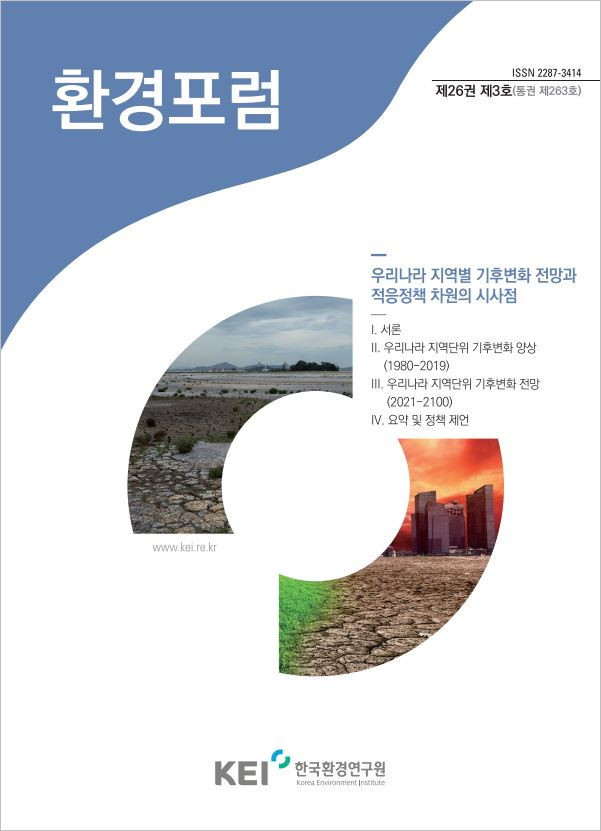 우리나라 지역별 기후변화 전망과 적응정책 차원의 시사점 (환경포럼 제26권 통권 263호) Año de publicación: 2022 Autor: 심창섭 | 문준기 | 한지현 | 서지현 | 송영일 | 홍재우 | 유명수 Autor corporativo: 한국환경연구원 지역 차원의 기후변화 적응을 위해서는 지역 차원의 기후변화 특징을 파악하고 고해상도의 미래 기후전망이 필요하다. 본고에서는 우리나라의 과거 기상관측 및 다종의 기후 시나리오 앙상블을 기반으로 지역별 기후변화 양상과 전망에 대해 논의하였다. 본 저작물은 한국환경연구원에서 2022년 작성하여 공공누리 제4유형으로 개방한 '우리나라 지역별 기후변화 전망과 적응정책 차원의 시사점(작성자: 심창섭)'을 이용하였으며, 해당 저작물은 한국환경연구원 홈페이지(https://www.kei.re.kr/)에서 무료로 내려받으실 수 있습니다.
 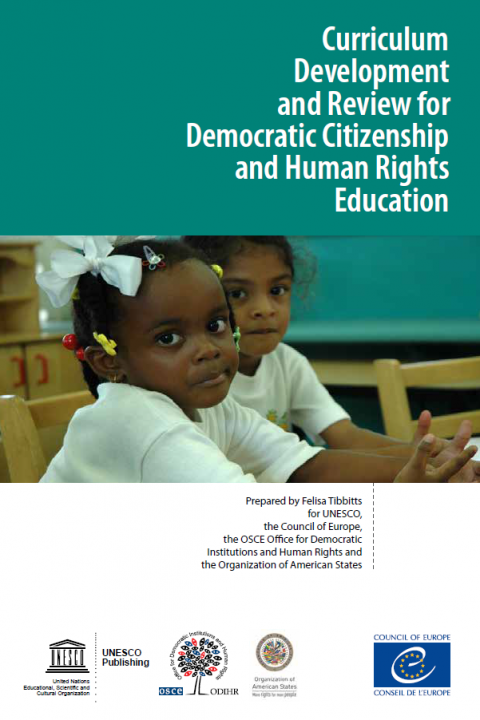 Curriculum development and review for democratic citizenship and human rights education Año de publicación: 2015 Autor: Felisa Tibbitts Autor corporativo: Council of Europe Education for democratic citizenship and human rights education (EDC/HRE) are educational areas that contribute fundamentally to our ability to live together in communities, in countries and as neighbours across national borders. They also help to enable a flourishing global community. The wider aim of EDC/HRE is the establishment of sustainable and participative forms of democracy based on respect for human rights and good governance. As such, EDC/HRE is a public good and an ongoing investment for producing societies characterised by human rights principles such as non-discrimination, inclusion and participation, and the rule of law. The central purpose of this resource is to support the development of education policies and curricula in schools that support and promote young people’s participation in democratic life. As such, EDC/HRE is inevitably in an ongoing state of development and review. This resource aims to support the work of education leaders and curriculum developers in integrating EDC/HRE within curriculum systems and to encourage the engagement of stakeholders in supporting such efforts. Élaboration et examen d'un curriculum pour la citoyenneté démocratique et l'éducation aux droits de l'homme Año de publicación: 2015 Autor: Felisa Tibbitts Autor corporativo: Conseil de l'Europe La plupart des jeunes grandissent en apprenant les leçons de vie des soins, de la solidarité, de la responsabilité et de la justice en s'engageant quotidiennement auprès des familles, des amis, des écoles et des institutions communautaires. L'éducation à la citoyenneté démocratique et l'éducation aux droits de l'homme (EDC / EDH) sont des domaines éducatifs qui contribuent fondamentalement à notre capacité à vivre ensemble dans les communautés, dans les pays et comme voisins à travers les frontières nationales. Ils aident également à favoriser une communauté mondiale florissante. L'objectif plus large d'EDC / EDH est l'instauration de formes de démocratie durables et participatives fondées sur le respect des droits de l'homme et la bonne gouvernance. À ce titre, l'EDC / EDH est un bien public et un investissement permanent pour des sociétés productrices caractérisées par des principes relatifs aux droits de l'homme tels que la non-discrimination, l'inclusion et la participation et l'état de droit. L'objectif central de cette ressource est d'appuyer l'élaboration de politiques et de programmes éducatifs dans les écoles qui soutiennent et encouragent la participation des jeunes à la vie démocratique. À ce titre, EDC / EDH est inévitablement dans un état de développement et d'examen permanent. Cette ressource vise à appuyer le travail des leaders de l'éducation et des concepteurs de programmes d'études pour intégrer EDC / EDH dans les systèmes curriculaires et encourager l'engagement des parties prenantes à soutenir ces efforts. Разработка и пересмотр учебных программ по воспитанию демократической гражданственности и образованию в области прав человека Año de publicación: 2015 Autor: Felisa Tibbitts Autor corporativo: Council of Europe Воспитание демократической гражданственности и образование в об-ласти прав человека необходимы для построения мирного, устойчивого и инклюзивного общеcтва, основанного на уважении прав человека каждой личности. Повышение качества образовательной политики в сфере воспитания демократической гражданственности и образования в области прав человека является важнейшим направлением работы Совета Европы, Организации Объединенных Наций по вопросам образования, науки и культуры, Бюро по демократическим институтам и правам человека Организации по бе-зопасности и сотрудничеству в Европе и Организации американских государств. Эти организации совместно подготовили настоящую публикацию, с тем чтобы оказать поддержку государствам-членам и государствам-участникам в выпол-нении ими своих обязательств, касающихся содействия образованию в области прав человека и демократической гражданственности и улучшения доступа к качественному образованию для всех лиц. Помимо этого, данная публикация является вкладом в глобальную инициативу Генерального секретаря ООН Пан Ги Муна «Образование прежде всего», начатую в 2012 году. Эта инициатива определила содействие воспитанию глобальной гражданственности как один из трех важнейших приоритетов образования, тем самым создав дополнитель-ный стимул для действий в данной области и послав ясный сигнал о поддержке работникам сферы образования во всем мире.
  Présentation de l'assurance de la qualité de l'éducation à la citoyenneté démocratique dans les écoles - étude comparative de 10 pays Año de publicación: 2009 Autor corporativo: Conseil de l'Europe (Recommandation Rec (2002) 12). Selon cette recommandation, les gouvernements européens ont reconnu leur responsabilité de veiller à la base culturelle de la démocratie par l'éducation. Cependant, la politique est pas si simple que les recommandations supranationales sont immédiatement traduites en politique dans les Etats nationaux. Cet écart entre les politiques convenues et réalisés a été appelé un «écart de conformité». Une des raisons les plus logiques pour la non-conformité provient d'un manque de sensibilisation ou de compétences. Par conséquent, le Conseil de l'Europe concentrée sur la production de matériaux qui pourraient aider à sensibiliser et développer les compétences. Les principaux produits résultant de cet effort ont été collectées comme un «ECD / EDH Pack » depuis 2005. Cette collection couvre les domaines de l'élaboration des politiques, la gouvernance démocratique des établissements d'enseignement, la formation des enseignants et l'assurance qualité. Le «Outil pour l'assurance qualité de l'éducation à la citoyenneté démocratique dans les écoles» (Bîrzea et al., 2005), qui est l'un de ces matériaux, constitue le document de référence pour cette étude. Cette étude analyse les conditions pertinentes et les activités possibles en ce qui concerne la mise en œuvre de l'outil dans 10 systèmes éducatifs nationaux. Comme les conditions pertinentes, l'étude considère les tentatives existantes pour offrir une qualité d'enseignement au sein des pays, ainsi que les programmes de formation des enseignants qui accompagnent ces tentatives. Comme les activités possibles, les adaptations nationales de l'outil, et diverses façons de travailler avec différents groupes cibles, sont également pris en compte. Les sections suivantes fournissent des informations de base concernant le projet. Cela aidera le lecteur à comprendre pourquoi l'outil doit être adapté dans des circonstances différentes. La section 2 présente des points de référence qui ouvrent des perspectives théoriques sur le travail présenté. Section 3 fournit une justification pour la sélection des pays participants et donne et décrit la méthodologie utilisée lors de la réalisation de cette étude. Enfin, la section 4 donne un aperçu du reste du contenu de ce livre.
 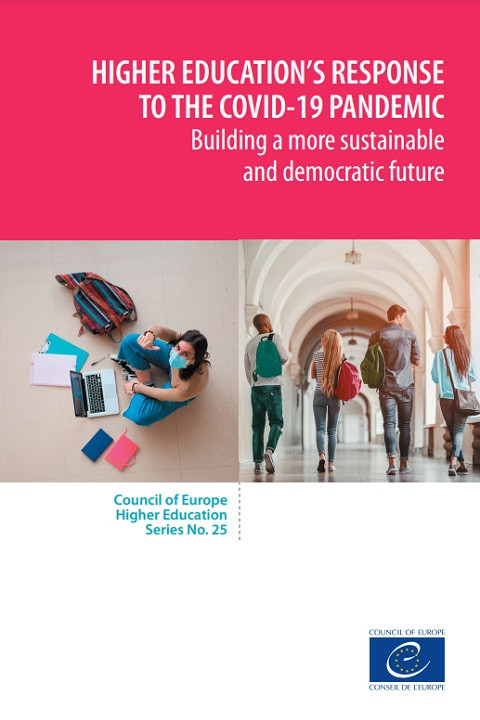 Higher Education's Response to the COVID-19 Pandemic: Building a More Sustainable and Democratic Future (Council of Europe Higher Education Series; No. 25) Año de publicación: 2021 Autor: Sjur Bergan | Tony Gallagher | Ira Harkavy | Ronaldo Munck | Hilligje van’t Land Autor corporativo: Council of Europe Public health was the immediate concern when the Covid-19 pandemic struck in Asia, then in Europe and other parts of the world. The response of our education systems is no less vital. Higher education has played a major role in responding to the pandemic and it must help shape a better, more equitable and just post-Covid-19 world. This book explores the various responses of higher education to the pandemic across Europe and North America, with contributions also from Africa, Asia and South America.The book describes the various ways in which higher education is facing the Covid-19 pandemic. It is designed to help universities, specifically their staff and students as well as their partners, contribute to a more sustainable and democratic future.
 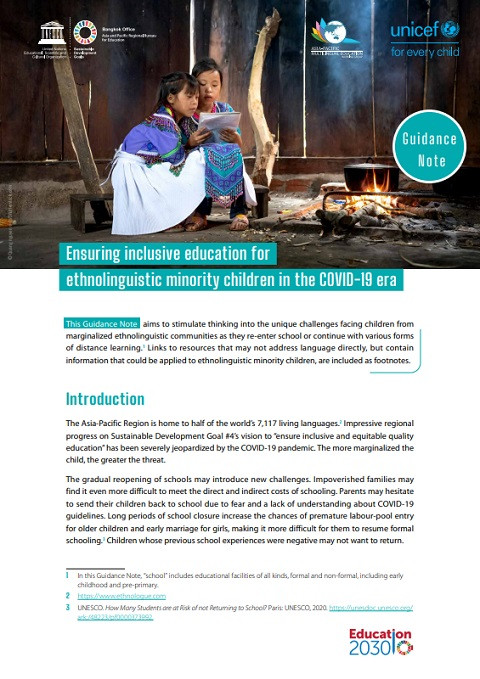 Ensuring Inclusive Education for Ethnolinguistic Minority Children in the COVID-19 Era: Guidance Note Año de publicación: 2021 Autor corporativo: UNESCO Bangkok This Guidance Note aims to stimulate thinking into the unique challenges facing children from marginalized ethnolinguistic communities as they re-enter school or continue with various forms of distance learning. Links to resources that may not address language directly, but contain information that could be applied to ethnolinguistic minority children, are included as footnotes. Astrolabe: a guide to education for sustainable development coordination in Asia and the Pacific Año de publicación: 2011 Autor corporativo: UNESCO Bangkok An astrolabe is an ancient instrument used to measure the position of the sun and stars. In the past it was used for a number of purposes, such as determining the time of day or night and measuring one’s current position in relation to the north and south poles. A mariner’s astrolabe was used to determine the latitude of a ship at sea and guide its direction. Similar to the mariner’s astrolabe, the Asia-Pacific Education for Sustainable Development (ESD) Astrolabe aims to assist UNESCO Member States in determining the current position of ESD in their country and guiding education and learning in a desired direction, so as to support the advancement of sustainable development in the national context. The ESD Astrolabe is also intended to complement ongoing efforts to enhance the quality of education throughout the Asia-Pacific region. Astrolabe: un guide de l'éducation pour la coordination du développement durable en Asie et dans le Pacifique Año de publicación: 2011 Autor corporativo: UNESCO Bangkok Un astrolabe est un instrument ancien utilisé pour mesurer la position du soleil et des étoiles. Dans le passé, il a été utilisé pour un certain nombre de buts, tels que la détermination de l'heure du jour ou de nuit et la mesure de sa position actuelle par rapport aux pôles nord et sud. Un astrolabe de marin a été utilisé pour déterminer la latitude d'un navire en mer et de guider sa direction. Similaire à l'astrolabe du marins, l'Astrolabe de l'Asie-Pacifique pour le développement durable (EDD) vise à aider les États membres de l'UNESCO à déterminer la position actuelle de l'EDD dans leur pays et à orienter l'éducation et l'apprentissage dans une direction souhaitée, Développement durable dans le contexte national. L'EDD Astrolabe est également destiné à compléter les efforts en cours pour améliorer la qualité de l'éducation dans toute la région Asie-Pacifique.
 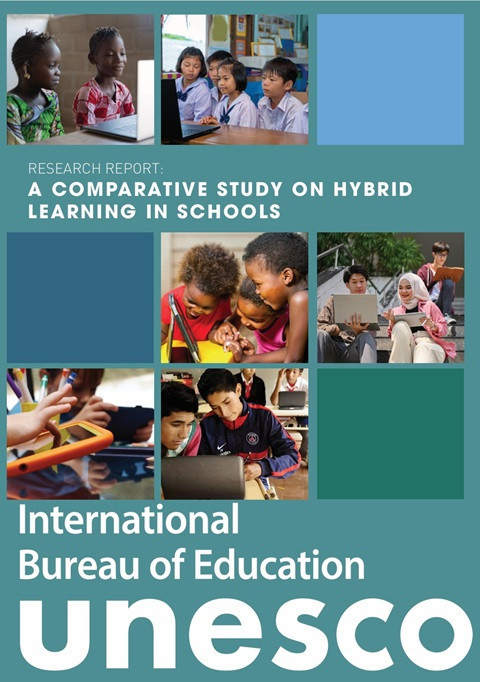 Research Report: A Comparative Study on Hybrid Learning in Schools Año de publicación: 2024 Autor corporativo: UNESCO International Bureau of Education (IBE) During the COVID-19 lockdown, policymakers and educators faced an unprecedented challenge disrupting all levels of education. The initial optimism about replacing physical classes with virtual lessons diminished as complex interconnected issues emerged. To address the need for continuous and sustainable learning, school systems implemented variations of hybrid learning during the pandemic, seeking to integrate physical and virtual classes. These approaches prompted this comparative study led by UNESCO-IBE. The initial phase of this study involved collecting and analysing data on hybrid strategies from six countries. The research aimed to examine factors influencing hybrid learning implementation during the lockdown, with a subsequent focus on developing and validating a practical Hybrid Learning Framework for Schools. The cross-case analysis was designed not to rank or compare, but to understand and connect different scenarios and contexts. Phase I focuses on current hybrid learning practices and influencing factors, while Phases II and III will concentrate on using the information gathered to create and validate a Hybrid Learning Framework for Schools. Hybrid learning is not just a response to pandemics but also serves as a viable solution for other scenarios where full school attendance is difficult. Aligned with UNESCO-IBE’s overarching vision of a comprehensive, personalized, and democratized curriculum accessible to all, hybrid learning facilitates inclusive education across diverse regions, overcoming geographical and temporal limitations. The approach aims to unlock the unique potential of every learner, fostering a more flexible educational environment.Published in February 2024 by the UNESCO International Bureau of Education (IBE) with support from the European Union.