
Recursos
Exploren una amplia gama de recursos valiosos en GCED para profundizar su comprensión y promover su búsqueda, incidencia, enseñanza y aprendizaje.
3,385 resultados encontrados
 Education 2030: Incheon declaration and framework for action towards inclusive and equitable quality education and lifelong learning for all Año de publicación: 2015 Autor corporativo: UNESCO | United Nations Development Programme (UNDP) | United Nations Population Fund (UNFPA) | UN. Office of the United Nations High Commissioner for Refugees (UNHCR) | United Nations Children's Fund (UNICEF) | United Nations Entity for Gender Equality and the Empowerment of Women (UN Women) | World Bank This framework — painstakingly drafted over many months with input from governments, international agencies, civil society and experts — provides guidance for implementing the education commitments made in the 2030 Agenda for Sustainable Development at a national, regional and global level. In particular: it aims at mobilizing all countries and partners around Sustainable Education Goal 4 and its targets;it proposes ways of implementing, coordinating, financing and monitoring the new commitments; andit proposes indicative strategies which countries may wish to draw upon in developing their plans, taking into account different national realities, capacities and levels of development and respecting national policies and priorities. 교육 2030 인천선언과 실행계획: 포용적이고 공평한 양질의 교육과 모두를 위한 평생학습을 향해 Año de publicación: 2015 Autor corporativo: 유네스코 | United Nations Development Programme (UNDP) | United Nations Population Fund (UNFPA) | UN. Office of the United Nations High Commissioner for Refugees (UNHCR) | United Nations Children's Fund (UNICEF) | United Nations Entity for Gender Equality and the Empowerment of Women (UN Women) | World Bank 정부, 국제기구, 시민사회와 전문가의 조언을 받아 몇 달 동안 많은 노력을 기울여 초안이 작성된 이 실행계획은 지속가능한 발전을 위한 2030 아젠다의 국가적, 지역적, 세계적 단계에서의 실현을 위한 교육의 역할에 대한 실천 가이드를 제공한다. 이는 모든 국가와 지속가능목표 4와 그 대상을 둘러싼 파트너들을 움직이도록 하는 데에 그 목적을 둔다.이 실행계획은 새로운 역할에 대한 실천, 협력, 자금조달과 관찰 방안을 제안한다.이 실행계획은 각 국가들이 서로 다른 국가적 상황과 역량, 발전 단계 및 각국의 정책과 우선순위를 존중한 계획을 세울 수 있도록 전략을 보여준다.
 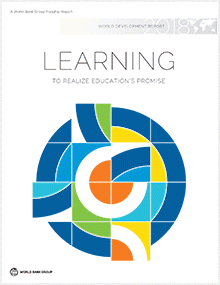 LEARNING to Realize Education’s Promise Autor corporativo: World Bank The World Development Report 2018 (WDR 2018)—LEARNING to Realize Education’s Promise—is the first ever devoted entirely to education. And the timing is excellent: education has long been critical to human welfare, but it is even more so in a time of rapid economic and social change. The best way to equip children and youth for the future is to place their learning at the center. The 2018 WDR explores four main themes: 1) education’s promise; 2) the need to shine a light on learning; 3) how to make schools work for learners; and 4) how to make systems work for learning.
 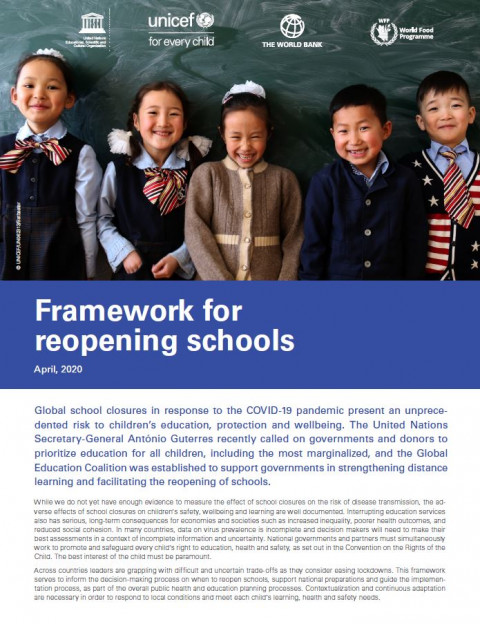 Framework for Reopening Schools; April, 2020 Año de publicación: 2020 Autor corporativo: UNESCO | United Nations Children's Fund (UNICEF) | World Bank | World Food Programme By late April, nationwide school closures were still disrupting the learning of more than 73 per cent of students, or more than 1.2 billion children and youth. When deciding whether to reopen schools, authorities should look at the benefits and risks across education, public health and socio-economic factors, in the local context, using the best available evidence. The best interest of every child should be paramount.The guidelines aim to inform the decision-making process regarding school reopening, support national preparations and guide the implementation process, as part of overall public health and education planning processes. It is designed to be a flexible tool that can be adapted to each context and updated as the situation changes. The guidelines outline six key priorities to assess the readiness of those schools and inform planning.
  [Video] Central Asian Kids Share Their Views on Gender Inequality Año de publicación: 2020 Autor corporativo: World Bank In Central Asia, and around the world, women earn 30% less than men. In anticipation of March 8, we asked the children what they think about it. [Видео] Что говорят дети в Центральной Азии о гендерном неравенстве в оплате труда Año de publicación: 2020 Autor corporativo: World Bank В Центральной Азии, и по всему миру, женщины зарабатывают на 30% меньше, чем мужчины. В преддверии 8 марта мы спросили детей, что они думают об этом.
 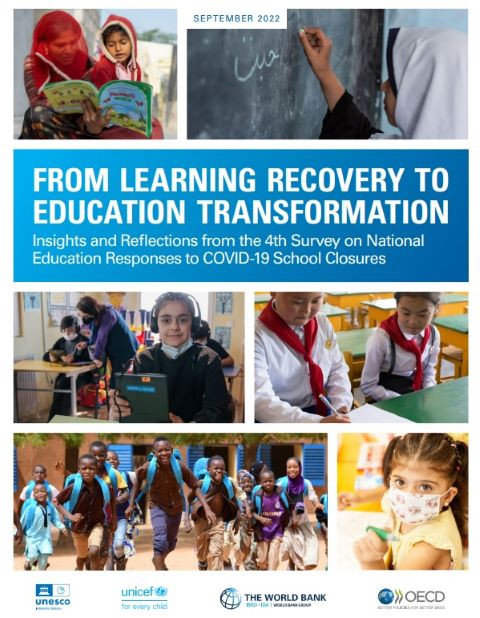 From Learning Recovery to Education Transformation: Insights and Reflections from the 4th Survey on National Education Responses to COVID-19 School Closures Año de publicación: 2022 Autor corporativo: UNESCO | UNESCO Institute for Statistics (UIS) | United Nations Children's Fund (UNICEF) | World Bank | Organisation for Economic Co-operation and Development (OECD) From Learning Recovery to Education Transformation, a new joint report by UNESCO, UNESCO Institute for Statistics (UIS), UNICEF, The World Bank and The OECD, presents findings from the fourth round of the Survey on National Education Responses to COVID-19 School Closures, administered between April–July 2022 with responses from Ministries of Education in 93 countries. It explores how countries are progressing in the RAPID actions to recover learning: Reach every child and keep them in school; Assess learning levels regularly; Prioritize teaching the fundamentals; Increase the efficiency of instruction; and Develop psychosocial health and wellbeing.
 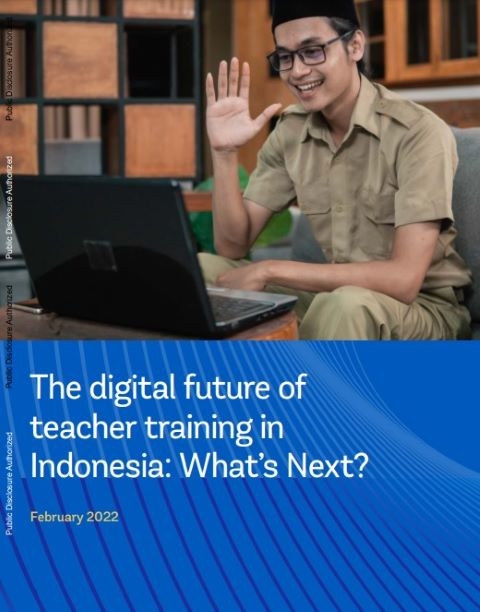 The Digital Future of Teacher Training in Indonesia: What’s Next? Año de publicación: 2022 Autor: Noah Yarrow | Noviandri Khairina | Jacobus Cilliers | Indah Dini Autor corporativo: World Bank | Government of Australia This report reflects on the Indonesia’s online teacher training ecosystem based on unique data collected from both teachers and providers during the COVID-19 period. A detailed mapping of the eight largest providers of online teacher training in Indonesia was conducted, covering 25 programs. We find that the majority of programs are short in duration and focus on digital literacy skills and remote learning. Training programs were mostly provided using online lectures, few provided individual coaching, while none provided opportunities for personalized learning. Second, we conducted a nationally representative phone survey of 435 primary and junior secondary teachers spanning 30 provinces across Indonesia (66 percent of whom are female teachers). The teacher survey was conducted between February and March 2021 and covered teachers under both the Ministry of Education, Research, and Technology (MoECRT) and the Ministry of Religious Affairs (MoRA). We find that 44 percent of teachers participated in online learning during the pandemic, and that three quarters of these teachers had never participated in online training prior to the pandemic. Many training participants reported challenges in implementing what they learned from online training. Most of the teachers who participated (88 percent) would like to continue receiving training online even after the pandemic ends. These results suggest that demand for online training is expected to persist, but more can be done to improve their quality.
 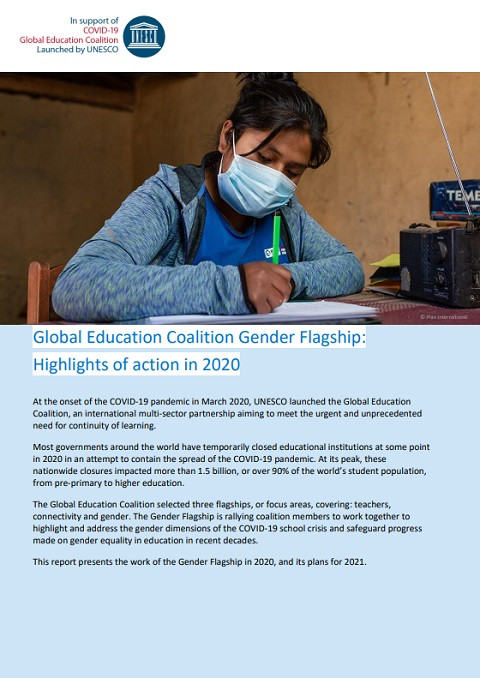 Global Education Coalition Gender Flagship: Highlights of Action in 2020 Año de publicación: 2021 Autor corporativo: UNESCO | Global Education Coalition At the onset of the COVID-19 pandemic in March 2020, UNESCO launched the Global Education Coalition, an international multi-sector partnership aiming to meet the urgent and unprecedented need for continuity of learning.Most governments around the world have temporarily closed educational institutions at some point in 2020 in an attempt to contain the spread of the COVID-19 pandemic. At its peak, these nationwide closures impacted more than 1.5 billion, or over 90% of the world’s student population, from pre-primary to higher education. The Global Education Coalition selected three flagships, or focus areas, covering: teachers, connectivity and gender.The Gender Flagship is rallying coalition members to work together to highlight and address the gender dimensions of the COVID-19 school crisis and safeguard progress made on gender equality in education in recent decades.This report presents the work of the Gender Flagship in 2020, and its plans for 2021.
 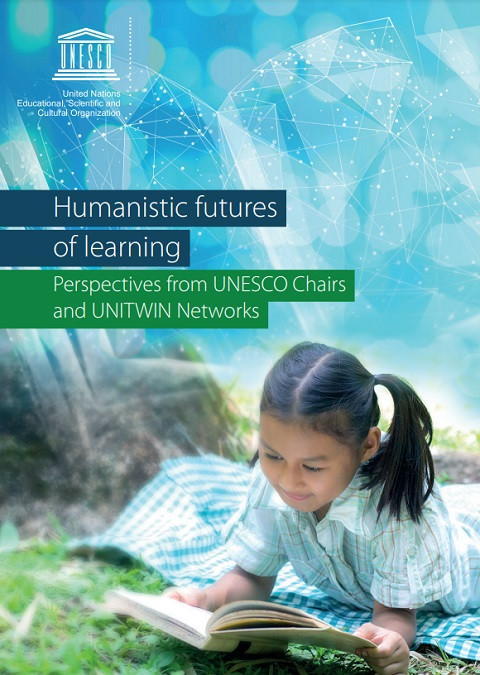 Humanistic Futures of Learning: Perspectives from UNESCO Chairs and UNITWIN Networks Año de publicación: 2020 Autor corporativo: UNESCO UNESCO’s Futures of Education initiative aims to rethink education and shape the future. The initiative is catalyzing a global debate on how knowledge, education and learning need to be reimagined in a world of increasing complexity, uncertainty and precarity. This publication presents the first curated input to the Futures of Education initiative from the UNITWIN/UNESCO Chairs Programme, which now represents an extensive global network of more than 800 higher education institutions in over 115 countries. It features think pieces that highlight key dimensions to be considered in re-visioning and re-purposing education for the future of humanity and the planet. The collection of the pieces calls for greater focus on a number of critical areas such as: The role of culture in strengthening social and environmental sustainability; the values and attitudes that are needed to shape future generations; the importance of both robust public education, as well as of other learning spaces; the need to strengthen human creativity and capability in the digital era, as well as the role of higher education in generating the knowledge and driving the innovation required to transform our world.